

Ideal Customer Profile How to Build and Use It
Learn what an ideal customer profile is, how to build and validate it, and turn it into a prospecting pipeline that finds accounts that fit now.
Your SDR opens a prospecting list and sees hundreds of companies that appear to fit. They're in the right industry, fall somewhere within the target size range, and have a familiar job title on the team. After a week of research and outreach, replies remain rare because most accounts were only superficially relevant. The list described who could buy, but it didn't identify who was likely to buy, succeed, and expand.
That's the problem an ideal customer profile solves. It gives sales, marketing, and revenue operations a control layer for deciding which accounts deserve research, outreach, follow-up, or nurture. A useful ICP goes beyond a static company description. It combines structural fit with evidence that an account is ready now.
This guide moves from the basic definition to practical construction, validation, and daily use. You'll learn how to separate company fit from buyer personas, select meaningful criteria, add anti-ICP rules, set confidence thresholds, and turn live signals into a prioritized pipeline. The destination isn't another document that sits in a shared folder. It's a working system that helps your team answer two questions: Is this company a good fit, and why should we contact it now?
Table of Contents
- Introduction Why Spray and Pray Prospecting Fails
- What an Ideal Customer Profile Really Is
- The Core Building Blocks of a Strong ICP
- How to Build and Validate Your Ideal Customer Profile
- Ideal Customer Profile Examples That Make It Click
- Turning Your ICP Into a Prospecting Pipeline
- Keeping Your Ideal Customer Profile Accurate Over Time
Introduction Why Spray and Pray Prospecting Fails
A founder tells an SDR to “find more SaaS companies.” The SDR searches by industry, adds companies that look established, finds a marketing or sales contact, and starts a sequence. Some accounts have the wrong systems, some lack the problem the product solves, and others have no active reason to change. The team spends time personalizing messages for companies that were never serious candidates.
Broad targeting creates three kinds of waste. Researchers investigate accounts with weak fit. SDRs write outreach without a relevant trigger. Managers review activity totals instead of asking whether the team is working the right opportunities. A broad list can look productive while filling the pipeline with false positives.
An ideal customer profile narrows the field before those costs appear. It defines the characteristics of accounts that can implement the solution, gain value from it, and remain commercially healthy. The strongest profiles also distinguish between an account that fits in theory and one showing signs of active need.
Practical rule: Fit earns an account a place on the list. Timing earns it a place in today's queue.
The distinction matters because an account can match your industry and company-size filters while still being a poor prospect. It may lack the required technology, have no internal owner, or be committed to an alternative. Conversely, a smaller company may be attractive if it has the right operating model, a clear pain point, and a visible buying trigger.
The commercial case for formalizing this work is substantial. A benchmark covering 2019 to 2024 found that 65% of high-growth B2B companies, defined by the source as firms with 40% or more year-over-year revenue growth, had a documented ICP, compared with 14% of no-growth firms. The same benchmark reports ICP adoption at 62% among enterprise companies with $1 billion or more in revenue and 48% among mid-market firms with $25 million to $1 billion in revenue in its B2B buyer persona and ICP benchmarks.
Those figures show association, not proof that an ICP causes growth. They do show that disciplined companies are more likely to formalize account selection. For an SDR team, that discipline means fewer arbitrary searches, clearer handoffs, and a defensible reason behind every priority account. The practical guide to AI sales prospecting for SDR teams can help teams think about how that account research fits into a wider workflow.
What an Ideal Customer Profile Really Is
Think of your business as designing a building. The ideal customer profile is the blueprint for the kind of building that can support your solution. It describes the company, its operating environment, and the conditions under which your product creates durable value.
A persona is different. It describes a resident inside that building, such as a revenue leader, operations manager, or agency owner. A buyer journey describes how that resident discovers a problem, evaluates options, gains internal approval, and makes a decision. Confusing these layers leads teams to target job titles without confirming whether the company itself is suitable.
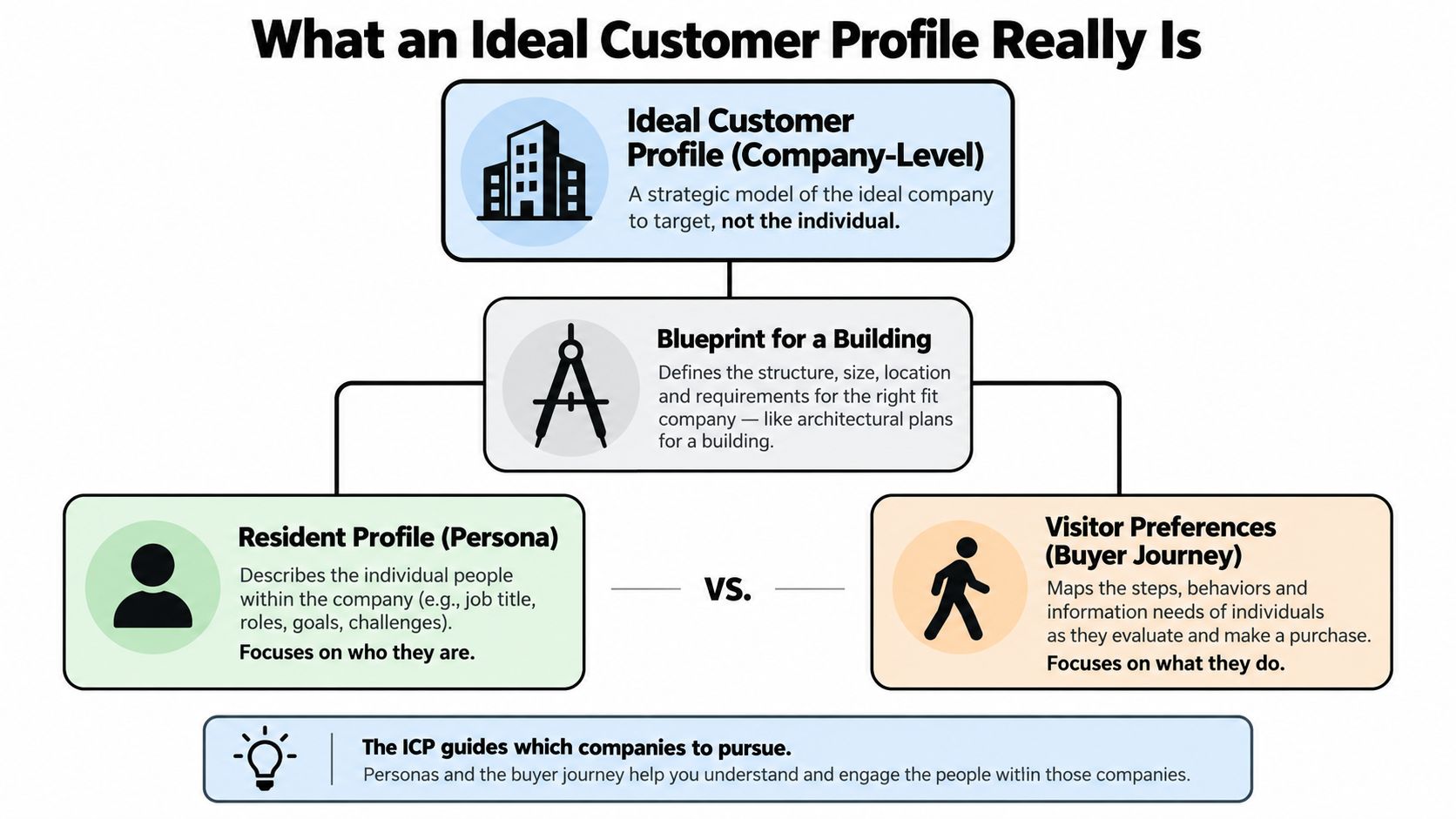
An ideal customer profile is a company-level model of the accounts most likely to buy, implement successfully, retain, and expand.
That definition contains more than “companies that can afford us.” A good account may have the budget but lack the technical environment, workflow, urgency, or internal champion required for a successful rollout. The profile should therefore describe the conditions that make the customer valuable to both sides.
The three layers of customer understanding
The company layer identifies the account itself. Firmographics can include industry, geography, company size, revenue range, business model, and operating structure. These fields make an account searchable, but they rarely explain readiness on their own.
The implementation layer describes whether the company can use the product effectively. Technographic details, existing platforms, integration capacity, data maturity, and process ownership reveal whether the solution fits the account's environment.
The individual and journey layer helps sales understand who acts inside the account and how decisions progress. The buyer may be a founder, sales leader, operations executive, or local business owner, while other stakeholders influence security, budget, procurement, or implementation.
Traditional ICP frameworks leaned heavily on firmographics. Newer guidance adds technology, intent, hiring patterns, funding events, and account behavior, reflecting a shift from static segmentation toward dynamic qualification. This evolution is described in ZoomInfo's overview of the ideal customer profile.
The practical test is simple. If your profile only tells an SDR where a company sits in a directory, it's incomplete. It should also help answer whether the company can adopt the solution and whether something has changed that makes a conversation timely.
The Core Building Blocks of a Strong ICP
A strong ICP combines several layers because each one answers a different question. Firmographics ask who the company is. Technographics ask what the company can implement. Behavioral and intent data ask how and when it may buy.
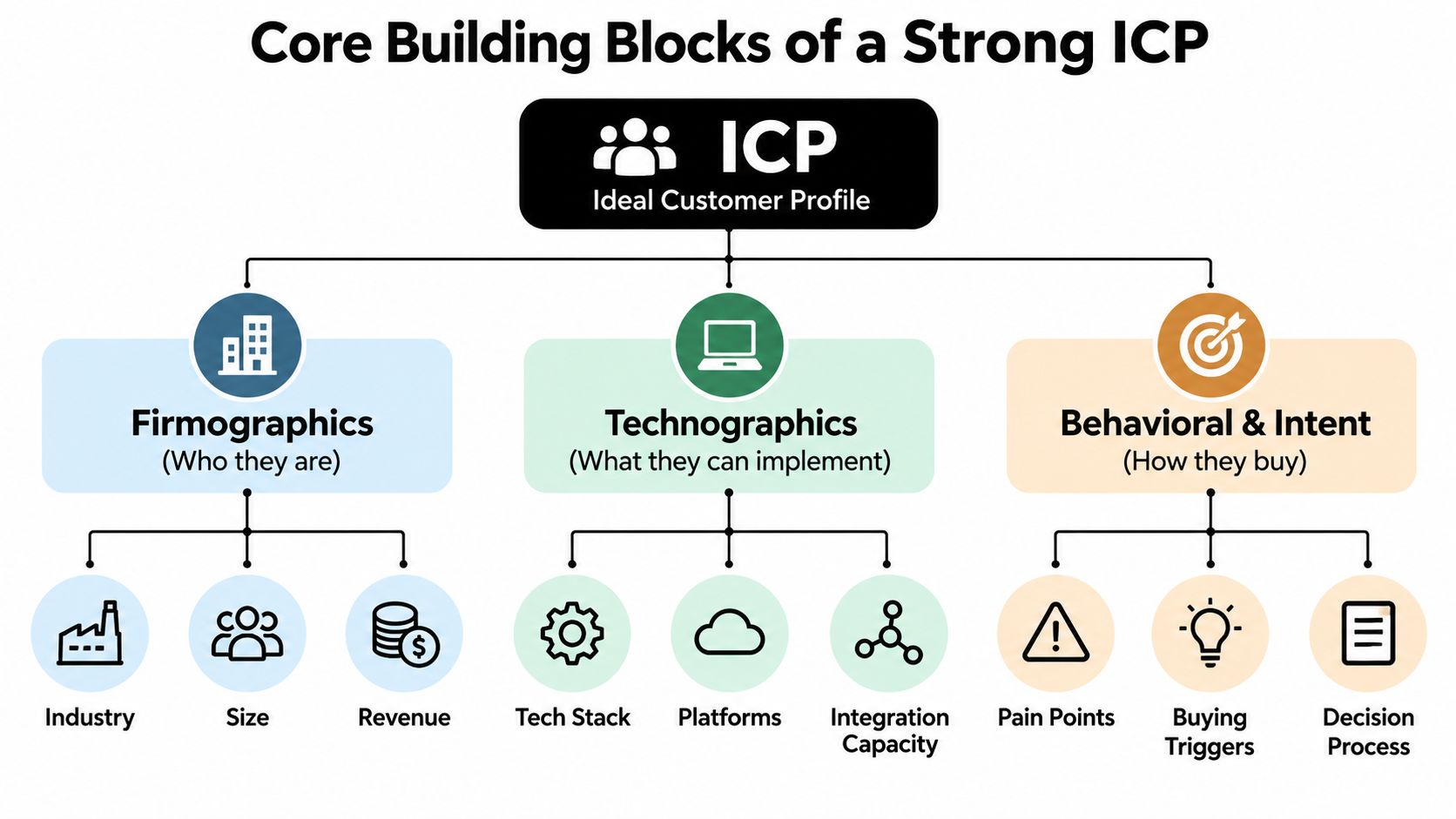
Firmographics provide the starting boundary. A B2B software company may prioritize a specific industry, operating model, geography, or revenue range. A local agency may care more about service category, location, review condition, number of branches, and whether the business has a customer acquisition problem it can address.
Technographics add implementation context. An account may match your industry and size filters but use a platform that doesn't integrate with your product. Another company may have the right stack but no owner for the workflow. Including technology and process signals reduces the number of accounts that look good on paper but cannot become successful customers.
Behavioral and intent signals add timing. Hiring for a relevant function, announcing funding, changing leadership, revising a technology stack, returning to pricing or integration pages, or showing a shift in customer reviews can indicate a current business event. These signals don't guarantee a purchase. They provide a reason to investigate and tailor the message.
Why one filter creates false positives
Suppose your team targets companies by size alone. You'll include accounts with incompatible systems, low operational maturity, or no urgent problem. Targeting only technology produces a different error, because companies often retain tools they aren't actively reconsidering. Combining dimensions creates a more useful qualification model.
The guide to buying signals and how to find them supports this fit-plus-timing approach. Independent guidance also emphasizes that the most predictive profiles come from customers with strong retention, expansion, and margin, not merely the largest initial contracts. A large deal that churns quickly or consumes excessive support may be a worse reference point than a smaller account that remains healthy and expands.
Keep the model usable
More fields don't automatically create more precision. Current guidance recommends limiting the core ICP to 8 to 12 fields and adding two categories that many teams omit:
- Anti-ICP disqualifiers: Conditions that make an account unsuitable, such as an incompatible platform, an excluded market, or a service requirement your team can't support.
- Detectable intent signals: Observable events, such as hiring posts, recent funding, or visits to relevant review pages, that can indicate a fitting account.
The profile should be specific enough to score but compact enough for salespeople to use consistently. If an SDR can't understand why an account qualifies after a quick review, the model is too complicated or too abstract.
How to Build and Validate Your Ideal Customer Profile
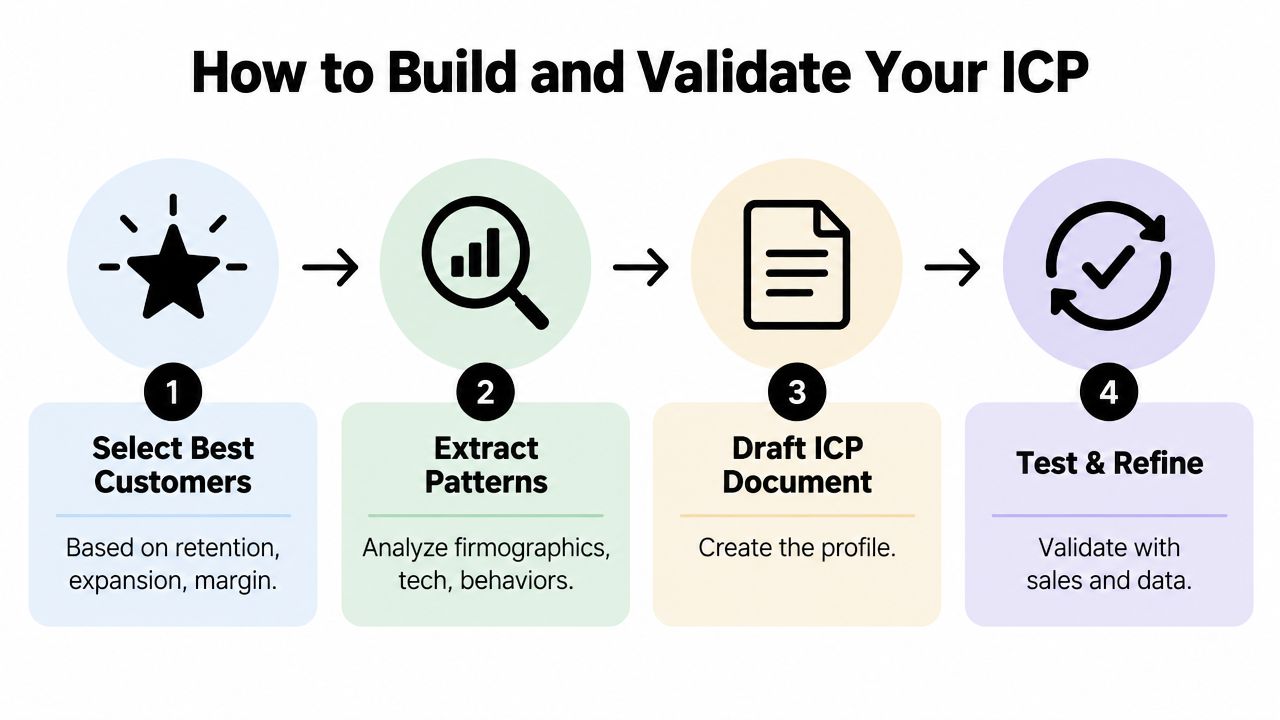
Start with customers, not assumptions. Your largest contract isn't automatically your best reference account. Examine which customers stay, expand, produce healthy margins, require manageable support, and reach value without extraordinary intervention. Expert guidance on building an ideal customer profile makes this economic distinction central to the process.
Select the evidence
Create a working set of successful customers and look for repeated patterns. Review industry, location, business model, systems, team structure, implementation path, original pain, buying committee, and events that preceded the purchase. Ask customer-facing teams what made these accounts easy or difficult to serve.
Don't treat every observed characteristic as a requirement. A pattern becomes useful when it helps distinguish healthy customers from accounts that looked promising but struggled. Compare the same attributes against churned, stalled, and lost opportunities.
Draft the profile
Write the account criteria in plain language. Separate fit fields from timing fields so your team doesn't mistake a permanent characteristic for an active buying moment.
A simple model might include:
- Fit score: How closely the company matches the structural profile.
- Timing score: How much current behavior suggests an active need.
- Risk status: Whether an anti-ICP condition weakens or blocks pursuit.
- Confidence level: How reliable and recent the evidence is.
Set routing thresholds before the model enters production. For example, a high-fit account with weak evidence may enter nurture, while a moderate-fit account with a strong, relevant trigger may receive human research. The exact threshold depends on your sales capacity and tolerance for false positives. What matters is that the team agrees on the rule before individual reps interpret it differently.
Test, inspect, and refine
Run the draft against won, lost, stalled, and retained accounts. Look for accounts the model incorrectly promotes and accounts it incorrectly excludes. A profile that only describes current wins may overfit to historical conditions, so sales, marketing, customer success, and operations should challenge the criteria.
Keep the source and date for each important field. CRM enrichment can supply firmographics and technology context, while a practical CRM data enrichment guide can help teams think about record quality and refresh processes. Validation isn't a one-time approval meeting. It's a repeated check that the profile still reflects the customers you want more of.
Ideal Customer Profile Examples That Make It Click
A vague profile sounds useful because it uses familiar business language. “Our ideal customer is a growing B2B company that needs better sales efficiency” describes a large market, but it gives an SDR little guidance. The rep still doesn't know which companies to search, which accounts to exclude, or what event makes outreach relevant.
A stronger profile translates the strategy into observable fields. Consider a B2B SaaS product that helps revenue teams discover and prioritize accounts. The weak version might target “B2B SaaS companies with sales teams.” The stronger version identifies an operating environment, a compatible workflow, a relevant pain, and a reason the issue may be active now.
A local service example shows why use case matters. A reputation management agency doesn't need every local business. It may want service businesses in a defined market that depend on reviews, have visible reputation deterioration, and have enough operational capacity to respond to new customer demand.
| Criterion | Vague ICP | Strong Signal Ready ICP |
|---|---|---|
| Company type | Growing B2B company | B2B SaaS company with a defined revenue motion and an owned sales process |
| Operating context | Has a sales team | Uses a CRM and relies on repeatable account research, routing, or outbound workflows |
| Technology | Uses business software | Has a compatible CRM and a workflow that can support enrichment or signal-based prioritization |
| Trigger | Wants more pipeline | Recently changed sales leadership, expanded a relevant team, or shows active interest in a relevant product area |
| Local-market example | Local business with customers | Review-dependent service business showing a recent reputation or customer-acquisition issue |
| Disqualifier | None stated | Incompatible stack, unsupported market, no responsible owner, or a problem outside the agency's service scope |
| Rep action | Find a contact and send a sequence | Confirm fit, verify the trigger, write a source-backed reason for outreach, and route by confidence |
The strong version is not valuable because it contains more adjectives. It's valuable because each criterion changes a decision. A rep can search for the account, verify the technology, inspect the trigger, and decide whether to contact, nurture, or exclude it.
Separate acquisition from expansion
The ideal account for new business may differ from the ideal account for expansion. Acquisition prioritizes problem recognition, implementation readiness, and a reachable buying committee. Expansion may prioritize product usage, adjacent teams, new locations, leadership changes, or operational growth inside an existing customer.
Inbound routing has another purpose. A signup with strong company fit may deserve prompt human review, while an account with weak fit should follow a different path even if the individual provides a relevant email address. Local outreach may rely more heavily on reputation signals and location-specific events than on the fields used in B2B SaaS prospecting.
Turning Your ICP Into a Prospecting Pipeline
A profile becomes useful when it changes what the team does each morning. Translate the criteria into saved searches, enrichment fields, monitoring rules, and routing actions. The workflow should move from account discovery to evidence review without forcing an SDR to rebuild the same research process for every prospect.
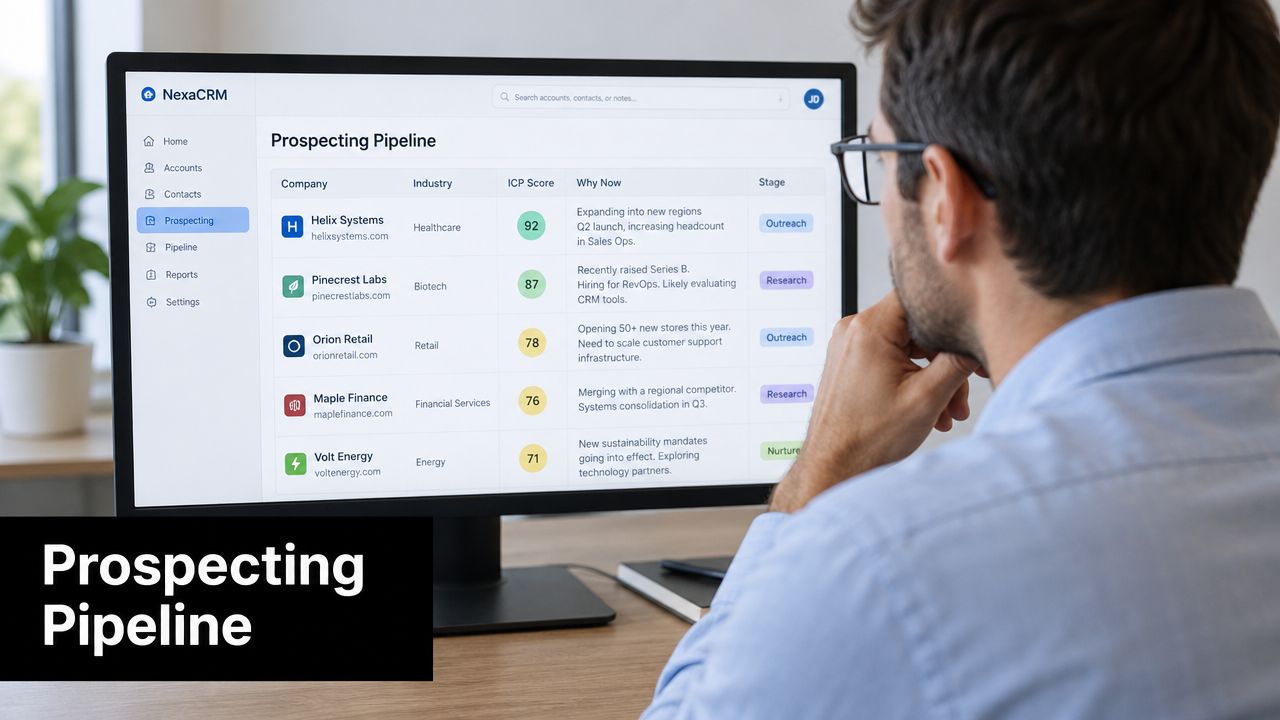
Start with natural-language searches that reflect the profile. Search by competitor, technology stack, hiring activity, niche, location, or business category rather than relying only on an industry label. Save reusable lists, then enrich each account with the fields your team agreed to use.
The CRM record should make the decision visible. Useful fields include:
- ICP grade: The account's structural fit.
- Why now note: The current event or behavior that justifies attention.
- Confidence level: The strength and recency of the evidence.
- Next action: Route to sales, research further, nurture, or hold.
- Source context: The page or event supporting the qualification.
This structure prevents a common failure mode: an account receives a high score, but nobody knows why. A score without evidence encourages blind trust. A score paired with a recent, source-backed observation gives the rep a starting point for relevant outreach.
Build a Today queue
The daily queue should combine fit, timing, and confidence. A high-fit account with no current signal may remain in a monitored list. A fitting account with a relevant leadership change, hiring pattern, funding announcement, technology shift, website return visit, or review movement can move into active research.
CapyScout can search the live web for fitting companies, score inbound signups, enrich CRM records with ICP grades, monitor account signals, and route alerts to systems such as Slack, Teams, HubSpot, Pipedrive, and Attio. Treat it as one operational option within a broader revenue stack, alongside your CRM, enrichment tools, and sales engagement platform.
The queue shouldn't just sort by company size. It should show why an account is present today and what the rep should verify before sending a message. That turns prospecting from list consumption into evidence-based prioritization.
A short walkthrough can help teams visualize how an ICP dashboard and signal workflow fit together:
Before outreach, verify the signal. A hiring page may be old, a leadership announcement may describe an internal move, and a website visit may indicate research rather than purchase intent. The purpose of monitoring is not to automate judgment. It's to surface accounts that deserve timely, informed judgment.
Keeping Your Ideal Customer Profile Accurate Over Time
An ICP decays when the business, market, product, or customer base changes. A technology that once indicated strong fit may become less important after a product integration changes. A segment that produced large deals may later create retention or support problems. New buying signals may emerge while old ones become too common to distinguish serious interest.
Review the profile against commercial outcomes rather than personal preference. Compare win quality, retention, expansion, margin, sales cycle behavior, and implementation effort by ICP tier. If a field appears in the profile but doesn't help explain those outcomes, question whether it belongs there.
Run a practical review loop
Use a recurring operating rhythm:
- Inspect recent wins: Identify which fit and timing conditions appeared before purchase.
- Study weak outcomes: Look at churned, stalled, heavily supported, and lost accounts.
- Prune weak fields: Remove criteria that add complexity without improving decisions.
- Add emerging signals: Capture new hiring patterns, leadership events, technology changes, funding activity, intent behavior, or reputation shifts.
- Check routing quality: Review whether high-confidence accounts reached sales and whether uncertain accounts were held back appropriately.
- Refresh CRM records: Keep company data, ICP grades, and Why Now notes aligned with current account conditions.
A dynamic ICP doesn't mean changing the definition every time a rep has a surprising conversation. It means updating the model when repeated evidence shows that customer economics or buying behavior has shifted. The discipline lies in distinguishing a useful new pattern from an isolated anecdote.
The most practical next step is small. Audit the current profile, compare it with your healthiest recent customers, write down explicit anti-ICP rules, and activate one signal-driven prospecting list this week. Give every account a fit judgment, a timing judgment, and a confidence level. That simple habit turns the ideal customer profile from a static worksheet into a living control layer for pipeline decisions.
CapyScout helps teams find fitting companies, screen inbound signups, enrich CRM records, and monitor live buying signals with source-backed account briefs and alerts. Visit CapyScout to turn your ICP into a daily, signal-driven prospecting workflow.