

Account-Based Marketing Campaigns That Actually Convert
Learn how to plan and run account-based marketing campaigns that convert — from account selection and personalization to channels, measurement and scaling.
71% of B2B marketing practitioners now use an account-based marketing strategy, up from 46% in 2022 and 31% in 2018, according to the 2026 ABM benchmark summary. Yet another 2026 benchmark survey reports that only 26% of organizations describe their ABM program as successful.
That gap changes the question. Teams don't need another definition of ABM or a longer list of campaign ideas. They need an operating system that detects when an account is changing, matches the response to its value, and keeps sales and marketing working from the same evidence after launch.
The strongest account-based marketing campaigns don't begin with a static spreadsheet of company names. They begin with fit, a live buying signal, and a clear next action. A lean SaaS team can run that motion without enterprise headcount, but only if it treats tiering, orchestration, and measurement as connected operating decisions rather than separate campaign tasks.
Table of Contents
- Why Most Account-Based Marketing Campaigns Stall After Launch
- Building Your Account List and Tiering Model
- Personalization That Scales Without Burning Your Team
- Orchestrating Your Channel Mix and Buying Group Outreach
- Measuring What Matters and Proving ABM ROI
- Scaling and Automating Your ABM Engine for the Long Run
Why Most Account-Based Marketing Campaigns Stall After Launch
The adoption figures create a misleading sense of progress. More companies have accepted ABM as a core go-to-market motion, and budgets are following that belief. ABM represented 28.4% of the B2B marketing budget in 2026, compared with 18.7% in 2022, according to the same 2026 benchmark summary. Adoption has also become especially established among B2B SaaS firms and financial services organizations, where buying groups, deal values, and evaluation cycles justify account-centered coordination.
But funding a motion doesn't make it operational. The 2025/2026 ABM benchmark survey reports that 23% of practitioners plan to add an ABM strategy, while only 26% describe their current program as successful. That isn't a targeting problem alone. It shows that teams can agree on named accounts, launch personalized assets, and still fail to create a repeatable way to act on account intelligence.
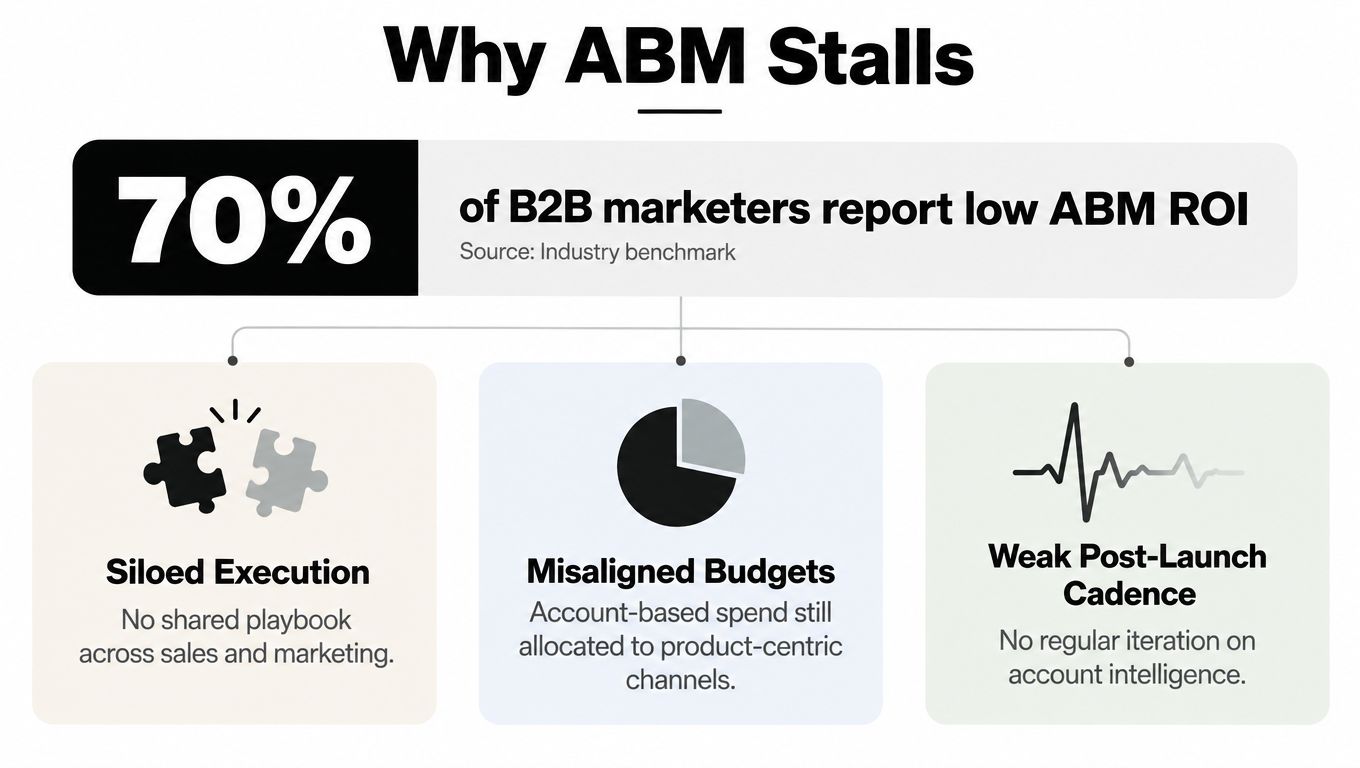
The five execution blockers
The most useful diagnosis happens after the list is approved. Recent benchmark coverage identifies five recurring blockers:
- Sales and marketing alignment: Reported by 63% of respondents. Teams often define target accounts together, then use different qualification rules, messaging, and follow-up expectations.
- Scaling personalization: Reported by 53%. A campaign that requires bespoke research for every account quickly becomes a queue nobody can maintain.
- Attribution and ROI proof: Reported by 47%. Lead-level reporting hides whether multiple contacts belong to the same buying group and whether marketing influenced progression.
- Lead-to-account mapping: Reported by 42%. If contacts aren't attached to the correct account, engagement gets fragmented across records and routing breaks.
- Predicting in-market accounts: Reported by 41%. A well-fit account may still be a poor priority if nothing indicates that its circumstances have changed.
These blockers reinforce one another. Poor mapping weakens scoring, weak scoring produces generic outreach, generic outreach frustrates sales, and weak coordination makes attribution harder. Teams then respond by adding more contacts or channels, which creates activity without improving timing.
Practical rule: If your ABM program only changes the account list, it isn't an operating model yet.
A working model has a daily queue. Someone sees which watched accounts have changed, why the change matters, which tier they belong to, and what sales or marketing should do next. The CRM stores the decision, marketing supplies the right asset, and sales receives a usable reason to contact the account. That cadence matters more than the launch announcement.
Building Your Account List and Tiering Model
Start with the customer you can serve well, not the market you could theoretically sell into. Define the ICP through firmographic traits, commercial context, technology compatibility, and the conditions that make your offer urgent. A useful ICP document should tell a seller why an account fits and what would disqualify it, rather than describing a broad industry.
If the underlying profile needs work, use this guide to building and using an ideal customer profile as a practical reference. Then turn the profile into filters that can be applied consistently across prospect discovery and CRM records.
A four-pass selection workflow
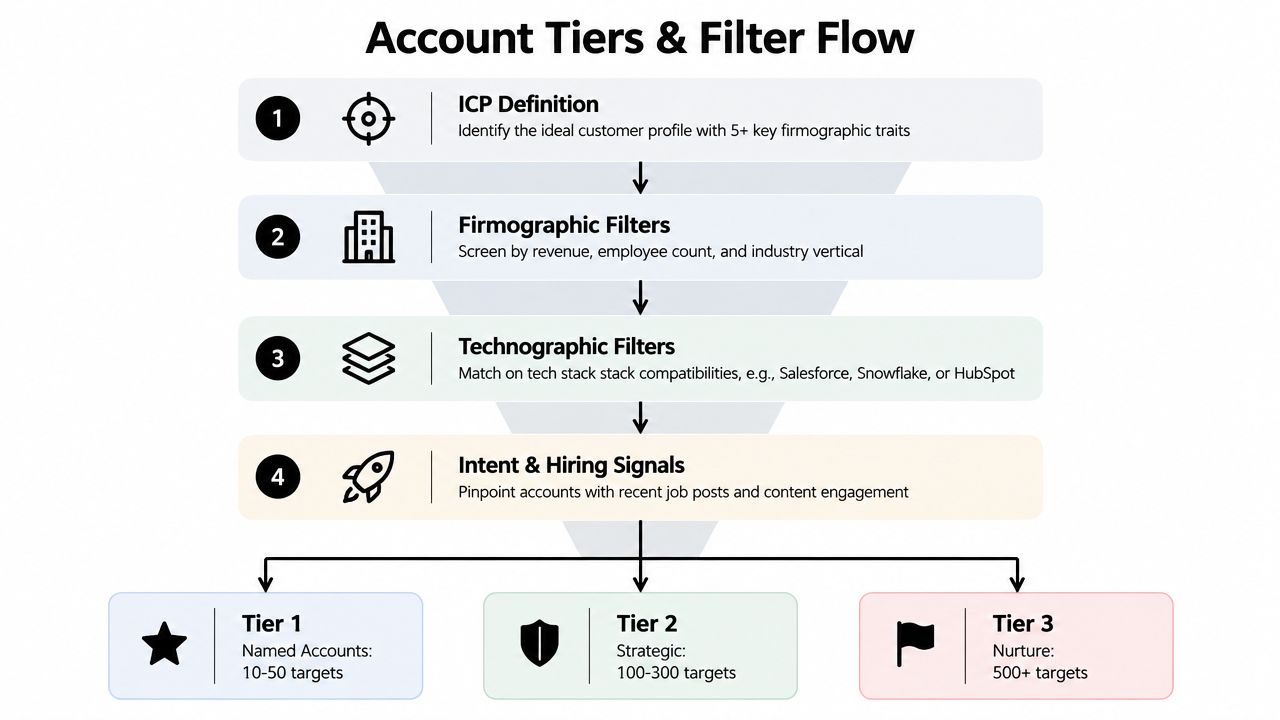
First, define fit. Document the traits shared by your strongest customers, including market, operating model, geography, buyer structure, and problem severity. Keep the list specific enough that two people would reach a similar conclusion about an unfamiliar account.
Next, apply firmographic filters. Screen for the characteristics that affect sales capacity and commercial value. Revenue, employee count, industry vertical, location, and business model can narrow the universe before anyone spends time researching contacts.
Then check technographics. A compatible stack can make implementation easier, while a conflicting system can create hidden delivery costs. Look for the platforms your product integrates with, replaces, or depends on. Don't treat a technology match as proof of buying intent. It confirms feasibility, not timing.
Finally, add live signals. Hiring, leadership changes, funding announcements, product launches, technology shifts, reviews, and website engagement can reveal that an account's priorities have moved. A signal should change the account's priority only when it connects to a plausible business problem and a relevant offer.
Match effort to account value
Use three tiers, but give each tier a different job:
| Tier | Account role | Operating motion |
|---|---|---|
| Tier 1 | Highest-value named accounts | Deep research, coordinated sales ownership, bespoke assets, and direct executive or buying-group coverage |
| Tier 2 | Strategic account clusters | Modular industry or use-case personalization, shared plays, and coordinated seller follow-up |
| Tier 3 | Broader nurture universe | Automated education, signal-based routing, and selective human intervention |
The infographic's suggested ranges, 10 to 50 named accounts for Tier 1, 100 to 300 strategic accounts for Tier 2, and 500 or more for Tier 3, are useful starting points for planning, but capacity should decide the final list. A small team shouldn't place more Tier 1 accounts into the program than sellers can research and follow up with properly.
Validate each account before outreach. Confirm the company still fits, identify the likely buying group, check the source and date of the signal, and write a one-sentence hypothesis about why your offer matters now. Promote an account when fit and urgency strengthen together. Demote it when the signal expires, ownership changes, the business no longer matches the ICP, or the team can't support the required touch intensity.
Personalization That Scales Without Burning Your Team
Personalization becomes expensive when marketers treat every account as a blank page. It becomes manageable when a live signal selects the message module, offer, and proof point.

Build a signal-to-message map before writing the campaign. For example, a hiring push can support a conversation about scaling operations, while a technology change can support an integration or migration angle. A leadership change may justify a fresh business-case conversation, and repeated visits to pricing, demo, or integration pages can indicate that the account deserves faster human follow-up.
The point isn't to mention the signal theatrically. Use it to form a credible hypothesis. “I saw you hired three people” is weak if the hiring has no connection to your solution. “Your team is expanding the function our platform supports, so I thought this workflow might be relevant” gives the buyer a reason to evaluate the message.
Create three levels of personalization
Tier 1 deserves a research brief. Include the account's business context, the signal source, the likely buying group, a problem hypothesis, relevant proof, and one next action. The brief should help an AE prepare for a conversation, not become a long internal essay.
Tier 2 should use modular blocks. Create reusable versions by industry, use case, technology environment, or trigger. A seller can combine the correct opening, proof point, objection response, and offer without asking marketing to build a campaign from scratch.
Tier 3 needs dependable triggers. Use segmented email, account-specific advertising where appropriate, and automated routing when an account crosses a meaningful engagement or intent threshold. Don't force a custom message onto an account that hasn't shown a reason to receive one.
A SaaS example might pair a new operations hire with a workflow audit. A services firm might pair a reputation shift with a diagnostic review. In both cases, the signal determines the conversation, while the account's fit determines whether the conversation is worth having.
Specificity earns attention, but unsupported specificity damages trust.
Before outreach, verify the signal on a source you can cite, check that it is recent enough to matter, connect it to the account rather than an individual assumption, and avoid sensitive personal inferences. Source-backed notes are more useful than clever personalization because the seller can explain exactly why the account was prioritized.
The following video offers another visual reference for thinking about account-level marketing and sales coordination.
Keep the first touch narrow. One signal, one relevant problem, one useful offer, and one low-friction next step are usually stronger than a message that lists every product capability.
Orchestrating Your Channel Mix and Buying Group Outreach
ABM channels should reflect account value and seller capacity, not a checklist. Email scales well but carries little distinctiveness. LinkedIn can add visibility and role-specific context, while a warm introduction often creates more credibility at a higher coordination cost. Direct mail can interrupt digital noise, but it needs a real reason and careful recipient data. Ads provide air cover, while website personalization helps an interested buying group find relevant information without requiring another sales touch.
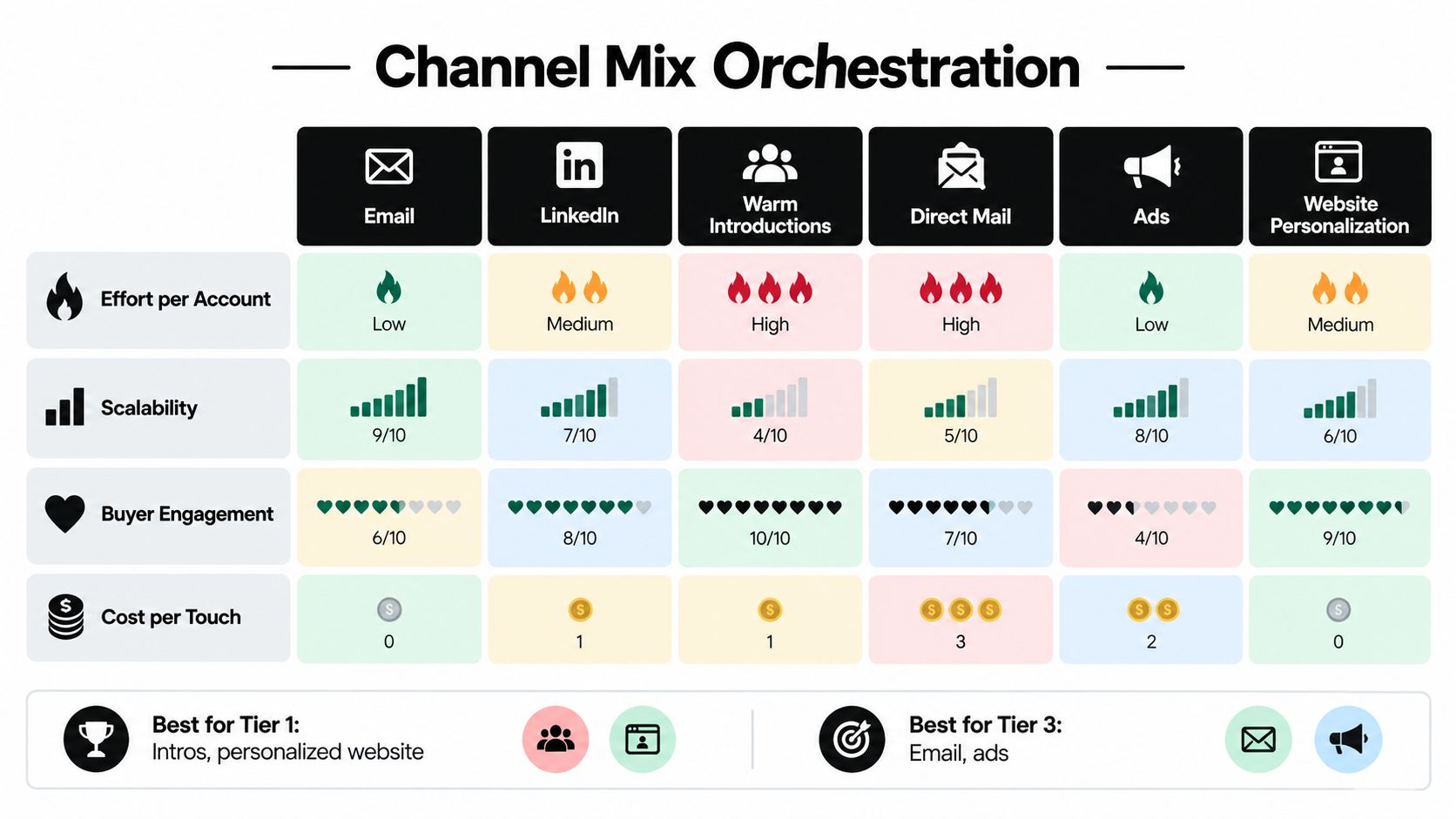
A lean team should sequence channels around a reason to act. Start with a signal-backed email or warm path, add LinkedIn when the buying role is active there, and use ads or website personalization to reinforce the same point. Direct mail belongs where deal value and account importance justify the operational work. Sending every channel to every account usually creates noise and makes it harder to tell which motion helped.
Cover the buying group deliberately
Account engagement from one contact isn't account consensus. Map the economic buyer, technical evaluator, operational user, champion, and potential blocker, then decide which roles need direct outreach and which can be reached through content. Sales should own the relationship sequence, while marketing coordinates supporting touches so the account doesn't receive disconnected messages from multiple people.
CRM alerts, Slack or Teams notifications, and shared account notes can keep the motion synchronized. The alert should include the account, signal, source, tier, owner, and recommended next action. A notification that only says “high intent detected” creates more research work instead of removing it.
Use this practical guide to buying signals to expand the trigger library, then define which signals justify immediate contact and which belong in nurture.
| Tier | Primary channels | Touch intensity |
|---|---|---|
| Tier 1 | Warm introductions, personalized email, LinkedIn, executive content, tailored website experience, selective direct mail | Coordinated touches owned by sales and marketing, adjusted to live signals |
| Tier 2 | Modular email, LinkedIn, account-focused content, ads, and seller alerts | Structured sequences with human follow-up when engagement or intent rises |
| Tier 3 | Segmented email, educational content, ads, and automated routing | Low-touch nurture until fit and timing justify promotion |
The practical trade-off is simple. If the sales team can't follow up, adding channels won't improve the campaign. Allocate the highest-intensity motion to accounts where the commercial upside justifies the time, and keep the rest observable rather than overworked.
Measuring What Matters and Proving ABM ROI
Lead volume is a poor primary scorecard for account-based marketing campaigns. One account can contain several contacts, and a single contact can represent only one part of a buying group. Measurement should show whether target accounts are engaging, progressing, creating opportunities, and producing revenue.
Start with a shared account dashboard. It should connect the account record to engagement, opportunity stage, sales activity, and revenue outcomes. Track the movement that matches your operating model:
- Account engagement: Which target accounts interacted with relevant content, email, ads, events, or key website pages?
- Buying-group coverage: Are multiple relevant roles known and engaged, or is activity concentrated in one contact?
- Opportunity creation: Did an engaged target account create a qualified opportunity?
- Pipeline velocity: How quickly do ABM-engaged opportunities move through the agreed stages?
- Win rate and ACV: Do account-based opportunities progress and close differently from comparable non-ABM opportunities?
A 2024/2025 ABM benchmark summary reports 76% higher ROI for mature ABM programs, along with a 208% increase in marketing-sourced revenue for ABM-engaged accounts versus inbound-only accounts. The same source reports median opportunity win rates of about 38% for 1:1 ABM, 24% for 1:few, and 14% for 1:many, compared with roughly 9% for non-ABM B2B baseline deals. It also reports pipeline velocity at 1.6x to 2.1x faster and ACV 30% to 70% higher in the relevant benchmark comparisons.
Those figures are benchmarks, not a forecast for your company. Use them to frame the questions your own dashboard must answer, not to claim that every campaign will produce the same outcome.
Use attribution with restraint
Record every meaningful marketing and sales touch against the account, but don't claim that every touch caused the result. A contact downloading an asset after an opportunity already exists may show engagement, not demand creation. Likewise, an ad impression without account progression shouldn't receive revenue credit because it occurred.
A cleaner comparison uses agreed cohorts. Define what “ABM-engaged” means before reviewing outcomes, compare it with a similar non-ABM group, and keep the account-selection rules visible. Separate sourced pipeline from influenced pipeline, document exclusions, and review the dashboard with sales so the definitions survive contact with quarterly pressure.
The useful question isn't “Did marketing touch this account?” It's “Did the coordinated motion create a measurable change in account progression, and can we explain the evidence?”
Scaling and Automating Your ABM Engine for the Long Run
An ABM pilot becomes durable when the team turns decisions into routines. The operating cadence should be light enough to maintain and structured enough to prevent important signals from disappearing inside the CRM.
Use a simple operating rhythm
- Nightly signal checks: Recheck saved account searches and monitored sources for hiring, funding, leadership, technology, news, reviews, and website intent changes.
- Daily priority queue: Give sellers a ranked list with the account, trigger, evidence, tier, owner, and suggested next action.
- Weekly tier review: Promote, demote, merge, or remove accounts based on fit, signal freshness, buying-group coverage, and available sales capacity.
- Monthly ROI review: Compare account engagement, opportunity movement, pipeline, win rate, and ACV against the agreed cohort definitions.
Automation should remove repetitive research, not remove judgment. CRM enrichment can refresh firmographics and ICP grades, while rules can route urgent alerts to Slack, Teams, email, or a webhook. Outreach drafting can prepare a source-backed opening, but the seller should verify the context before sending.
For teams using HubSpot, Pipedrive, or Attio, CapyScout's campaigns and autopilot documentation describes workflows for saved searches, monitored signals, CRM sync, and prioritized queues. The useful design principle is that the CRM should receive the reason an account matters now, not just another contact row.
Launch the next 30 days deliberately
Days one through five: Confirm the ICP, clean account ownership, define tiers, and agree on promotion rules.
Days six through ten: Build signal-to-message modules, create the account brief template, and define the buying-group roles for each tier.
Days eleven through twenty: Run the motion on a controlled set of accounts. Review every alert, message, routing decision, and seller response.
Days twenty-one through thirty: Remove noisy signals, refine scoring, compare account progression, and decide whether the team has capacity to expand.
Don't scale by adding accounts first. Scale when the queue stays current, sellers trust the alerts, the CRM records remain accurate, and the team can explain which signals lead to useful conversations. Enterprise-style complexity isn't the goal. A small team wins when its account intelligence is timely, its tiering is disciplined, and every high-priority signal has an owner.
CapyScout helps B2B teams discover fitting accounts from the live web, monitor buying signals, enrich CRM records, and turn verified changes into prioritized outreach briefs. Visit CapyScout to see how an always-on, signal-led ABM workflow can fit your team without adding enterprise headcount.