

Aligning Sales and Marketing Playbook That Drives Revenue
Learn aligning sales and marketing with shared ICPs, SLAs, routing rules and dashboards. A step-by-step playbook for faster handoffs and revenue growth.
Only 8% of companies report strong sales and marketing alignment, yet aligned organizations can grow revenue 20% annually, compared with a 4% revenue decline for poorly aligned firms, according to ZoomInfo's benchmark on sales and marketing alignment. That gap changes the question. Alignment isn't mainly about getting marketing to pass better leads to sales. It's about making both teams recognize the same account signal, apply the same priority, and coordinate the next action before buying momentum fades.
In B2B SaaS, a form fill rarely tells the whole story. A company may be hiring for a role your product supports, researching a relevant category, returning to a pricing page, or changing its technology stack while several people evaluate vendors. The operating model that wins is therefore less dependent on lead volume and more dependent on shared ICPs, live buying signals, accountable routing, trusted data, and closed-loop learning.
Table of Contents
- Why Aligning Sales and Marketing Pays Off Now
- Building a Shared Ideal Customer Profile and Lead Definition
- Designing Signal Driven Routing Rules and SLAs That Stick
- Creating Shared Dashboards and a Unified Data Model
- Running Daily Workflows That Keep Teams in Sync
- Your Alignment Playbook Checklist and Next Steps
Why Aligning Sales and Marketing Pays Off Now
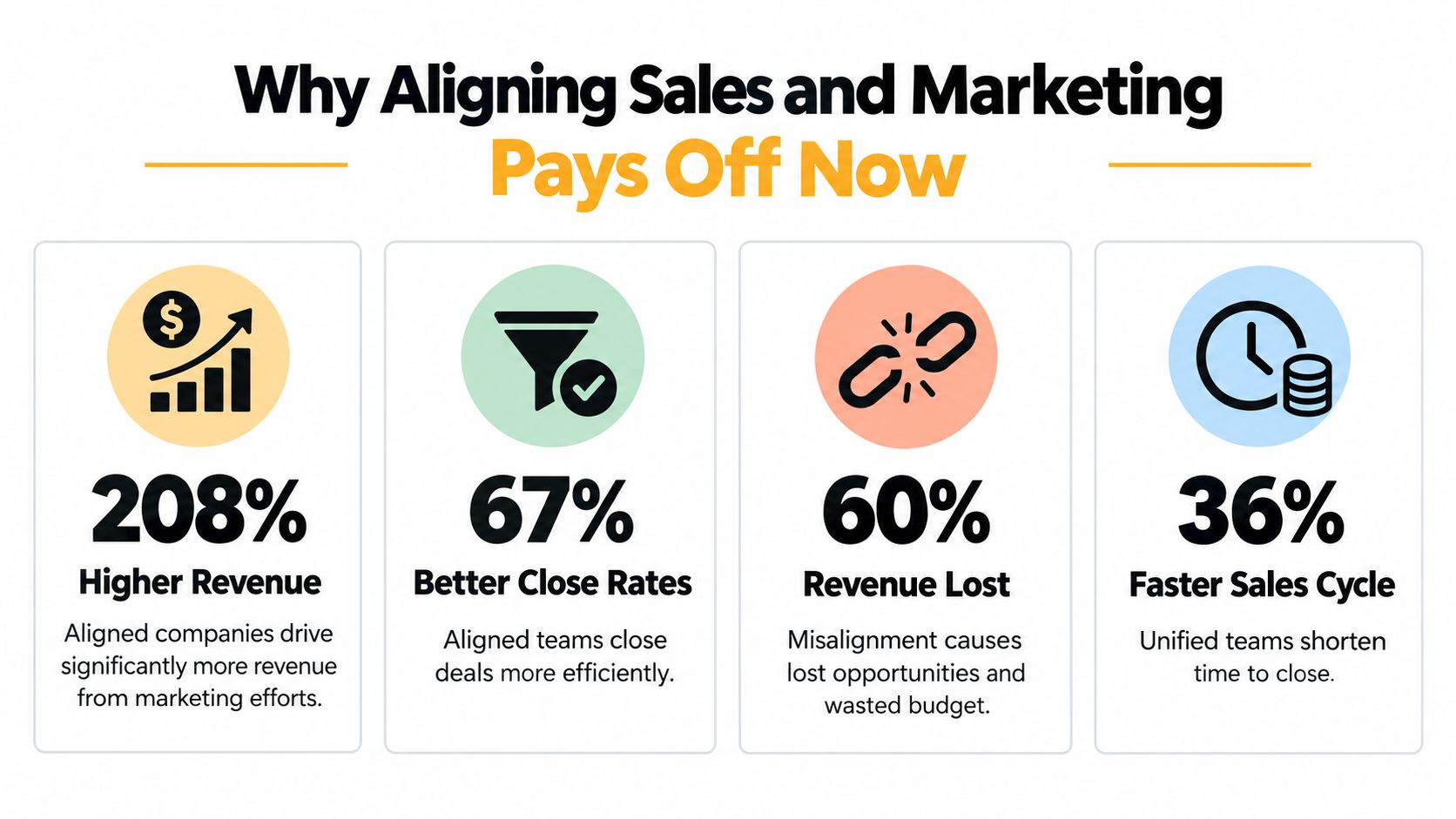
A 2015 benchmark summarized by Microsoft Dynamics found that 29.8% of organizations with formally agreed qualified-lead definitions reported lead-to-opportunity conversion above 75%, compared with 18.2% among organizations without that agreement. The same research found that 56% of aligned organizations met revenue goals and 19% exceeded them, versus 37% and 7% among misaligned organizations.
The lesson is operational. Revenue systems lose context at the handoff. Marketing may know which campaign, page, or account activity created interest. Sales may know whether the company fits, whether a real buying problem exists, and whether timing is credible. If those facts remain in separate tools or conversations, the seller receives a name without a reason to act, while marketing sees engagement without learning what happened next.
Alignment is an operating system
Strong alignment does not depend on another recurring meeting or a signed SLA document. It depends on shared rules that shape daily decisions:
- A shared market: Both teams use the same ICP tiers, exclusions, account ownership, and buying-group assumptions.
- A shared trigger model: Hiring, funding, technology changes, website intent, reputation movement, and direct engagement influence priority.
- A shared action model: Each signal has a route, owner, response expectation, message, and recycling path.
- A shared measurement model: Teams monitor handoff quality, speed, conversion, pipeline progression, and revenue instead of isolated activity counts.
The distinction is practical. A lead-volume model asks, “How many MQLs did marketing create?” A signal-driven model asks, “Which accounts now show credible readiness, who owns them, what context does the seller need, and did the action change account progression?”
Account coordination also reflects how B2B buying happens. One contact may download content, another may evaluate integrations, and a finance stakeholder may appear later. Treating the first contact as the opportunity creates false precision. Coordinating activity at the account level gives both teams a clearer view of demand as it forms.
The cost of weak coordination
The ZoomInfo research reports that aligned teams generate 209% more revenue from marketing, achieve 36% higher customer retention, and see 38% higher sales win rates. Those figures are not a forecast for every company. They do show why alignment belongs in revenue operations, where teams can inspect routing, follow-up, and outcomes rather than treat alignment as a culture initiative.
A practical program makes speed and context visible. It shows whether high-intent accounts receive action, whether sellers pursue accounts outside marketing's targeting, whether rejected leads return useful reasons, and whether marketing changes campaigns based on sales outcomes. Without those controls, teams can stay busy while buyers experience delay, repeated outreach, and inconsistent messaging.
The operating question is simple: can both teams identify the same account, explain why it matters now, choose the next action, and prove what happened after the signal appeared? If not, an MQL handoff debate will not fix the revenue system. Shared definitions, live signals, closed-loop routing, and account-level follow-up will.
Building a Shared Ideal Customer Profile and Lead Definition
An ICP becomes useful only when it changes decisions. A document describing your favorite customers isn't enough. Sales and marketing need a shared definition that determines which accounts deserve attention, which signals raise priority, and which conditions should prevent routing.
Start with the company-level fit, then separate fit from readiness. Industry, size, geography, operating model, technology environment, use case, and serviceability describe whether an account belongs in your market. Website activity, hiring, funding, product research, leadership changes, or direct engagement describe whether the account may be moving now. Risk criteria, such as poor data quality, unsupported geography, or a weak use case, keep attractive-looking but unserviceable accounts out of active queues.
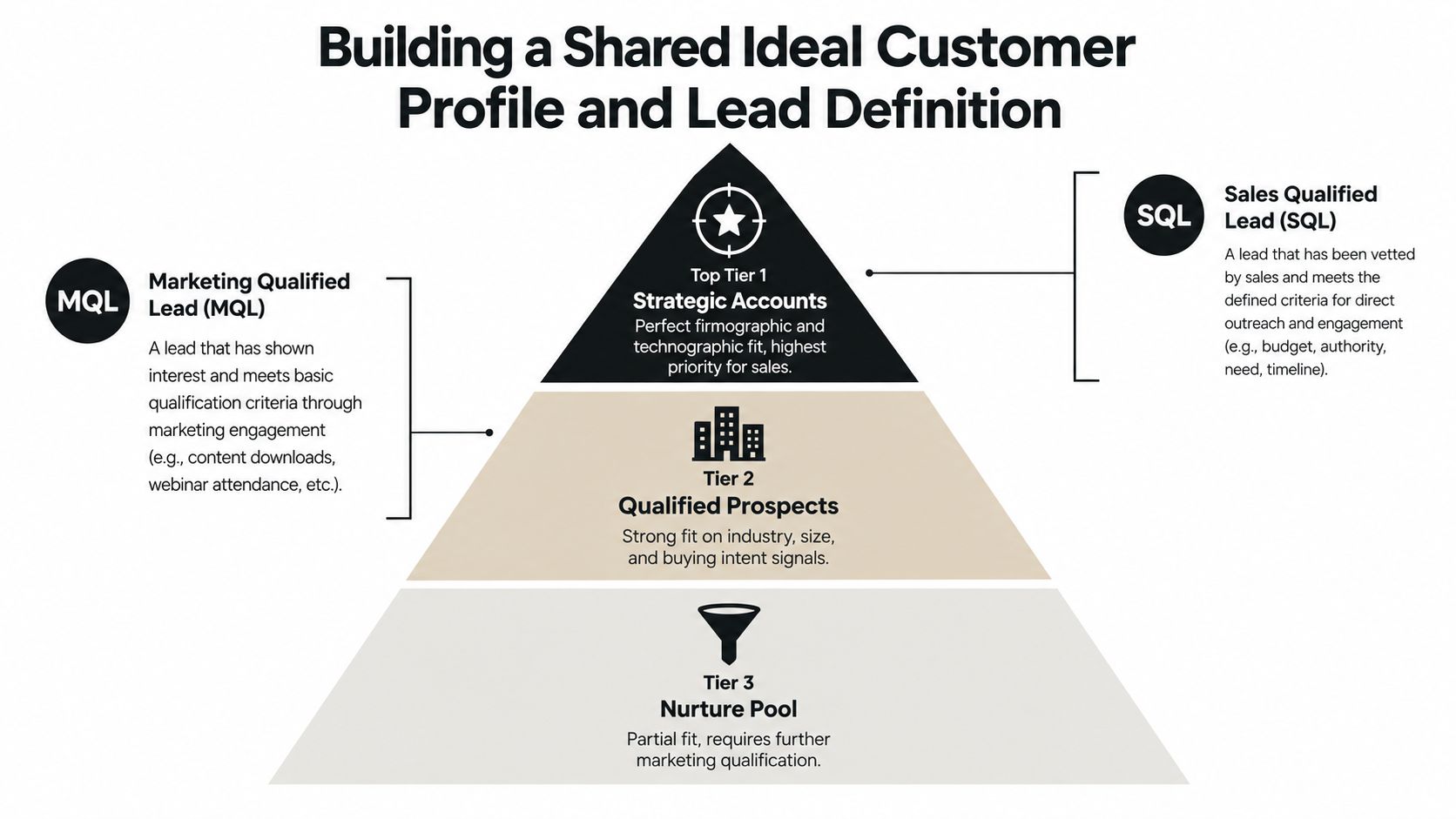
A practical ICP structure has three tiers:
- Strategic accounts: Strong fit, meaningful potential, and a reason to coordinate personalized action.
- Qualified prospects: Clear fit with enough buying evidence to justify seller attention.
- Nurture pool: Partial fit or weak readiness, with marketing responsible for developing context before sales involvement.
Define qualification as observable evidence
Avoid definitions such as “engaged lead” or “marketing-ready account” unless the CRM records what those labels mean. Write entrance and exit criteria in observable language.
An MQL might require a fit threshold plus a meaningful combination of first-party activity and account context. An SQL should require sales acceptance, a documented reason for pursuit, and a next action. If the account is rejected, the seller should select a reason such as poor fit, wrong timing, duplicate record, unsupported need, or insufficient evidence. That reason becomes input for targeting and scoring.
For scoring, use separate dimensions rather than hiding everything in one opaque number:
- Fit: Does the company match the ICP and tier?
- Intent: Is there evidence of active research or a relevant business change?
- Coverage: Do you know enough of the buying group to act responsibly?
- Risk: Is the data reliable, and are there reasons not to pursue?
- Actionability: Can a seller identify a useful next step from the available context?
The model should favor evidence over activity theater. A form fill from an unqualified company shouldn't outrank a target account showing several coordinated buying signals merely because the form is easier to count.
Assign ownership before definitions decay
Marketing can own audience and engagement data. Sales can own qualification outcomes and opportunity context. RevOps should own field definitions, required fields, system-of-record rules, deduplication, and change control. No team should be able to redefine MQL or SQL in isolation.
Document the definitions in the CRM, marketing automation platform, routing rules, and dashboard. Review rejected and recycled records regularly for definition drift. A useful ideal customer profile guide can help teams structure firmographic, technographic, and behavioral criteria before adapting them to their own revenue motion. For a deeper foundation, compare the process with this guide to building an ICP.
The definition isn't finished when both teams approve it. It's finished when a seller can make the same qualification decision from the same record, without asking marketing to interpret the data manually.
Designing Signal Driven Routing Rules and SLAs That Stick
A routing rule should answer four questions immediately: What happened, who owns the account, what must happen next, and how will the outcome return to the system? If it only sends a notification, it isn't a workflow. It's an interruption.
Begin with account-level signals. Hiring can indicate a new capability or operational priority. Funding can change urgency and available resources. A technology shift can create an integration need. Visits to pricing, demo, or integration pages can indicate active evaluation. A reputation change can create an urgent outreach angle for local businesses. None of these signals proves intent by itself, so combine them with ICP fit and available buying-group context.
Route by priority, not by arrival order
Build routing logic around tiers and signal combinations:
- High-fit plus urgent signal: Route to the named account owner, attach the source and context, and create a time-bound task.
- Strong fit plus moderate signal: Assign to the appropriate segment queue, with a research and qualification action.
- Partial fit or ambiguous signal: Send to nurture or an enrichment queue rather than forcing a premature sales handoff.
- Conflicting or low-confidence data: Hold the record, flag the uncertainty, and require validation before outreach.
- Existing opportunity: Route the signal to the opportunity owner and customer-facing stakeholders so outreach doesn't conflict with an active deal.
Account ownership matters. Contact-based routing often sends activity to the wrong representative when several people from one company engage. Match the account first, then attach contacts and events to the account hierarchy. If the account has no owner, route through a defined territory or segment fallback, with RevOps responsible for resolving the ownership gap.
Make SLAs specific enough to enforce
A useful SLA includes the trigger, qualification condition, owner, expected response, required action, feedback field, and recycling rule. Don't copy a generic “contact within 24 hours” rule across every motion. The right expectation depends on signal strength, account tier, business hours, territory coverage, and whether the seller has enough context to make a relevant approach.
The Influ2 alignment benchmark defines an effective handoff as sales contacting 35% or more of high-intent prospects after they click ads. It also recommends auditing the last 200 MQLs to measure the median time between the MQL stage change and the first sales touch. These are useful diagnostic methods because they test actual behavior rather than SLA compliance on paper.
Use alerts sparingly. A Slack notification that lacks the account, signal source, affected page or event, owner, and recommended action creates noise. A good alert lets the seller act without rebuilding the research trail.
A fast irrelevant message is still a bad handoff. Optimize for response speed and usable context together.
The routing system also needs an exception path. If an owner rejects an alert, the reason must be recorded. If a signal is invalidated, the data source should be marked. If the account becomes active again, the workflow should be able to re-enter it without creating duplicate tasks.
For teams using machine-assisted qualification, this guide to AI lead scoring and routing offers useful implementation context.
Creating Shared Dashboards and a Unified Data Model
A dashboard cannot repair conflicting records. The CRM may hold account ownership, the marketing platform engagement, a data provider firmographics, and a sales tool activity. If those systems disagree about the account, stage, or source, the dashboard becomes a negotiation instead of a management tool.
Start with a unified data model and data integrity process. Make the account the primary coordination object, then connect contacts, activities, buying signals, opportunities, campaigns, and outcomes. Map fields explicitly across systems such as HubSpot, Pipedrive, Attio, and the marketing platform. Assign an authoritative system for every field, mark required values, and define edit permissions.
Technical controls that preserve trust
Field-level mapping prevents incompatible formats from overwriting useful values. Validation rules keep incomplete records out of active queues. Bi-directional syncing exposes sales outcomes to marketing and marketing context to sales. Near-real-time updates suit urgent buying signals, while scheduled refreshes work for slower-changing enrichment.
The data alignment workflow described by Leadenforce emphasizes unified data models, CRM and marketing-system syncing, shared funnel KPIs, closed-loop reporting, and recurring reviews. These controls affect daily execution. Without ownership and validation, an integrated stack degrades as teams add fields, change campaigns, or create exceptions.
A shared dashboard should show account status and the next required action without forcing either team to calculate it manually.
Shared Funnel Health Dashboard
| Metric | What It Measures | Owner |
|---|---|---|
| ICP account coverage | Whether priority accounts have valid fit, tier, ownership, and required data | RevOps |
| Signal-to-action rate | Whether agreed account signals produce the required next action | Sales and marketing |
| Median response time | How long assigned owners take to begin action after a trigger | Sales |
| Qualified account progression | Whether qualified accounts advance, recycle, or stall | Sales and RevOps |
| Buying-group coverage | Whether active accounts include the relevant stakeholder context | Sales and marketing |
| Closed-loop reason quality | Whether rejection, recycling, and loss reasons are usable for improvement | RevOps and marketing |
| Pipeline contribution | How coordinated plays connect to opportunities and revenue | Revenue leadership |
Keep definitions beside the dashboard. Every metric needs a formula, source fields, refresh expectation, segment filters, and an accountable owner. Review operational exceptions weekly, conversion patterns monthly, and ICP or capacity decisions during broader planning.
The most useful view may be a queue rather than an executive chart. Show accounts with strong fit and a recent signal, missing ownership, or overdue seller action. That turns reporting into coordinated work, with live buying signals and closed-loop outcomes replacing performative MQL handoff debates.
Running Daily Workflows That Keep Teams in Sync
Alignment becomes real in the morning queue, not in the quarterly planning deck. A revenue team needs a shared “Today” view that prioritizes accounts requiring action and gives each owner enough evidence to act without starting research from scratch.
Consider an inbound signup from a company that fits the ICP but uses a personal email address and provides little context. Marketing's job isn't to celebrate the conversion and send it blindly to sales. The record should be enriched, checked for fit and risk, matched to an account, and assigned a next action. It may go to sales, nurture, or hold depending on the evidence. Sales then returns a disposition that improves the rule instead of ignoring the record.
A practical daily rhythm
At the start of the day, RevOps or the revenue manager reviews:
- New buying signals: Hiring, funding, technology changes, leadership movement, news, reviews, and website intent.
- Unaccepted assignments: Accounts with an owner but no recorded action.
- Ownership gaps: High-priority accounts that don't have a responsible seller.
- Stale context: Records where the signal is old, unverifiable, or contradicted by newer information.
- Feedback exceptions: Rejected or recycled accounts missing a reason code.
Marketing uses the same queue to coordinate campaigns and audience suppression. If sales is already working an account, marketing shouldn't create conflicting outreach. If a target account shows interest but lacks a technical evaluator, marketing can support the missing stakeholder while sales develops the active relationship.
Put sources inside the brief
The seller's brief should show the account, the relevant signal, the source, the likely business implication, known contacts, recent engagement, and a suggested opening. Source-backed outreach is more useful than a generic “saw you visited our site” message because it gives the seller a legitimate reason to start a conversation.
A daily review doesn't need to become another meeting. Use Slack, Teams, email, or CRM tasks for routine alerts. Reserve live discussion for conflicting ownership, unclear signals, stalled opportunities, and changes to the routing logic.
The handoff is complete only when the receiving owner records what happened.
That feedback might confirm a live project, identify poor fit, reveal a competitor, show that timing is later, or expose bad enrichment. Marketing can then adjust targeting and messaging, while sales receives better future context. The workflow improves because the system captures decisions, not because teams promise to communicate more.
Your Alignment Playbook Checklist and Next Steps
Most alignment programs fail by changing too much at once or by stopping at agreement. A practical rollout starts with the smallest operating loop that can expose failure: one ICP, one account view, one signal class, one routing path, and one shared outcome.
Audit the current system
Use the following checklist before changing tools:
- Compare definitions: Put the sales and marketing versions of ICP, MQL, SQL, opportunity, and recycle side by side.
- Inspect recent handoffs: Review whether owners acted, what context they received, and whether outcomes were recorded.
- Find ownership gaps: Identify accounts with strong fit or signals but no accountable seller.
- Trace the data: Confirm where account, contact, source, stage, activity, and rejection fields originate.
- Separate activity from evidence: Remove signals that don't change prioritization or next action.
- Check the dashboard: Make sure both teams use the same formulas and can see the same progression.
A phased sequence works better than a big-bang redesign. First, agree on the ICP and account hierarchy. Then define one high-value signal and its route. Add the SLA, required feedback, and exception path. Once the workflow produces reliable outcomes, expand to other signals, buying-group coverage, content plays, and opportunity stages.
Replace meetings with decisions
Weekly reviews should focus on active accounts, overdue actions, ownership conflicts, and evidence that a rule needs changing. Monthly reviews should examine conversion, response time, rejected records, and pipeline progression by ICP tier and play. Keep quarterly discussions for strategic changes such as market focus, account capacity, messaging, and investment.
For broader implementation guidance, the Prometheus Agency GTM alignment playbook provides another perspective on connecting strategy, process, and revenue execution. The principle is consistent: alignment sticks when teams share consequences for the same pipeline outcomes.
The next step is concrete. Choose one account segment this week, define its fit and readiness rules, select one live signal, assign an owner, and create a dashboard that shows whether action occurred. If the team can't explain why an account is prioritized or what happened after the alert, fix that workflow before adding more leads.
CapyScout helps B2B teams discover fitting accounts, screen inbound signups, enrich HubSpot, Pipedrive, and Attio records, and monitor live buying signals with source-backed briefs and alerts. Visit CapyScout to build a signal-driven routing workflow that tells your team who to contact, why now, and what to do next.