

AI Lead Qualification: A Practical Guide for 2026

Learn how AI lead qualification works, what signals to score, and how to build a workflow that turns intent into revenue without losing trust.
At 9:14 a.m., a strong demo request arrives in a shared inbox. The account matches your ideal customer profile, the buyer has visited your pricing page, and the form includes a credible use case. The notification gets buried beneath an office-supplies thread. Someone replies at 2:47 p.m., after competing vendors have already made contact.
That's the operational problem AI lead qualification should solve. It isn't just a matter of assigning a score to every form fill. It's a sequence of decisions made under time pressure: Is this account a fit? Is the buyer active now? Is the evidence reliable? Who should act, and how quickly? The answer must be useful to sales, explainable to RevOps, and reversible when the system is wrong.
This guide is for founders, sales leaders, SDRs, BDRs, RevOps teams, and local-agency owners building qualification into a real CRM. It focuses on the mechanics that survive launch, including signal quality, response speed, routing, confidence thresholds, human review, and measurement. The central principle is simple: a model should know when it has enough evidence to decide, and when it should refuse to decide.
Table of Contents
- The Moment a Good Lead Goes Cold
- What AI Lead Qualification Actually Means
- The Three Signal Families and How to Combine Them
- Building the Qualification Workflow Step by Step
- Two Qualification Stories Side by Side
- Speed to Lead as a Revenue Lever
- Why Confidence Matters More Than the Score
- Vendors, Pilots, and the Mistakes That Quietly Kill Programs
The Moment a Good Lead Goes Cold
A strong inbound lead can go cold before anyone decides whether it is qualified. The failure often starts earlier, when qualification is treated as a software purchase instead of an operating process with clear ownership.
A lead may arrive through a form, chat, product signup, phone call, or referral. One system captures it, another enriches it, a model scores it, the CRM assigns it, and an alert asks a salesperson to respond. Every handoff can introduce delay, duplicate records, missing context, or an incorrect decision. If the model receives stale enrichment or conflicting CRM fields, the right action may be to flag uncertainty rather than force a ranking.
A Harvard Business Review study summarized through its speed-to-lead analysis examined 2,241 U.S. companies. Organizations contacting an inbound lead within one hour were nearly seven times more likely to establish a meaningful conversation with a decision-maker than those waiting an additional hour. The analysis also found that companies responding within an hour were more than 60 times as likely to qualify a lead as companies waiting at least a day.
Practical rule: Qualification is complete only when the right person receives a defensible next action, with the evidence and uncertainty visible.
The audit exposed a coverage problem that manual follow-up cannot solve by itself. Only 37% of companies responded within an hour, while 24% took more than a day and 23% never responded at all, according to the same audit. AI can reduce that gap when scoring is connected to enrichment, routing, alerts, and explicit ownership. A score without those controls just creates another field in the CRM.
Good qualification therefore needs two outputs: a recommendation and a confidence state. The system should record the supporting signals, identify conflicts or missing evidence, route urgent opportunities quickly, and send ambiguous records to a human. A human override is not a failure of automation. It is part of a qualification system designed to know when it should refuse to decide.
What AI Lead Qualification Actually Means
AI lead qualification is the automated assessment of incoming contacts and accounts to determine fit, current intent, risk, confidence, and next action. It can combine rules, historical outcomes, live account activity, enrichment, language signals, and CRM context. The output isn't merely “qualified” or “unqualified.” It should answer what happens next and why.
A useful way to design the output is to separate four dimensions that many stacks collapse into one score:
- Fit: Does the account resemble the customers your team can serve well? Relevant attributes may include industry, geography, company structure, technology environment, or use case.
- Intent: Is the account showing current buying activity? Website behavior, a product signup, a pricing inquiry, a hiring move, or a reputation change can provide timing context.
- Risk: Could routing create compliance, deliverability, data-quality, or reputational problems? Disposable contact details, contradictory records, and unclear consent belong here.
- Confidence: How strong and current is the supporting evidence? Confidence should fall when sources disagree, enrichment is stale, or important fields are missing.
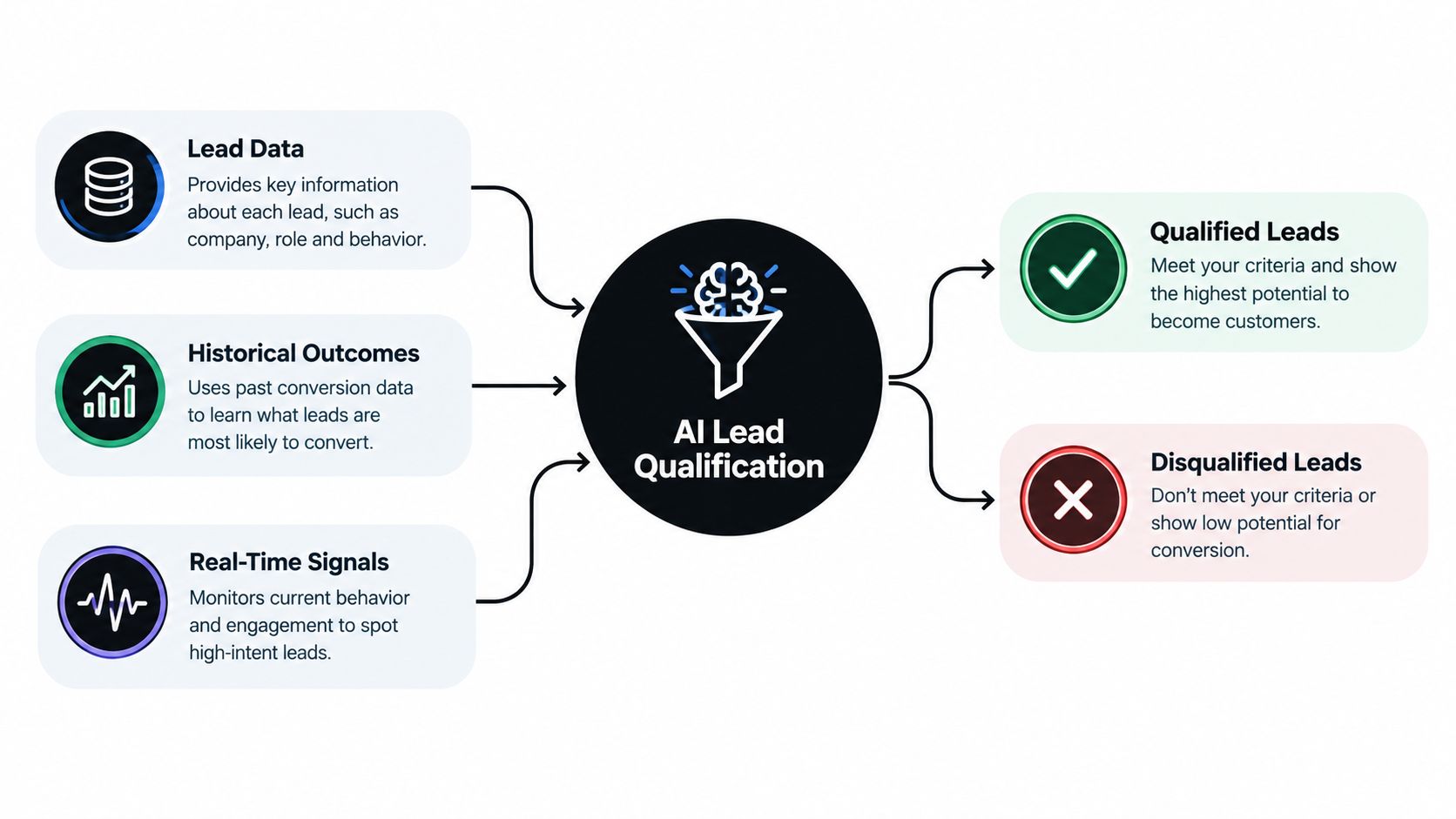
A score is not a decision
Think of qualification as an air-traffic-control problem. The controller doesn't fly the aircraft or decide whether the aircraft is good by nature. The controller sequences arrivals, checks constraints, and sends each aircraft to the appropriate runway. A qualification system performs a similar function for demand.
A high-fit account with weak intent may belong in nurture. A modest-fit account with a highly specific, recent use case may deserve review. A high score backed by an unverified source should not receive the same treatment as a similar score supported by several fresh records.
For a practical grounding in the broader qualification discipline, Crescade's guide to how to qualify leads for revenue is useful because it connects qualification criteria to commercial outcomes rather than treating scoring as an isolated analytics exercise. The implementation detail that matters most is traceability. Each important signal should carry its source, timestamp, freshness status, and effect on the recommendation.
Teams working through model ranking and routing mechanics can also review CapyScout's explanation of how AI models rank and route leads faster. The underlying principle is worth preserving regardless of the vendor: the system should recommend an action, not hide a verdict inside an opaque number.
The Three Signal Families and How to Combine Them
Qualification systems usually draw from three signal families, and each answers a different question. Firmographic data identifies who the account is. Behavioral data shows what the account is doing. Intent data helps establish whether the broader buying moment is active. Combining them doesn't mean averaging them. It means assigning each family a distinct job.
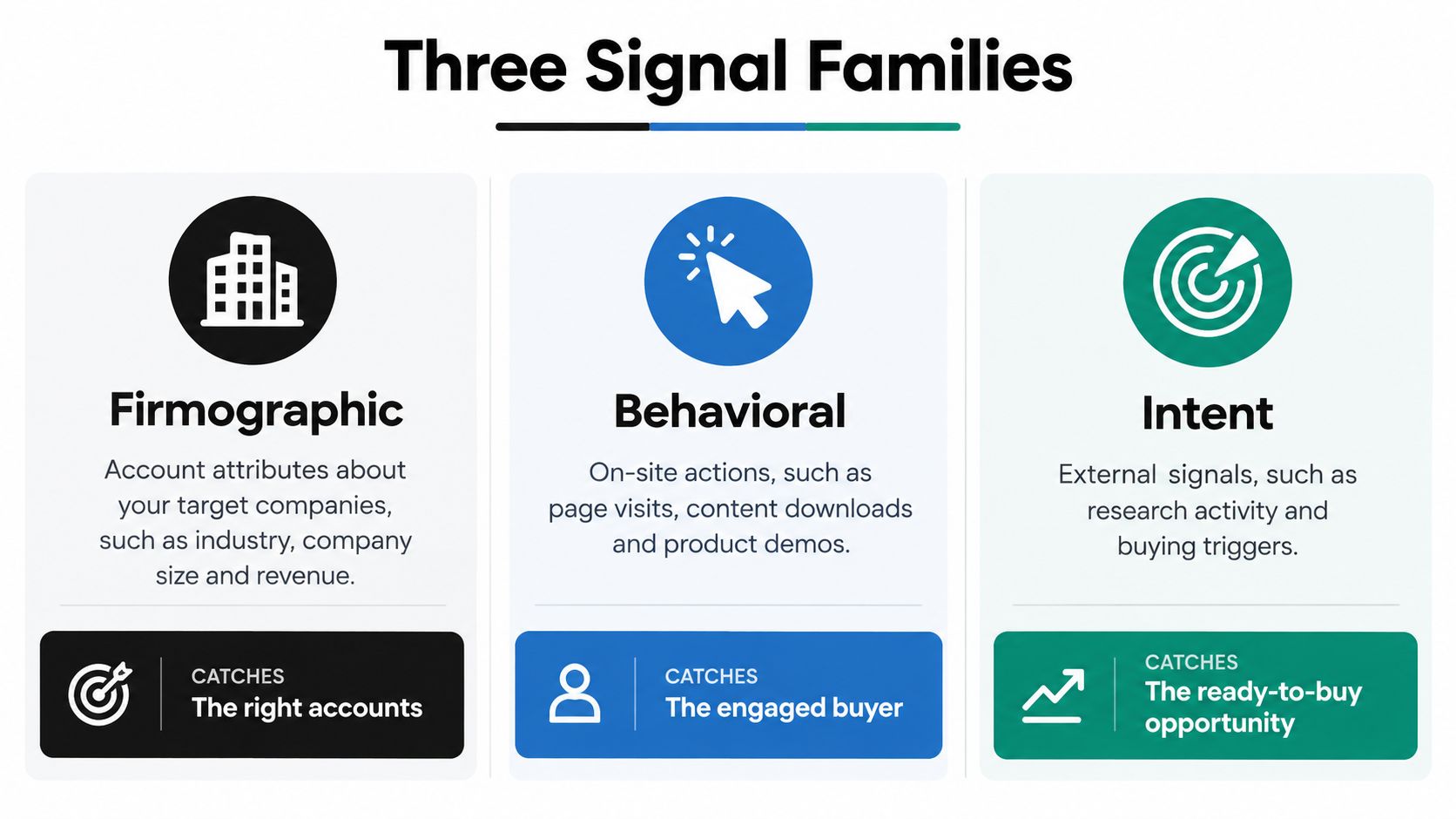
Firmographics provide the gate
Firmographics include industry, company size, geography, revenue profile, technology stack, and organizational structure. They're useful for excluding obvious mismatches and identifying accounts that fit a territory or segment. They're less useful for timing. A perfect account profile may not be evaluating anything today.
Static data also decays. A company changes its technology, enters a new market, hires a new leader, or shifts its operating model. If an enrichment record has no timestamp, sales can't distinguish a current fact from an old assumption.
Behavior shows active evaluation
Behavioral signals include repeat visits to pricing or integration pages, content downloads, demo interaction, product activation, and return visits from the same account. These signals are closer to the buying process, but they can still be noisy. A researcher, student, consultant, or existing customer may create activity that resembles new demand.
The strongest behavioral designs preserve sequence and context. A single page visit is weak evidence. A pattern that moves from educational content to product documentation to pricing deserves a different interpretation, especially when the account and contact are verified.
Intent sets the clock
Intent signals include relevant hiring activity, leadership changes, technology shifts, regulatory events, competitive changes, and reputation movement. These signals often explain why now, but external intent doesn't necessarily prove that a buyer has engaged with your company. It should influence timing and prioritization, not replace account-level fit.
A useful mental model is: firmographics gate, behavior qualifies, intent times. The signal ledger should record a source URL, timestamp, freshness half-life, and contradiction status for every material input. That prevents a strong but old signal from overpowering a weaker, current one.
For practical examples of external buying triggers and how teams can identify them, see CapyScout's guide to the top buying signals. The important design choice isn't a universal weighting formula. It's the discipline of making every weight explainable and revisable.
Building the Qualification Workflow Step by Step
A reliable pipeline is event-driven. A new signup, form completion, chat exchange, or monitored account event should trigger a defined chain of actions rather than wait for someone to notice a new row in the CRM.
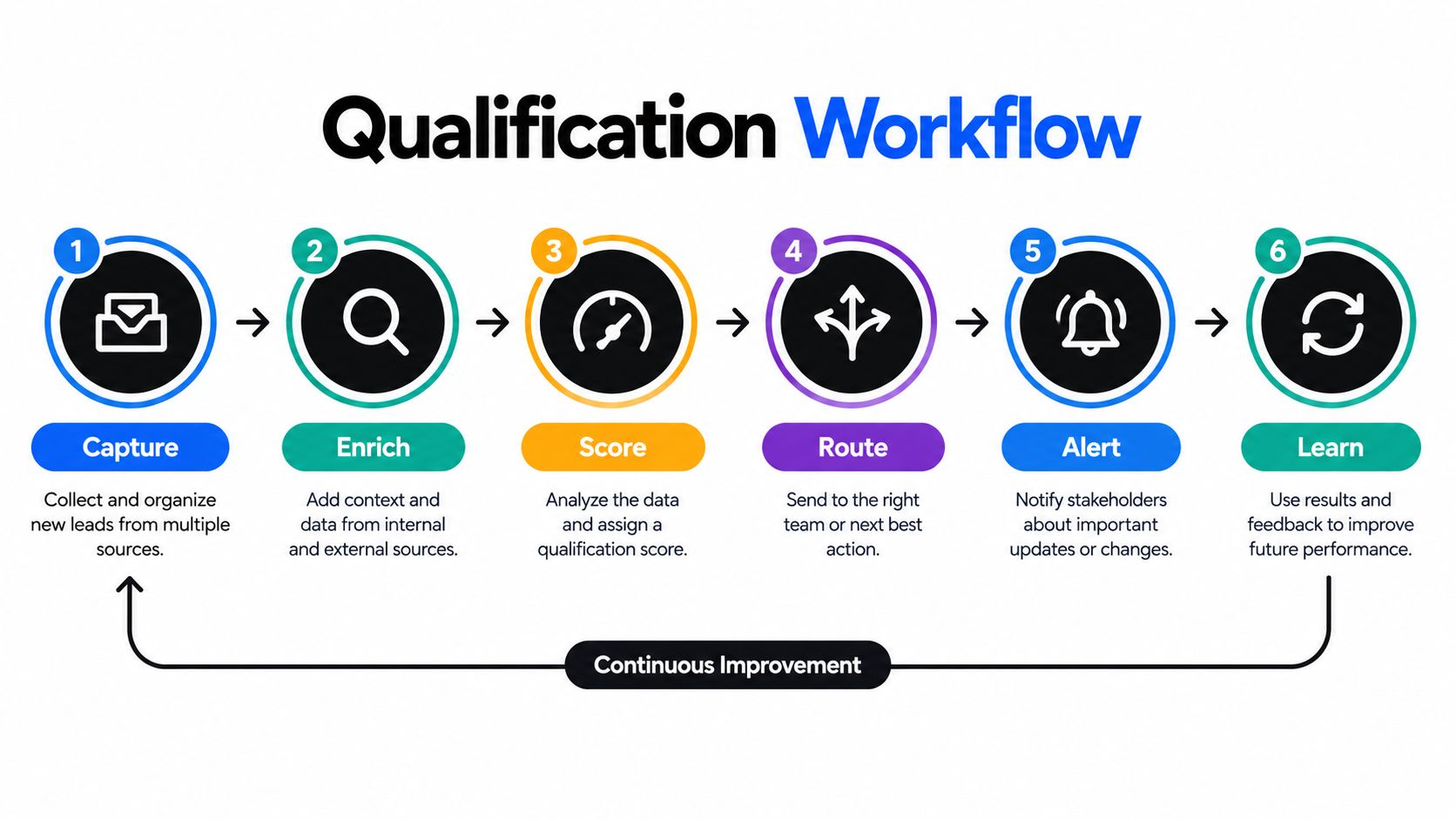
Start with capture and enrichment
Capture the original event with its timestamp, channel, page context, consent state, and submitted fields. Preserve the raw payload. If the model later makes a bad recommendation, the team needs to know what it saw.
Enrichment comes next. Resolve the account, verify contact details, identify relevant firmographics, check existing CRM history, and attach external signals. Don't let incomplete enrichment become a false negative. Mark missing fields explicitly and lower confidence when the missing information matters.
Score, route, and alert
Scoring should combine model inference with explicit overrides. For example, a strong fit may still be held when risk is high, while a lower-confidence record can enter a human-review queue. Routing should then apply ownership, expertise, geography, account history, and current capacity.
| Routing approach | Useful when | Common failure |
|---|---|---|
| Round-robin | Reps have similar capacity and segment coverage | Ignores expertise and account relationships |
| Capacity-weighted | Workload varies across the team | Requires current capacity data |
| Account-based | Named accounts have clear owners | Can delay action when the owner is unavailable |
| Geographic | Territory rules drive coverage | Can misroute global or distributed accounts |
The alert should appear where the team already works, such as Slack, Teams, email, a CRM task, or a webhook. Every alert needs the lead identity, decision, confidence, evidence, timestamp, suggested action, and override path. A notification that says “high score” without context becomes background noise.
A study using more than 78,000 B2B opportunity records found that an XGBoost model achieved 95.9% recall and a 0.993 AUC when qualification combined dynamic signals such as sales velocity and engagement with static attributes, according to the RIT repository study. The result supports a fit-plus-behavior design, but it doesn't remove the need for calibration, source quality, or human review.
Teams designing outsourced qualification operations may also find CallZent's BPO lead generation process useful for thinking about ownership, handoffs, and queue discipline. The same operational questions apply whether the next action belongs to an internal AE or an external team.
The workflow should close with learning. Capture human overrides, accepted and rejected handoffs, contact outcomes, meeting outcomes, and reasons for disqualification. Feed those outcomes back into evaluation, not blindly into the model.
Two Qualification Stories Side by Side
The same qualification architecture can serve very different businesses. What changes is the evidence, the urgency, the owner, and the definition of a successful handoff.

A B2B SaaS signup
A SaaS company selling to RevOps teams receives a trial signup from an account that appears to match its target segment. Enrichment checks the company profile, technology environment, existing CRM history, and relevant hiring activity. The behavioral layer then looks at activation events, return visits, feature exploration, and movement toward a paid workflow.
The routing recommendation isn't based on the signup alone. It combines account fit with current product engagement and assigns the record to the AE responsible for that vertical. The handoff includes the evidence, the activation pattern, unresolved questions, and a suggested follow-up. If the account is a weak fit but shows curious behavior, the system sends it to nurture rather than asking an AE to improvise.
The success metric is not raw signup volume. The team should inspect whether routed accounts receive timely contact, whether the handoff is useful, and whether accepted opportunities progress through the sales process.
A local reputation opportunity
A three-person marketing agency serving dental practices receives a monitored account alert. The practice's Google Business Profile rating moves from 4.6 to 4.1 over six days in the scenario, while recent reviews show a noticeable shift in sentiment. The agency's qualification layer marks the account as a timely outreach opportunity because it can explain exactly what changed and when.
That recommendation uses a different signal mix from the SaaS workflow. Local reputation movement carries more weight than technology stack, and the suggested action is a concise, evidence-backed conversation about review response and patient experience. The agency may route the account to the owner rather than a territory-based AE, and it may measure success by a completed conversation or audit rather than a software opportunity.
The shared pattern is more important than the industry difference:
- Evidence differs: product activity for SaaS, public reputation movement for local services.
- Routing differs: vertical ownership for SaaS, direct owner action for a small agency.
- Timing differs: activation momentum versus a recent reputation change.
- Confidence still matters: both recommendations need a source, timestamp, and clear reason.
AI qualification is a pattern of controlled decisions, not a fixed product category. The same plumbing can support a self-serve funnel and a local outreach motion without pretending their buying cycles are identical.
Speed to Lead as a Revenue Lever
A qualified inquiry can lose value while it waits in a queue. The buyer is active when a signup or request arrives. Delay gives competing vendors time to respond first and makes the original context harder for a representative to recover.
As noted earlier, many teams miss the one-hour window. The operational question is therefore service-window design: how quickly can the system capture, enrich, score, route, and alert without pretending uncertain evidence deserves immediate human attention?
Design the service window
For high-confidence records, design the pipeline to complete those steps within minutes. The target depends on system latency and team coverage, but the rule is firm. A model that reaches a decision after buying intent has weakened is not serving revenue, even if its classification is accurate.
Track more than an average. Median response time shows the typical experience, while 90th-percentile response time exposes the slow tail created by failed integrations, overloaded queues, or unclear ownership. Review both measures by source, segment, hour, and routing path. A timestamped audit trail should show when each handoff occurred and which signal supported the decision.
A practical latency policy can look like this:
- Under five minutes: send high-confidence, high-fit records to live sales coverage.
- Under one hour: place qualified records in a high-priority queue with an immediate alert.
- Under 24 hours: use standard follow-up or nurture, based on intent and confidence.
- Older than 24 hours: treat the record as recycled demand and revalidate its buying context before assigning urgency.
These buckets are operating rules, not universal truths. A recent lead with an uncertain identity match or conflicting enrichment should pause for review rather than jump directly to a representative. Speed strengthens a sound decision and spreads a weak one faster.
Response operations also depend on routing mechanics. Truespeak's guide to speeding up follow-up offers a useful comparison point for follow-up design, while CapyScout's explanation of lead-routing software covers the infrastructure behind ownership and handoffs.
The implementation test is concrete: can a real signup reach the right owner quickly, with its source, timestamp, qualification reason, and uncertainty visible? If the answer is no, reducing model latency alone will not improve revenue response.
Why Confidence Matters More Than the Score
A score looks precise even when its evidence is weak. That's why confidence is the operational variable many qualification programs miss.
Consider two records. One has a fit score of 0.78 supported by several fresh, sourced signals and a verified contact. Another has a score of 0.82 based on stale firmographics, an uncertain match, and enrichment that conflicts with the CRM. Routing the second record first just because its score is higher turns numerical neatness into operational risk.
Use a fit-by-confidence matrix
A simple matrix creates better actions than a single ranked list:
| High confidence | Low confidence | |
|---|---|---|
| High fit | Route promptly with evidence | Send to human review or request enrichment |
| Low fit | Nurture, redirect, or suppress | Hold, verify, or suppress |
This approach separates “we think this account fits” from “we have enough evidence to act.” It also creates room for different risk tolerances. A small transactional motion may accept more automation. A complex enterprise motion may require source confirmation before a rep spends time.
Machine learning can rank opportunities effectively without being right in every case. The RIT analysis cited earlier reported strong results for a model combining dynamic and static signals, but the practical lesson isn't that a model deserves unrestricted authority. The model still needs calibration checks, drift monitoring, class-imbalance handling, and outcome review.
The most valuable AI decision may be a refusal to decide.
Confidence should fall when sources conflict, timestamps are old, contact identity is uncertain, or the model encounters a pattern outside its training history. The system should expose those reasons directly. A human reviewer then knows what to verify instead of treating a low-confidence record as a mysterious exception.
Every routed lead should carry four things: score, confidence, freshness, and override status. Measure whether overrides improve qualification and contact outcomes. Also measure the leads the system withholds. A model can appear efficient while suppressing valuable demand if nobody examines its rejects, nurture queue, and unresolved cases.
Vendors, Pilots, and the Mistakes That Quietly Kill Programs
Vendor selection should start with the decision record, not the model demo. Ask to see how the system explains a recommendation when the evidence is incomplete, contradictory, or stale.
What to require before a pilot
A credible qualification platform should provide:
- Evidence traceability: Every material signal has a source, timestamp, and freshness indicator.
- Decision transparency: The system separates fit, intent, risk, and confidence instead of hiding them in one score.
- CRM integration: It can read existing context and write back the recommendation, evidence, status, and next action.
- Alert flexibility: It can reach the channels your team already uses, including CRM tasks, Slack, Teams, email, or webhooks.
- Human control: Reviewers can override a decision, record why, and prevent the same error from repeating.
- Commercial clarity: Credits, usage, seats, enrichment limits, and workflow costs are visible before deployment.
- Data boundaries: The vendor explains what it accesses, what it stores, and what it won't infer.
Run a controlled pilot rather than turning on every workflow. Select one inbound motion and one outbound or monitored-account motion. Define a control group with human-only routing, instrument the data layer first, and establish baseline measures for response time, contact rate, qualified rate, and revenue per routed lead.
Measure routing outcomes
Model accuracy can be useful, but it isn't the finish line. Review whether the assigned owner contacted the lead, whether the contact was meaningful, whether the lead entered a real opportunity, and whether the handoff context saved work. Inspect the leads that weren't routed, too. Suppression errors often remain invisible until lost demand becomes difficult to reconstruct.
Common failures are predictable:
- Silent enrichment drift: A provider changes coverage or field definitions, but the model continues using the data as if nothing changed.
- No override path: Reps find a bad recommendation but have no structured way to correct it.
- Accuracy obsession: The team optimizes a leaderboard metric instead of qualified conversations and commercial outcomes.
- Alert overload: Every event creates a notification, so urgent alerts look like routine noise.
- Unowned queues: Ambiguous records accumulate because nobody owns human review.
- Unmeasured rejects: The team celebrates automation without checking whether valuable leads were held or suppressed.
Take these questions into a vendor call:
- Can every score show its supporting sources and timestamps?
- How does confidence change when signals conflict?
- What happens when enrichment fails or returns incomplete data?
- Can the system route to review, nurture, or suppression without deleting the record?
- How are human overrides captured and used in evaluation?
- Can we compare automated routing with a human-only control group?
- What does the alert include before a rep opens the CRM?
- How are rejected and unassigned leads audited?
- Which CRM fields are read, and which are written back?
- What usage limits apply to enrichment, monitoring, and routing?
CapyScout is one example of a platform built around this operating model. It can screen inbound signups for fit, risk, and confidence, enrich CRM records, monitor account-level buying signals, and deliver source-backed routing recommendations through CRM integrations, alerts, and webhooks. The relevant evaluation question isn't whether a vendor claims to replace qualification. It's whether the system helps your team make faster, more defensible decisions while keeping uncertain cases visible.
If your inbound leads are waiting in a shared inbox, start by mapping the event path from capture to human action and identifying where confidence is lost. Then use CapyScout to enrich signups, surface source-backed buying signals, and route high-priority opportunities with a clear reason to act.