

What Is Sales Prospecting: A Modern Guide

What is sales prospecting? Learn how modern teams use live web signals, account intelligence, and automation to find and engage the right buyers
Most advice about sales prospecting starts in the wrong place. It tells reps to build a larger list, find more email addresses, and increase outreach volume. That approach treats a prospect as a contact record, even though the commercial question is more important: why should this company speak with you now?
Sales prospecting is the structured process of identifying organizations or people that fit an ideal customer profile, researching their situation, qualifying potential fit, and initiating a relevant sales conversation. It includes outbound and inbound activity, but it isn't the same as collecting leads. Effective prospecting connects market selection, account research, timing, qualification, and outreach.
Modern buyers make that distinction unavoidable. HubSpot's sales statistics report that 96% of prospects research companies or products before engaging with a sales representative, while 71% prefer independent research rather than talking with a salesperson. Your message arrives after a prospect has already formed an opinion, so a generic introduction has to overcome both low relevance and an informed buyer.
Table of Contents
- Redefining Sales Prospecting for Modern Buyers
- Comparing Traditional Methods and Signal-Driven Approaches
- The Mechanics of Live Web Signal Monitoring
- Building an Automated Prospecting Workflow
- Aligning Outreach Channels with Buying Signals
- Measuring Prospecting Success Beyond Vanity Metrics
- Transitioning to Continuous Account Intelligence
Redefining Sales Prospecting for Modern Buyers
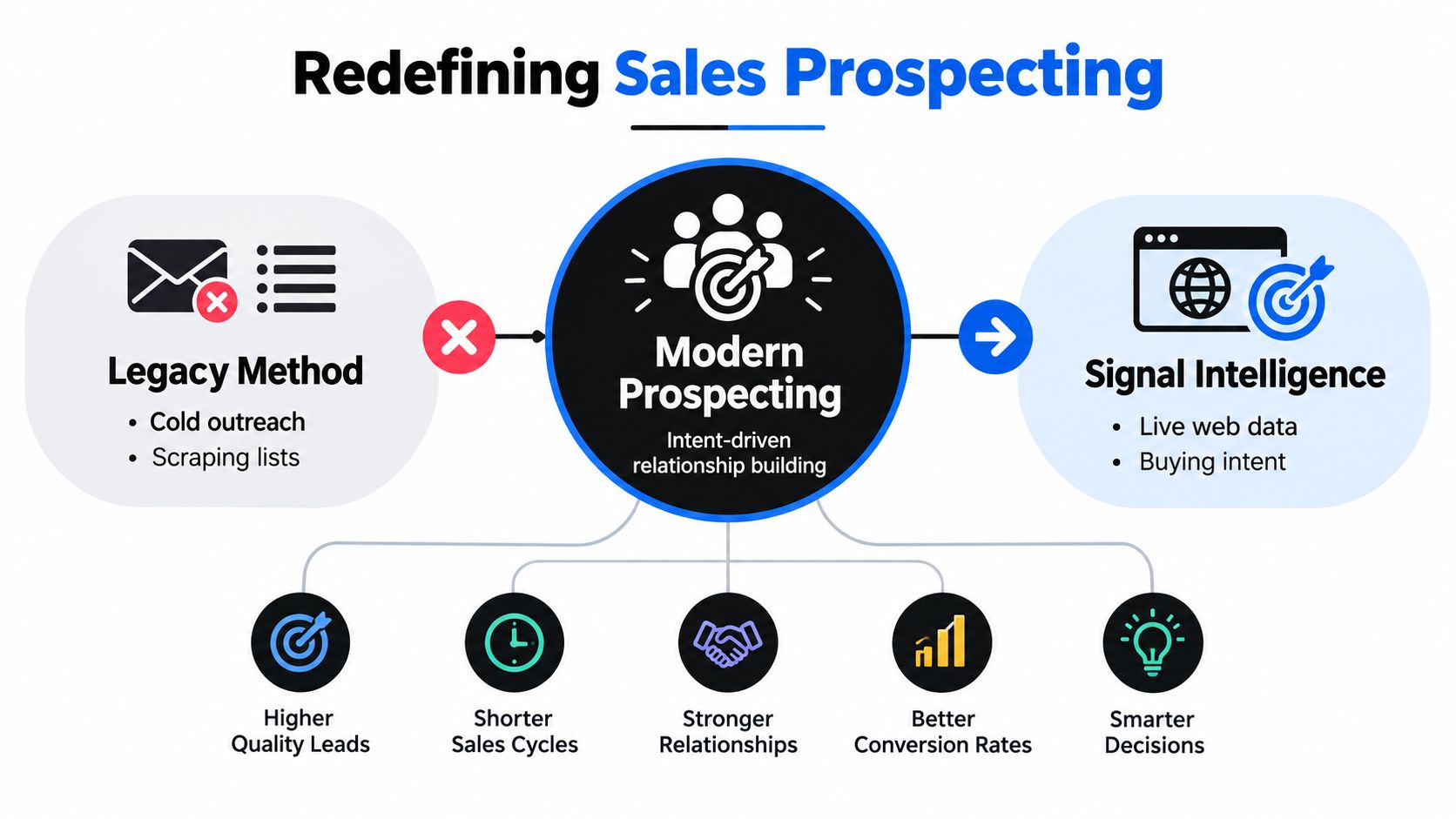
The old definition of prospecting is simple: find a contact, add the record to a sequence, and send enough messages to create meetings. That workflow can produce activity, but activity isn't the same as opportunity. A static list tells a rep who works at a company. It rarely explains what changed, what problem may be active, or why the timing is appropriate.
A modern definition is more useful. Prospecting means finding accounts that fit, detecting a meaningful business signal, and using that evidence to decide whether and how to reach out. The contact still matters, but the account comes first. A rep should understand the company's market, likely priorities, relevant stakeholders, and the public event that makes a conversation reasonable.
The contact is not the opportunity
A lead may be a name, form submission, referral, or website visitor. A prospect is a lead that has been researched and judged plausible for a sales conversation. An opportunity requires stronger evidence, such as a defined business need and active evaluation. Treating all three as interchangeable causes teams to overwork weak records and miss accounts with stronger context.
The shift from lead collection to account intelligence changes daily behavior:
- Selection: Start with the ideal customer profile, not an indiscriminate database export.
- Research: Look for current business context rather than copying old firmographic fields.
- Qualification: Separate strong fit and credible intent from weak fit or incomplete evidence.
- Outreach: Give the prospect a specific reason to respond, supported by a public source where possible.
This approach doesn't eliminate cold outreach. It makes cold outreach more responsible. A company can be an excellent fit without showing an obvious buying signal, but the message should acknowledge that uncertainty rather than pretending to know the prospect's priorities.
For teams refining their broader outbound motion, FOMOchat's B2B sales guide offers additional context on sales strategy and buyer engagement. The practical lesson is straightforward: prospecting isn't a race to contact as many people as possible. It's the discipline of identifying the accounts where relevance, timing, and fit overlap.
Comparing Traditional Methods and Signal-Driven Approaches
Traditional outbound still has a place. A well-prepared phone call can create a useful conversation, and a carefully written email can reach a buyer who isn't actively searching. The problem appears when teams use the method without account judgment. Generic email blasts and blind calling turn the salesperson into a source of interruption.
Inbound prospecting has the opposite weakness. A content download, event registration, or form fill gives the team a reason to follow up, but not necessarily proof of fit or urgency. If marketing activity becomes the only prioritization rule, reps can spend time on curious visitors while overlooking a target account showing important changes elsewhere.
Signal-driven prospecting adds a layer of timing and evidence.
| Approach | Starting point | Strength | Common failure |
|---|---|---|---|
| Traditional outbound | Static list, role, or territory | Predictable coverage | Volume replaces judgment |
| Inbound follow-up | Form fill, download, or event activity | Existing engagement creates context | Interest gets mistaken for buying intent |
| Signal-driven account prospecting | Current business change linked to account fit | Timing and relevance improve | Weak signals can create false confidence |
Useful signals can include new hiring activity, a technology change, a funding announcement, a leadership transition, a reputation shift, or renewed interest in commercial pages. None of these proves that a company will buy. Each can, however, provide a reason to investigate before contacting the account.
Match the message to the event
Suppose a target company is hiring for a role connected to the problem your product addresses. The signal doesn't justify an aggressive pitch. It supports a concise question about the initiative, framed around the public change and the business outcome you help with.
A technology change may warrant a technical message to an implementation stakeholder. A leadership transition may call for a strategic note to the new executive. A local business experiencing a public reputation shift may be better approached with a useful observation than a product-heavy email.
Practical rule: A signal earns research first, outreach second. It doesn't replace qualification.
The trade-off is coverage. Static lists are easier to process at scale, while live signals require interpretation. Yet indiscriminate volume creates its own cost through wasted research, poor replies, damaged trust, and sales conversations with accounts that never fit. Signal-driven prospecting works when the team defines which changes matter, verifies them, and routes uncertain accounts to nurture instead of forcing immediate contact.
The Mechanics of Live Web Signal Monitoring
Live web monitoring turns prospecting from a periodic research project into an ongoing account process. The system watches selected companies and checks public sources for changes that may affect fit, urgency, or the appropriate message. The output shouldn't be a mysterious score alone. A useful alert identifies the account, describes the change, links to the source, and suggests a proportionate next action.

A practical monitoring model has four layers:
- Account universe: Define companies by industry, location, technology, competitor use, or other ICP criteria.
- Signal library: Choose changes that could indicate a relevant problem, initiative, or buying moment.
- Evidence check: Capture the public page, announcement, review, job listing, or website behavior supporting the alert.
- Action routing: Decide whether the account belongs in active outreach, nurture, or a holding queue.
Different markets need different signals
For B2B software, a pricing-page return visit or repeated interest in an integration page may justify a timely follow-up, particularly when the account already fits the target profile. Hiring and leadership changes can reveal initiatives, but they don't reveal the full buying process. The rep still needs to ask whether the signal connects to the product's actual value.
Local markets require a different lens. A service business may not publish funding news or detailed technology changes, but its public reputation can shift. Review sentiment, rating movement, unanswered feedback, or a long pause in new reviews can create a relevant opening for an agency or reputation specialist.
The mechanics are less important than the evidence standard. Every alert should answer three questions: what changed, where is the proof, and why might it matter to this account? If the system can't answer those questions, the rep should treat the alert as a research prompt, not a sales fact.
For a practical catalog of triggers and discovery methods, see CapyScout's guide to the top buying signals and how to find them. A monitoring workflow becomes valuable when it reduces manual scanning without encouraging unsupported assumptions.
The visual below illustrates the kind of operational context a team can review before deciding on a next step.
Building an Automated Prospecting Workflow
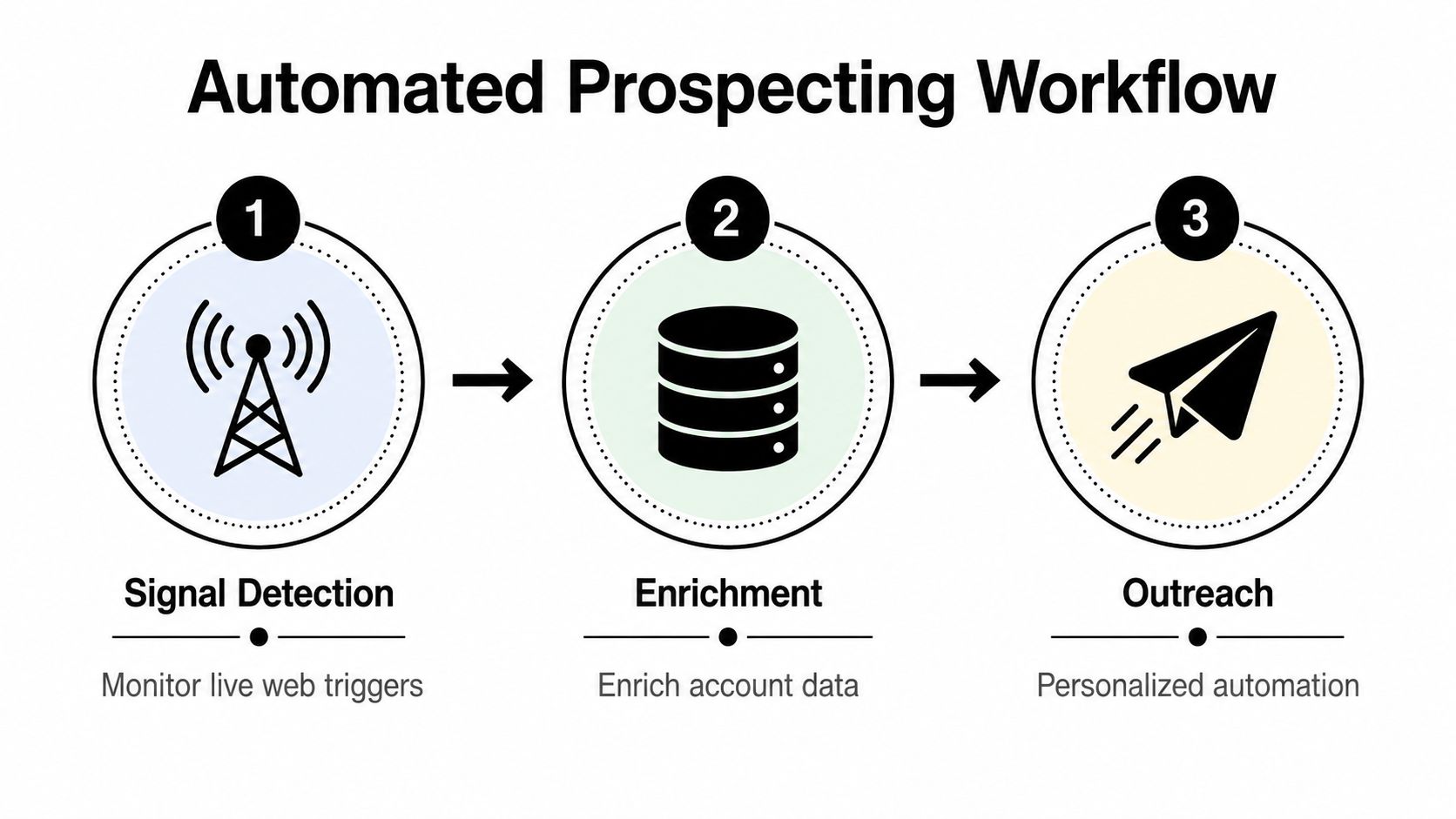
Automation should remove repetitive research, not remove judgment from selling. The strongest workflow gives reps a ranked queue with enough account context to make a sensible decision. It doesn't blindly send every alert into an email sequence.
Start with account rules
Write the ICP in operational terms. Identify the industries, locations, technologies, company situations, and roles that make an account plausible. Then define exclusions, such as poor-fit sectors, unsupported markets, or records with insufficient evidence.
Next, create saved searches in plain language. A search might look for companies in a target niche that use a particular technology, are hiring for a relevant function, or have recently changed leadership. Reusable searches create consistency and make it easier to compare the quality of discovered accounts over time.
Enrich before prioritizing
A signal alone shouldn't determine priority. Combine it with account fit, known contacts, previous CRM activity, and confidence in the source. For inbound signups, screen the company and role before routing the record. A high-fit signup can move quickly to sales, while a low-confidence or disposable record should go to nurture or hold.
A practical daily routine looks like this:
- Detect: Run saved searches and review monitored account changes.
- Enrich: Refresh company details, decision-maker context, CRM history, and source links.
- Score: Assess fit, signal strength, confidence, and potential next action.
- Queue: Give each rep a focused Today list instead of another unranked export.
- Draft: Prepare an opening based on the verified change, then let the rep edit it.
- Learn: Record outcomes so the team can remove noisy signals and strengthen useful ones.
Tools should fit the team's existing workflow. Before choosing a platform, compare software picks for B2B outreach against practical requirements such as CRM compatibility, source transparency, routing, and control over sending.
CapyScout can discover fitting companies through live-web searches, enrich CRM records, monitor account signals, and create source-backed outreach drafts. Its campaign and automation controls are documented in CapyScout's campaigns and Autopilot help page. The important design choice is that drafts open in the rep's existing email client, so automation supports preparation without taking over delivery or threading.
Aligning Outreach Channels with Buying Signals
The right channel depends on both the signal and the relationship. A public announcement may make a social interaction feel natural. A private website-intent signal should not be exposed in a message as though the prospect agreed to be watched. A sensitive or uncertain observation may belong in nurture until the team has stronger evidence.
Channel selection also deserves current evidence. HubSpot's 2025 sales research found that 42% of sales professionals reported the highest cold-outreach response rate from social media, compared with 26% for email and 23% for phone. That doesn't mean every team should replace email and calls with social selling. It means channel performance is not fixed, and reps should test the mix against their audience and signal type.
Use the least intrusive effective channel
Social outreach works well when the relevant event is already public and conversation-friendly. A thoughtful comment on a leadership post or company announcement can create recognition before a direct message. The risk is performative engagement. A generic compliment followed by a pitch is still generic outreach.
Email suits a more detailed explanation, especially when the source and relevance need context. Keep the opening tied to one observable change, explain why it may matter, and ask a modest question. Don't turn a public job listing into a confident claim about internal priorities.
Phone outreach is useful when the signal is clear enough to support a short conversation and the role is likely to value direct discussion. The opening should identify the business context, not recite surveillance data. If the prospect says the timing isn't right, respect that answer and update the account rather than escalating pressure.
Personalization has a cost. Research that improves relevance is valuable. Research that produces an oddly specific message unsupported by the evidence can feel invasive.
Personalization should be specific enough to prove relevance, but restrained enough to preserve trust.
Route uncertain accounts to nurture. Route high-confidence, high-fit accounts to active outreach. That simple separation protects the brand from turning every weak signal into a manufactured sales emergency.
Measuring Prospecting Success Beyond Vanity Metrics
“Emails sent” is an activity count, not a prospecting result. It can show whether a sequence ran, but it can't tell you whether the team selected the right accounts, used credible evidence, or created qualified conversations. A useful measurement system follows the chain from account quality to pipeline movement.
Track the quality of the inputs first. Are discovered accounts within the ICP? Do alerts contain a source that a rep can verify? Are inbound signups being routed according to fit and confidence? If these measures deteriorate, a higher outreach volume only spreads the problem.
Build a diagnostic scorecard
A practical dashboard can include:
- ICP accuracy: Review whether contacted accounts fit the agreed profile.
- Signal validity: Check whether alerts describe real, relevant changes.
- Routing speed: Measure how quickly high-fit inbound activity reaches the right owner.
- Channel response: Compare replies and conversations by channel and signal type.
- Qualified conversation rate: Count conversations that meet your qualification standard, not every response.
- Pipeline contribution: Connect prospecting sources to accepted opportunities and later revenue stages.
- Disposition quality: Record whether accounts move to outreach, nurture, hold, or disqualification for a clear reason.
Follow-up deserves its own analysis because one unanswered message rarely provides enough information to judge an account. An analysis of more than 20 million cold emails found that sequences with 4 to 7 messages achieved about a 27% reply rate, compared with roughly 9% for sequences with only 1 to 3 messages. The figures are reported in Cirrus Insight's sales follow-up analysis.
The conclusion isn't to send more identical emails. A sequence should add context, change the angle when appropriate, and stop when the evidence no longer supports continued pursuit. Measure the response to signal-triggered sequences separately from static-list campaigns. Otherwise, a blended average can hide which targeting decisions help.
Measurement principle: Evaluate the quality of the account decision before judging the copywriter or the channel.
Transitioning to Continuous Account Intelligence
A modern sales team's day starts before the first rep opens an inbox. Overnight, monitored accounts may have changed. A target company may have published a relevant job, updated its technology pages, announced a leadership move, or received a meaningful reputation signal. The rep's job isn't to investigate every company from scratch. It's to review the evidence, decide whether the change matters, and choose the next action.
That routine is different from a one-off campaign. A static list becomes outdated as people move roles, priorities change, and companies enter new markets. Continuous account intelligence keeps the account record connected to current context, while preserving a human decision at the point of outreach.
Replace exhaustion with judgment
The transition doesn't require rebuilding the entire revenue stack at once. Start with a narrow account group and a small signal library. Compare the resulting conversations with those from static targeting. Remove signals that create noise, refine the ICP when poor-fit accounts appear, and give reps clear language for handling uncertain evidence.
The most mature workflow treats prospecting as a loop:
- Define fit using the accounts that can benefit from the offer.
- Monitor change across public company, market, website, and reputation sources.
- Verify evidence before turning a signal into a message.
- Select a channel that matches the signal and relationship.
- Follow up with new value rather than repeating the same request.
- Record the outcome and improve the rules.
For a deeper look at this operating model, explore account monitoring software and the modern sales playbook. The principle is simple: buyers may research independently, but sales teams can still earn attention by arriving with a relevant, verifiable reason to talk.
CapyScout helps teams discover fitting accounts, monitor live buying signals, enrich CRM records, and create source-backed outreach drafts for B2B and local prospecting. Visit CapyScout to turn static lead lists into a daily, signal-driven account workflow.