

Lead Scoring B2B: A Practical Framework That Converts
Lead Scoring B2B. Build a B2B lead scoring model that actually converts. Learn how to pick signals, weight them, set thresholds, route leads, and keep
An SDR opens the morning queue and finds a familiar mess. Several MQLs have disposable email addresses or defunct domains. Others are students, competitors, or researchers. A few belong to credible companies, but none has shown a current reason to talk. Every record has a score, yet the score doesn't tell the SDR which account deserves attention first or what to say.
That isn't a points problem. It's an evidence and confidence problem. Effective lead scoring B2B programs combine account fit, buying evidence, timing, data freshness, and a recommended next action. They also show what the system doesn't know. A high number without supporting signals creates false urgency, while a cautious score with clear evidence can help a rep make a better decision.
Table of Contents
- Why Most B2B Lead Scoring Models Fail Before Lunch
- Defining Your ICP and Account Segments Before Any Points
- Choosing the Signals That Actually Move Pipeline
- Weighting Signals and Setting Thresholds That Hold Up
- Wiring Scoring Into Your CRM and Routing the Right Action
- Beyond the Single Contact Score Account-Level Buying Signals
- Calibrating Monthly and Troubleshooting the Edge Cases
Why Most B2B Lead Scoring Models Fail Before Lunch
Most scoring models fail because they answer the wrong question. They rank contacts by accumulated activity, but sales needs to know which account has a credible reason for action now.
A contact may have downloaded several guides, opened emails, and visited a website. Those events can indicate interest, but they don't prove that the person works at a viable account, owns the problem, or is part of an active buying group. A student can generate more activity than a decision-maker. A competitor can look like an ideal prospect. A bot can create a suspiciously energetic record.
Practical rule: A score should explain the next action, not merely justify a place in a queue.
Fit and timing must remain separate. Firmographic fit tells you whether the account resembles the customers your sales team can serve. Recency and intent tell you whether something may be happening now. Evidence quality tells you how much confidence to place in those signals.
The response-time research associated with James B. Oldroyd, Kristina McElheran, and David Elkington analyzed approximately 15,000 web-generated leads and about 100,000 call attempts. It found that contacting a lead within five minutes made the company roughly 21 times more likely to qualify that lead than contacting it after 30 minutes, with qualification odds declining sharply after the first hour. The Harvard Business Review response-time research summary supports an operational point: scoring isn't only about predicting value. It determines priority.
A useful model therefore records more than score = 82. It should expose:
- Fit: Why does this company match the ICP?
- Evidence: Which named events support the score?
- Freshness: When did each signal occur, and is it still relevant?
- Confidence: Are the firmographics verified, inferred, or missing?
- Action: Should the record route to sales, enter nurture, or wait for review?
That structure protects sales from a spreadsheet that looks logical but lowers qualified-call rates. It also makes the model auditable when a rep asks why an account was routed or held.
Defining Your ICP and Account Segments Before Any Points
Scoring only works inside a clear container. Before assigning points, write down the accounts your business can serve, the accounts it can't serve, and the conditions that separate a promising segment from a poor one.
Start with observable attributes rather than vague personas. Document:
- Industry: Identify the sectors where your product solves a repeatable problem.
- Company size: Use employee range, revenue band when available, or another consistently captured measure.
- Geography: Specify supported markets, language requirements, regulatory boundaries, and sales coverage.
- Technology context: Record systems or workflows that make adoption more plausible.
- Buying role: Distinguish users, champions, economic buyers, operational owners, and influencers.
- Disqualifiers: Name conditions such as unsupported regions, incompatible use cases, disposable domains, or clearly noncommercial activity.

Segment before you calibrate
A single mega-profile usually hides meaningful differences. A mid-market SaaS account may show different buying behavior from a local service business or an enterprise prospect with a longer procurement process. Create a small number of segments that sales can recognize and that contain enough historical examples for comparison.
For each segment, create a one-page ICP sheet with four fields:
- Positive definition: The attributes that make an account worth pursuing.
- Negative definition: The conditions that make it unsuitable.
- Evidence sources: CRM fields, product data, public company pages, hiring pages, technology data, and website behavior.
- Fallback action: What happens when information is missing or the account sits outside the main segments?
A practical fallback might be nurture or manual review, not an automatic rejection. Missing data isn't the same as poor fit. Treating it as poor fit can hide promising accounts in markets where firmographic coverage is incomplete.
For teams formalizing qualification criteria, this sales lead scoring guide offers useful context on connecting lead qualification with sales action. Your own ICP should still reflect your historical customers, delivery constraints, and current market focus.
Keep the source of each attribute visible. The ICP building and usage framework can help teams turn a general customer profile into a working operational document rather than a marketing slide.
Choosing the Signals That Actually Move Pipeline
Not every signal deserves points. The best scoring systems group evidence by what it helps predict, then limit weak events so they can't overpower stronger account facts.
Firmographic signals establish fit
Firmographics answer, “Could this account realistically buy and succeed with us?” Industry, company size, geography, operating model, and relevant technology can establish a useful baseline. They shouldn't determine urgency on their own.
A large company in the right sector may be an excellent fit with no active project. A smaller account may deserve attention if it shows a verified problem and a credible buying trigger. Keep fit and intent in separate fields even when they contribute to a combined priority view.
Intent signals indicate a possible project
Intent signals are strongest when they connect to a business change. A new hiring pattern, leadership move, technology shift, funding event, repeated pricing-page visits, or public discussion of a relevant problem can be more informative than generic content consumption.
Source credibility matters. A company job page or official announcement is easier for a rep to verify than an unexplained third-party intent label. Record the signal, its source, its date, and the account it belongs to.
Engagement signals need context
A demo request, product trial, integration-page visit, or form completion can be meaningful. A generic email open or one anonymous article visit is much noisier. Directory scrapes and duplicated events can also inflate activity without adding evidence.
Don't let event volume stand in for buying intent. Cap repeated low-value events, and avoid awarding a new burst of points every time the same person triggers an identical tracking event.
Recency decides whether fit is actionable
Timing deserves its own dimension. The later InsideSales/XANT analysis covered approximately 5.7 million inbound leads, 55 million sales activities, and more than 400 companies across the 2018 to 2020 period. It found that conversion rates were about eight times higher when the first call occurred within five minutes than when it occurred after that initial window. Separate Velocify research involving roughly 3.5 million leads across about 400 companies reported a 391% increase in conversion when the first call was attempted within one minute. These findings are summarized in speed-to-lead research, and they shouldn't be treated as universal close-rate benchmarks.
The practical implication is straightforward. Store last_verified_signal_at separately from fit_score. An ideal account with no recent evidence may belong in nurture, while a moderately fitting account with a fresh demo request may need immediate review.
A focused signal inventory should name the data source for every input. The buying signal guide is useful when mapping account changes to a practical monitoring process.
Weighting Signals and Setting Thresholds That Hold Up
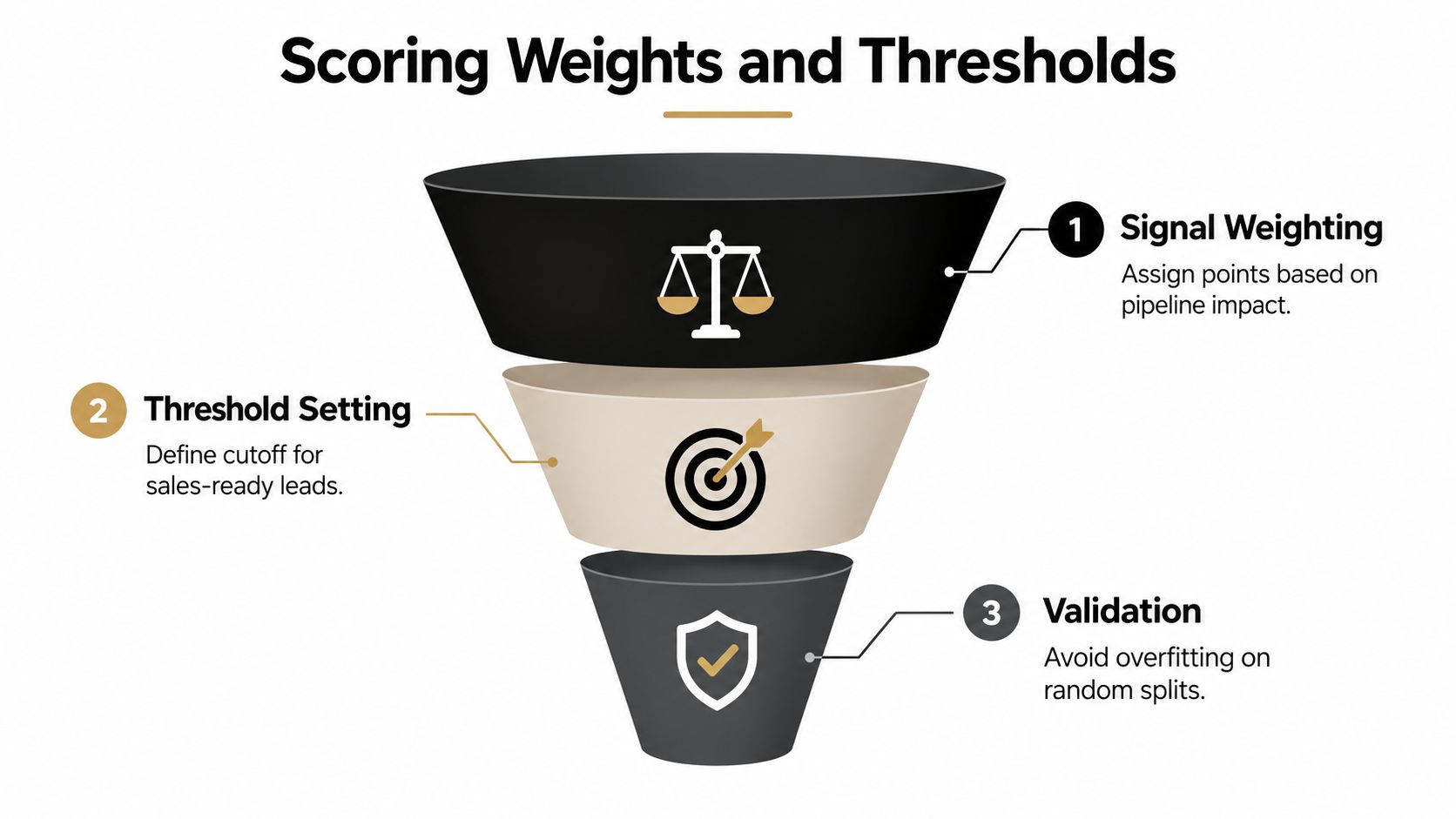
Once the signal inventory is stable, calibrate weights against outcomes rather than intuition. Use a recent set of accepted opportunities, closed-won accounts, closed-lost accounts, and disqualified records. Define the outcome clearly and freeze the observation window, otherwise the model will learn from inconsistent labels.
Segmentation changes the weights. A pricing-page return may matter more for a self-serve SaaS segment than for an enterprise account where procurement and security review create a longer path. A hiring signal may carry more meaning in a services segment than in a small product-led segment.
Start with a transparent rules baseline. Assign larger values to verified, specific, recent signals and smaller values to broad or ambiguous activity. Then compare the model's top-ranked records with what sales accepts, rejects, and converts.
A worked scoring decision
Consider a hypothetical mid-market SaaS account with roughly 200 employees. It returned to the pricing page twice this week and posted a VP of Revenue Operations role. The account matches the target industry and region, but no individual has requested a demo.
A reasonable decision isn't “the account has a 91% chance to buy.” The defensible output is:
- Fit appears strong because the account matches the segment profile.
- Pricing activity is recent and relevant, but identity and intent strength require verification.
- The hiring event supports a possible operational change.
- Suggested action: review promptly, verify the hiring and website evidence, then route if the account has a reachable buying role.
- Confidence: medium until source quality and contact relevance are confirmed.
Use bands rather than a single universal cutoff:
| Signal | Points | Notes |
|---|---|---|
| Target industry match | 20 | Confirmed from company information |
| Target company-size range | 15 | Use the segment definition |
| Supported geography | 10 | Exclude unsupported coverage areas |
| Relevant technology context | 10 | Verify the technology source |
| Recent pricing-page return | 15 | Cap repeated low-specificity activity |
| Demo or trial request | 25 | Route quickly when identity is valid |
| Relevant hiring signal | 15 | Record role, source, and date |
| Missing or stale firmographics | -10 | Reduce confidence as well as priority |
| Disposable or invalid business email | Hold | Don't compensate with activity points |
The exact values are a starting configuration, not a universal formula. Recalibrate only when outcome evidence supports a change. Constant weekly tweaking creates a moving target and makes it impossible to tell whether performance changed because of the model or the market.
A PRISM study comparing classification-only modeling with an integrated profiling-and-ranking approach across three B2B service industries illustrates why segmentation and ranking belong together. In its legal-consulting dataset, the integrated method produced a 19.30% conversion rate, compared with 13.67% for the strongest classification-only model and 5.81% for an intuition-based baseline. The reported comparison appears in the published PRISM study. Use the result as support for the design principle, not as a promised outcome for every business.
Validate the queue, not just the model
Accuracy can look impressive while the sales queue remains weak. A cited B2B software-SME benchmark reported 98.39% accuracy, 0.9891 AUC, 0.9586 recall, 0.9106 precision, and 0.9338 F1 for a gradient-boosting model, but the associated review warns that random splits, duplicate records, temporal leakage, and imbalanced outcomes can make such figures misleading. The predictive lead-scoring benchmark discussion recommends time-based holdouts and commercial metrics such as lift and precision at the team's capacity limit.
Evaluate precision at the number of accounts sales can handle, recall, PR-AUC, calibration, false positives, and false negatives. A model that ranks the right small queue is more useful than one that wins an abstract accuracy contest.
Wiring Scoring Into Your CRM and Routing the Right Action
A score earns its place when it changes a human action. Add fields that preserve the decision context instead of writing one opaque number into a contact record.
A practical CRM schema includes:
fit_gradeintent_scorerecency_scoreconfidencelast_verified_signal_atsignal_sourcesevidence_summaryrecommended_next_actionrouting_statusreview_owner
Store evidence on the company record when the signal belongs to the account. Link the contact to that account, then show the rep why the record surfaced. A short note such as “new RevOps leadership hire, recent pricing return, source verified on company page” is more useful than “hot lead.”

Route by action band
Use routing rules that sales can understand:
- Immediate review: High fit, fresh evidence, valid identity, and sufficient confidence. Send to the correct SDR queue and alert the owner through Slack, Teams, email, or a webhook.
- Nurture: Good fit but weak or aging intent. Enroll the account in a relevant sequence and refresh the score when a new event appears.
- Hold: Missing evidence, conflicting firmographics, duplicate records, or suspicious contact data. Request enrichment or manual verification.
- Disqualify: Clear mismatch with the ICP or an explicit exclusion condition. Preserve the reason for later model review.
HubSpot, Pipedrive, and Attio can support this pattern through custom fields, workflows, ownership rules, and integrations. The important design choice is to keep the evidence and action visible in whichever CRM the team uses. Guidance on how to streamline sales and support tools is useful when connecting data sources without creating another isolated workflow.
A practical implementation should also define what happens when a rep rejects a recommendation. Capture the reason. “Wrong industry,” “no current project,” “duplicate account,” and “signal was stale” are training data for the next calibration cycle.
For teams using HubSpot, this HubSpot lead routing setup guide provides a concrete reference for translating thresholds into ownership and workflow rules.
Beyond the Single Contact Score Account-Level Buying Signals
The individual contact is often the wrong unit of analysis. A buying group can show meaningful movement without any one person completing the action your scoring spreadsheet considers “high intent.”
Account-level evidence can include a relevant hiring change, funding announcement, leadership move, technology adoption, repeated visits to pricing or integration pages, and public discussion of a problem. None of these proves a purchase. Together, they can establish a stronger reason for review than a single anonymous page view.
The reliability problem is already visible in intent programs. Reported research found that 87% of organizations viewed their marketing-generated intent signals as unreliable or inflated, while only 26% converted into qualified opportunities, as summarized in buyer-intent data research. The lesson isn't that intent data is useless. It is that teams should demand corroboration and source transparency.
Use evidence triangulation
Set simple governance rules:
- Require two different signal families before placing an account in the highest-priority band.
- Cap the contribution of repeated low-specificity events.
- Separate anonymous website activity from verified account activity.
- Attach a source and timestamp to every important signal.
- Lower confidence when firmographics are inferred or stale.
- Treat several contacts from one account as account-level activity, not independent proof from unrelated leads.
- Route uncertain records to review instead of forcing them into sales or nurture.
This approach also supports more independent buying journeys. Recent buyer-journey reporting cited in the research indicates that 94% of buying groups had ranked preferred vendors before speaking with sales, and that the balance between buyer research and seller engagement shifted from 70/30 to 60/40. Those figures appear in the linked buyer-intent research above. The operational implication is that sales shouldn't wait for one known contact to perform a perfect conversion event.
A useful output might say, “Account shows a recent technology change and repeated integration-page activity. Contact identity is unconfirmed. Confidence is medium. Review the account and identify the operational owner.” That is more honest and actionable than assigning a large score to an anonymous browser.
Calibrating Monthly and Troubleshooting the Edge Cases
Treat scoring as a monthly operating process, not a one-time launch. Review the records that entered each action band, compare them with sales acceptance and opportunity outcomes, and inspect both false positives and false negatives.
A practical 30-day loop looks like this:
- Week one: Audit duplicates, missing firmographics, invalid contacts, and stale evidence.
- Week two: Compare ranked accounts with accepted, rejected, won, and lost outcomes.
- Week three: Check drift after pricing, territory, product, or qualification changes.
- Week four: Recalibrate weights only where evidence supports a change, then compare the result with the transparent rules baseline.
When data is missing, lower confidence rather than automatically assigning a failing fit grade. When a record is stale, remove urgency while preserving the historical signal. When two CRM records describe one account, deduplicate before evaluating model performance. When the model and an experienced rep disagree, send the record to human review and capture the reason.
The operating principle is simple: no score should outrank its evidence. Sales should know what happened, when it happened, how reliable the source is, and what action the system recommends.
CapyScout screens inbound signups with fit, risk, and confidence scoring, then recommends whether to route, nurture, or hold each record. It also monitors account-level buying signals and delivers source-backed briefs for prioritization, so visit CapyScout to build a lead-scoring workflow that gives your team evidence and a next action, not just another number.