

Apollo vs Cognism: Which Database Fits You
Compare Apollo vs Cognism on data freshness, accuracy, compliance, and CRM fit so your outbound team picks the right stack.
You're staring at two vendor tabs, a bounce report your reps don't trust, and a sprint that starts Monday. Apollo looks bigger. Cognism looks safer for Europe. Picking the larger logo feels decisive, but it won't tell you whether the next list produces usable contacts, reachable mobiles, or another week of cleanup.
Table of Contents
- Why Apollo vs Cognism Starts in the Wrong Place
- How Apollo and Cognism Grew Apart
- Comparing Data Freshness Coverage and Accuracy
- Email Phones and Compliance by Region
- Pricing Models CRM Fit and Hidden Cost
- Matching Apollo or Cognism to Real Buyers
- Choose the Right Stack and Take the Next Step
Why Apollo vs Cognism Starts in the Wrong Place
A founder I worked with put it plainly during a buying call. His team needed pipeline fast, the current list was bouncing, and someone had to pick a database before the next outbound push. The shortlist narrowed to Apollo vs Cognism, and the conversation immediately became a contest over size and claimed accuracy.
That framing sounds practical. It isn't. Your team isn't buying one job, you're bundling four separate jobs into a single logo choice and then acting surprised when the winner only solves one of them.
Four Jobs Hidden Inside One Purchase
- Finding accounts worth contacting now: This depends on timing, fit, and a recent trigger, not on whether a vendor stores millions of company rows.
- Getting a usable email: A verified address that reaches the right person is different from an address that merely exists in a file.
- Reaching a mobile: Phone connectability is a separate test from email deliverability, and it changes sharply by country and seniority.
- Writing a clean record to the CRM: If the record lands without source, date, or reason to call, your reps will re-research it before they touch it.
Those jobs rarely share a winner. A platform can be excellent at fast list building and sequencing while still giving you weak mobiles in a specific European market. Another can give you stronger phone coverage in that market and still leave you without a built in execution workflow.
Don't ask which database is more accurate. Ask which one produces the highest usable contact rate for your ICP, country, and channel.
By the end of this comparison, you should be able to name three things clearly. First, which platform fits North American list and sequence work. Second, which fits Europe heavy phone outreach where compliance posture matters. Third, when neither database should decide who your reps contact today because the missing piece is account timing, not contact rows.
The criteria stay consistent throughout. You'll judge coverage, freshness, field level accuracy, compliance, CRM fit, and buyer profile separately. That's deliberate. Collapsing them into one score is exactly how teams buy a big database and still miss quota.
How Apollo and Cognism Grew Apart
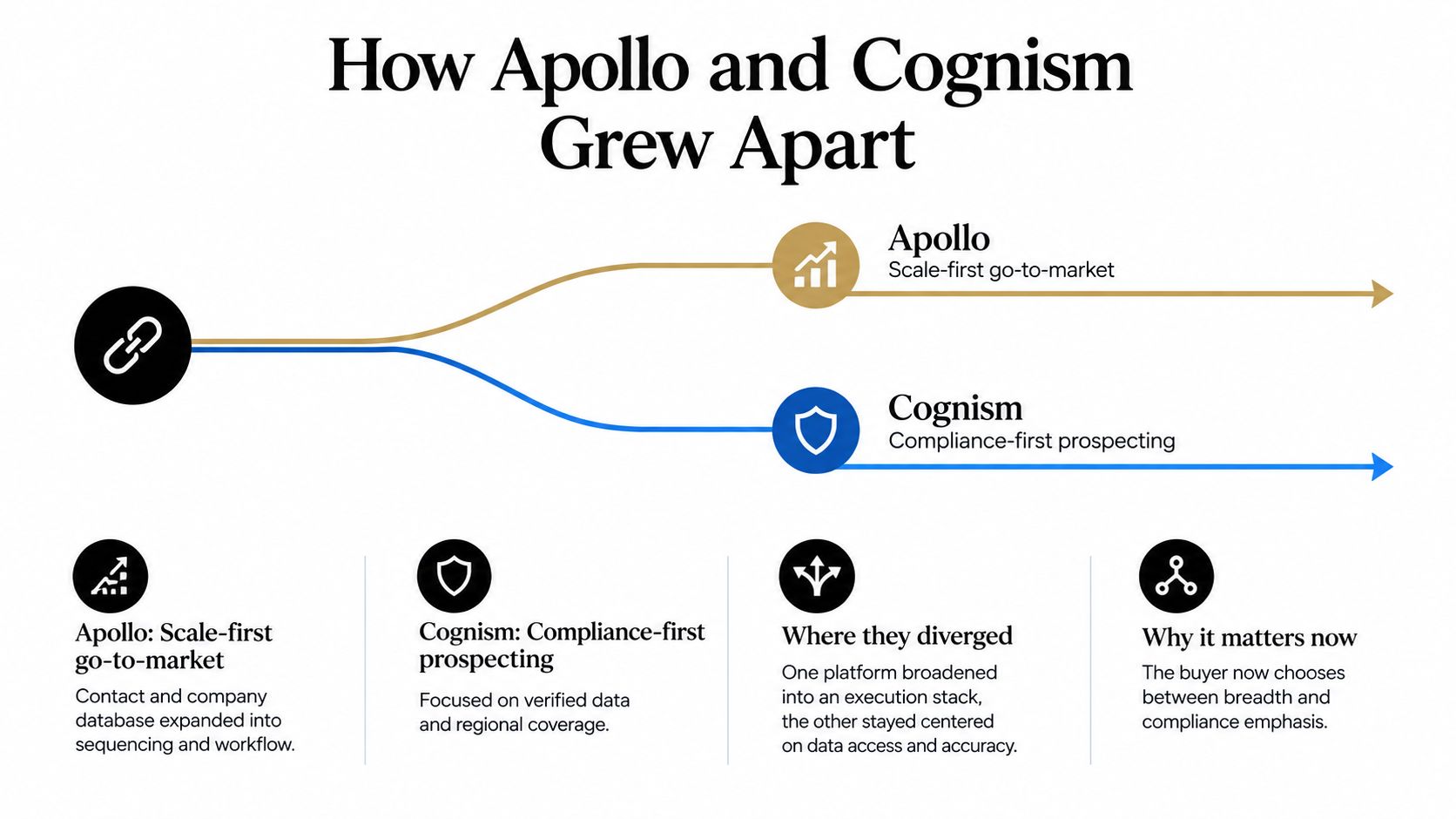
Both companies started in the same era, but they made opposite distribution bets. That history explains why their products feel different today, long before you compare filters or exports.
Apollo was founded in 2015, joined Y Combinator's Winter 2016 batch, and released its first product in 2018, according to Apollo's account of its founding and early growth. Growth accelerated after the company introduced a freemium model. It reached 5,000 paying users in January 2021 and 10,000 paying users by October 2021 in that same account.
Apollo Optimized for a Large User Ecosystem
Funding followed distribution. Apollo raised a $32 million Series B in November 2021, a $110 million Series C in March 2022, and $100 million in Series D funding in August 2023 at a $1.6 billion valuation, with 3 million users across 500,000 customers, including 40,000 paying customers, reported that month in the company's story linked above. Revenue had also grown 900% since 2021, a figure reported alongside those milestones.
Those numbers don't prove any single contact is fresh. They do explain the product shape. A company that grows through free users has to make list building, enrichment, and sequencing easy enough for a small team to adopt without procurement. Apollo became a sales execution platform with a database inside it, not just a file you export.
Cognism Optimized for a Different Buyer
Cognism also began in 2015, but its starting problem was regional. It served revenue teams selling into and across Europe that needed GDPR compliant contact data, then expanded internationally over the following years. In 2022 it added telephone data capabilities by acquiring Kaspr alongside a Series C round.
That path produces a narrower posture. Instead of chasing a self serve user base, Cognism built around compliant multinational data and phone heavy selling for larger teams. Its customer base is far smaller than Apollo's, yet that isn't automatically a weakness. It's a concentration signal. Fewer customers, paid contracts, and a regional specialism point to enterprise buying rather than freemium spread.
Apollo's milestones emphasize mass adoption and rapid revenue expansion. Cognism's emphasize compliant European coverage and phone data. You're choosing between bets, not just features.
That divergence matters because it shapes what each vendor is incentivized to improve. Apollo improves when more users build and send inside its workflow. Cognism improves when a revenue team can call into Europe with confidence in the number and the legal basis behind it.
Comparing Data Freshness Coverage and Accuracy
Start with breadth, because that's where most buyers stop. Reported figures attribute Apollo with roughly 275 million contacts and 70 to 73 million companies, as summarized in Pipeline's comparison of Apollo and Cognism for outbound teams. A file that large makes wide North American list building plausible. It doesn't tell you when a record was last checked, whether the person still holds that job, or whether the account has any reason to buy now.
Split Accuracy by Field, Not by Vendor
Apollo's claims are mainly about email. Its automated seven step email verification process is associated with about 91% claimed email accuracy in the comparison linked above, while independent commentary summarized there places performance nearer 85 to 90% and notes variation by industry and geography. A separate 98% figure cited in comparison material also concerns verified email accuracy, not every field in the record, as noted in Supered's breakdown of non comparable accuracy claims.
Cognism's prominent claims point elsewhere. They center on manually verified mobile data, which answers a phone question rather than an email question. That's why a snapshot of roughly 8.2 for Apollo versus 7.8 for Cognism on G2 in that same Supered summary shouldn't be read as proof that one database is more accurate overall. You're comparing different fields measured different ways.
| Question | Apollo | Cognism | How to read it |
|---|---|---|---|
| How broad is the file? | Large contact and company coverage suited to wide list building | More concentrated, enterprise oriented coverage | Breadth helps you find candidates. It doesn't prove freshness |
| What does the headline claim measure? | Verified email accuracy | Manually verified mobile data | Email and mobile claims aren't interchangeable scores |
| What should I test? | Deliverability for your personas and industries | Connect rate for your countries and seniorities | Measure your sample, not the brochure |
| What decays fastest? | Job title, employer, and inbox validity | Job title, employer, and number ownership | Ask when each field was last verified |
Independent style ranges widen the picture further. Testing summarized in the materials above places single source email accuracy nearer 65 to 90% and phone accuracy at 45 to 70%, with EMEA generally weaker than the US and waterfall enrichment improving results. Those ranges are uncomfortable, but they're more useful than a polished vendor number because they force a sample test.
The Metric That Actually Matters
Your useful metric is usable contact rate. Count only records that match your ICP, reach the intended person through your chosen channel, and stay inside your bounce or failed connect threshold. Then track freshness decay by checking when the source was last seen.
If you're deciding how enrichment should write back to the CRM, this explanation of how B2B data enrichment works is a helpful primer on separating firmographic fills from contact verification. Treat those as different passes with different pass marks.
Email Phones and Compliance by Region
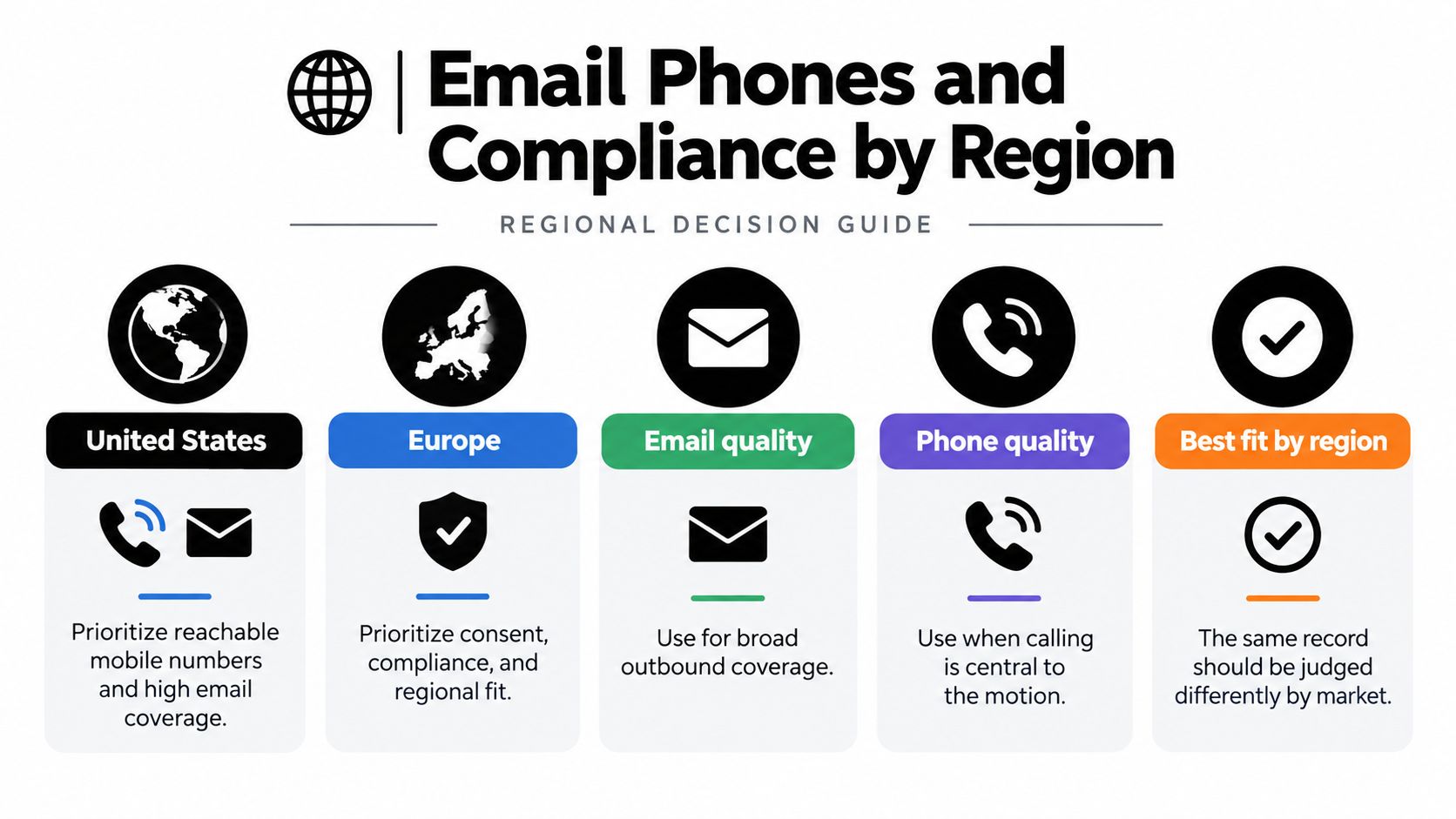
A US focused SDR team and a team calling mobiles across Europe shouldn't grade the same record the same way. Region changes which field matters, which law constrains storage and dialing, and which vendor's history helps you.
Apollo is repeatedly positioned as the broad US coverage option because the contact file sits next to native sequencing and a dialer. For a North American team, that combination shortens the path from list to sent sequence. It doesn't remove the need to verify, but it does reduce tool switching.
Cognism's story runs in the opposite direction. It was founded in 2015 for GDPR compliant European contact data, expanded internationally through 2019, and in 2022 added phone data by acquiring Kaspr alongside a Series C, according to AdamGTM's company profile covering Cognism's funding and scale. That profile cites 9 funding rounds and about $127.3 million raised, operations in more than 40 countries, over 3,000 customers, roughly 250 to 500 employees, an approximate $436 million 2024 valuation, and about $101.3 million in 2025 revenue in the same profile.
Treat Compliance as a Constraint, Not a Badge
GDPR and CCPA don't make one vendor universally safer. They define which records you're allowed to store, enrich, email, and call in a given market, and what basis you need to document. Review the GDPR commitments and data handling details for any tool that writes personal data into your CRM, and ask how suppression and deletion requests flow through exports.
If email is your primary channel while you test, this guide on how to generate qualified leads for email marketing offers useful context on building lists around fit and permission rather than volume alone. That's the right instinct for Europe, where a technically deliverable address can still be the wrong record to use.
Run the test before you sign. Pull the same ICP sample from both vendors, split it by country and persona, and report email deliverability and phone connect rate on separate lines. Log the date you pulled each record and repeat the check later so you can see decay with your own eyes.
Pricing Models CRM Fit and Hidden Cost
Don't price the logo. Price the workflow it replaces and the waste it creates.
Apollo's freemium history is part of its cost story. A large free user base lowered the barrier for small teams that want contacts, sequences, and a dialer without assembling three separate tools. If your SDRs currently copy rows between a database, a verifier, and a sequencer, consolidation has real value even before you negotiate anything.
Cognism implies a different purchase. A smaller, enterprise leaning customer base suggests paid, compliance heavy data bought mainly for coverage, especially phone coverage, rather than a self serve seat for everyone. You're not just buying rows. You're buying documentation and regional confidence your legal team can review.
Where the Hidden Bill Shows Up
- Bounced email: A cheap contact that damages sender reputation costs more than a pricier verified one.
- Unconnected mobiles: Rep time spent dialing dead numbers in your target country is a salary cost, not a data discount.
- Re research: Records written to the CRM without a source or reason to call get researched again by every rep who touches them.
- Seat sprawl: Per seat models punish you for giving visibility to marketing, RevOps, and customer success.
Ask each vendor the same direct questions. Is pricing per seat, per credit, or per revealed lead? Which CRM objects sync, and does enrichment write to companies, contacts, or both? Are sequencing and dialer features included, or do they sit in a higher tier you'll need within a quarter?
Before you model that against alternatives, it helps to compare B2B data enrichment services on workflow scope rather than headline seat price, since enrichment, verification, and engagement are often sold as separate layers. A credit based model with unlimited seats and daily CRM refresh changes the math differently from a per seat database, particularly when alerts need to reach Slack, Teams, email, or a webhook instead of sitting in a dashboard nobody opens.
Practical rule: Calculate cost per usable, contacted record in your CRM. License price alone will mislead you every time.
Matching Apollo or Cognism to Real Buyers
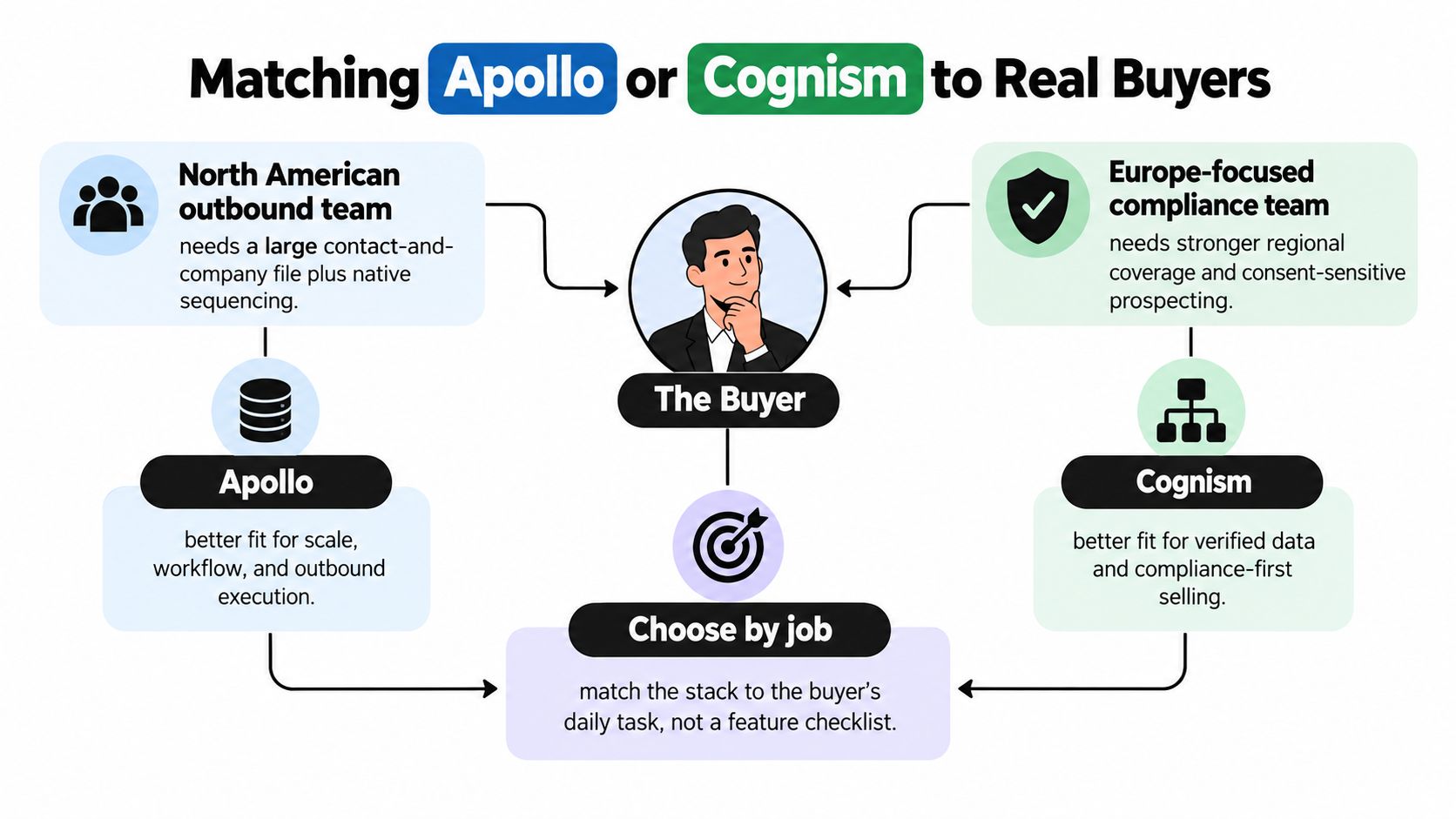
Buyer fit becomes clearer when you name the daily job instead of the department. Three common profiles cover the needs of teams reading an Apollo vs Cognism comparison.
North American Outbound Teams
Choose Apollo when your reps need a large contact and company file plus native sequencing, a dialer, and engagement in one system. As covered in the section above, its reported scale supports broad list building, while its email claims need sample verification because results move by industry and geography. Database size also isn't buying intent. Apollo activates contacts well, but it won't by itself tell you which account changed leadership this week.
Europe Focused Phone Teams
Choose Cognism when pipeline depends on reachable mobiles in Europe and your vendor needs a compliance first posture for international selling. Its smaller customer count fits that concentrated model. You're paying for regional coverage and phone confidence, not for a mass market self serve platform.
Teams Whose Real Leak Is Timing
Some teams don't lack contacts. They lack a specific reason to call today, so first lines stay generic and replies stay flat. That's the buyer a two way database comparison misses. A local agency chasing multi location operators, for example, may learn more from how a specialist franchise lead generation company structures territory and timing than from another contact export, because the trigger matters more than the row.
For that job, CapyScout functions as an account layer in front of either database. It discovers companies from the live web by competitor, stack, hiring, location, or niche, monitors watched accounts for hiring, funding, leadership, technology shifts, reviews, news, and website intent, and delivers source cited briefs with fit, risk, and confidence scores plus a daily Today queue. Local agencies can also use its Reputation Watch for rating drops and review stalls, which is a separate use case rather than a database substitute.
A split implementation often works best. Use the signal layer to select accounts and write the why now, use Apollo selectively for contact lookup and sequence execution, and block automated enrollment when there's no recent source or meaningful trigger. Keep Cognism in the phone heavy EMEA path where mobile connect rate is the constraint.
If you're also weighing adjacent categories, this buyer comparison of ZoomInfo and Cognism helps separate enterprise database depth from the Europe first phone decision. Don't force a three way winner when the jobs are different.
Choose the Right Stack and Take the Next Step
Force one primary constraint before you talk to sales again. Most stalled evaluations happen because every criterion feels equally important, so nobody can lose.
A Short Decision Checklist
- Geography: Is your revenue concentrated in North America, Europe, or both, and in which specific countries?
- Channel: Will reps win mainly by email, by phone, or by a sequenced mix?
- Compliance exposure: Which records can you legally store, email, and dial in each market?
- CRM fit: Do records, sources, and reasons to call sync cleanly to HubSpot, Pipedrive, or Attio?
- Real leak: Are you losing on bad contacts, or on bad timing and generic first lines?
Choose Apollo when broad contact activation and sequencing are the core need, especially in North America, and your team will still verify before automated enrollment. Choose Cognism when EMEA mobile connect rate and a compliance first data posture are what lose you deals. Add a live signal layer when reps need source backed reasons to contact an account and a daily queue that isn't a static list, knowing it can sit in front of either database rather than replace contact lookup.
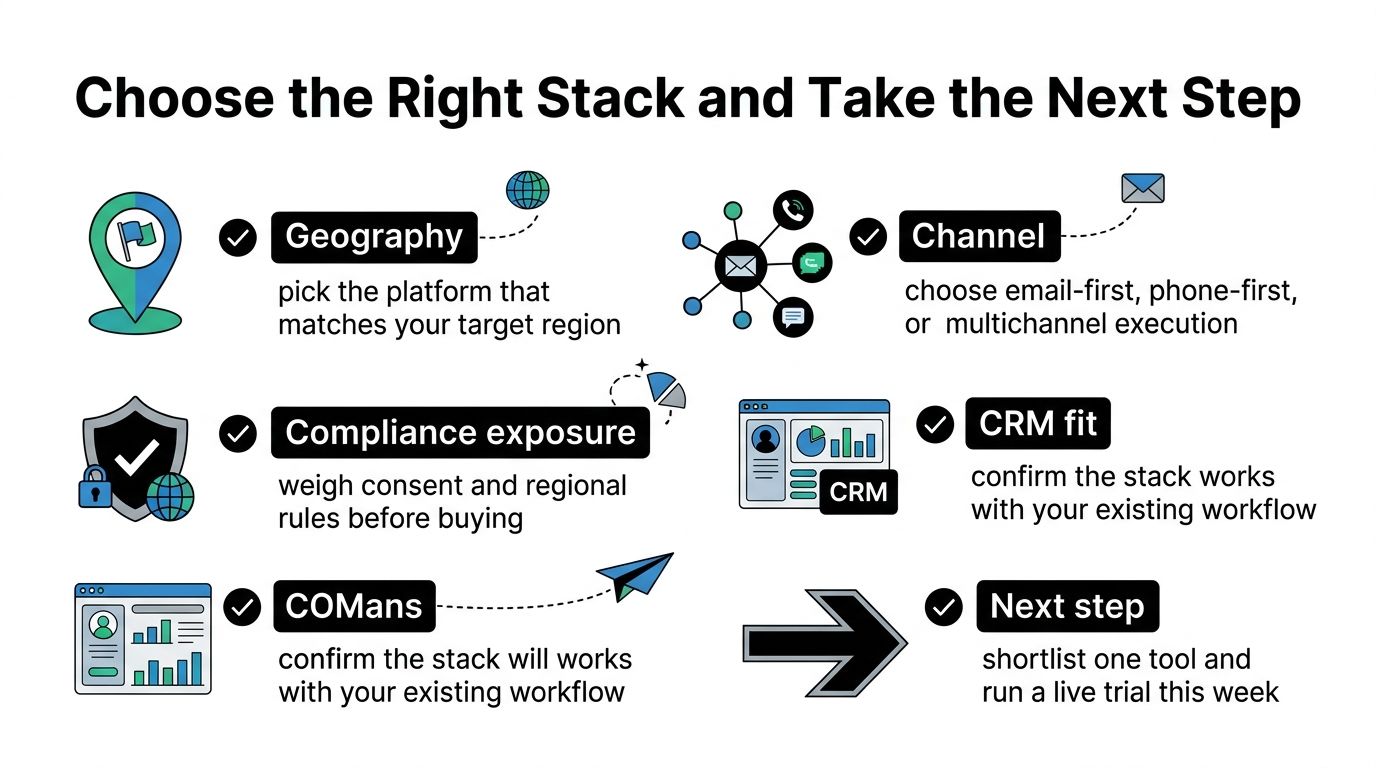
Run the next step this week. Pull a fixed ICP sample in the two countries that matter most, measure email acceptance and phone connects separately, suppress records with no recent source, and only then enroll a sequence. You'll learn more from that small test than from another month of vendor decks.
If timing, not row count, is your gap, explore how CapyScout uses live web discovery, source backed account briefs, and signal alerts to show your team who to contact and why now. Review the workflow, connect it to your CRM, and put a signal layer in front of Apollo or Cognism before your next outbound sprint.