

ZoomInfo vs Cognism: A 2026 Buyer's Comparison
ZoomInfo vs Cognism compared on data freshness, coverage, signals, pricing, and compliance, plus a signal-first alternative for timing-led teams.
Your ZoomInfo or Cognism renewal is probably being judged on the wrong spreadsheet. The team compares contact counts, accuracy claims, seat prices, and integration checkboxes, then discovers after signing that reps still spend hours checking whether people remain in role, whether phone numbers are lawful to call, and whether an account has any reason to buy now.
That's the operational test that matters. Which platform produces a usable, compliant conversation at the lowest total cost, including verification, list decay, CRM cleanup, suppression handling, and research time? ZoomInfo and Cognism can both be valuable, but they solve different risks. ZoomInfo is the stronger scale play for North American account coverage. Cognism is the more natural fit for EMEA phone prospecting and compliance-sensitive workflows. Neither should be evaluated as a magic answer to timing.
Table of Contents
- Why Database Size Is the Wrong Question
- Company Background and Market Positioning
- Head-to-Head Comparison Across the Criteria That Matter
- How to Validate Accuracy for Your Specific Market
- Best-Fit Scenarios for Each Platform
- Pricing Models and the Hidden Cost of Stale Data
- A Signal-First Alternative for Timing-Led Teams
- Migration Checklist and Final Recommendation
Why Database Size Is the Wrong Question
Database size is an easy procurement metric because vendors can display it in a demo. It's much harder to answer whether a specific contact is still employed, still owns the buying problem, reachable through a lawful channel, and attached to an account showing current demand.
That distinction changes the entire ZoomInfo vs Cognism decision. A large inventory of contact rows helps with territory building, enrichment, and CRM backfills. It doesn't automatically create relevance. A smaller list tied to hiring, funding, leadership changes, technology shifts, reviews, or a visible website visit may give a rep a better reason to call.
Practical rule: judge a data vendor by the cost of a defensible conversation, not the size of its database.
The common intent-data model illustrates the issue. Account intent is useful only when it changes prioritization and gives sales a credible reason to act. A score without a source, timing, or account context is another field for RevOps to maintain. This guide to what intent data means in B2B is a useful reference for separating observable account activity from vague interest scores.
A static database answers, “Who matches these filters?” A signal-first workflow asks, “Which matching account changed, and why should we contact it now?” The first is useful for building coverage. The second is useful for deciding where a rep should spend limited selling time.
That doesn't make contact data irrelevant. Firmographics, role information, direct dials, email addresses, and CRM enrichment still matter. The point is that they should support an account decision, not become the decision itself.
The operational cost hidden behind a row
A contact becomes usable only after someone checks several things:
- Identity: Does the person work at the company and hold the relevant role?
- Reachability: Is the email valid, and does the phone number connect to the intended person?
- Permission: Can the team lawfully contact the person in that country and channel?
- Relevance: Is the account inside the actual ICP?
- Timing: Has something happened that makes outreach appropriate now?
ZoomInfo generally wins when the first requirement is breadth across North American accounts. Cognism often wins when phone verification and EMEA compliance carry more weight. A live-web workflow adds a different layer by connecting account research to current public evidence.
The rest of the evaluation should therefore focus on operational economics, regional risk, freshness, and buying moments. If a vendor's headline number doesn't help your team produce a better conversation, it isn't the metric that should decide the renewal.
Company Background and Market Positioning
A renewal decision here is less about which vendor sounds bigger and more about what kind of operating model you are buying. ZoomInfo sells like an enterprise system of record. Cognism sells like a prospecting tool built around call quality, regional fit, and rep usability.
ZoomInfo entered the public market in 2020. In its 2024 filing, the company reported $1.2143 billion in GAAP revenue, down 2% year over year, and 1,867 customers with contracts above $100,000 in annual contract value as of December 31, 2024, up by 47 customers, according to its fiscal 2024 annual report. The same report lists 87% net revenue retention and says international customers and partners accounted for about 12% of total revenue.
That profile matters. It points to a vendor built for procurement scrutiny, multi-team rollouts, and large-account governance. If your sales ops team needs broad enrichment, established buying processes, and a platform that can survive a long security review, ZoomInfo fits that motion.
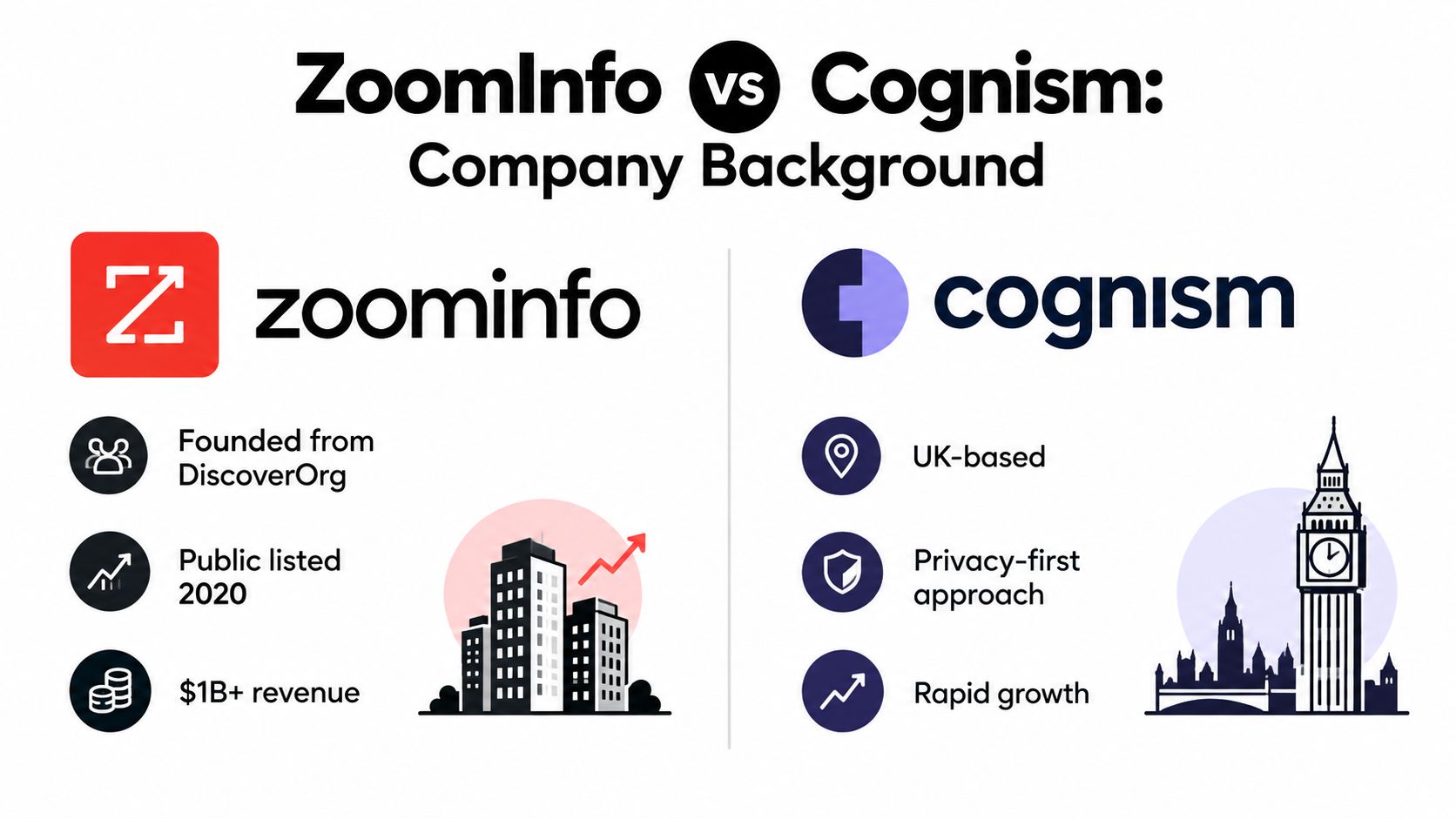
Cognism signals a different kind of maturity. It was founded in 2016 by James Isilay and Stjepan Buljat, and the company announced $10 million in Series B funding in July 2019, bringing disclosed funding at that stage to more than $16.5 million. In the same announcement, Cognism said annual recurring revenue had grown more than fourfold during 2018. Those are early-growth markers, not the reporting structure of a public company, and they come from Cognism's Series B announcement.
For buyers, the practical takeaway is straightforward. ZoomInfo reduces vendor-risk questions. Cognism puts more weight on execution-risk questions such as whether reps can reach the right people in the right regions with fewer wasted dials.
That distinction is easy to miss if you compare both tools as generic databases. A better frame is category role. ZoomInfo often sits closer to a broad commercial data layer. Cognism is easier to justify when outbound performance depends on verified mobile numbers and EMEA-friendly workflows, which is why many teams evaluate it alongside other lead generation software for sales teams rather than as a pure enrichment purchase. If you want a wider category view before choosing, this sales intelligence platform guide for 2026 is a useful reference.
My recommendation is blunt. Pick ZoomInfo if your business case depends on enterprise coverage, governance, and North American scale. Pick Cognism if your reps live or die by phone connection rates, compliance handling, and European account coverage. Company size affects contract confidence. It does not fix stale contacts, weak timing, or poor account selection.
Head-to-Head Comparison Across the Criteria That Matter
The right comparison isn't “which platform has more records?” It's whether each platform can supply a contact who is current, relevant, reachable, and usable under your team's calling and privacy rules.
| Criterion | ZoomInfo | Cognism |
|---|---|---|
| Data sources | Automated web scanning, third-party sources, user-contributed data, and more than 300 human researchers, according to vendor reporting | Strong emphasis on human phone verification through Diamond Data |
| Coverage | Stronger breadth for North American company, contact, firmographic, and technographic discovery | Stronger positioning for European coverage and verified mobile data |
| Mobile direct dials | Vendor-reported scale includes 135 million verified phone numbers | Phone verification is the principal differentiator, particularly in EMEA |
| Intent and signals | Buyer intent, technographics, IP-to-organization mapping, and website-related capabilities | Hiring, funding, job-change, and intent capabilities are associated with its prospecting workflow |
| CRM and workflow | Better fit for teams seeking broad enrichment and enterprise workflow integration | Better fit when the main need is compliant data and phone-led prospecting |
| Compliance | Supports GDPR and CCPA workflows, but regional screening scope needs validation | Compliance-oriented EMEA workflow with DNC/TPS screening reported across approximately 15 countries |
| Pricing posture | Custom enterprise contracts and credit-based usage | Custom quote, commonly structured around seats, region, and data requirements |
| Best operating risk to solve | Coverage depth and account discovery in North America | EMEA calling reliability and compliance operations |
ZoomInfo reports more than 500 million contacts, 100 million companies, 135 million verified phone numbers, and 200 million verified business emails. Its published comparison material also reports coverage of more than 30,000 technologies and first-party accuracy of up to 95%. Those are vendor-reported figures, so they should be tested against your own segments rather than accepted as a guarantee. The relevant question is whether the data is complete for your target accounts and current enough for your sales cycle.
Cognism's technical advantage is narrower but meaningful. Its Diamond Data product uses human phone verification, and comparisons report DNC/TPS screening across approximately 15 countries, with strong positioning in the UK, DACH, Benelux, Nordics, France, and Spain. That doesn't remove the need for country-specific legal review, suppression management, or documented lawful basis.
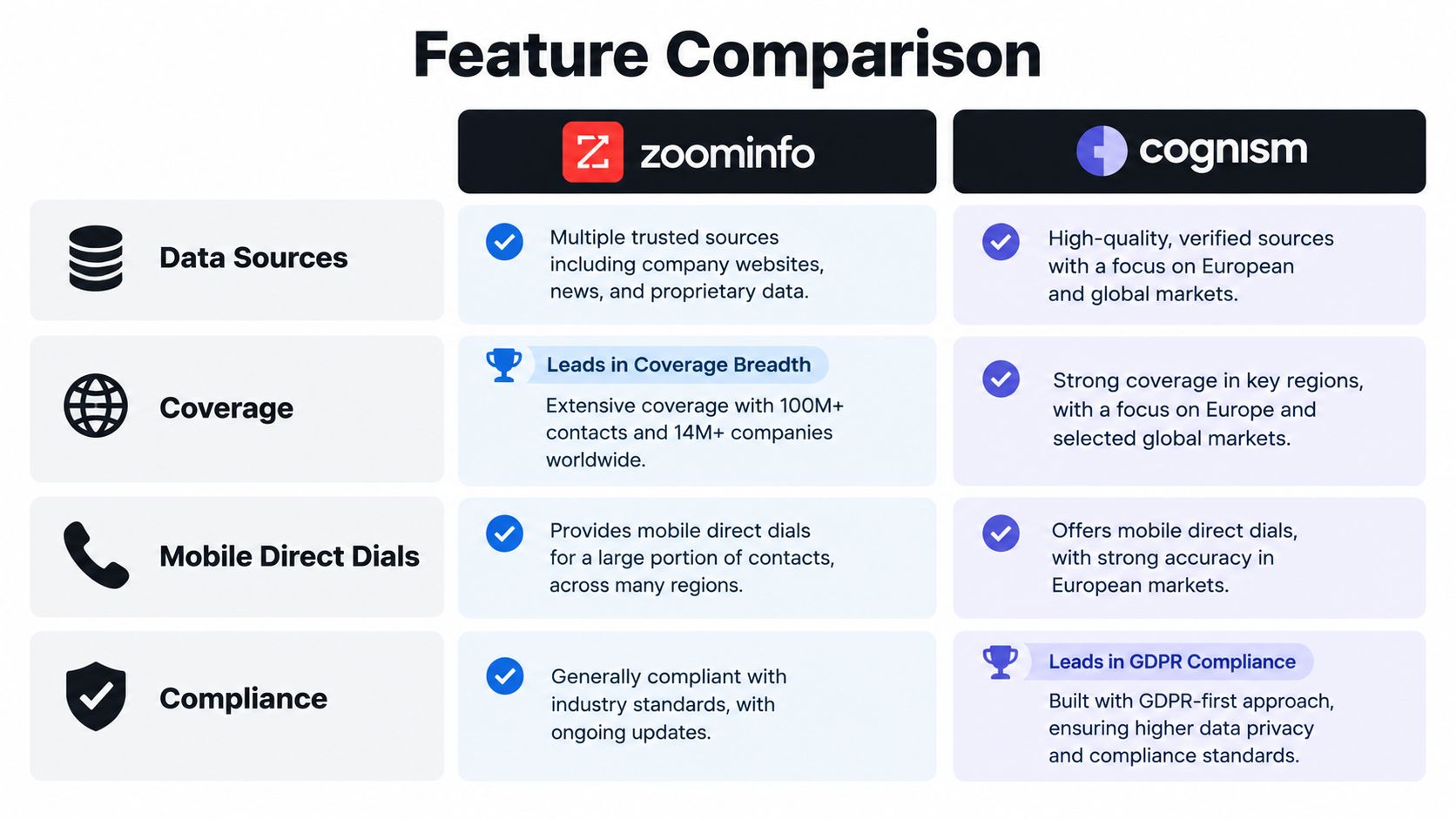
The integrations question deserves more attention than it usually gets. ZoomInfo is the stronger candidate for a team that wants broad CRM enrichment, technographics, intent, and account discovery under one enterprise agreement. Cognism makes more sense when the workflow starts with a compliant, phone-led European list and the rest of the execution happens elsewhere.
Teams that want a wider market scan can use this resource to compare B2B data vendors. Keep the evaluation grounded in your own CRM fields, target countries, and outreach channels.
Neither product should get a free pass on freshness. The platform that wins the demo may still lose in production if reps export lists, wait weeks, and contact people after roles or account priorities have changed.
How to Validate Accuracy for Your Specific Market
A renewal decision goes sideways when teams compare vendor claims instead of measuring selling outcomes. A database can look strong in a demo and still create waste in production if reps spend time chasing the wrong contacts, calling old numbers, or sequencing people who already changed roles.
Cognism's widely cited 98% figure is a good example of why headline accuracy numbers need context. Independent comparison reporting says that claim applies to roughly 10 million phone-verified records inside a database of about 440 million total records, or approximately 2.3% of the full record set, as explained in this analysis of the Cognism accuracy claim. Read that as a statement about a defined subset, not a blanket guarantee across every contact type, country, and job function you buy.
The same standard applies to ZoomInfo. Test it against your actual market, not a vendor-selected sample.

Start with revenue reality. Pull a live slice of accounts from your ICP and make both vendors compete on the same ground. Do not let reps pick their own lists, and do not score the test on record volume alone. Volume hides waste.
A clean evaluation usually has five parts, but it should run like an operating test, not a spreadsheet exercise. Select 200 target accounts from the countries, industries, company sizes, and seniority bands that matter to pipeline. Ask each vendor for the same roles and the same fields. Keep the output categories consistent, including direct dial, mobile, switchboard, personal email, and work email. Then remove vendor names from the review sheet and have RevOps, or another neutral reviewer, confirm employment, role fit, company match, and contactability.
Then wait long enough to see what the records do. Track valid email rate, correct-role rate, direct-dial connection rate, job-change rate, and opt-out or complaint rate over 30 to 90 days. That is the point where operational economics show up. A smaller file with better connection quality often beats a bigger export full of stale rows.
Also ask harder procurement questions. Why does each record exist? When was it last verified? What suppression logic applies in the country you plan to work? For a wider buying framework, GRIT's vendor evaluation insights are useful for structuring a vendor review that can survive finance, legal, and sales scrutiny.
The right vendor is the one that creates more usable yield in your market, even if it returns fewer records.
Run this test before renewal. If one platform wins by region and the other wins by role coverage, buy for the motion you run.
Best-Fit Scenarios for Each Platform
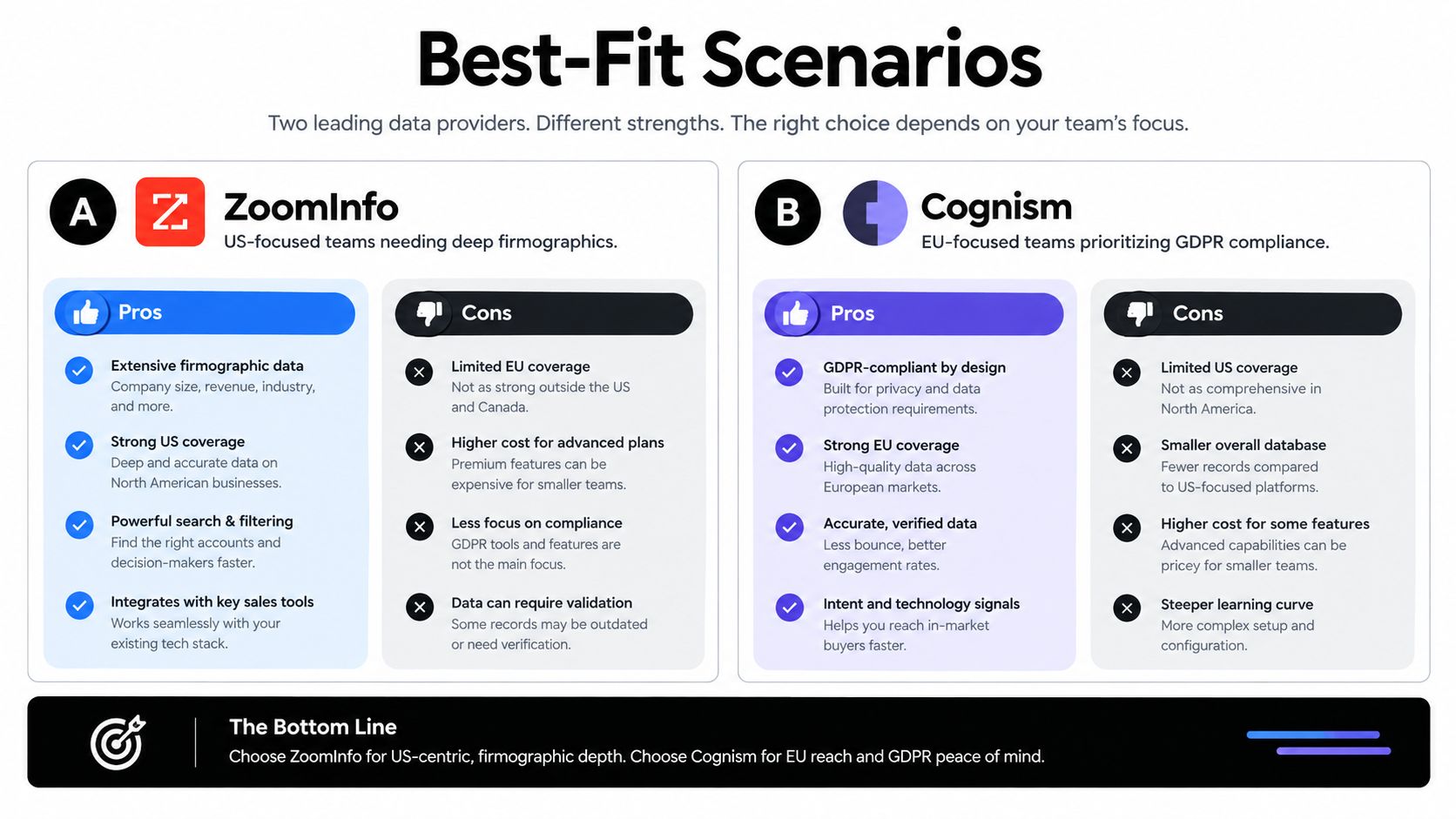
A single winner doesn't exist because the two tools carry different strengths. The correct choice follows the shape of your market, the channel your reps use, and the cost of getting a contact wrong.
The North American B2B SaaS scale-up
Choose ZoomInfo if your growth plan depends on US and Canadian account coverage, complex buying committees, firmographic segmentation, technographics, and high-volume CRM backfills. Its reported scale of more than 500 million contacts and 100 million companies gives enterprise RevOps teams more room to build territories, find adjacent stakeholders, and enrich account records.
The trade-off is operational discipline. Your team should verify priority contacts before sequencing, monitor bounce and connect rates, and avoid treating a large result set as a ready-to-call list. ZoomInfo pays for itself when the cost of missing account coverage is higher than the cost of enterprise licensing and verification work.
The EMEA-led outbound team
Choose Cognism when outbound depends on lawful calling into the UK, DACH, Benelux, Nordics, France, Spain, or adjacent European markets. Human phone verification and reported DNC/TPS screening across approximately 15 countries make compliance operations part of the product's practical value.
Cognism's trade-off is breadth outside its strongest regional use cases. If the same team also sells heavily into North America, APAC, or less-covered markets, it may need another source for account discovery and enrichment.
The HubSpot or Pipedrive RevOps team
Don't choose on CRM brand alone. Map the actual workflow: bidirectional sync, field ownership, duplicate handling, enrichment frequency, suppression-list behavior, and the point where a rep receives a signal. ZoomInfo is generally the stronger option for teams seeking a broad data and workflow layer. Cognism is more suitable when the CRM needs a reliable EMEA prospecting input and the core differentiation is verified phone data.
Run a pilot with real records. A native connector can still create duplicate companies, overwrite valuable fields, or push stale contacts into active sequences if governance isn't defined.
The small team with limited procurement capacity
A small agency or founder-led sales team should be cautious with either platform if the main need is occasional research. Enterprise data contracts can create more commercial and administrative overhead than the team can justify. Cognism may fit a focused European calling motion, while ZoomInfo may fit a concentrated North American account list, but neither should be purchased merely because a demo showed a large database.
For this profile, a signal-first workflow may be more economical if the team needs a reason to contact a smaller number of accounts rather than bulk list access. The team should compare time spent researching, verifying, and cleaning data with the number of conversations created.
Pricing Models and the Hidden Cost of Stale Data
Renewal conversations usually start in the wrong place. Procurement asks for seat price, credit limits, and discount terms. Sales ops should start with the work required after the export, because that is where the budget keeps leaking.
ZoomInfo usually lands as an enterprise contract with negotiated packaging around licenses, credits, integrations, and usage terms. Cognism is also quote-led, with pricing shaped by seats, region, and access to products such as phone-verified data. Exact terms vary enough that a generic market estimate is not useful. Read the contract, then model the operating cost around it.
Once records hit your workflow, the spend is no longer abstract. Someone has to verify job changes, remove duplicates, suppress excluded accounts, screen for country-specific calling rules, enrich the CRM, and revisit records that have already drifted. That labor sits outside the headline subscription price, but it decides whether the tool pays for itself.
B2B contact data decays at approximately 2.1% per month, or roughly 22.5% annually, according to this B2B contact data decay summary. If your team refreshes quarterly or annually, the list your reps work from can look very different from the one they approved at the start of the cycle.
Use a simple operating model at renewal time. Allocate the contract cost across the teams that use it. Add the hours RevOps, SDRs, or sales assistants spend checking records before outreach. Count bounces, wrong-role calls, dead numbers, duplicate records, and the meetings lost because the rep started with bad context. Add compliance work too, including suppression management, DNC screening, lawful-basis documentation, opt-out handling, and country review.
The output that matters is cost per compliant, relevant conversation, because a cheaper record that consumes manual review and produces no meeting is the most expensive record you own.
This is also where CRM discipline stops being an admin detail and becomes a pricing issue. If field ownership is unclear, timestamps are missing, source notes are inconsistent, and refresh rules are loose, both platforms look worse than they should. A practical baseline is to tighten your data integrity checking process for CRMs and customer databases.
Ask one hard question before signing a renewal: how many conversations did this platform create after verification, compliance, and cleanup were included? If the answer still depends on heavy manual effort, the quoted seat price is the least important number in the deal.
A Signal-First Alternative for Timing-Led Teams
ZoomInfo and Cognism start with a contact or company database. A signal-first workflow starts with the account event that gives sales a reason to act.
That means searching the live web for companies that match a market, location, technology, hiring pattern, niche, or competitor relationship, then monitoring those accounts for meaningful changes. Relevant signals can include hiring, funding, leadership shifts, technology changes, reviews, news, and return visits to pricing, demo, or integration pages.
CapyScout is one option in this category. It discovers companies through live-web research, enriches CRM records, scores fit and confidence, and creates source-backed account briefs with a “Why now” explanation. The workflow can route alerts to HubSpot, Pipedrive, Attio, Slack, Teams, email, or webhooks, while outreach drafts open in Gmail or Outlook without requiring inbox OAuth.
Change the unit of work
A database workflow asks a rep to select a person, export a record, and invent a reason to reach out. A signal-first workflow asks the rep to review an account, understand the recent change, identify the relevant stakeholder, and act while the context is still useful.
That approach doesn't replace ZoomInfo or Cognism in every environment. A large North American sales organization may still need ZoomInfo for account depth and CRM enrichment. An EMEA calling team may still need Cognism for verified mobile data and compliance workflows. Signal-first research adds value when the bottleneck is prioritization, timing, or account context rather than raw contact inventory.
The economics also differ. CapyScout uses credit-based pricing with unlimited seats and monitors watched accounts rather than charging per seat or per lead. Its website intent workflow is cookie-free and limited to watched accounts, and its briefs cite sources while flagging unverifiable items.
This model suits founders, lean sales teams, RevOps groups, and account managers that can't afford to research every account manually. It also fits local agencies that need to act on reputation changes, such as rating drops, sentiment shifts, or stalled reviews, rather than buy a broad B2B contact database.
Migration Checklist and Final Recommendation
Before renewal or migration:
- Export account, contact, source, consent, and suppression fields.
- Preserve internal opt-outs and DNC exclusions.
- Re-sync CRM records with a clear field-ownership map.
- Re-screen contacts for the countries and channels you'll use.
- Run the matched-record pilot and measure usable conversations over 30 to 90 days.
- Add signal monitoring if timing, research workload, or account prioritization is the bottleneck.
Recommendation matrix: Choose ZoomInfo for North American enterprise breadth, Cognism for EMEA phone-led compliance, and a signal-first workflow when account timing matters more than database volume. Use both only when the incremental conversations justify the added governance.
CapyScout searches the live web, monitors watched accounts for buying signals, enriches HubSpot, Pipedrive, and Attio records, and delivers source-backed “Why now” briefs. Visit CapyScout to evaluate a timing-led workflow alongside your ZoomInfo or Cognism renewal.