

ZoomInfo vs Apollo: Which Sales Platform Fits?
ZoomInfo vs Apollo: compare data quality, workflows, pricing, integrations, signals, and fit for startups, SMBs, and enterprise RevOps teams.
The usual ZoomInfo vs Apollo advice is too simple: buy ZoomInfo for better data, buy Apollo to save money. That skips the question that determines whether either purchase pays off: what work must your team complete between finding a record and creating an account that sales accepts? A larger database won't compensate for the wrong contacts, expensive verification, or outreach without a credible reason to act.
Table of Contents
- Why the Right Sales Platform Depends on the Workflow
- ZoomInfo and Apollo at a Glance
- Comparing Data Quality and Prospecting Workflows
- Buying Signals, CRM Operations, and Governance
- Pricing, ROI, and the Cost of Usable Data
- Which Platform Fits Each Buyer Persona
- A Practical Migration and Selection Checklist
Why the Right Sales Platform Depends on the Workflow
Two buying teams can export similar contact lists and still face very different workloads. An SDR team might need to launch email sequences immediately. An enterprise account team might need to understand reporting lines, technology dependencies, and purchasing context before approaching anyone.
The right comparison starts with those jobs, not the number of rows a vendor advertises.
| Workflow priority | ZoomInfo evaluation hypothesis | Apollo evaluation hypothesis | Deciding constraint |
|---|---|---|---|
| Research complex target accounts | Broader account intelligence may justify the investment | Integrated prospecting may cover simpler research needs | Depth of account research |
| Move from discovery to outreach | Confirm which products the proposed package includes | Test the combined discovery and engagement workflow | Handoffs and execution effort |
| Support phone-led prospecting | Validate usable direct-dial coverage | Validate phone availability and credit consumption | Cost of connected conversations |
| Prioritize accounts by timing | Test whether intelligence supports a defensible action | Test whether discovery and execution provide enough context | Evidence behind account priority |
These are evaluation hypotheses, not universal product rankings. Published comparisons distinguish ZoomInfo's broader data and intent orientation from Apollo's integrated prospecting workflow, but they don't establish which package will produce better outcomes for your team.
Define the buyer jobs before evaluating features
Use the same operating questions for both platforms:
- Find accounts: Can reps identify companies that fit the actual territory and commercial model?
- Identify contacts: Can they locate the person responsible for the relevant problem, rather than someone with a loosely related title?
- Know when to act: Can they explain why the account deserves attention today?
- Move work into the CRM: Can they preserve ownership, context, and suppression rules without manual repair?
- Prove ROI: Can RevOps connect platform usage to accepted accounts and qualified conversations?
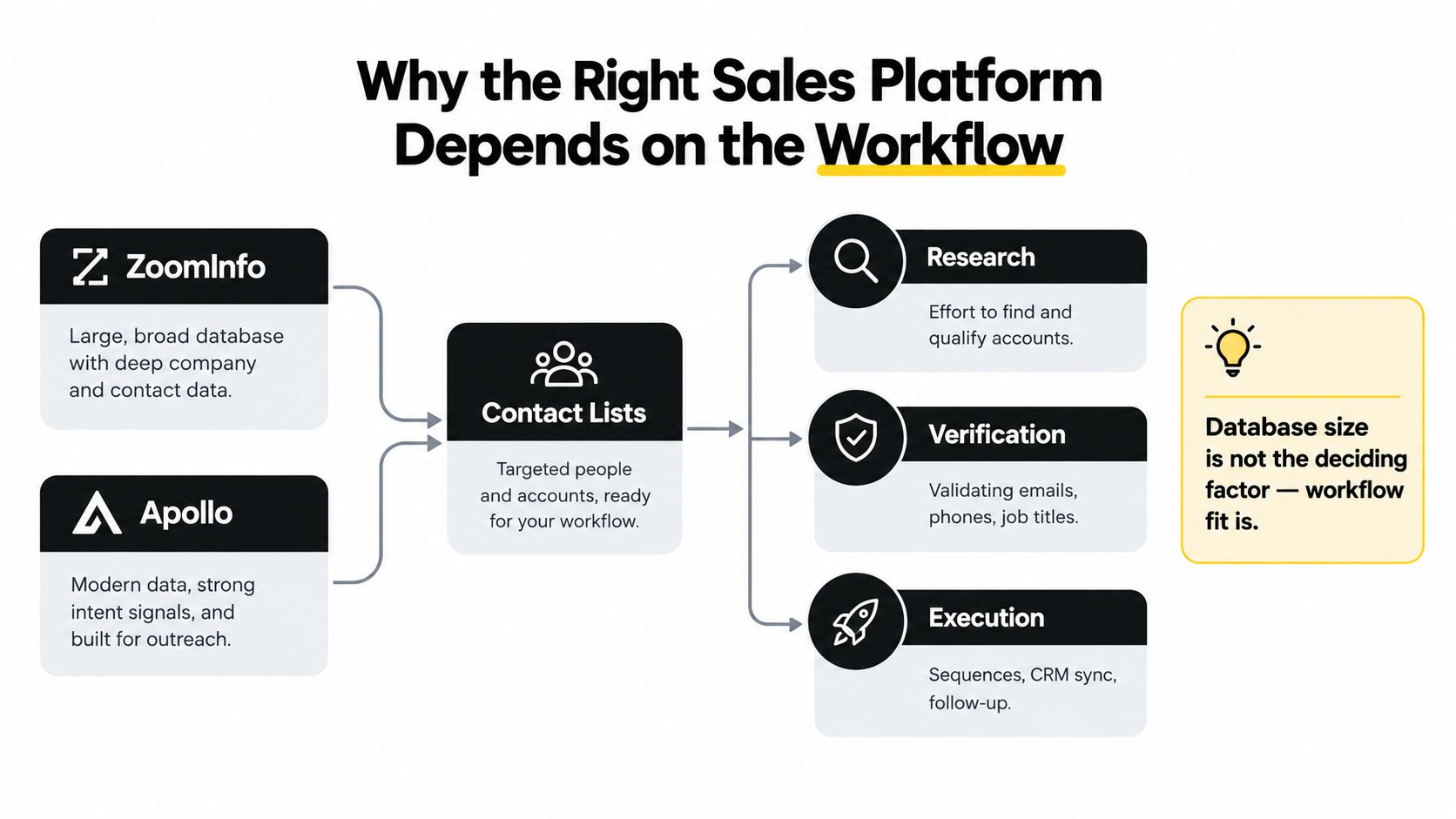
The workflow diagram makes the distinction between obtaining records and completing useful sales work explicit.
Evaluate the bottleneck, not the catalog
An email-first team should emphasize deliverable addresses, qualification effort, and sequence activation. A phone-first team should put more weight on whether a number reaches the intended buyer. A named-account team should examine whether additional context changes whom reps approach or what they say.
Practical rule: Ask each vendor to demonstrate a completed workflow using your target accounts, not a polished search against its strongest market.
This avoids purchasing features that look impressive but don't remove the team's actual constraint. Define what a sales-accepted account means before requesting a demo, including fit, contactability, ownership, and sufficient context for a next action.
ZoomInfo and Apollo at a Glance
ZoomInfo and Apollo occupy different commercial positions. Understanding those positions helps buyers interpret their packaging, but company scale isn't evidence that a particular contact record will be useful.
ZoomInfo's enterprise-oriented commercial base
ZoomInfo's public reporting documents $1.2143 billion in GAAP revenue for 2024, down 2%, and 1,867 customers with at least $100,000 in annual contract value at year-end; international customer revenue represented approximately 12% of the total, according to its annual financial reporting.
Those measures support describing ZoomInfo as an enterprise-oriented provider with substantial high-value customer relationships. They also show that its international business exists alongside a predominantly domestic revenue base. They do not establish regional contact accuracy or prove that an enterprise buyer should select it automatically.
For procurement, the relevant implication is commercial fit. A buyer considering a broad intelligence deployment should evaluate the proposed product scope, implementation ownership, and expected adoption across departments. A buyer seeking a narrow prospecting tool should ask whether that scope exceeds the job.
Apollo's product-led adoption profile
Apollo's disclosed milestones emphasize a different distribution model: its August 2023 financing included a $100 million Series D at a $1.6 billion valuation, while its reported platform footprint exceeded 3 million users across 500,000 companies, including approximately 40,000 paying customers, as summarized in Sacra's Apollo company analysis.
The gap between overall adoption and paying customers matters more than a superficial comparison with ZoomInfo's enterprise customer count. Apollo's footprint reflects broad access and product-led distribution. ZoomInfo's high-value customer disclosure describes a specific commercial segment.
| Measure | What it helps establish | What it doesn't establish |
|---|---|---|
| GAAP revenue | Recognized business revenue | Contact accuracy or workflow ROI |
| Annual recurring revenue | Recurring subscription scale | An interchangeable GAAP revenue figure |
| Users and companies | Adoption footprint | Paid deployment depth |
| Paying customers | Commercial adoption | Uniform contract size |
| Database records | Advertised inventory | Usability within your ICP |
For teams considering an adjacent implementation resource, Cyndra's Apollo AI that goes live fast is relevant to deployment planning. Evaluate any such resource separately from the underlying platform's data quality and commercial terms.
The strategic distinction is data-depth orientation versus integrated prospecting and execution. ZoomInfo deserves consideration when a buyer needs broader account intelligence. Apollo deserves consideration when the buyer wants to discover prospects and execute outreach within a tighter workflow.
Neither positioning substitutes for a test. An enterprise organization can have a straightforward outreach job, while a startup can require unusually detailed account research.
Comparing Data Quality and Prospecting Workflows
A contact is usable only when its fields support the intended action. An email address, job title, and telephone number can each be present while the record still points the rep toward the wrong person.
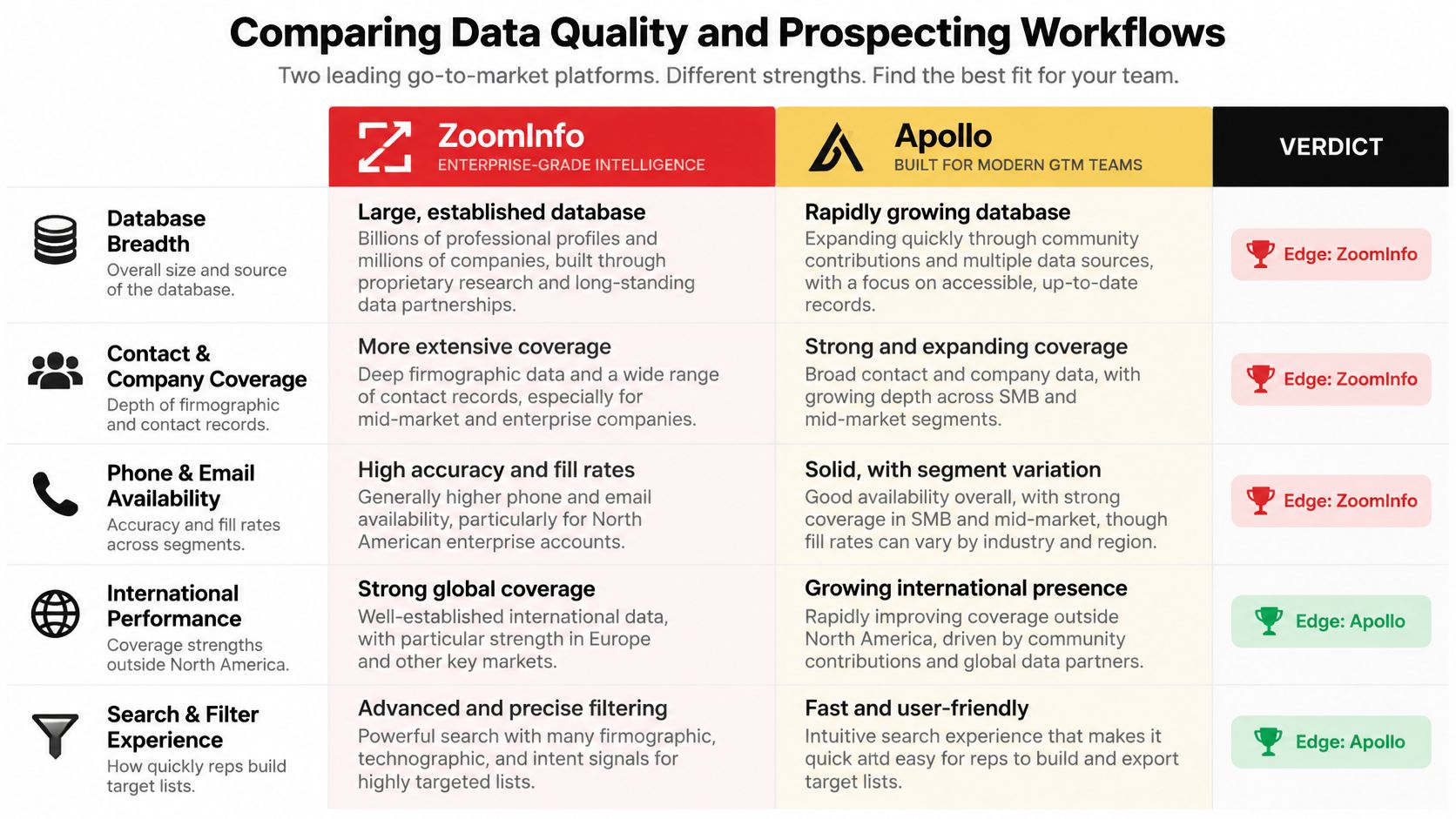
Use this visual comparison as a map of evaluation topics, not as proof of the depicted advantages.
Separate inventory claims from field usability
Vendor-adjacent comparison material reports approximately 500 million contacts and 100 million companies for ZoomInfo, versus more than 240 million contacts across roughly 30 million companies for Apollo; it also describes ZoomInfo's verification operation and recurring Apollo review concerns about outdated or inconsistent records, especially internationally, in ZoomInfo's discussion of Apollo reviews.
That source is commercially interested. Its database counts and accuracy descriptions should be treated as vendor claims, not independently audited, directly comparable measurements.
The operational question is narrower: can the provider identify the right buyer at your target account, through the channel you use, at the time you need to reach them? Company-level coverage doesn't answer whether the relevant decision-maker is available.
For enterprise prospecting, test organizational context, technographics, and intent enrichment where those fields affect qualification. For a simpler outbound motion, test whether Apollo's discovery-to-sequence workflow reduces research and handoff effort. Don't award either platform credit for fields that reps won't use.
ZoomInfo vs Apollo Data and Workflow Test
| Criterion | ZoomInfo | Apollo | Buyer Test |
|---|---|---|---|
| Match rate | Test depth within named accounts | Test discovery coverage within the same accounts | Compare matches against an independently defined target list |
| Valid-email rate | Validate returned addresses | Apply the identical validation process | Separate missing, invalid, and usable addresses |
| Direct-dial connection rate | Examine whether numbers reach the intended person | Check availability and connection outcomes | Distinguish verified contact from answered calls |
| Title freshness | Verify current role and responsibility | Verify current role and responsibility | Check against current company evidence |
| Duplicate rate | Inspect exported and synchronized records | Inspect exported and synchronized records | Check CRM identifiers and person-company relationships |
| Refresh latency | Observe when changed fields appear | Observe when changed fields appear | Record the delay between a known change and its correction |
| Cost per usable contact | Include the contracted data scope and verification work | Include credits and verification work | Divide attributable cost by records that pass your requirements |
Define the denominator before calculating any rate. A provider shouldn't receive a strong email-quality score merely because the test excluded accounts where it returned no address.
The distinction between appending a field and improving a usable record is central to how B2B data enrichment works. Require the evaluator to preserve missing values, conflicting values, and verification evidence rather than collapsing everything into a single completeness score.
A product walkthrough can help identify workflow steps worth reproducing in your own environment.
Test whether records remain usable
Run a 30-day decay test, revalidating a stratified sample weekly, following the evaluation approach recommended in the vendor-adjacent comparison cited above. Track changed roles, newly invalid addresses, corrected numbers, and whether those changes reach the CRM.
Keep geographic segments separate. A good result in the team's main domestic territory shouldn't conceal weak coverage in a planned expansion market.
A database can pass an export test and fail a maintenance test. Purchase decisions should account for both.
The strongest result isn't the largest initial list. It's the most useful set of records your team can maintain without an unreasonable verification workload.
Buying Signals, CRM Operations, and Governance
Finding a person doesn't establish a reason to contact them. RevOps should evaluate contact availability, account context, and evidence of timing as separate requirements.
A current email address answers where to send a message. An account change may help explain why that message is relevant. Neither proves that the buyer has budget, authority, or an active project.
Require a defensible interpretation of signals
For ZoomInfo, ask the vendor to demonstrate how the proposed intelligence package changes account prioritization. For Apollo, examine whether the prospecting and execution workflow provides enough context for the team's outreach standard. Don't assume a sequence-ready contact is a sales-ready account.
Use the visual below as a discussion checklist. Treat its governance and implementation labels as questions requiring documentary evidence, not verified procurement conclusions.
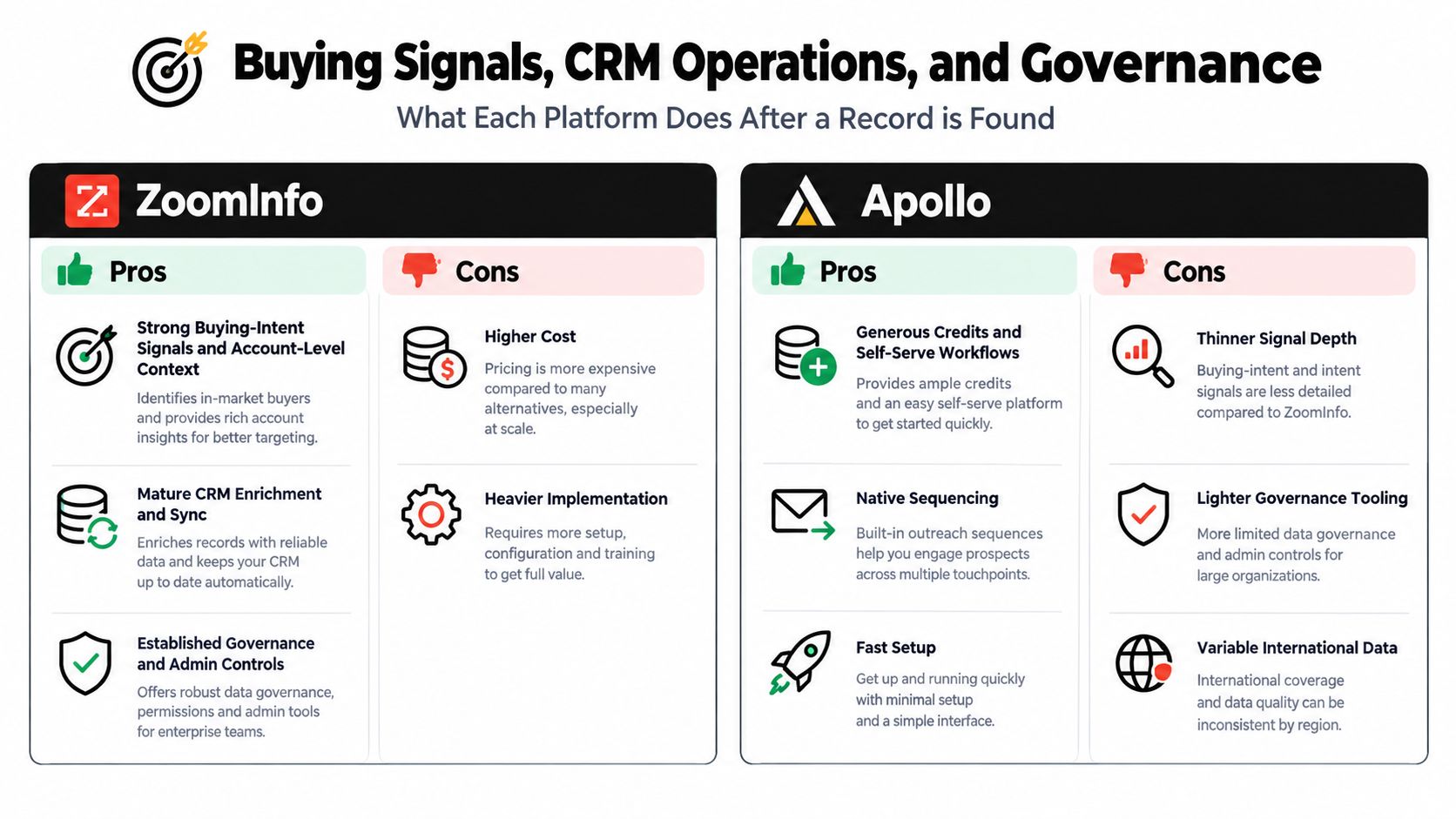
Ask the rep evaluating a signal to record what changed, where the evidence came from, when it appeared, and why it matters to the offer. The discipline described in this guide to buying signals and outreach timing helps separate observable events from unsupported purchase assumptions.
For example, hiring can support a hypothesis about operational pressure. It isn't proof that the company intends to buy your product. Keep that distinction visible in CRM notes and outreach drafts.
Test CRM behavior under exceptions
A successful demonstration should include messy records, not just clean imports. Ask the administrator to show how the workflow handles an existing account, a contact who changed employers, a protected owner field, and a previously suppressed person.
- Field precedence: Decide which system can overwrite each field and which values require review.
- Ownership: Preserve account and contact assignments unless an approved routing rule changes them.
- Suppression: Verify that opt-outs and exclusions survive imports, enrichment, and sequence enrollment.
- Exception handling: Assign responsibility for failed synchronization, conflicting records, and ambiguous matches.
These are acceptance criteria, not claims about either vendor's implementation. Require the proposed integration and package to meet them in your environment.
Also inspect how reps see the result. A populated CRM field has little operational value if the salesperson can't distinguish recent evidence from an old inference.
Make governance a procurement workstream
Don't infer compliance from company size or a general assurance on a sales slide. Ask both vendors for documentation covering data provenance, permitted use, retention, deletion requests, access controls, and the regional scope of relevant protections.
Have the appropriate legal and security reviewers examine your intended outreach channels and jurisdictions. Data access and lawful outreach are separate questions.
Governance checkpoint: Require a reviewable explanation of where information came from, who can use it, and what happens when it must be corrected or removed.
For teams whose primary job is monitoring account changes, evaluate an account-intelligence alternative separately. Live-web research, local-business reputation monitoring, source-backed briefs, and inbox-independent drafting address a different operating need from a traditional contact inventory.
That alternative may complement a contact provider rather than replace it. Preserve a clear boundary between finding a timely account, identifying a reachable person, and executing the communication.
Pricing, ROI, and the Cost of Usable Data
A lower seat price isn't necessarily a lower operating cost. The buyer must include the work required to turn purchased access into accepted accounts, not merely compare subscription invoices.
Use published pricing as a starting point
Public comparison material lists Apollo's annual-billing tiers at $49, $79, and $119 per user per month, while citing a ZoomInfo median contract value of approximately $33,500 annually from Vendr data in Apollo's ZoomInfo comparison.
Those are different kinds of pricing evidence. Published seat tiers are not equivalent to a median negotiated contract, and neither should be treated as your current quote. Confirm plan terms, included capabilities, export rights, credits, and commitment length directly.
Credit economics also depend on the outreach channel: a published comparison describes an Apollo verified email as commonly consuming one credit, versus eight credits for a phone number, while describing ZoomInfo's custom annual agreements and separate Sales, Engage, and Copilot products in Emelia's platform comparison.
A phone-heavy team therefore needs a different usage forecast from an email-first team. Model the expected mix of reveals, enrichment, exports, and repeated research against the actual offer, including how unsuccessful lookups and refreshes are billed.
Build the operating-cost model
Use this definition:
Total operating cost = subscription and contracted extras + usage charges + implementation and administration + research and verification labor.
Then calculate outcomes with explicit acceptance rules.
| Metric | What belongs in the calculation |
|---|---|
| Cost per sales-ready account | Attributable operating cost divided by accounts meeting research and contactability requirements |
| Cost per sales-accepted account | Attributable operating cost divided by accounts explicitly accepted by sales |
| Cost per qualified meeting | Attributable operating cost divided by meetings meeting the agreed qualification standard |
| Verification effort | Staff time spent resolving missing, conflicting, or stale fields |
| Workflow reliability | Enrichment success, bounce behavior, and exception-handling effort |
Don't count every booked meeting as qualified. Don't count every populated company record as accepted. Otherwise, a platform can appear economical because the team lowered the quality threshold.
Run a 30–90-day pilot that includes verification labor and data maintenance, an approach recommended in the operational comparison of Apollo and ZoomInfo. Track positive replies alongside the metrics above, but avoid attributing every response difference to the data provider when messaging, sender practices, or territory conditions also changed.
Identify the premium that actually pays back
Apollo's packaging is worth considering when integrated execution removes meaningful handoffs and the credit model suits the team's channel mix. ZoomInfo's premium is defensible when additional account depth improves qualification or contactability enough to offset the broader commitment.
Unused access belongs in the model too. Allocate the full contracted cost even when adoption falls below plan.
A signal-led alternative deserves evaluation when reps already know the target accounts but spend their time determining which deserve attention. In that situation, buying more contact inventory may leave the expensive research task untouched.
Which Platform Fits Each Buyer Persona
Company size is an incomplete purchasing criterion. The more useful distinction is which constraint prevents the team from turning target accounts into credible conversations.
Startups and SMB teams
For a B2B SaaS startup with a defined ICP and an email-led motion, Apollo is a sensible candidate to test first. The relevant hypothesis is that integrated discovery and execution will reduce the operational burden on a small team.
That recommendation changes when the startup sells into complex enterprise accounts. If reps need detailed account context before they can identify a viable entry point, evaluate ZoomInfo's proposed intelligence scope alongside Apollo rather than assuming the smaller company needs the lighter deployment.
For an SMB sales team, channel economics should guide the decision. A team that relies on phone outreach must validate number usability and usage costs before choosing based on advertised affordability.
- Limited RevOps capacity: Favor the workflow that the existing team can administer and audit.
- Heavy verification work: Include rep time in the purchase decision rather than treating it as free.
- Existing engagement stack: Assess whether bundled execution creates savings or duplicates tools already in use.
Enterprise RevOps organizations
ZoomInfo belongs on the shortlist when the organization needs account depth across a broader revenue workflow. Require a concrete deployment design showing which teams use which capabilities and what business decision each field supports.
Don't treat its enterprise commercial profile as proof that it meets your governance requirements. Procurement still needs evidence for access controls, integration behavior, regional use, and data handling.
Apollo can remain relevant for an enterprise team with a contained prospecting workflow. A narrower deployment may be appropriate if it passes the same operational and governance gates.
Local agencies and customer-success teams
A local agency may care more about a recent reputation issue at a service business than a large corporate contact inventory. Test whether account-level monitoring can supply an observable issue and enough evidence for a specific, responsible outreach message.
Customer-success teams have a different starting point again: they already own the relationship. Their evaluation should emphasize changes worth reviewing, reliable routing to the account owner, and useful context rather than net-new contact volume.
A broader comparison of B2B prospecting tools can help establish whether a contact database, engagement platform, or monitoring tool belongs on the shortlist.
| Buyer persona | Candidate to prioritize | Required proof |
|---|---|---|
| Email-led SaaS startup | Apollo | Practical discovery-to-outreach economics |
| Complex-account startup | Compare both | Useful intelligence for identifying an entry point |
| Phone-led SMB team | Compare both | Reachable contacts at an acceptable operating cost |
| Enterprise RevOps | ZoomInfo, with Apollo where appropriate | Deployment value and documented governance fit |
| Local agency | Account-intelligence alternative | Reviewable, relevant local-business changes |
| Customer-success team | Account monitoring | Actionable context for existing relationships |
These are starting positions, not verdicts. The platform should fit the team's bottleneck, not its company-size label.
A Practical Migration and Selection Checklist
Make the selection reproducible. Keep a written decision record so procurement, sales, and RevOps can see why the chosen platform passed and which limitations remain.
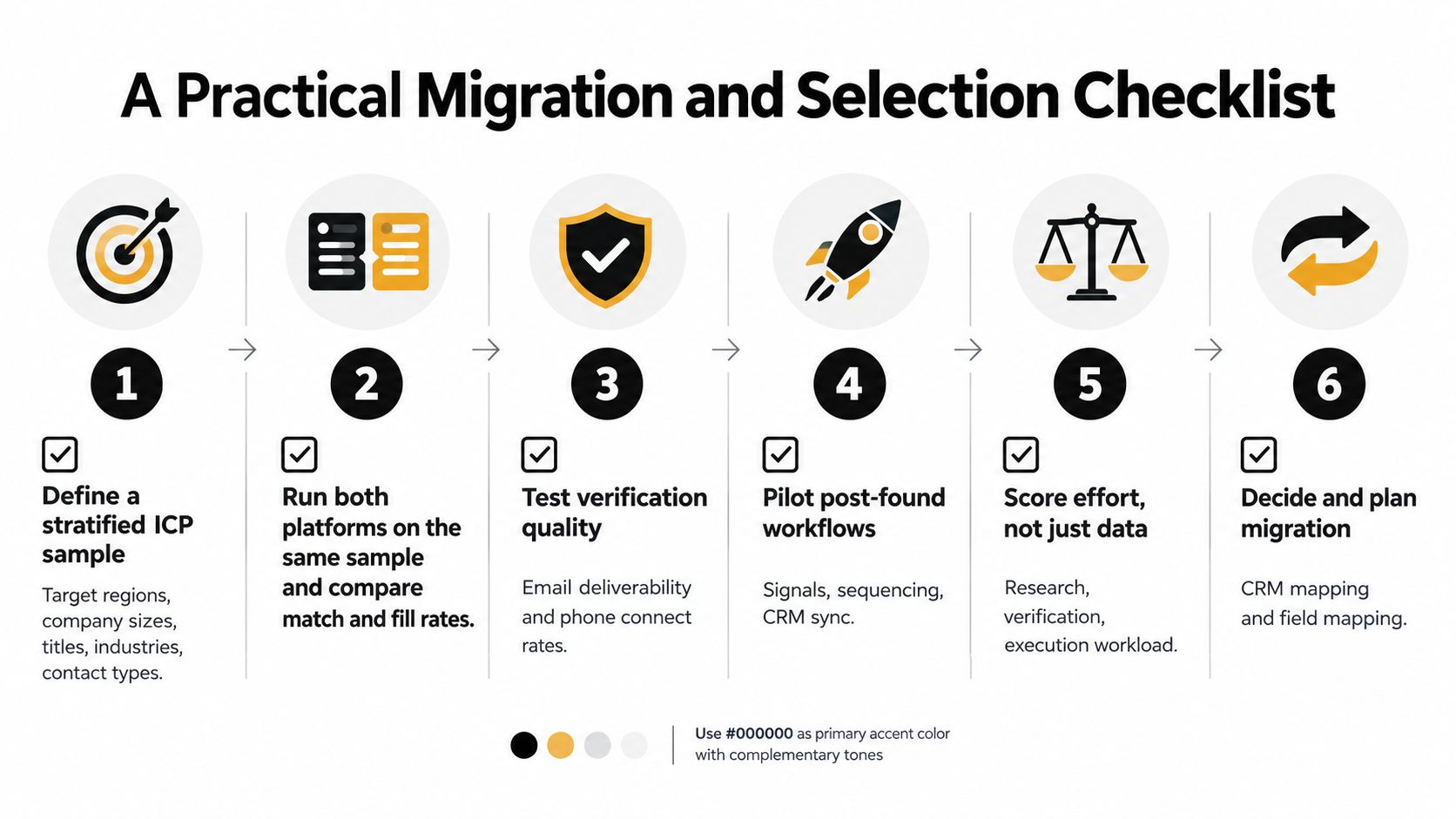
The checklist below covers both evaluation and migration readiness.
Establish the acceptance gates
- Freeze the ICP sample: Include target regions, company sizes, industries, roles, and contact channels. Don't let vendors substitute easier accounts.
- Apply consistent validation: Test match quality, role freshness, email validity, phone connections, geographic coverage, and enrichment latency.
- Observe complete work: Measure the effort required to produce a credible brief, resolve exceptions, and move the account into the correct CRM workflow.
- Document rejected records: Preserve failure reasons so aggregate results don't conceal a weak segment.
Plan the change before exporting
Map existing fields, CRM objects, sequence dependencies, ownership rules, suppression lists, and integration requirements. Agree on compliance obligations and which historical values must remain reviewable.
Use the pilot framework established earlier for both options. Record credit consumption, verification labor, administrative effort, and the accounts sales accepts.
Choose ZoomInfo when the tested value of enterprise data depth and broader intelligence justifies the investment. Choose Apollo when integrated prospecting and sequencing best fit the operating constraints. Choose an account-intelligence alternative when the main job is discovering timely account changes and preserving source-backed context.
Don't authorize migration until someone owns rollback, exception resolution, and post-launch quality checks.
CapyScout searches the live web, monitors account changes, and delivers source-backed briefs and outreach drafts for B2B and local-business prospecting. If your ZoomInfo vs Apollo evaluation reveals that timing and account research are the bigger bottlenecks, visit CapyScout and test that workflow against the same target-account sample.