

Intent Based Targeting: A Practical Guide for 2026
Learn what intent based targeting is, the signals that matter, and how B2B and local teams turn live web signals into qualified pipeline in 2026.
Your SDR team has probably lived this already. The list looked clean, the ICP was tight, the emails were decent, and the meetings still didn't come. The accounts fit on paper, but they weren't buying, not yet, and your reps spent weeks learning that the hard way.
That's the core problem with intent based targeting. It's not just about finding the right kind of company, it's about catching the account while the buying window is still open. If you miss that window, even a perfect list turns into dead air.
The teams that win treat intent as a winnability problem, not a research problem. They watch for fit, in-market activity, and readiness together, then they move fast before the signal decays. The rest of the article is the working version of that playbook, the signal stack, the filtering logic, and the live-web workflow you can copy without guessing.
Table of Contents
- The Moment Timing Beats Targeting
- What Intent Based Targeting Actually Means
- First Party and Third Party Intent Signals
- Off Site Signals Worth Watching in Real Time
- How Intent Data Differs From Behavioral and Third Party Targeting
- A Live Web Workflow That Turns Signals Into Pipeline
- Winnability Is the Missing Layer
- Measuring Whether Intent Based Targeting Is Working
The Moment Timing Beats Targeting
A founder I knew had an SDR spend a whole quarter hammering mid-market SaaS companies that looked perfect on paper. Same employee band, same stack, same geography, same revenue range. None of them had raised recently, none had posted a relevant hiring role, and none had shown any category research. The list was right, the timing was dead.
Then one smaller account changed shape in a single week. It posted a VP of RevOps role, replaced its billing tool, and started comparison searching around the category. The SDR reached out on day two, opened with the specific change, and booked a pilot that closed in 21 days. That wasn't better copy. That was better timing.
That's why I treat intent based targeting as the discipline of catching accounts inside a buying window, not as a smarter version of list building. Account-based marketing gave us the list logic, but intent gives us the clock. The whole point is to stop spraying the same message at every company that looks eligible and start prioritizing the ones that are moving.
Practical rule: if the account fits but nothing has changed, it's not a sales lead yet.
The useful internal question is simple. Is this account a fit, is it in market, and is it winnable right now? If you can't answer all three, it doesn't belong in the active queue. For a practical buying-signal framework, the Buying Signals Sales Guide to Timing and Outreach is a useful companion.
What Intent Based Targeting Actually Means
Intent based targeting is the practice of prioritizing accounts that show live, attributable signals of an active buying problem, then layering that signal on top of fit instead of pretending all matching companies are equally reachable. It's not a list of names. It's a moving queue.
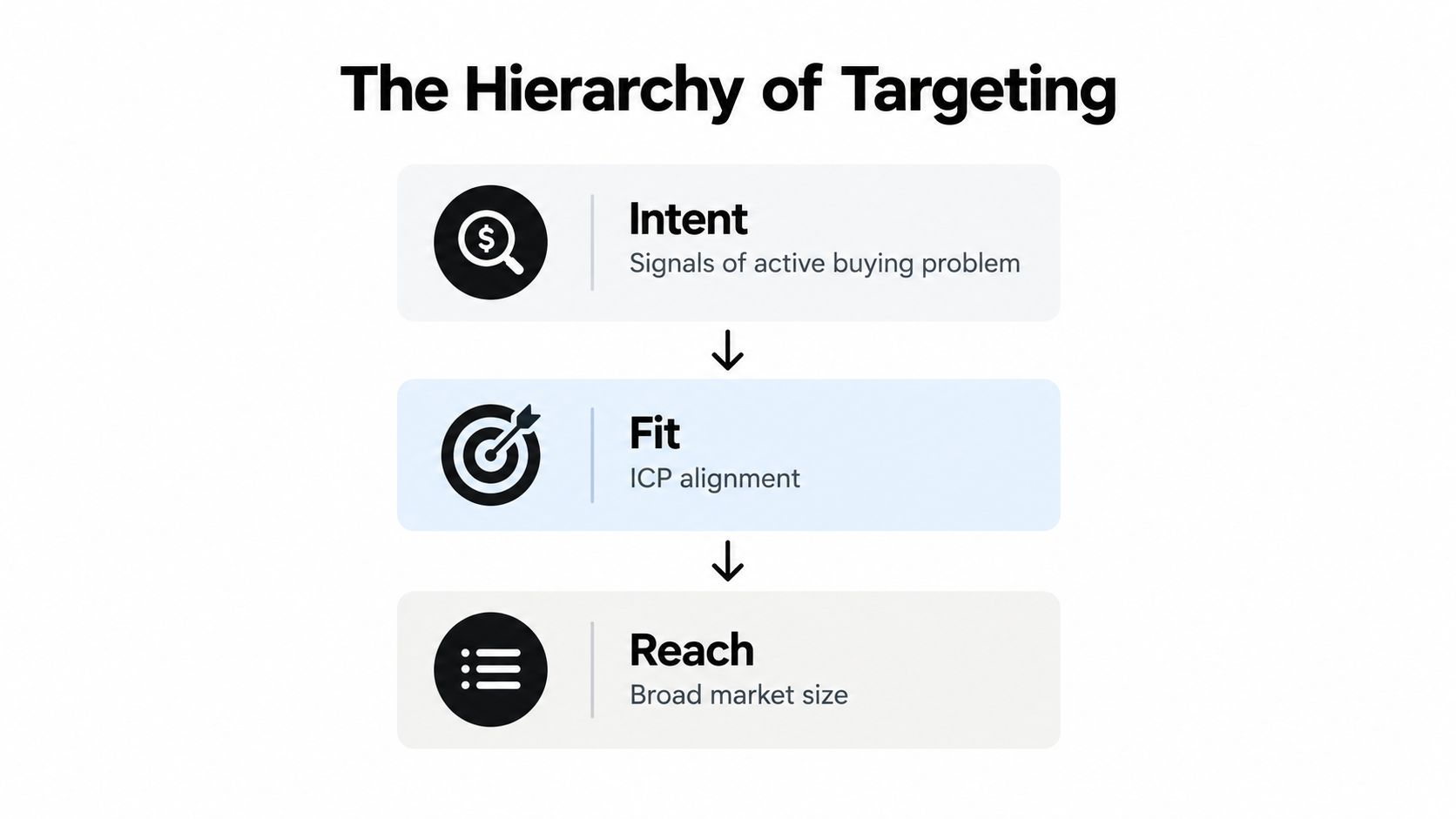
Fit, in market, and winnability are different filters
Fit is the shape of the company. For a B2B SaaS team, that means firmographics and tech stack, the sort of account that could use your product without you forcing it. In local markets, fit is more basic, service area, license, and whether the business model matches what you sell.
In market means the company has an open problem. A hiring spree for a role your product supports is one example. So is a new platform replacement, repeated comparison browsing, or a fresh round of category research. The company might still be anonymous, but the problem is loud.
Winnability is the layer most skip, and it's the one that saves the most time. It asks whether the budget exists, whether someone with authority can act, and whether the timeline is short enough for your team to matter. If the answer is no, the account can still be interesting, but it shouldn't consume sales time yet.
For a clean definition of the underlying data layer, see what intent data means in B2B. For a broader outbound angle, the Eludic outbound targeting playbook is worth a read because it frames targeting around timing, not just audience shape.
Intent is not a list, it's a moving signal
A common mistake is treating intent as a static account property. It isn't. A company can look cold on Monday, then show multiple buying cues by Thursday, then go stale again by the next week. That's why signal freshness matters as much as signal source.
The better mental model is layered. Reach is who you could contact, fit is who should care, and intent is who cares now. When those three overlap, you have an account worth touching.
Local example
A local service business works the same way. Fit might be a licensed operator in your service area. In-market could be a new property manager, a code violation, or a competitor leaving the neighborhood. Winnability is whether the decision lives at the site level and whether you can get to the right person fast enough to matter.
First Party and Third Party Intent Signals
First-party and third-party intent do different jobs, and you need both. First-party tells you what people are doing on your own properties. Third-party tells you what they're researching before they get there. If you only watch one side, you miss either timing or reach.
| Dimension | First Party Intent | Third Party Intent |
|---|---|---|
| Source | Your website, app, CRM, email, and sales conversations | External research behavior across publisher networks, review sites, and live-web sources |
| Freshness | Usually the freshest signal you have | Often earlier, but less direct and more likely to decay before you act |
| Identity | Stronger tie to known contacts and accounts | Often starts anonymous or loosely matched |
| Best use | Sales follow-up, PQL routing, and fast nurture handoff | Prospecting, account selection, and expansion of target lists |
| Limitation | Limited to the audience you already reach | Weaker attribution and more noise if you don't corroborate it |
First-party signals are conversion signals
First-party intent is what your team already owns. Pricing page revisits, repeat demo requests, content downloads tied to a named account, call transcripts, and product usage spikes all sit here. These signals are high-trust because they come from direct interaction, and they're the best trigger for sales follow-up.
That said, they only cover the audience you already touch. If no one from the account is on your site, your first-party stack goes quiet even if buying is active elsewhere. So first-party is your conversion engine, not your discovery engine.
Third-party signals are account discovery signals
Third-party intent comes from outside your funnel. It catches publisher co-reads, review-site browsing, public job posts, funding activity, and tech-stack changes before the account lands on your site. That makes it the better layer for finding accounts early and expanding the top of the funnel.
The tradeoff is freshness and confidence. Third-party signals can be strong, but they need corroboration before sales spends time. A single signal often tells you to watch. Two independent signals tell you to act.
Hybrid is the only setup that scales
The best programs join both layers with a shared account key. First-party confirms the conversion path. Third-party widens the field so you're not only chasing people who already found you. That's why a hybrid stack beats any single source by itself.
Practical rule: first-party gets the rep to the right conversation, third-party gets the account onto the board in the first place.
Off Site Signals Worth Watching in Real Time
Think of off-site signals as detection logic, not as a vendor menu. You're looking for events that make a buying problem visible before a form fill shows up. If you watch the right surfaces, the pattern becomes obvious quickly.
| Signal | Example Trigger | Half-Life | Pair With |
|---|---|---|---|
| Hiring spikes | Multiple SDR or RevOps job posts inside a short window | Warm for a short period before the budget or project settles | Funding or tech changes |
| Funding events | Seed, Series A, or growth round | Strong early, then cools as teams turn from announcement to execution | Leadership changes or hiring |
| Tech stack changes | CRM replacement, new CDP, or analytics migration | Warms around implementation planning, then fades once migration starts | Reviews or job posts |
| Review and community activity | G2, Capterra, Reddit, or niche Slack chatter about category evaluation | Short and noisy, but useful when repeated | Search or comparison activity |
| News and leadership moves | Executive hire, expansion, or earnings language about efficiency | Moves fast when priorities shift, then levels off | Hiring or product changes |
Hiring, funding, and tech changes move first
A cluster of relevant job posts usually means the company is adding capacity or creating a new owner for the problem you solve. That signal tends to be warm quickly and cool fast once the role is filled. Funding is similar, because fresh capital often puts accounts into sprint mode for a short stretch.
Tech-stack changes tell a different story. A new CRM, CDP, or analytics replacement often means the team is already in implementation planning or is unhappy enough to move. The signal is valuable because it usually points to a real project, not casual interest.
Reviews and news expose active evaluation
Review sites and community chatter are underrated because buyers talk there before they fill out a demo form. G2, Capterra, Reddit, and niche communities can all surface active comparison behavior. The signal cools quickly if it's just curiosity, but it stays useful when you see repeated evaluation language.
News and leadership moves change priorities fast. A new executive, expansion, or a public push toward efficiency can make an account reachable almost overnight. That's the kind of context SDRs should see before they write a first line.
Use two signals before you spend time
One signal is a clue. Two corroborating signals are a reason to route the account. If hiring, funding, and tech change all point the same way, you've probably found an account with real urgency. If they don't line up, keep it monitored and move on.
How Intent Data Differs From Behavioral and Third Party Targeting
These three get mixed up constantly, and they shouldn't be. They answer different questions, and each one has a different job in the stack. If you blur them together, you end up overvaluing data that only looks predictive.
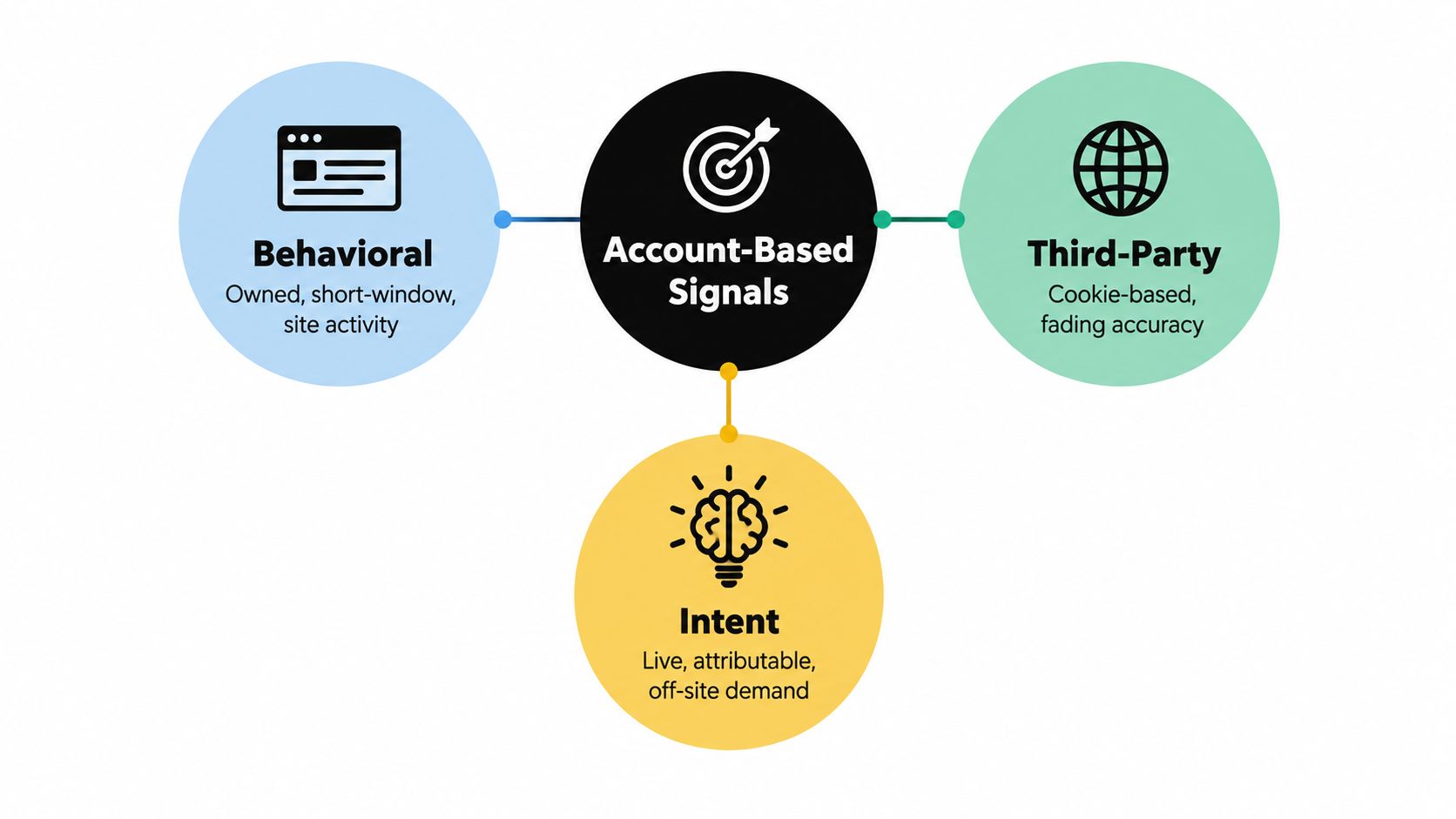
Behavioral data tells you what happened on your property
Behavioral data answers a narrow question, what did this person do on my site or app. Page views, pricing visits, repeat logins, feature toggles, and demo requests all live here. It's high-fidelity because you own the environment, and it's usually the fastest signal for sales follow-up.
Behavioral data doesn't tell you whether the broader account is shopping elsewhere. It only tells you that someone touched your property. That's useful, but it's not the same thing as market demand.
Intent data tells you whether the account is shopping
Intent data sits wider. It includes what happened on your site, but it also includes off-site research behavior that shows a company is actively looking for a solution like yours. This is the layer that helps you catch accounts before they raise their hand.
The catch is staleness. By the time third-party intent lands in many CRM workflows, it can already be old enough to miss the buying window. That's why intent only works when freshness is respected and action happens quickly.
Third-party targeting is a different tool again
Third-party targeting adds firmographic, technographic, and lookalike filters bought from data brokers. That helps with audience building, but it doesn't tell you whether the buying committee is assembled or whether the project can move. It's useful for shaping the pool, not for declaring the account ready.
The highest-converting accounts sit where behavioral, intent, and targeting overlap. The biggest waste is acting on only one layer and pretending it's enough.
A Live Web Workflow That Turns Signals Into Pipeline
The fastest way to operationalize this is a four-stage workflow. If you're running ops, you can stand this up in a sprint without rebuilding the whole stack. The goal is simple, turn raw signal into a Today queue that reps trust.
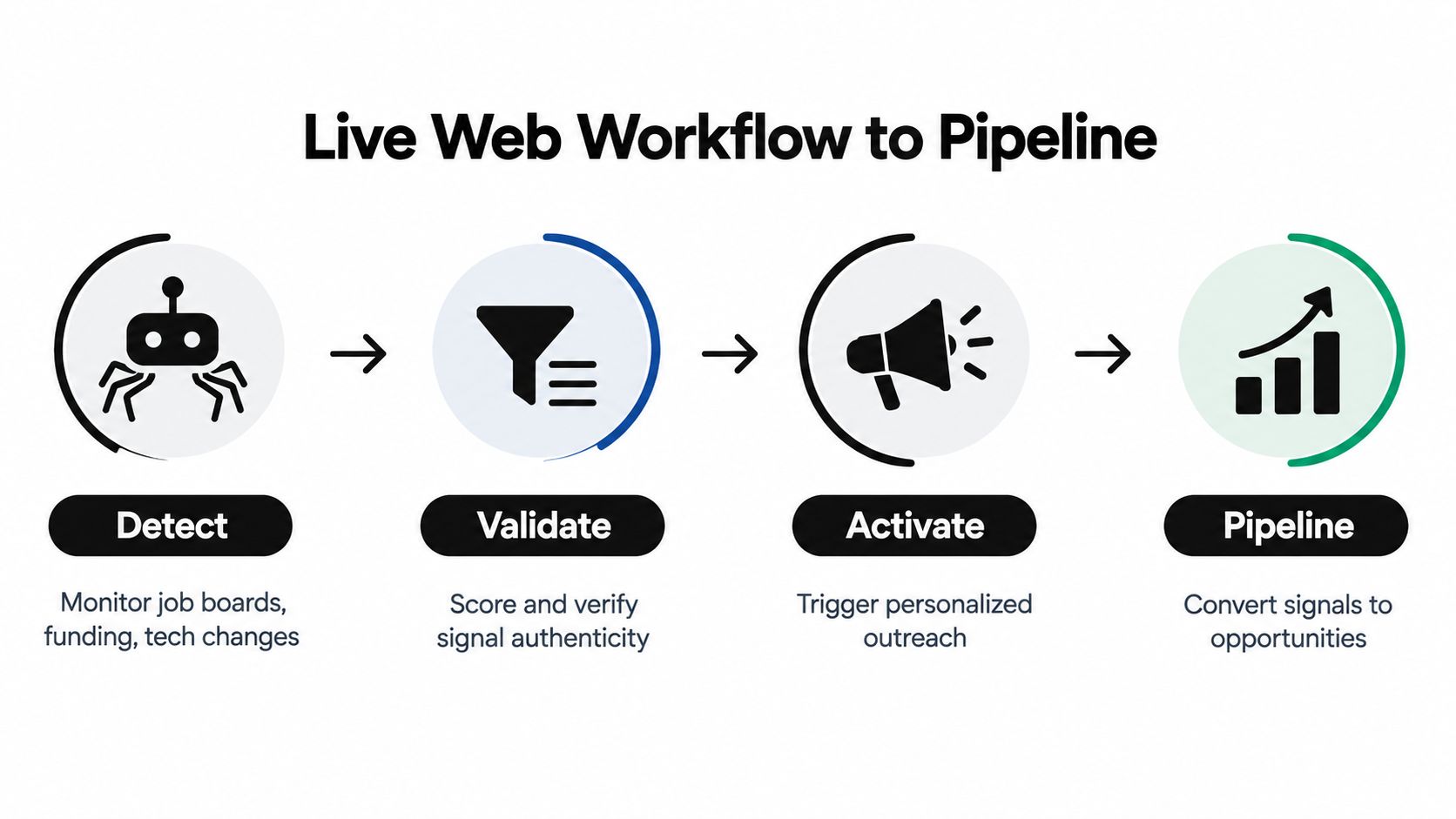
Detect, validate, activate, then push to CRM
Detect means watching a defined set of live-web surfaces, job boards, funding sources, review sites, press wires, and tech-intel feeds. CapyScout does this by looking at the live web for account-level buying moments and then sorting the accounts by what changed and why it matters now.
Validate means requiring corroboration. I like a simple rule, don't promote an account until you've seen at least two independent signals in a short window. That cuts a lot of noise before it ever reaches sales.
Activate means ranking accounts by fit, readiness, and contact authority. A fit score tells you whether the account belongs in your market. A readiness score tells you whether the problem is live. An authority score tells you whether the person you can reach has enough influence to matter.
Push means sending the account into CRM with a source-cited brief. The brief should say what changed, when it changed, why it matters, and what the next step is. The signal-driven prospect list-building playbook is the right way to think about that handoff.
Briefs need an owner and a deadline
A brief without a named next action is just research. Don't let it sit in the queue. Every alert should tell the rep what to do next, when to do it, and why the timing matters.
Operational rule: if the brief doesn't say who to contact and by when, it doesn't leave the queue.
Use live-web detection, not stale lists
Live-web systems have an advantage over static databases. They keep the signals current, they keep the context attached, and they let ops route the account while the signal is still warm. That's the difference between a useful alert and a forgotten record.
Winnability Is the Missing Layer
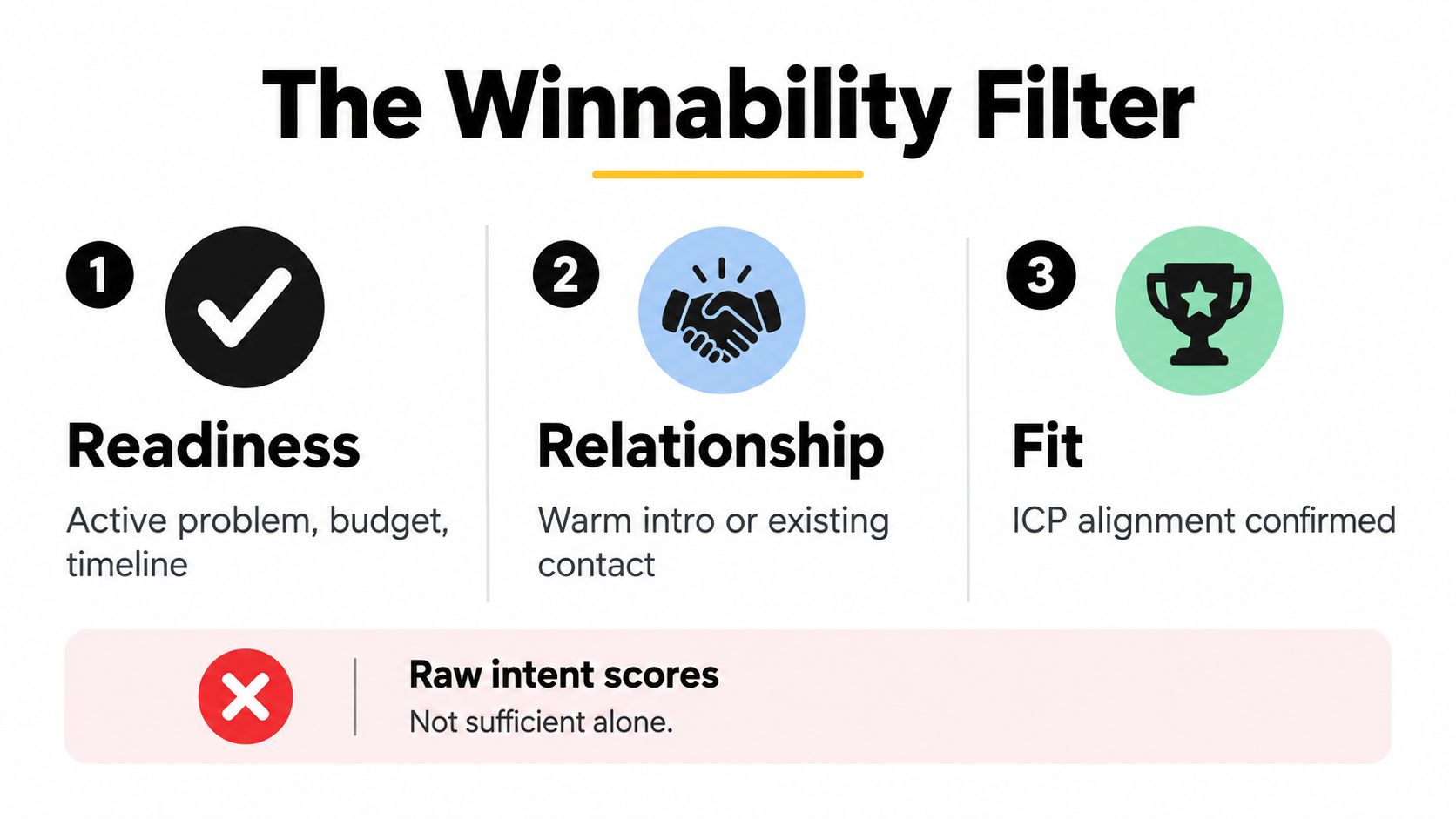
Raw intent scores make teams feel productive, but they don't predict pipeline well on their own. I've seen accounts with flashy scores stall for months because nobody asked the essential question: can we win this now? If the answer is no, the score is just decoration.
Readiness, authority, and timing decide the outcome
Readiness means the account has an active problem, a budget path, and a real timeline. Authority means the contact you've found can sign, influence, or unblock the decision. Timing means the signal is fresh enough that the buying cycle is still open.
Those three filters beat a generic “high intent” label every time. A company with a public RFP and a hiring post for a procurement lead is a better sales target than one that just subscribed to a blog three months ago. The first one has motion, the second one has noise.
Strong signal, weak winnability is still a bad bet
That's the part many teams miss. An account can look hot and still be unavailable. Maybe the project has no owner, maybe budget is frozen, maybe the person you reached is too far from the decision, or maybe the signal already cooled off.
Use a simple pre-queue test:
- Is there a live project? If not, don't route it yet.
- Can this contact move it? If not, keep mapping the buying group.
- Is the signal still fresh? If not, lower priority immediately.
- Does the account fit the ICP? If not, don't force it into the plan.
Fewer accounts, better odds
Discipline is what matters here. You don't need more signal volume. You need fewer accounts that are both interested and winnable. That's what turns intent from a curiosity metric into a pipeline metric.
Measuring Whether Intent Based Targeting Is Working
If the program is real, the numbers will show it. Start with the smallest set of metrics that prove the system is doing actual work, then stop staring at vanity counts that only make dashboards look busy. I care about revenue movement, not how many accounts tripped a threshold.
| Metric Type | What to Track | Why It Matters |
|---|---|---|
| Lagging revenue | Pipeline created from intent-sourced accounts | Shows whether the program creates real opportunities |
| Lagging revenue | Opportunity-to-close rate versus your baseline lists | Tells you if intent is improving quality, not just activity |
| Leading activity | Average time from first signal touch to qualified meeting | Exposes whether speed is helping or hurting |
| Leading activity | Signal-to-meeting conversion by category | Reveals which signals are worth scaling and which are noise |
| Leading activity | Time from signal to SDR action | Measures whether your team is moving while the account is still warm |
Retire the vanity metrics
Total accounts “showing intent” doesn't tell you anything useful. Neither does an average intent score, because scores can rise while pipeline stays flat. MQL counts from scored form fills are also a trap if they don't convert into actual opportunities.
You want to know which signal categories produce meetings, which ones produce pipeline, and which ones just create work. That's the filter. Everything else is reporting theater.
Review the program every 30 days
Run the review on a 30-day cadence. Pick one signal category, one ICP slice, and one matched control list, then test them against each other for four weeks. If the intent-sourced set doesn't outperform the control on qualified meetings or pipeline quality, tighten the filter before you scale.
The smartest teams don't ask whether intent based targeting works in theory. They ask which signals are current, which accounts are winnable, and which plays create meetings fast enough to matter. That's the whole game.
If you want a cleaner way to turn live-web signals into accounts your reps can work, CapyScout is built for that workflow. It finds fitting companies from the live web, watches for buying signals, and writes source-backed briefs so your team knows who to contact and why. Visit CapyScout and see how it can fit into your targeting, scoring, and outbound process.