

10 Demandbase Competitors for Smarter ABM
Compare 10 demandbase competitors for B2B ABM and prospecting, including features, pricing hints, pros, cons, migration tips, and CapyScout.
Most advice about Demandbase competitors starts with the wrong question: “Which platform has the same feature list?” A full ABM suite may be exactly right for an enterprise team, but it may also be unnecessary if your actual problem is weak predictive scoring, missed website visitors, poorly timed prospecting, account advertising, content syndication, or a lack of execution capacity.
The better question is which operating model your team can run consistently. Some platforms are built for predictive ABM and buying-group orchestration. Others focus on data-led prospecting, account advertising, first-party research intent, managed services, or live-web signals that explain why an account deserves attention today.
This comparison separates those models instead of treating every tool as a like-for-like replacement. Each option is assessed by practical fit, standout capabilities, pricing visibility, implementation effort, migration risk, media commitments, and how well it connects to real sales and marketing workflows. The category itself is expanding quickly, with the global ABM market estimated at USD 1.41 billion in 2024 and projected to reach USD 3.81 billion by 2030, according to ABM market research summarized by Ploy. That growth leaves room for different approaches, not just another monolithic suite.
If you're comparing vendors, also consider benchmarking with social data to understand how competitors appear in public conversations and market activity. CapyScout belongs in that evaluation as a timing-and-context layer that can sit beside your CRM or existing ABM stack.
Table of Contents
- 1. CapyScout
- 2. 6sense
- 3. ZoomInfo MarketingOS
- 4. RollWorks
- 5. Terminus
- 6. Madison Logic
- 7. Foundry ABM powered by Triblio
- 8. TechTarget Priority Engine
- 9. MRP Prelytix
- 10. Dealfront including Leadfeeder and Echobot
- Demandbase Competitors, Top 10 Feature Comparison
- Choose the Signal Model Your Team Can Operate
1. CapyScout
Best for live-web account intelligence
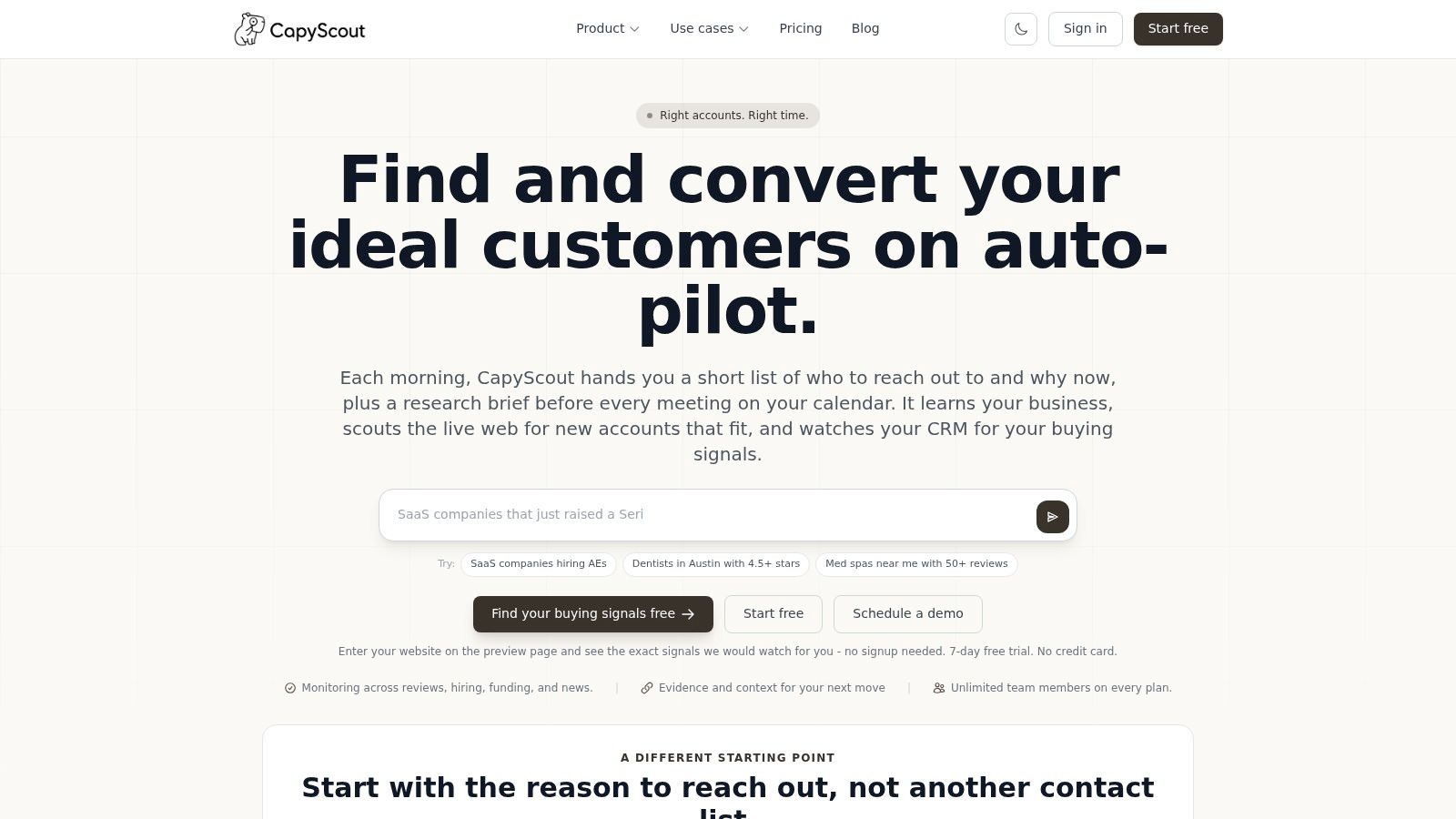
CapyScout is a practical fit for teams that need current account context without replacing an established CRM, marketing automation platform, or ABM program. Its agent searches the live web for funding announcements, hiring activity, leadership changes, SEC filings, Google Business Profile changes, news, website activity, technology shifts, and review movement. Those findings become source-backed “Why now” briefs and a prioritized daily queue.
A concrete workflow illustrates the difference. A team can save searches based on a competitor, technology stack, location, hiring pattern, or niche, then review newly detected companies and watched accounts in one Today queue. Unverifiable items are flagged instead of presented as established facts. That makes the product useful for prospecting and account research, while limiting the risk of treating an unverified signal as buying intent.
CapyScout also supports several adjacent workflows:
- Inbound screening: New signups receive fit, risk, and confidence scoring with a suggested action, such as route, nurture, or hold.
- CRM enrichment: Firmographics, ICP grades, and “Why now” notes can sync back to HubSpot, Pipedrive, and Attio.
- Monitoring: Autopilot runs saved searches and watched-account checks, then builds a scored Today queue.
- Local intelligence: Local Reputation Watch detects rating drops, sentiment changes, and stalled reviews for service businesses.
- Outreach support: Drafts open prefilled in Gmail or Outlook without inbox OAuth, preserving the existing sending workflow.
Commercial fit and limitations
CapyScout offers unlimited seats on all plans and uses credit-based pricing rather than per-seat or per-lead fees. The website offers a free Buying Signal Finder and a 7-day free trial with no credit card. Monitoring cadence and feature access vary by plan, while public monthly tier prices and detailed credit-pack consumption are not published. Buyers should therefore use the trial or sales process to estimate usage before committing.
Implementation effort is usually lower than a full ABM migration because the product can sit beside the current stack. The trade-off is coverage. It relies on public web traces, so organizations with limited public activity may produce fewer usable signals. It also does not automatically replace mature advertising, buying-group orchestration, or enterprise media infrastructure.
The strongest operating model is a lightweight intelligence layer for RevOps, SDR, marketing, and agency teams. It can add discovery, screening, enrichment, monitoring, and evidence-backed outreach without requiring existing campaigns and audiences to move.
Practical rule: Test whether reps can act on the signal before testing whether the platform can replace the stack.
Explore the platform through the main navigation or CapyScout.
2. 6sense
Best for predictive full-funnel ABM
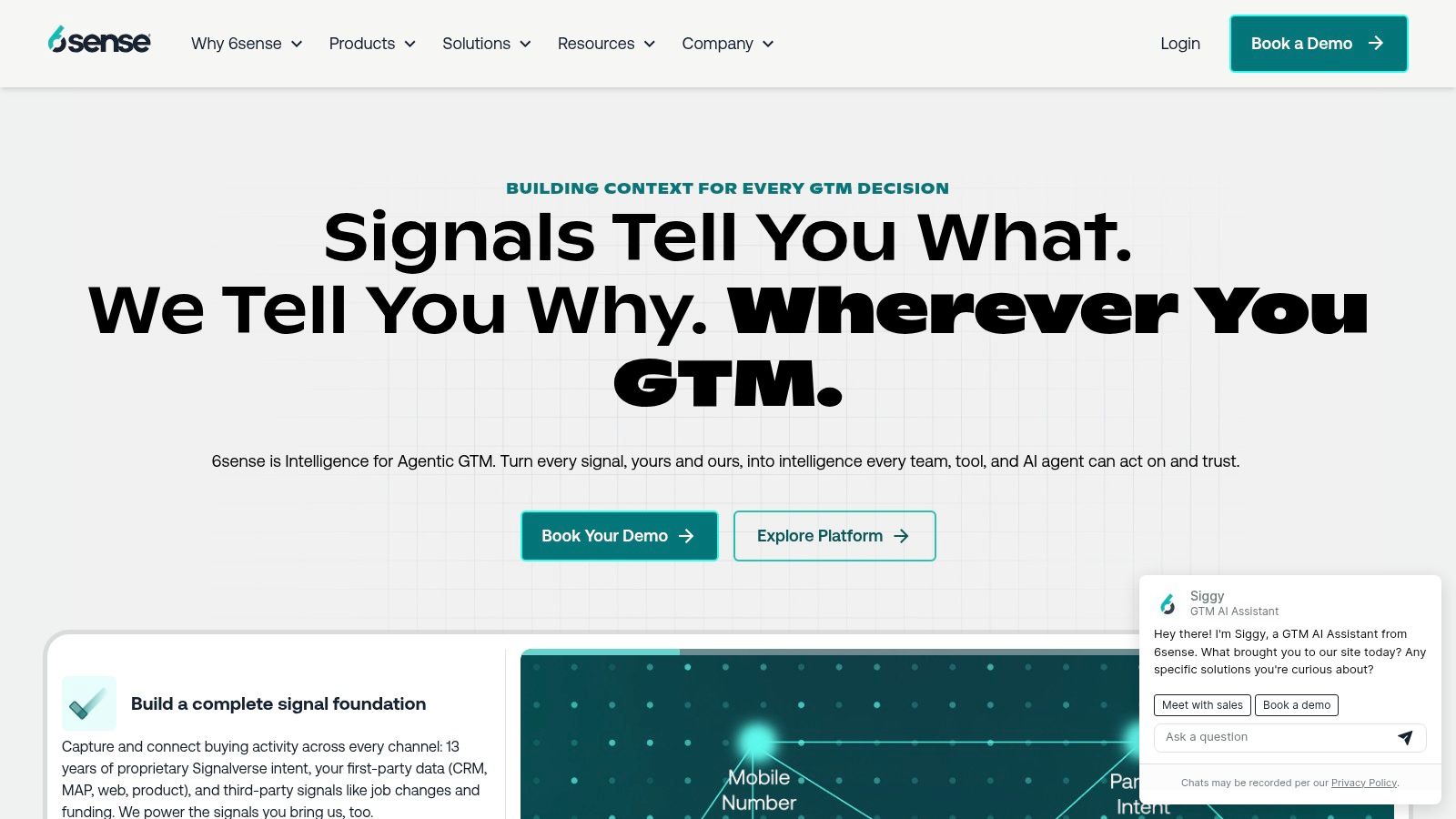
6sense is the closest head-to-head choice for teams that want to reproduce the predictive, full-funnel ABM model associated with Demandbase. Its operating model combines first-party and third-party intent, account prediction, journey-stage scoring, audience building, workflow automation, and advertising activation.
The platform supports display, video, connected TV, search, and social activation, with audiences that can sync to major advertising platforms. Its native DSP gives marketing teams another route for account-level media, while the Sales Intelligence module adds company and contact data, website visitor identification, alerts, and a Chrome extension for sales research. This makes 6sense more than a scoring tool. It connects prioritization to paid reach and sales action.
Teams should distinguish predictive depth from implementation simplicity. The value comes from aligning CRM history, intent inputs, account definitions, advertising audiences, sales workflows, and reporting. If marketing and sales don't agree on account ownership or journey stages, the platform can produce refined outputs that still fail to change daily behavior.
For buyers researching why intent data matters in B2B, 6sense is best understood as an orchestration system, not merely an intent feed. It suits enterprise teams with the staff to manage models, audiences, campaigns, and governance across several modules.
Commercial and migration considerations
6sense uses custom pricing, and its advertising model is positioned around market-based CPMs rather than opaque media margins. That transparency can help a buyer separate software economics from media economics, although the overall commercial process remains complex.
Migration risk is highest when the outgoing platform powers many downstream objects. Audit account hierarchies, score fields, audience definitions, campaign history, and sales alerts before moving. If the requirement is just to identify a few high-priority accounts and notify reps, 6sense may be more platform than the workflow requires. If the requirement is predictive ABM with coordinated activation across the funnel, it is one of the strongest direct alternatives.
3. ZoomInfo MarketingOS
Best for a ZoomInfo-centered data and media stack
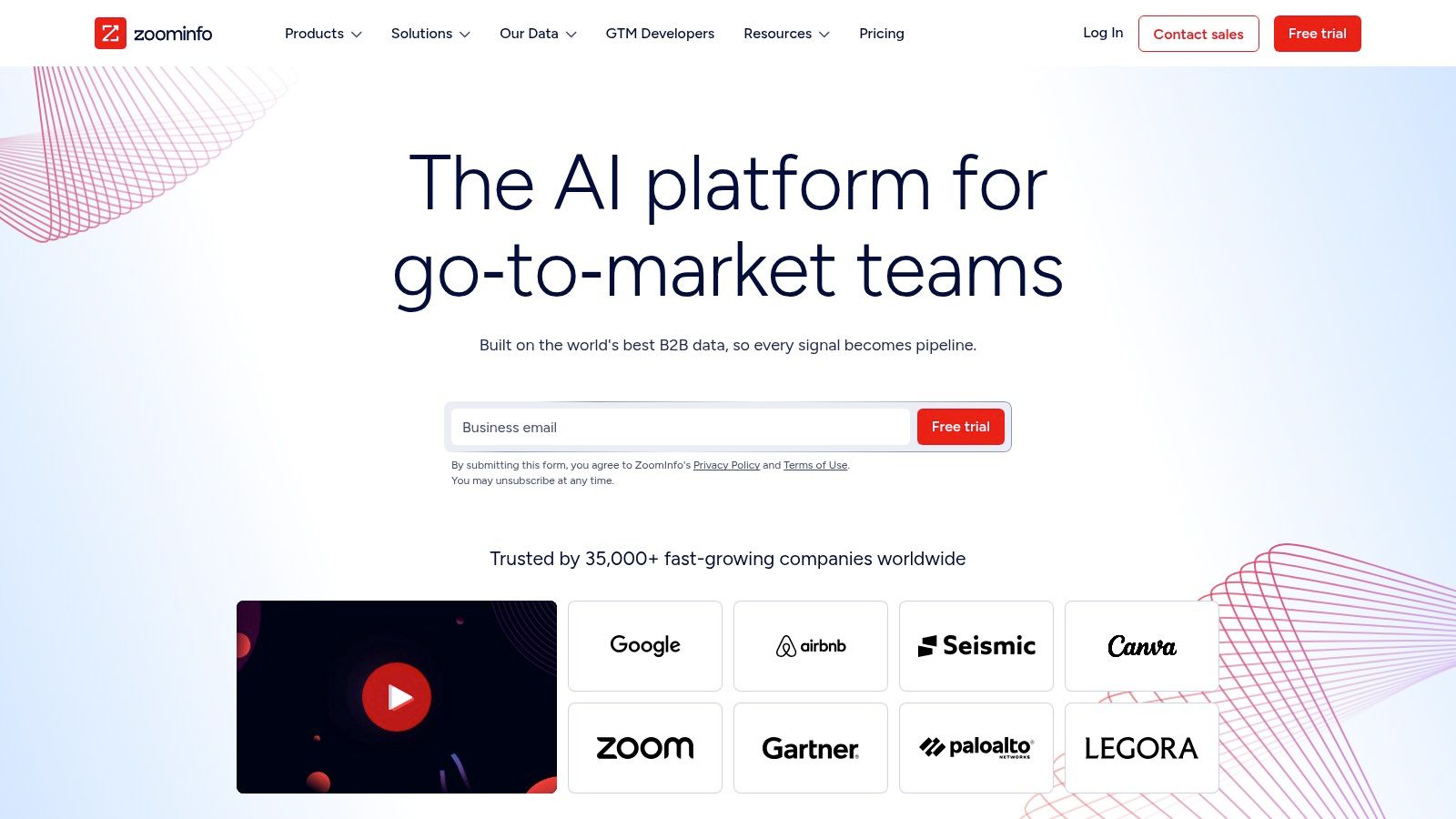
ZoomInfo MarketingOS makes the most sense when ZoomInfo is already the organization's central B2B data layer. Its ABM and advertising workflows sit on the broader ZoomInfo company and contact graph, connecting audiences, buying signals, website conversion tools, web chat, and advertising management.
That integrated model can reduce vendor sprawl. Marketing can build audiences from the same environment used for sales intelligence and operations, while website conversion and chat features connect visitor engagement to downstream workflows. Bundling with SalesOS or OperationsOS can also create a tighter relationship between account research, enrichment, marketing activation, and CRM processes.
The trade-off is that the platform's value depends on how much of the broader ZoomInfo ecosystem the buyer will use. A team that only needs live account signals or website visitor identification could end up paying for a larger operating model than it can absorb. Buyers should map every proposed module to a named workflow before accepting a bundle.
Data coverage versus commercial control
ZoomInfo is often treated as the data-coverage alternative to Demandbase, particularly for teams prioritizing company and contact enrichment. Its strengths are most relevant to organizations that need a broad prospecting database connected to advertising and marketing actions. Buyers with a heavily US-focused motion may find that orientation useful, while teams targeting markets where coverage is less consistent should validate records directly.
Pricing isn't publicly listed, and commercial scope can vary by package and module. That makes the discovery process part of the evaluation. Ask which capabilities are included, which require additional contracts, how usage is measured, and what happens if the team doesn't adopt the full suite.
A practical migration path is to preserve the CRM and compare ZoomInfo MarketingOS against the current enrichment, audience, chat, and advertising workflows separately. CapyScout can also complement a ZoomInfo deployment by adding ZoomInfo integration workflows for source-backed live-web context rather than forcing the team to choose between a database and a timing layer.
4. RollWorks
Best for accessible account advertising
RollWorks is primarily an account-based advertising and activation option for mid-market teams. It offers account-list building from sources such as Salesforce, HubSpot, Marketo, Bombora, G2, and CSV files, then connects those lists to advertising and website analytics.
Its account-level website analytics and traffic revealer help marketing teams understand which target companies are engaging. Native keyword intent can be combined with third-party intent from providers such as Bombora and G2, giving buyers a way to build audiences without adopting a full predictive modeling environment.
The accessible entry point is a meaningful differentiator. RollWorks provides a Free Tier self-serve option, although many ABM capabilities aren't included at that level. This creates a lower-risk way to test account advertising, but it can also lead to an incomplete comparison if a buyer evaluates only the free package and assumes it represents the full platform.
Where it falls short
RollWorks is more advertising-led than prediction-led. Teams looking for advanced journey-stage modeling, deep buying-group analysis, or broad AI orchestration may find that they still need other systems for those jobs. The platform can be a good fit when the immediate problem is getting target-account ads live and measuring account engagement, not building a full-scale revenue-intelligence layer.
Commercial scope varies by package, so confirm which integrations, intent inputs, reporting functions, and audience features are included. Also separate platform costs from media commitments. A campaign may be easy to launch but still require disciplined coordination between paid media, sales follow-up, and CRM ownership.
The most useful RollWorks pilot isn't “did impressions run?” It's whether the target-account list produced a clear next action for sales.
Teams planning a broader account-based motion should define that next action before launch. The principles in account-based marketing campaigns that actually convert are especially relevant here, because advertising only becomes useful when it changes the account workflow.
5. Terminus
Best for native multi-channel execution
Terminus supports an operating model built around coordinated activation rather than one isolated signal source. Its Engagement Hub includes Data Studio, Measurement Studio, and Engagement Channels, with native capabilities spanning advertising, website experiences, chat, modals, embeds, and email signature marketing.
That breadth matters for teams that want fewer stitched-together point tools. A target account can encounter paid media, on-site personalization, conversational experiences, and sales-facing engagement signals within one broader ABM environment. GTM Insights also extends the workflow into sales and customer success contexts, where account engagement can inform follow-up and expansion conversations.
Terminus tends to fit teams that already have a defined account strategy and need practical execution across several channels. It isn't necessarily the right choice for a company that still needs to determine which signals matter or how sales should respond. A broad activation suite can increase operational complexity if ownership is unclear.
Fit, reporting, and contract scope
Pricing is custom, so buyers should specify the channels they intend to operate rather than accepting the broadest package by default. Ask how unused channels affect the commercial model, which reporting views are standard, and how account engagement connects to pipeline definitions in the CRM.
Compared with predictive leaders such as 6sense, Terminus may offer less predictive depth. Its strength is the ability to activate a coordinated program without stitching together advertising, web experiences, and measurement from separate vendors. Migration is therefore less about moving a score model and more about recreating audiences, web rules, campaigns, dashboards, and ownership procedures.
A phased rollout can reduce risk. Start with one account segment and a single activation path, such as advertising plus an on-site experience. Add email signature marketing or broader measurement only after the initial audience and conversion definitions are stable.
6. Madison Logic
Best for media-led enterprise ABM
Madison Logic supports an enterprise operating model centered on content syndication, programmatic advertising, and managed media execution. Its ML Platform combines content distribution with display, connected TV, audio, and LinkedIn programs, then brings those channels into a unified measurement framework.
The important distinction is commercial as much as technical. The platform is commonly positioned as included with media, which can reduce the friction of buying a separate software license and then funding campaigns independently. That structure is attractive to enterprise teams that already plan ongoing paid programs and want account-level measurement tied to pipeline outcomes.
An AI-assisted planner helps coordinate audience, channel mix, and budget using proprietary and partner intent data. The practical value depends on whether the buyer has enough content, creative capacity, and media budget to keep those channels active. Madison Logic isn't a natural fit for a team seeking a software-only replacement for Demandbase.
Services and operating requirements
Madison Logic is strongest when marketing has a clear account list, content assets, channel goals, and a measurement model that sales accepts. Content syndication can create reach, but the buyer still owns the quality of the content and the follow-up process unless services are added. That means implementation effort often moves from software configuration to campaign operations and sales alignment.
Buyers should ask how media commitments work, how audience delivery is defined, which reporting data can flow into the CRM, and what is included in services. Creative production and content operations may remain internal responsibilities or require add-ons.
The migration risk is lower if Madison Logic is evaluated as a media program rather than a database replacement. Preserve existing CRM account structures and campaign reporting, then test whether the platform can deliver the desired account reach, engagement signals, and pipeline measurement. If the organization doesn't intend to sustain paid programs, a lighter intelligence layer may be more economical.
7. Foundry ABM powered by Triblio
Best for web personalization and practical orchestration
Foundry ABM, powered by Triblio, focuses on account-based advertising, web personalization, and sales activation. It can be paired with Foundry and IDG intent or media, which gives buyers an option to combine orchestration with a broader media and intelligence relationship.
Its appeal is practical. A mid-market technology company may want to personalize website experiences for named accounts, activate account advertising, and give sales useful engagement context without adopting the full complexity of a top predictive suite. The HubSpot marketplace app and sales activation features support that lighter implementation path.
Foundry ABM is therefore better evaluated by workflow than by feature-count parity. Ask whether the team needs account-specific web content, advertising audiences, sales alerts, or Foundry media. If the answer is mainly web personalization and account activation, the platform may be easier to operate than a larger predictive environment.
Media commitments and capability limits
Pricing isn't published, and the commercial relationship may be linked to Foundry media commitments. Buyers should separate software access from media spend, confirm whether the preferred deployment requires a broader Foundry contract, and understand what happens if campaign volume changes.
The platform offers fewer advanced predictive and AI capabilities than leaders such as 6sense. That isn't automatically a weakness. It can reduce implementation burden when the team has a clear target-account list and wants to act on it directly. It becomes a limitation when marketing needs advanced journey prediction, broad signal fusion, or deep buying-group orchestration.
Migration can be relatively contained if the project starts with a website personalization use case. Keep the CRM as the source of account ownership, test a small segment, and measure whether sales receives actionable engagement rather than another dashboard.
8. TechTarget Priority Engine
Best for technology research intent
TechTarget Priority Engine supports an intent-data-first operating model. It draws on observed research activity across TechTarget's editorial network and BrightTALK, producing account-level and prospect-level insights around topic and vendor interest. For B2B technology vendors, that can be more actionable than a generic account score because the research context is tied to the subjects buyers are actively exploring.
The platform provides Account Intent Feeds and prospect feeds into CRM and sales engagement platforms. Its Inbound Converter can connect website visitors with TechTarget intent profiles and support outreach integrations such as Salesloft and Outreach. That creates a route from research behavior to contact prioritization and sales execution.
TechTarget's coverage spans 150+ technology sites, according to the product description on Priority Engine. That figure is a product-scope fact and not a guarantee that every category or geography will have equal signal depth. Buyers should test coverage for their actual markets, topics, competitors, and target accounts.
Strong signal, narrower category fit
Priority Engine isn't a complete ABM orchestration suite by itself. It typically works with a CRM, MAP, sales engagement platform, advertising system, or other activation layer. That can be a benefit for teams that want to preserve their existing infrastructure and add a focused research-intent feed. It can also create integration and governance work if no system owns prioritization.
The best fit is a B2B technology vendor whose buyers research on TechTarget properties. Teams outside that coverage model should validate whether the feed reflects their market before treating it as a Demandbase replacement.
Migration risk is manageable when the platform is introduced as an additional signal source. Define how intent topics map to account fields, what threshold triggers sales action, and how duplicate or stale records are handled. If those rules aren't established, a high-quality feed can still become another ignored queue.
9. MRP Prelytix
Best for complex managed ABM programs
MRP Prelytix is designed for organizations that need enterprise ABM software together with substantial execution support. Its platform and services model suits global companies managing several regions, business units, product lines, and account programs under common governance.
The operating model combines omnichannel engagement, real-time analytics, signal processing, and managed services. That makes it relevant when the problem is not just finding a tool, but staffing and coordinating a complex ABM operation. MRP can help accelerate execution for teams that don't want internal marketers to own every audience, campaign, activation, and measurement task.
This strength also changes the buying process. A buyer should assess the service relationship, not just the software interface. Define which work MRP performs, which tasks remain internal, how approvals work, and how the team will retain control of account definitions and reporting.
Enterprise governance at a price
MRP's positioning is services-forward, and product exploration often requires direct sales engagement. Contracts and pricing are customized, so teams need a clear business case and an implementation owner before entering procurement.
The platform makes more sense for a multi-business-unit organization than for a small team looking for a lightweight prospecting layer. Its full-service option can reduce internal workload, but it can also create dependency if the buyer doesn't document campaign logic, data mappings, and measurement definitions.
A sensible pilot should focus on one region, product line, or account motion. Preserve existing CRM ownership and reporting, establish how signals become actions, and assess whether the managed service improves execution without obscuring the underlying data. If the program later expands, the same governance model can be extended across business units.
10. Dealfront including Leadfeeder and Echobot
Best for European visitor identification
Dealfront combines website visitor identification through Leadfeeder, sales intelligence through Echobot, and B2B advertising. Its Web Visitors product identifies companies visiting a site and routes feeds into CRM, Slack, and related workflows. Target and Echobot add firmographics, prospecting filters, and account signals.
The product is particularly relevant to SMB and mid-market teams operating in Europe. Dealfront emphasizes GDPR-compliant visitor tracking, and its Web Visitors offering has published pricing with unlimited users on the Free tier. Transparent pricing for that part of the product gives buyers a clearer starting point than the custom-contract model common among enterprise ABM suites.
Its workflow is practical: identify a company, check fit, find relevant contacts or firmographic context, and route the account to sales. That can solve a concrete gap without requiring a full predictive ABM program.
Coverage, orchestration, and media economics
Dealfront's intent and orchestration depth is lighter than top-tier ABM suites. It isn't the strongest choice for predictive buying-group modeling, advanced cross-channel journey management, or a broad native activation system. Its advertising module also excludes media spend, so buyers need a separate budget if they want advertising to produce reach.
That separation can be useful during procurement. Teams can evaluate visitor identification and sales intelligence independently from media performance. Ask how visitor data is matched to accounts, how consent requirements affect coverage, how feeds enter the CRM, and which filters are available for the markets being targeted.
Dealfront is a good candidate for a contained pilot because it can begin with website visitor identification. Keep existing campaign infrastructure in place, define the handoff from visitor signal to rep action, and measure the quality of identified accounts before adding wider prospecting or advertising workflows.
Demandbase Competitors, Top 10 Feature Comparison
| Product | Core features | Unique selling points | Target audience | Pricing / Value | Rating |
|---|---|---|---|---|---|
| CapyScout 🏆 | Live-web signals; signup screening; daily CRM enrichment; Autopilot & outreach drafts | ✨ Account-level buying moments; source‑backed "Why now" briefs; no inbox OAuth; developer API | 👥 Founders, SDRs, RevOps, startups, local agencies | 💰 Credit-based; unlimited seats; 7‑day free trial | ★★★★★ |
| 6sense | Predictive account scoring; first/third‑party intent; ad activation & DSP | ✨ Deep journey-stage models + native multi-channel activation | 👥 Enterprise ABM teams, RevOps | 💰 Custom enterprise pricing | ★★★★☆ |
| ZoomInfo MarketingOS | Large B2B graph; audiences, web chat & conversion tools | ✨ Tight data↔ads↔enrichment bundling for ZoomInfo customers | 👥 Sales & marketing teams standardizing on ZoomInfo | 💰 Custom; module bundling & upsell common | ★★★★☆ |
| RollWorks | Account list builder; site analytics; intent integrations (Bombora/G2) | ✨ Free tier entry; strong ad buying via NextRoll stack | 👥 Mid-market marketers, ad-focused teams | 💰 Free tier; paid packages per feature | ★★★☆☆ |
| Terminus | Ads, website experiences, chat, email‑signature marketing; analytics | ✨ Multi-channel activation with turnkey playbooks | 👥 Mid-market → enterprise ABM practitioners | 💰 Custom; channel-based packaging | ★★★☆☆ |
| Madison Logic | Content syndication + programmatic (CTV/audio/LinkedIn); measurement | ✨ Platform+media model for syndicated lead acceleration | 👥 Enterprise marketers with ongoing media budgets | 💰 Media-included model; budget-driven | ★★★☆☆ |
| Foundry ABM (Triblio) | Account ads; web personalization; sales activation tools | ✨ Strong web personalization; option to bundle Foundry media/intent | 👥 Mid-market tech teams seeking quick ABM wins | 💰 Pricing often tied to media; custom | ★★★☆☆ |
| TechTarget Priority Engine | First-party editorial intent; prospect & account feeds; CRM integrations | ✨ High-signal topic/vendor intent from TechTarget network | 👥 B2B tech vendors, demand-gen teams | 💰 Custom intent subscriptions | ★★★★☆ |
| MRP Prelytix | Enterprise ABM platform; real-time analytics; managed services | ✨ Multitenant governance + full-service execution options | 👥 Global enterprises, multi‑BU organizations | 💰 Custom contracts; services-forward | ★★★☆☆ |
| Dealfront (Leadfeeder/Echobot) | Web visitor ID; firmographics; prospecting filters; GDPR-compliant | ✨ Published pricing for Web Visitors; EU-focused compliance | 👥 SMB / mid-market EU teams, GDPR-conscious | 💰 Published pricing for Web Visitors; free tier | ★★★☆☆ |
Choose the Signal Model Your Team Can Operate
The best Demandbase competitor isn't the platform with the longest feature list. It's the one that matches the way your team can identify accounts, interpret signals, assign ownership, launch actions, and measure outcomes without creating another neglected system.
Choose 6sense when you need predictive, full-funnel enterprise orchestration across intent, journey stages, buying groups, advertising, and sales intelligence. It is the closest fit for a team deliberately building a mature ABM operating model, but it requires organizational readiness and a willingness to manage a complex commercial and implementation process.
Choose ZoomInfo MarketingOS when ZoomInfo already anchors your data and prospecting workflows. Its advantage is the connection between company and contact data, buying signals, website conversion, audiences, chat, and media. Validate coverage, package scope, and module adoption carefully so the broader suite doesn't become an expensive collection of unused capabilities.
Choose RollWorks for accessible account advertising and website analytics, especially when the immediate priority is activating target-account campaigns rather than building the deepest predictive model. Choose Terminus when your team wants native multi-channel execution across ads, web experiences, chat, email signature marketing, and measurement.
Choose Madison Logic when media is the operating model. It fits enterprise teams that plan ongoing content syndication and programmatic programs across channels and want the platform included with media. It is less compelling as a software-only replacement, especially when the buyer lacks the content, creative, or campaign resources needed to sustain paid activity.
Choose Foundry ABM for practical account orchestration and web personalization, particularly for mid-market technology teams that want a lighter deployment and may also use Foundry media or intent. Choose TechTarget Priority Engine when your market is B2B technology and research behavior across TechTarget properties can provide a meaningful first-party intent layer. It works best as a focused signal source connected to the rest of your stack, not as a complete orchestration replacement.
Choose MRP Prelytix when your program spans regions, business units, or complex governance requirements and you want managed execution alongside the platform. Its services model can speed implementation, but you should document responsibilities, reporting, and data ownership before signing a custom contract.
Choose Dealfront when European website visitor identification, sales intelligence, and GDPR-conscious workflows matter more than enterprise predictive depth. Its published Web Visitors pricing and unlimited-user Free tier make initial evaluation easier, while its lighter orchestration model means you may still need separate systems for advanced ABM execution and media.
Choose CapyScout when your team cares most about live-web buying moments, source-backed context, inbound screening, CRM enrichment, local reputation signals, and timely prospecting. It isn't a substitute for every advertising or predictive ABM function. Its value is different: it can discover fitting companies, monitor accounts, surface public changes, score signups, write evidence-backed “Why now” notes into CRM records, and help reps act without starting research from a stale contact row.
Before migrating, audit the operating foundations that determine whether any platform will work:
- CRM fields and account ownership: Confirm that account IDs, territories, lifecycle stages, and ownership rules are consistent enough to route signals correctly.
- Identity resolution: Test how each vendor matches domains, subsidiaries, locations, anonymous visits, and duplicate records to the accounts your team sells to.
- Signal coverage: Compare the sources each platform can observe, including first-party engagement, third-party intent, hiring, news, reviews, technology changes, and research behavior.
- Integrations: Document what flows into the CRM, MAP, sales engagement tools, advertising platforms, Slack, Teams, webhooks, and reporting systems.
- Consent requirements: Review visitor identification, regional privacy rules, data processing terms, and the effect of consent choices on coverage.
- Credit and media usage: Model credit consumption, user limits, audience volume, media spend, minimum commitments, and service fees separately.
- Reporting definitions: Agree on what counts as an engaged account, a qualified signal, a routed opportunity, and pipeline influence before launch.
- Pilot criteria: Set a workflow-specific test, such as faster inbound routing, better account selection, stronger signal verification, or clearer sales follow-up.
A replacement doesn't have to be a single cutover. Preserve the CRM and campaign infrastructure, test one priority workflow, validate signal quality and routing, then expand only where the operating model proves useful. A live-web intelligence layer can sit beside an enterprise ABM suite. A focused intent provider can feed an existing sales process. An advertising platform can be evaluated without replacing the CRM. The safest migration is usually the one that proves a specific workflow before asking the organization to change everything at once.
CapyScout helps teams discover fitting companies, screen inbound signups, enrich CRM records, and monitor live-web buying signals with source-backed context. If you're assessing Demandbase competitors and need better timing without abandoning your existing stack, visit CapyScout to test a practical account-intelligence workflow.