

B2B Lead Prospecting: A Practical Playbook for 2026
B2B lead prospecting playbook: define your ICP, find accounts by live buying signals, score signups fast and sync to your CRM.
42% of sales professionals surveyed globally said social media produced their highest cold-outreach response rate, compared with 26% for email and 23% for phone, according to HubSpot's 2025 sales survey. That's a reason to test your channels, not abandon email. A channel preference still doesn't tell you which account deserves a message today.
Effective B2B lead prospecting starts with a different question: what changed, and can we prove it? For a lean team, a prospect is worth routing when the account fits, the signal is dated and recent, and independent evidence supports the reason to act. Keep those judgments separate. A company can fit perfectly and still have no reason to buy.
Table of Contents
- The Prospecting Workflow at a Glance
- How to Define an ICP You Can Score Against
- Finding Accounts Through Live Buying Signals
- Scoring Inbound Signups Within Five Minutes
- Keeping Accounts Fresh and Timing Your Outreach
- Syncing Scores to Your CRM and Routing Leads
- Launch Your First Outreach Sequence and Measure It
The Prospecting Workflow at a Glance
| Stage | What you produce | Typical owner | Success measure |
|---|---|---|---|
| Define ICP | Written schema with firmographics, technology, location, trigger and disqualifiers | Founder or sales leader | Team agrees on the same fit criteria |
| Find accounts | Saved search or lookalike list with a reason to reach out for each company | SDR or BDR | Share of accounts that pass fit review |
| Screen inbound | Scored signup with fit, risk and confidence labels | RevOps | Median time to first action |
| Watch signals | Dated alerts tied to watched accounts | SDR or account manager | Alerts acted on the same day |
| Sync CRM | Enriched company records with ICP grade and why-now note | RevOps | Share of records carrying a source date |
| Launch outreach | Sequence whose first line names the trigger | SDR or BDR | Reply rate by trigger type |
Treat each output as something a colleague can inspect, not a task someone marked complete. A saved list without an account-level reason isn't ready for outreach.
Define the ICP before buying data or expanding searches. If sales and marketing disagree about what qualifies, additional records only create additional arguments.
Find accounts using current evidence rather than treating a static contact database as the finished prospect list. Contact details help you reach someone; they don't establish why you should.
Screen inbound before spending time on enrichment. Enriching every record before triage makes good submissions wait behind disposable addresses and obvious mismatches.
Keep the work in order
Monitoring should produce actionable, dated alerts, not an unread activity feed. CRM sync should preserve the reason for the decision, not just add fields. Outreach should start after the rep knows what changed, not after someone finishes writing a sequence.
Our outbound process follows that order: find accounts, catch the right moment, then send outreach. Skipping the middle produces messages that name the right company but offer no useful context.
If you can't name the signal behind each prospect you message this week, you have a list, not a prospecting motion.
Start with the stage where your funnel leaks most. If strong inquiries sit unworked, fix routing before expanding discovery. If reps reject the accounts they receive, fix qualification before rewriting their emails.
How to Define an ICP You Can Score Against
An ideal customer profile, or ICP, must support a decision about an unfamiliar account. Descriptions such as ambitious companies or growing teams won't do that. Use observable fields, explicit exclusions and a clear treatment of unknown information.
The setup begins with customer evidence.
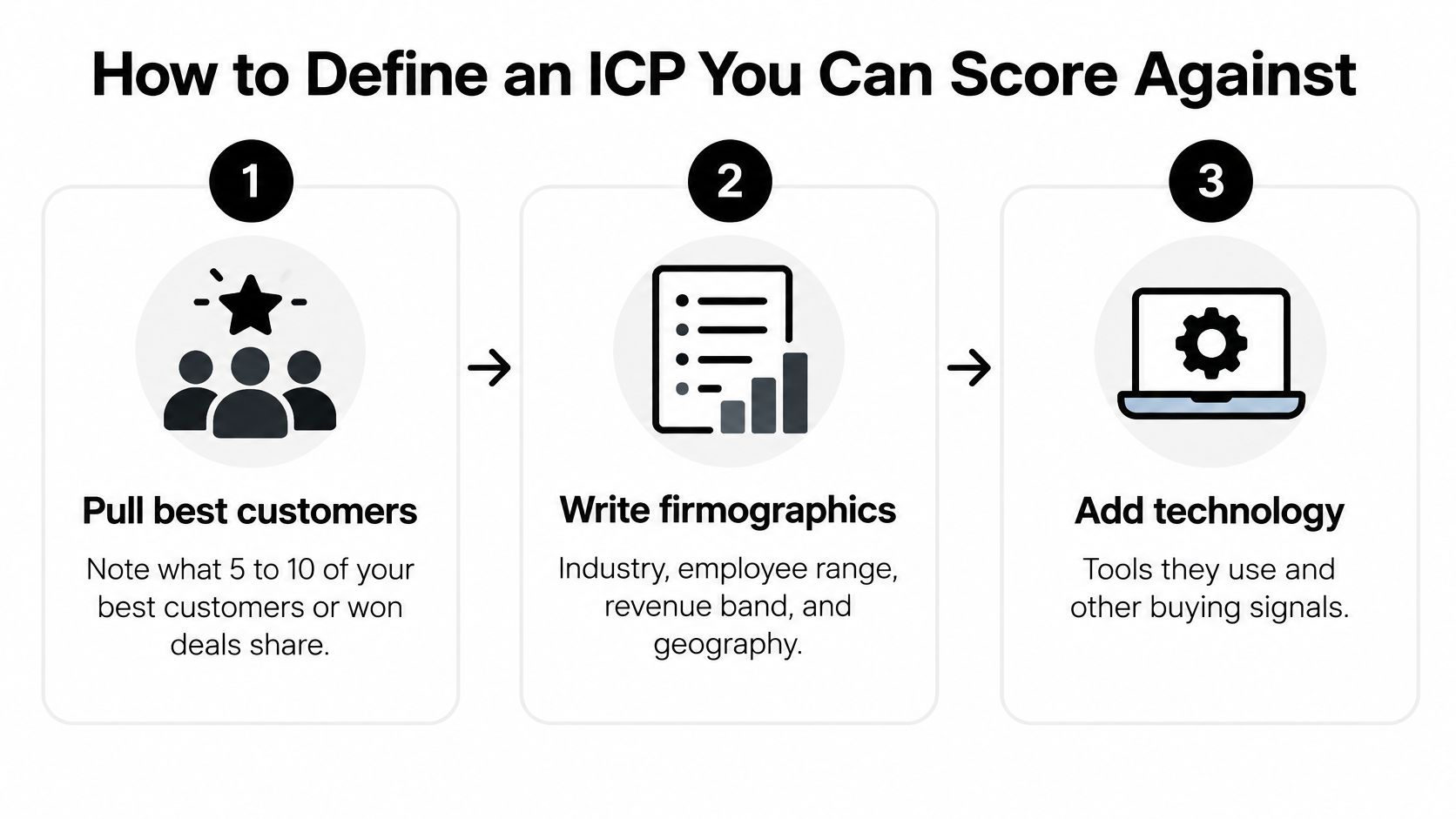
- Pull your best customers or won deals. Our lookalike setup starts by adding 5 to 10 best customers or importing won deals from your CRM. Compare why they bought, what implementation required and whether the relationship makes commercial sense.
- Write the firmographics. Specify industry, employee range, revenue band and geography. Distinguish requirements from preferences so a missing revenue estimate doesn't automatically reject an otherwise suitable account.
- Add technology requirements. Separate tools your product needs from tools that merely suggest an opportunity. A complementary platform can establish compatibility; an incumbent competitor may indicate either a replacement opportunity or a contractual obstacle.
- Choose relevant trigger types. An operations hire, location opening or funding announcement should connect to a problem you solve. Don't include a trigger just because it's easy to collect.
- List disqualifiers. Name unsupported markets, unsuitable company sizes and known contractual barriers. Record whether each disqualifier blocks outreach or defers it.
- Keep the judgments independent. Fit describes suitability, recency describes timing and confidence describes evidence quality. Don't let a recent announcement compensate for an unsupported company profile.
Work through an ambiguous account
Say you're evaluating a logistics firm with around sixty employees that appears to have hired a head of operations. These are hypothetical account details, not recommended size thresholds.
| Axis | Example judgment | Reason |
|---|---|---|
| Fit | High | Industry, scale and operational complexity match your requirements |
| Recency | High | The apparent hire falls inside your hiring window |
| Confidence | Low | Only an unverified profile update supports the hire |
The account belongs in verification, not immediate outreach. A combined score could hide that uncertainty behind strong fit.
Use the guide to building and using an ideal customer profile to turn the schema into a repeatable review. For calibration, give reps the same sample of accounts independently and compare their rankings. If they disagree about the strongest candidates, tighten the definitions before automating them.
Finding Accounts Through Live Buying Signals
Use these as starting operating windows, not research-established expiration dates. Shorten or extend them when your own results justify a change.
| Signal | Example | Freshness window | Why it matters |
|---|---|---|---|
| Hiring | Head of operations posted this month | Last 30 days | May signal a new priority or budget |
| Funding | Series B announced | Last 90 days | May create room for new tools |
| Leadership change | New CRO or VP of Sales | Last 90 days | A new owner may review vendors |
| Technology shift | Adds a data warehouse or drops a legacy tool | Last 60 days | May open an integration need or gap |
| Reviews or reputation | Rating drop on a review site | Last 30 days | Supports investigation of a specific problem |
| Website intent | Repeat visits to pricing or demo pages | Last 14 days | Indicates account-level research activity |
Organizational change is a useful starting point: Gartner's B2B buying report reports that 99% of B2B purchases are driven by organizational changes. That doesn't mean every change creates demand for your product.
Require independent evidence
Say a company announces funding and publishes a sales leadership vacancy. The announcement establishes the financing event; the vacancy supports a narrower hypothesis about commercial expansion. Together, they justify investigating sales infrastructure needs, not claiming the company has approved a software budget.
A syndicated copy of the same press release isn't independent confirmation. Require separate evidence for the commercial interpretation, and seek direct corroboration when the underlying event itself is uncertain.
Build saved searches around competitor, technology stack, hiring, location or niche. Re-run them nightly and add only new companies. Our live-signal lead discovery guide explains how to structure that search work.
For advertising-focused prospecting, SendX's overview of tools for researching potential advertisers offers a useful tool-selection reference. Choose sources that expose evidence you can inspect, rather than accepting an unexplained intent label.
Match the message to the role
Warm paths include former customers, account-level website visitors, relevant connections and people engaging with competitor content. They make an introduction less cold; they don't establish purchase readiness.
A technology migration points toward a technical owner. A reputation problem may point toward an owner or marketing lead. Website activity identifies an account, not necessarily the individual who visited.
Keep each signal list small enough to review manually. Remove expired triggers instead of preserving them to maintain list size.
Scoring Inbound Signups Within Five Minutes
Fast response requires a short decision path, not a fully completed company profile. Separate checks needed for safe routing from details a rep can collect after making contact.
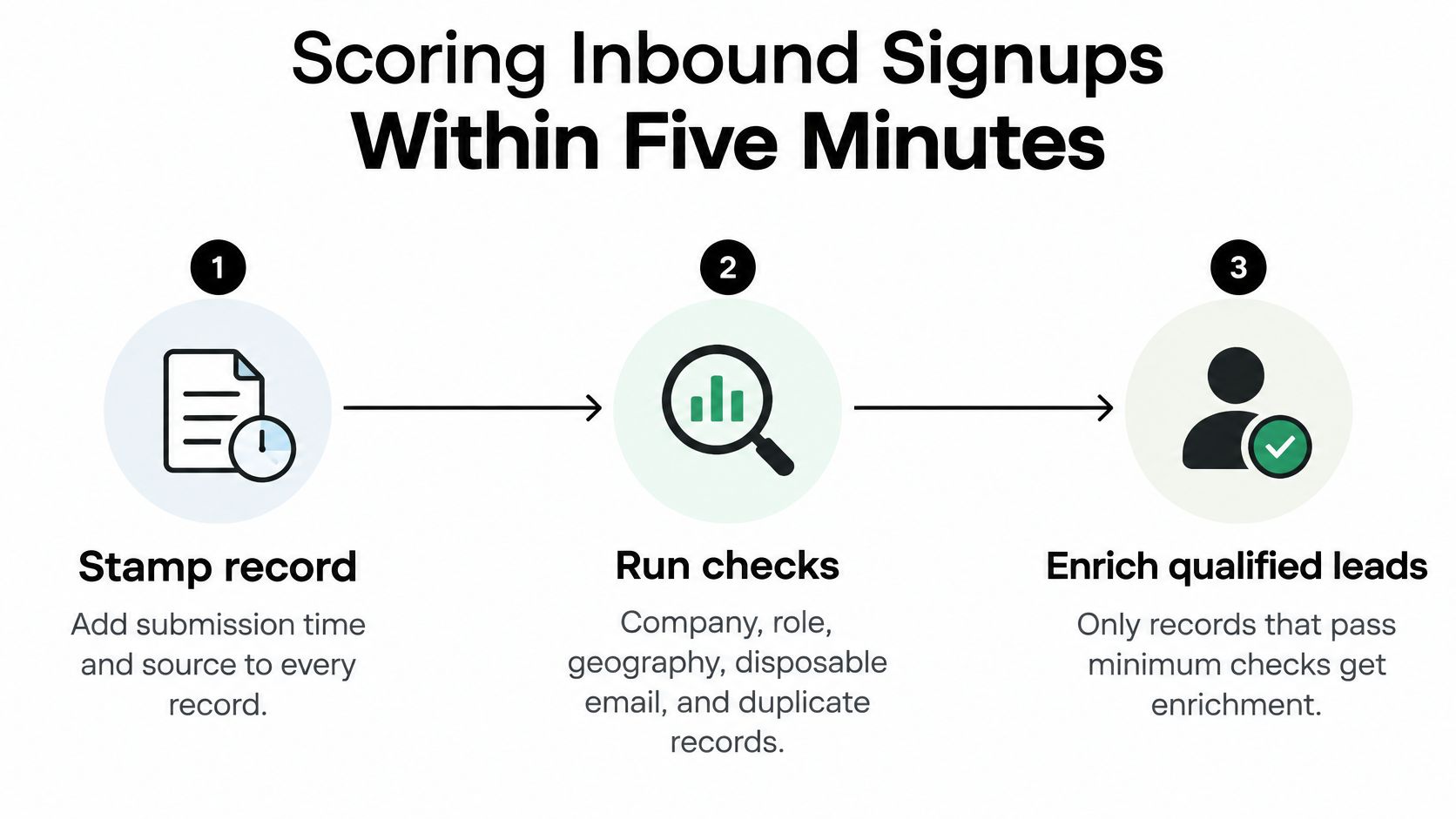
- Stamp the record. Save submission time, source and campaign context immediately. Keep the original timestamp through enrichment and CRM updates.
- Run deterministic checks. Check company, role, geography, disposable email and duplicates. Normalize domains before matching existing accounts.
- Enrich eligible records only. Reject obvious mismatches first. Don't block an otherwise verified inquiry while waiting for optional fields.
- Assign separate fit, risk and confidence labels. Missing information should reduce confidence, not become a poor fit without notice. Risk flags require their own decision.
- Route qualified submissions immediately. Apply the named owner and deadline attached to the outcome. A queue assignment alone isn't a contact attempt.
- Use hold and nurture deliberately. Hold means a fact needs resolving; nurture means the record isn't ready for sales involvement. Neither should become an abandoned inbox.
The screening path should remain short enough to operate while the buyer is still available.
Set the response target carefully
Martal's speed-to-lead review summarizes the following historical findings, including the Lead Response Management comparison of contact within five minutes versus thirty minutes, which found approximately 100 times higher contact odds and 21 times higher qualification odds.
| Response timing | Documented effect | Source |
|---|---|---|
| Within 5 minutes vs 30 minutes | About 100 times higher contact odds and 21 times higher qualification odds | Lead Response Management study, 15,000+ leads |
| Within 1 hour vs one hour later | Nearly 7 times more likely to qualify the lead | 2011 HBR research associated with its audit of 2,241 companies |
| Within 1 hour vs 24+ hours | Waiting at least 24 hours reduced qualification likelihood by more than 60 times | 2011 HBR research associated with its audit of 2,241 companies |
| No reply at all | 23% of companies never responded | 2011 HBR audit of 2,241 companies |
| Average reply among responders | About 42 hours | 2011 HBR audit of 2,241 companies |
These studies differ in design and age. Use them to justify a five-minute contact-attempt target, not to promise a conversion multiplier.
For example, a verified fintech signup arriving at 9:14 should receive an attempted human response by 9:19, not merely appear in an account executive's queue. A free-mail submission without a company belongs in verification.
Track median and 90th-percentile time to first action by segment, with contact attempts distinguished from automated acknowledgments. Escalate unworked high-fit submissions automatically. Job title alone and form completion alone aren't qualification.
Keeping Accounts Fresh and Timing Your Outreach
Before sending, check the record that exists today, not the version used to build the campaign.
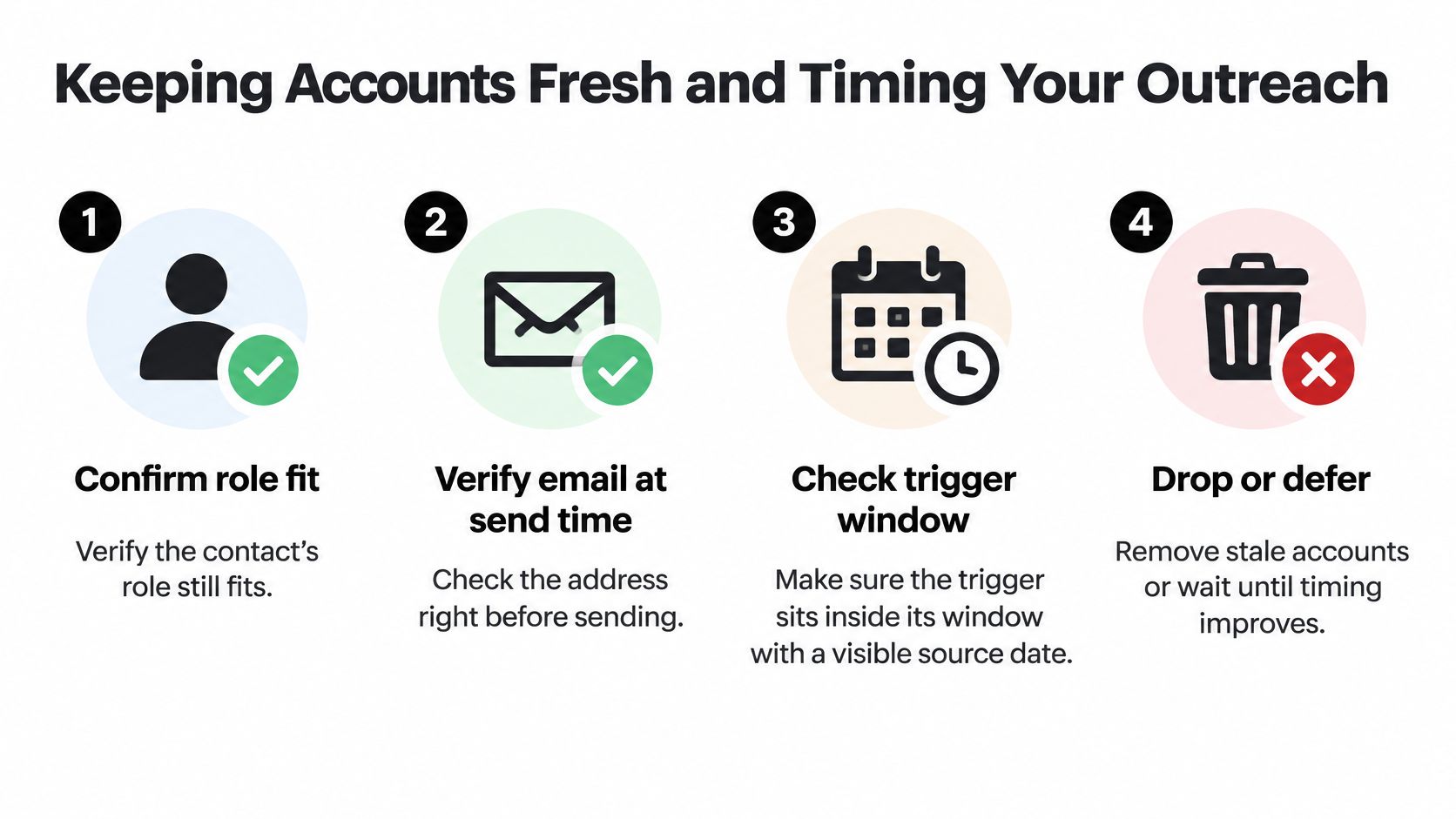
- Confirm role fit. Make sure the person still works at the account and owns the relevant responsibility.
- Verify the email at send time. A previously valid address isn't sufficient evidence for a new send.
- Check the trigger window. Preserve both the event date and the date you observed it.
- Drop or re-grade changed accounts. A closed location or replaced technology can invalidate the original reason to contact them.
Use this checklist as a send gate rather than an optional research task.
Track invalidation rather than a universal decay rate
Databar's guide to preventing CRM data decay cites an estimate of approximately 22.5% annual B2B contact-data decay, with about 2.1% monthly decay also reported. Definitions differ across published estimates, so neither figure guarantees the accuracy of your database.
A job change, bounced address and business closure affect different fields and require different responses. Logging an explicit invalidation event tells an operator what to fix; applying a blanket freshness percentage doesn't.
Check priority accounts daily and sweep the remainder weekly as a starting cadence. Deduplicate by domain, preserve confidence labels and suppress claims whose supporting evidence has disappeared.
A freshly verified email tells you where a message might arrive. It doesn't tell you why the recipient should care.
Test whether the moment needs human interpretation
Say a newly appointed operations leader has publicly described a vendor-consolidation initiative. A salesperson can help explain migration dependencies or integration trade-offs. A generic funding announcement doesn't establish that same need.
The useful question is what can the seller help this account decide? If the answer is only learn that our product exists, defer the outreach or improve the evidence.
Don't copy old personalization into a new sequence. Rebuild the opening from the current account situation, and remove scheduled touches when the underlying premise no longer holds.
Keep provenance attached as people enter campaigns from searches, feeds, connections, signups, customer lists or watched-account alerts. Different sources require different checks; a known former customer and an anonymous company visit shouldn't receive identical assumptions.
Syncing Scores to Your CRM and Routing Leads
Treat these deadlines as operating rules to adopt and test, not universal industry standards. Risk holds override sales routing until the flagged issue is resolved.
| Score outcome | Condition | Action | Owner | Deadline |
|---|---|---|---|---|
| High fit, high confidence | Fit and confidence both pass threshold | Route to sales now | Account executive | Within 5 minutes |
| High fit, low confidence | Fit passes but a key field is unverified | Enrich, then route once verified | SDR | Same business day |
| Low fit, low risk | Fit below threshold with no risk flags | Nurture sequence | Marketing | Next scheduled nurture run |
| Any risk flag | Disposable email, duplicate record or competitor domain | Hold for review | RevOps | Daily review |
| Watched account, new trigger | Two sources confirm a signal | Alert the account owner | Account owner | Same day |
Store decisions as usable fields
Write firmographics, ICP grade, trigger type, source date and decision status to company records as separate fields. Store the why-now explanation in its own field too, rather than burying everything in an activity note.
Keep fit, recency, confidence and risk independently filterable in HubSpot, Pipedrive or Attio. A rep should be able to find suitable accounts awaiting verification without reverse-engineering a blended score.
Define thresholds in plain language before translating them into automation. High fit might require every mandatory ICP condition and no hard disqualifier; high confidence requires verified routing fields and supported trigger evidence.
Backfill existing records once, then refresh priority accounts on schedule. Deduplicate before syncing, with an exception path for subsidiaries or separate business units sharing a domain.
Make ownership cross-functional
In a 2025 survey of 534 B2B marketing professionals across the U.S., UK, Europe and Asia, 36% identified qualification as problematic and 34% cited nurturing, according to MediaPost's account of the survey. These aren't problems an SDR can solve by finding more names.
Send alerts to Slack, Teams, email or a webhook with the evidence, date, owner and required action attached. An alert without an owner is just another notification.
For example, an account graded B with a fresh trigger can remain in nurture when it misses a mandatory sales-fit condition. Recent activity shouldn't erase that condition.
Review thresholds monthly. Compare conversion by response bucket, source, territory and ICP grade rather than celebrating an aggregate rate that may hide weak segments.
Before connecting integrations, write down the rules for sales routing, verification holds and nurture entry. Automating an unresolved policy makes the disagreement harder to diagnose.
Launch Your First Outreach Sequence and Measure It
Run a short sequence with a clear reason for every touch. Stop it immediately when someone replies, and suppress anyone who opts out.
The seller's job is to interpret the account change, not repeat it.

| Step | Channel | Message angle |
|---|---|---|
| 1 | A new office, location or hire, named in the first line | |
| 2 | Connection request with no note | |
| 3 | One short example from a firm like theirs | |
| 4 | A simple question that is easy to answer |
Cite the trigger's source naturally in the first email. Then connect it to a decision: a location announcement might justify asking how the company will standardize lead handling across branches. Don't claim it has a lead-handling problem unless you can support that claim.
Use a relevant published example in the follow-up, not an invented customer story. The B2B outreach email examples can help with structure, but the account evidence must supply the opening.
Measure relevance and execution
Relevance matters beyond reply rate: 73% of B2B buyers actively avoid suppliers sending irrelevant outreach, and 69% report inconsistencies between supplier websites and seller-provided information, according to Gartner's 2025 buyer survey. Check that your message matches what buyers can verify on your website.
Use the campaign walkthrough alongside your written operating rules.
Track time to first action, including its median and slower tail; reply rate by trigger type; meeting rate by source and ICP grade; source-date coverage; and bounce rate. Separate positive replies from refusals so provocative messaging doesn't look like progress.
For a practical pilot, use a two-week test: choose one ICP segment and saved search, review twenty signups, and run the sequence on thirty evidence-backed accounts. Those are manageable test sizes, not performance benchmarks. Review the outcomes against your routing rules before increasing volume.
CapyScout finds fitting companies and the right person, monitors account changes, and attaches evidence to the reason for outreach. Visit CapyScout to choose your audience and lead sources, review the drafted messages, and approve outreach from your own inbox or LinkedIn.
Not ready to start? Get a free target list: 10 companies to sell to, picked from your website.