

10 Review Monitoring Software Options for 2026
Compare 10 review monitoring software options for B2B, local, multi-location, and app teams by features, fit, pricing, and workflow.
The broadest review dashboard isn't automatically the best choice. A tool that aggregates every possible publisher can still fail if it doesn't detect a meaningful rating change, route the alert to the right owner, support safe responses, or connect the signal to a revenue decision.
Start with the job. Define which review sources matter, whether you manage one location or many, who responds, how much sentiment analysis you need, how quickly alerts must arrive, which integrations your team already uses, and whether you want subscription pricing, location-based pricing, or a credit-based model. Online reviews have become a measurable part of purchase consideration. LocaliQ's 2026 review compilation reports that 93% of people read online reviews before buying, 84% trust them as much as recommendations from friends or family, and 64% check Google Business Profiles first.
This list compares ten options by the workflow they support, from enterprise reputation management and SMS-led review collection to app-store intelligence and local prospecting. It also explains where online review monitoring for SEO growth fits into the decision, and where CapyScout adds account-level timing signals instead of trying to replace every response, survey, or listings function.
Table of Contents
- 1. Local Business Lead Generation, CapyScout
- 2. Birdeye
- 3. Podium
- 4. Reputation, formerly Reputation.com
- 5. ReviewTrackers
- 6. Yext Reviews
- 7. BrightLocal Reputation Manager
- 8. Chatmeter, Alchemer Reputation
- 9. SOCi, Genius Reviews and Reputation
- 10. AppFollow
- Top 10 Review Monitoring Tools, Side-by-Side Feature Comparison
- Choose the Workflow You Will Actually Run
1. Local Business Lead Generation, CapyScout
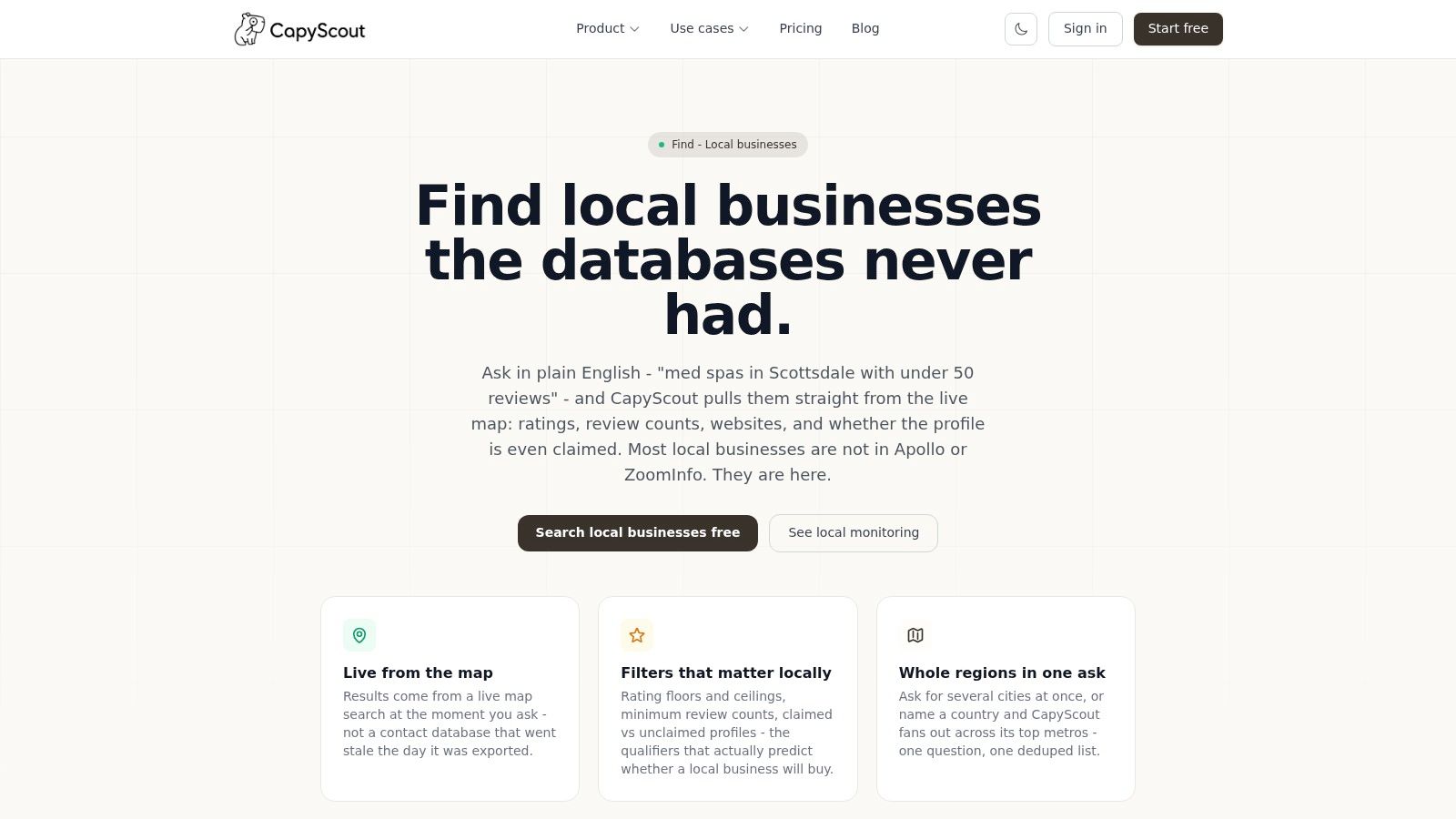
CapyScout is the strongest fit when a review change isn't just a reputation issue, but a reason to contact a business now. Its Local Business Lead Generation product monitors selected Google Business Profiles and other map listings for rating changes, review-count movements, sentiment shifts, profile-status issues, and review stalls. Instead of leaving an operator with a dashboard to inspect, it turns a detected change into a scored account opportunity.
That distinction matters for agencies, local marketers, and sales teams. A new negative review or a stalled review cadence gives an outreach message a specific business context. CapyScout's alerts are source-backed, so the user can see the origin of the signal and build a brief around a recent event rather than relying on a generic claim about reputation.
Where CapyScout changes the workflow
Saved watchlists run on Autopilot nightly, checking watched accounts and building a scored Today queue. Matched businesses can receive firmographic enrichment, ICP grading, and a “Why now” explanation. Alerts can route to Slack, Teams, email, or webhooks, while CRM records can sync with HubSpot, Pipedrive, or Attio.
Outreach drafts open prefilled in Gmail or Outlook without requiring inbox OAuth. That keeps the user's existing sending environment and threading intact, while the source-backed brief supplies the specific event behind the message. The platform also supports account monitoring beyond reviews, including hiring, funding, leadership, technology, news, and website-intent signals.
Practical rule: Choose CapyScout when the desired output is not simply “a review needs a reply,” but “this local account has a timely problem, a fit score, and a reason for sales or service outreach today.”
The limitation is equally clear. CapyScout is primarily valuable for businesses with public map listings and local service footprints. It isn't the natural choice for a purely digital SaaS company that mainly needs app-store reviews, or for an enterprise team whose central requirement is high-volume review response governance. Watchlist thresholds, enrichment rules, and integrations also require initial setup, and credit-based pricing needs planning for larger monitoring programs.
For local agencies and account teams, the relevant companion resource is the speed to lead bible for home. CapyScout's differentiator is timing and account intelligence, not a claim to be a full replacement for every dedicated reputation suite.
Website: CapyScout Local Business Lead Generation
2. Birdeye
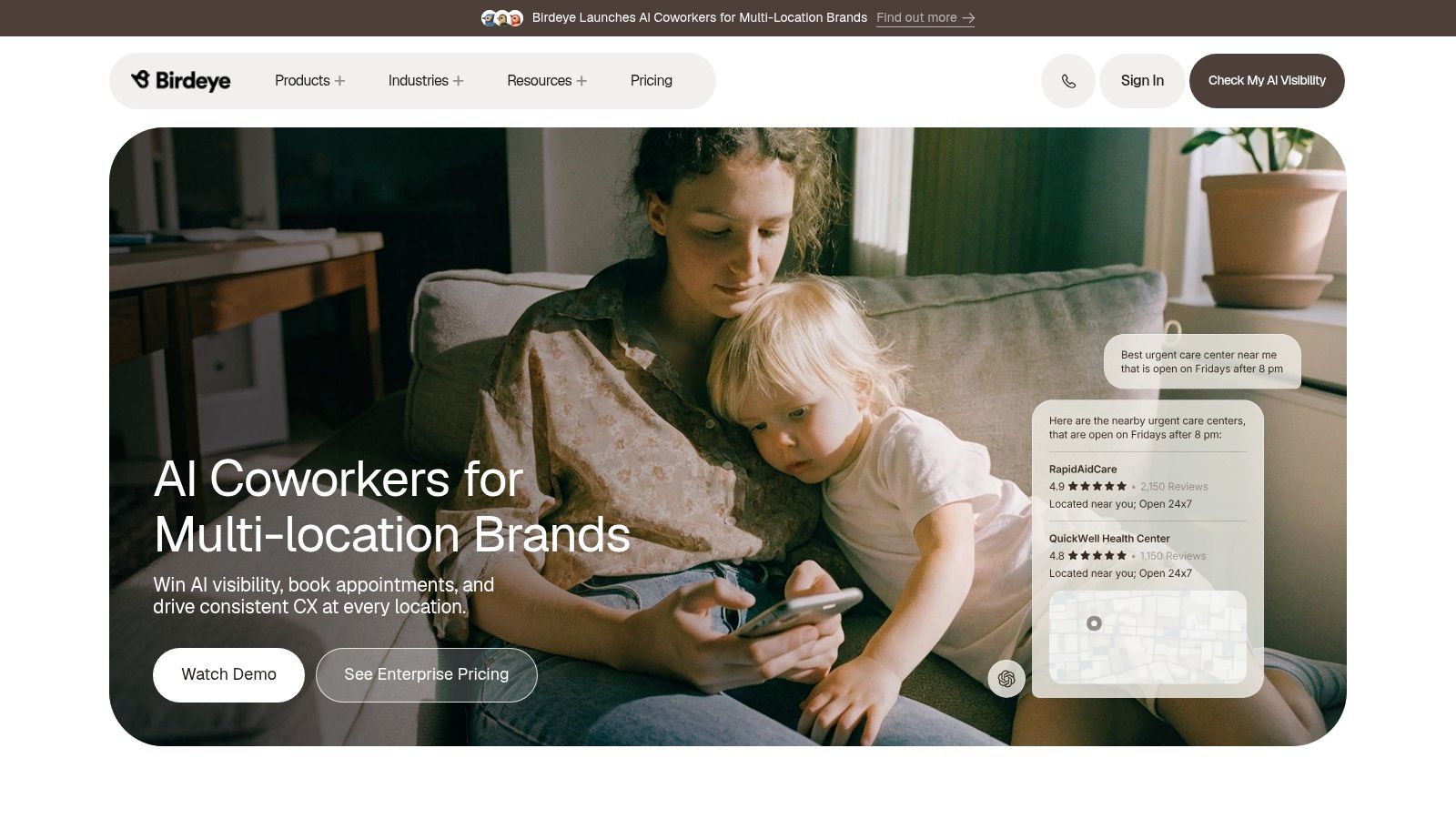
Birdeye is a reputation and customer-experience suite for organizations that need more than review alerts. It aggregates feedback from Google, Facebook, Yelp, and industry directories, then connects monitoring with response assignment, approvals, review requests, listings management, messaging, and surveys. That combination fits multi-location brands, franchises, healthcare organizations, home-service companies, and retailers with several teams or customer touchpoints.
The platform's main value is workflow coverage. Teams can monitor reviews, send SMS or email invitations, manage listings, and handle customer conversations through connected processes. Assigning responses to specific owners turns reputation work into a visible queue, which is more reliable than leaving each location to manage reviews informally.
Best use and trade-off
Birdeye makes the strongest fit when a business has enough locations, staff, and customer interactions to justify a shared reputation and experience system. Its review-generation automation matters when the operating goal includes requesting new feedback, not only detecting negative or positive changes in existing reviews.
That operating model differs from CapyScout. Birdeye helps teams run review, messaging, listings, and survey workflows. CapyScout helps an agency or sales team identify an account whose reputation has changed and assess whether the timing supports outreach. Neither tool replaces the other in every workflow.
A broad suite earns its cost when the team will actively use its connected workflows. Otherwise, the extra modules can create administrative overhead.
Pricing is not public, and package costs may increase as capabilities and locations are added. Smaller teams may find the platform heavier than needed if they only require alerts and basic response management. Buyers should confirm which publishers, automation features, reporting controls, and support services the proposed package includes. For a focused price and feature comparison, compare Birdeye alternatives for ecommerce brands.
Website: Birdeye
3. Podium
Podium treats reviews as part of a communication workflow rather than as an isolated monitoring category. Its platform combines review management with texting, payments, webchat, and shared-inbox functionality. That makes it especially suitable for dental practices, med-spas, automotive businesses, home-service providers, and other local companies whose front desk already communicates with customers by SMS.
The product's practical strength is simplicity at the point of use. A team can invite customers to review, monitor incoming feedback, and respond through a workflow that resembles its existing customer messaging process. SMS invitations and automation reduce the need to move between a review tool and a separate communication system.
Why SMS matters here
Podium is a good choice when the business wants review generation tied closely to day-to-day customer contact. A receptionist, service coordinator, or location manager can work from a shared hub instead of managing review requests through disconnected email templates and manual follow-up.
Its vertical packages and add-ons also make the product more relevant to local operators with specific operational needs. Payments and webchat can extend the value beyond reputation, although they also make the buying decision less about review monitoring alone.
The limitation is analytical depth. Podium's SMS-first model is compelling for execution, but teams seeking extensive cross-location benchmarking, advanced sentiment investigation, or a broad customer-experience analytics layer may need a more specialized or enterprise-oriented platform. Pricing isn't fully public and varies by features and locations, so comparisons should use the complete operating package rather than a headline plan.
Podium is therefore a strong fit for a local business that needs staff adoption and fast customer communication. It's less compelling for a B2B sales team that wants reputation changes converted into enriched account records, ICP scores, and prospecting queues.
Website: Podium
4. Reputation, formerly Reputation.com
Reputation is designed for large multi-location organizations that want reviews connected to wider customer-experience measurement. Its scope includes review collection and response, surveys, social channels, messaging, reputation insights, competitive benchmarking, and operational workflows such as case or ticket handling.
The platform's value comes from connecting a public review to the internal experience that may have caused it. A location or enterprise team can use review data alongside survey feedback and other customer signals, then route issues into a structured workflow. AI-assisted response features can support scale, while optional managed services provide additional help for organizations that don't want every response handled internally.
Enterprise governance over simple alerts
Reputation's Reputation Score and benchmarking functions give leadership a higher-level view than a simple stream of new reviews. That view is useful when executives need to compare locations, identify patterns, and connect reputation performance with customer-experience programs.
Its services layer is another differentiator. Large brands may prefer a platform that combines software with operational support, especially when response volume, approval requirements, and brand consistency make internal staffing difficult.
Buying implication: Reputation is strongest when review management is one component of a formal customer-experience program. It may be excessive if the only requirement is receiving alerts when a Google review arrives.
Pricing is quote-based, and modular packaging can make the buying process complex. Smaller businesses may pay for capabilities they won't use, while enterprise buyers should ask how integrations, benchmarking, managed response, surveys, social monitoring, and location administration affect the final scope.
Reputation is a dedicated reputation and CX choice. CapyScout serves a different moment, identifying a local account whose review or profile change may justify prospecting, enrichment, or account intervention.
Website: Reputation
5. ReviewTrackers
ReviewTrackers focuses more directly on review monitoring and response than on being a full customer-experience suite. It centralizes reviews and alerts from major sites, supports response management and routing, and adds practical analytics around themes, sentiment, and location-level trends. Embeddable widgets and sharing tools extend the value of positive feedback beyond the internal dashboard.
The product suits multi-location SMB and mid-market teams that want a usable monitoring layer without adopting a much broader platform. Its straightforward interface is important because review monitoring fails when location managers don't understand which alerts matter or who owns the response.
A practical middle ground
ReviewTrackers sits between lightweight alerting tools and enterprise reputation suites. It offers enough organization for teams that need assignments, response workflows, and reporting, while keeping the central job focused on reviews. Support and onboarding are often part of its appeal for businesses that want help turning the tool into a repeatable process.
A team evaluating the product should test whether its sentiment and theme reporting are specific enough to distinguish isolated complaints from recurring operational issues. It should also check how alerts are prioritized, whether location managers can be separated from corporate administrators, and how reports reach people who don't log into the product regularly.
For setup context, compare the workflow with this Google review monitoring practical setup guide. The key question isn't whether ReviewTrackers can display reviews. It's whether it can reliably move a meaningful review from detection to ownership, response, escalation, and reporting.
Pricing isn't public, and enterprise functionality requires sales engagement. That may be reasonable for a growing multi-location brand, but it makes direct cost comparison harder for smaller organizations.
Website: ReviewTrackers
6. Yext Reviews
Yext Reviews is most attractive when Yext already manages a company's listings, local pages, or broader digital presence. Its review capability monitors publishers such as Google, Facebook, and Yelp, while the wider platform connects reviews with local visibility administration. It can also track brand-level entities, including employer reviews on Glassdoor or Indeed and reviews in app stores.
That entity model separates Yext from tools focused only on location reviews. A company may need to monitor a restaurant or clinic's local feedback while also watching employer sentiment or app-store feedback at the brand level. Yext's appeal grows as those entities share administration, permissions, and reporting requirements.
When the platform fit is already there
Yext offers review response tools with assignments, export, and sharing options. Enterprise administration, permissions, and auditability matter for distributed teams that need to document who handled feedback and how local teams operate within central rules.
The practical limitation is commercial fit. Feature availability depends on the package and add-ons, so buyers need to map the precise publisher and entity coverage before treating Yext as a complete review solution. If the organization isn't already using Yext for listings or pages, the review module alone may not provide the same value as a focused review platform.
Yext is a sensible choice for an enterprise that wants local listings, pages, and reviews in one administrative environment. It isn't the clearest option for a local agency whose main goal is to discover new accounts showing a fresh reputation problem and send a source-backed outreach brief.
A useful evaluation should include publisher coverage, brand-level versus location-level monitoring, permissions, response exports, and how review signals flow into the rest of the Yext environment.
Website: Yext Reviews
7. BrightLocal Reputation Manager
BrightLocal Reputation Manager is the most natural fit for agencies and SMBs that already think in local SEO workflows. It monitors reviews across a wide publisher set, provides a unified feed with filters and actions, automates email and SMS review requests, and includes widgets for displaying feedback on a website. Its reputation functions sit alongside rank tracking, citation work, and other local SEO tools.
That combination reduces tool sprawl for an agency managing local visibility. The same environment can support review monitoring and local search reporting, which makes client reporting easier when reputation and rankings are managed by the same team.
Agency economics and limits
BrightLocal is known for transparent, lower-entry pricing and practical onboarding. Those qualities matter to agencies that need to control software costs across client accounts and don't want every location manager to learn a complex enterprise system. Add-on pricing per location still needs attention, particularly as the account list expands.
The product is more “good enough” than enterprise-deep in analytics and AI. That isn't necessarily a weakness. A smaller agency may gain more from a clear review feed, review requests, and local SEO reporting than from advanced governance features it won't use.
Operational test: Ask whether the agency can identify the review, assign the response, show the client what changed, and connect that change to a local visibility conversation without exporting data manually.
BrightLocal is a strong reputation-management companion for local SEO practitioners. CapyScout becomes more relevant when the agency wants to find businesses outside its current client base, score them, enrich their records, and prioritize outreach around a new rating or sentiment event.
For a broader use-case comparison, see local reputation workflows. The distinction is important: BrightLocal helps manage and report on local SEO operations, while CapyScout adds prospect discovery and “Why now” timing.
Website: BrightLocal Reputation Manager
8. Chatmeter, Alchemer Reputation
Chatmeter, now associated with Alchemer Reputation, targets enterprise multi-location programs that need deeper controls over review risk, sentiment, and response operations. It centralizes review monitoring and response, provides a mobile app, and adds Pulse AI for sentiment and risk monitoring. Automation rules can support carefully controlled auto-replies, while ChatExec offers an optional managed team for response handling.
The product is better suited to organizations where brand safety and governance matter as much as speed. A franchise or distributed brand may need to detect sensitive feedback, apply response rules consistently, and allow central administrators to oversee local execution.
AI is useful only with control
AI-assisted sentiment and risk triage can reduce the volume that humans must inspect, but the operational question is how the organization handles uncertainty. Teams should test whether automation rules can separate routine praise, service complaints, safety concerns, and issues requiring escalation. They should also verify whether human approval remains available for categories where an inappropriate reply could create a larger problem.
Chatmeter's optional managed service changes the staffing calculation. A brand can use the platform as software, or combine it with external response support when internal location teams aren't equipped to manage review volume.
Quote-based, per-location pricing can become premium at scale, and the depth of the feature set requires training. Smaller organizations may find that they are buying governance and workflow capabilities beyond their actual needs.
Chatmeter is strongest for enterprise reputation operations with meaningful risk controls. It isn't designed primarily to identify new prospects from local reputation changes, which is where CapyScout's account-level queue and CRM workflows take a different position.
For a reusable operating pattern, review these local reputation templates and compare the required rules with the controls available in the proposed Chatmeter package.
Website: Chatmeter
9. SOCi, Genius Reviews and Reputation
SOCi combines review management with listings and social marketing for franchises and distributed brands. Its review workflows centralize monitoring and responses, while brand and approval controls help corporate teams manage local execution. AI-assisted responses operate within compliance guardrails, including SOCi Shield, so locations can work faster without abandoning brand standards.
This is a strong architecture for organizations with many local operators and a central marketing function. Corporate teams can define permissions, reporting, and approval expectations, while local teams handle the interactions closest to customers. Combining reviews, listings, and social can also reduce the number of separate systems franchise marketers must administer.
The franchise fit
SOCi's value is less about being the simplest review inbox and more about coordinating a distributed marketing system. Its reporting and integrations support oversight, while the role and permission model addresses a problem that smaller review tools may not solve well: local autonomy without uncontrolled messaging.
The trade-off is implementation effort. AI and templates need upfront configuration if responses are to sound appropriate across brands, locations, and issue types. Enterprise pricing is quote-based and may exceed the budget of a small business that only needs Google review monitoring and basic response assignment.
Buyers should test the approval path with real examples. Can a location respond quickly to a routine review? Can corporate staff review a sensitive complaint? Can the system preserve brand language without producing repetitive or unsuitable replies? Those tests reveal more than a feature list.
SOCi is a decisive choice for franchise governance and multi-location marketing. CapyScout complements rather than replaces it when a team wants to discover external local accounts, monitor their reputation signals, and route high-priority opportunities into sales or agency outreach.
Website: SOCi
10. AppFollow
AppFollow is the specialist option for app-store reviews. It consolidates reviews from the Apple App Store, Google Play, Samsung, and other stores, then adds reply and escalation tools, semantic analysis, tags, auto-replies, translation, reporting, APIs, and integrations.
Its fit is clear for SaaS and product teams whose customers leave feedback inside mobile ecosystems. Product managers can identify recurring themes, customer-success teams can escalate issues, and support or community teams can coordinate replies without manually checking each store.
App intelligence rather than local reputation
AppFollow's advantage is depth within app ecosystems. Translation and semantic analysis help distributed product teams work across markets, while tagging and reporting can connect public feedback with roadmap or support decisions. Different tiers, including a free option, make it easier for smaller product teams to begin with a focused use case and expand as requirements grow.
The limitation is equally important. AppFollow isn't a local-business review platform, so it won't replace Google Business Profile monitoring, map-listing reputation workflows, or location-level outreach. A local agency evaluating it for service-business clients would be solving the wrong problem.
Advanced capabilities are available only on higher-tier plans, so teams should test the specific stores, automation rules, integrations, and reporting functions needed for production use. They should also define who owns escalation when an app review signals a support issue, a product defect, or a broader customer-experience pattern.
AppFollow is the right choice when app-store feedback is the primary reputation surface. It doesn't compete directly with CapyScout's local account intelligence, because CapyScout's job is to connect reputation and other live-web signals with account prioritization and outreach timing.
Website: AppFollow
Top 10 Review Monitoring Tools, Side-by-Side Feature Comparison
| Product | Core features | UX / Quality | Value & Pricing | Target audience | Unique selling points |
|---|---|---|---|---|---|
| 🏆 CapyScout, Local Business Lead Generation | Real‑time Google Business Profile & map listing monitoring; Autopilot watchlists; CRM enrichment & outreach drafts | ★★★★★, precision signals, source‑backed briefs | 💰 Credit‑based, unlimited seats; costed for teams | 👥 Local agencies, SMBs, service businesses | ✨ Source‑backed buying moments, nightly Autopilot, CRM sync & prefilled drafts (no inbox OAuth) |
| Birdeye | Aggregated review monitoring, review generation, listings, surveys | ★★★★☆, enterprise polish | 💰 Quote / higher with add‑ons | 👥 Multi‑location brands, franchises, healthcare, retail | ✨ Broad publisher coverage + mature multi‑location controls |
| Podium | SMS review invites, unified messaging inbox, payments & webchat | ★★★★, mobile & SMS‑first UX | 💰 Feature/location pricing; varies by package | 👥 Local businesses (dental, auto, home services) | ✨ Excellent SMS workflows and front‑desk friendliness |
| Reputation (formerly Reputation.com) | Reviews + surveys + social + analytics; Reputation Score & CX insights | ★★★★, enterprise analytics | 💰 Quote‑based, modular packaging | 👥 Large enterprises & multi‑location brands | ✨ Deep CX benchmarking + optional managed services |
| ReviewTrackers | Centralized review feed, response routing, basic analytics, widgets | ★★★★, straightforward, strong support | 💰 Pricing via sales; practical mid‑market value | 👥 SMBs & mid‑market multi‑location brands | ✨ Easy onboarding and customer success focus |
| Yext Reviews | Reviews + response tools integrated with Listings & Pages | ★★★★, integrated local visibility | 💰 Package/add‑on dependent; best with Yext stack | 👥 Brands already using Yext; enterprises | ✨ Listings + reviews in one platform; brand‑level entities |
| BrightLocal Reputation Manager | Monitor 80+ sites, review requests, local SEO tools | ★★★★, simple, agency‑friendly | 💰 Transparent, lower entry pricing; per‑location add‑ons | 👥 Agencies & SMBs focused on local SEO | ✨ Cost‑effective combo of reputation + local SEO |
| Chatmeter (Alchemer/Chatmeter) | AI sentiment/risk, automation, mobile app, managed response | ★★★★, powerful AI triage | 💰 Quote‑based; premium at scale | 👥 Large multi‑location brands needing governance | ✨ AI risk monitoring + optional managed review teams |
| SOCi (Genius Reviews) | Centralized reviews, AI responses with compliance, franchise controls | ★★★★, governance & compliance focus | 💰 Quote‑based enterprise pricing | 👥 Franchises & distributed brands | ✨ Role/permission model + brand‑safe AI responses |
| AppFollow | App Store & Play review consolidation, AI analysis, auto‑replies, API | ★★★★, product & CS focused | 💰 Free & paid tiers; clear tiers for teams | 👥 Product, mobile & SaaS teams tracking app reviews | ✨ Purpose‑built for app ecosystems and roadmap insights |
Choose the Workflow You Will Actually Run
The market is moving from manual review checking toward automated, always-on monitoring. One Market Research Future analysis values the online reputation management software market at USD 13.24 billion in 2024, projects USD 14.03 billion in 2025, and forecasts USD 24.96 billion by 2035, with a 5.93% CAGR. A separate review monitoring tool market estimate places the category at USD 2.55 billion in 2024 and forecasts USD 5.5 billion by 2035, implying a 7.2% CAGR across the stated period.
Those figures don't tell you which product to buy. They do explain why buyers now encounter tools with very different purposes, from SMS review generation to app-store analysis, enterprise governance, and account-level prospecting. The right comparison starts with the operational outcome, not the longest feature list.
Map the entities first. List every location, brand, app, employer profile, marketplace presence, and account that must be watched. Then identify the sources that affect decisions. Google Business Profiles may be central for local service businesses, while app stores matter more for product teams and employer platforms may matter for recruitment or brand functions.
Next, test the alert-to-action path:
- Alert quality: Can the tool identify a rating movement, new negative review, sentiment shift, review stall, or risk pattern without flooding the team?
- Ownership: Does each alert reach a named responder, location manager, customer-success owner, or sales representative?
- Sentiment handling: Can users inspect the theme behind a change rather than relying on a score with no explanation?
- Response controls: Are templates, AI assistance, approvals, escalation, audit trails, and managed services appropriate to the risk?
- Integrations: Can signals reach the CRM, Slack, Teams, email, webhook, support system, or reporting environment already used by the team?
- Commercial fit: Are location limits, account limits, add-ons, credits, seats, and support costs clear?
- Implementation effort: How much configuration, training, publisher connection, and threshold tuning will the workflow require?
The adoption pressure is real. WorldMetrics' review monitoring figures report that 68% of businesses actively monitor review platforms and 41% use automated tools. That doesn't make automation automatically effective. A poor alert creates another queue, while a well-routed alert creates a decision.
Run a short pilot with representative locations or watched accounts. Include a mix of ordinary positive reviews, genuine complaints, rating changes, quiet periods, and any known operational edge cases. Verify that the tool captures the right sources, routes urgent changes to the correct owner, produces useful sentiment context, supports safe approval, and generates reporting that informs a real decision.
Also test for manipulation. Coordinated or AI-generated review activity may appear through generic language, low detail, or sudden clusters of similar reviews, but detection isn't a solved problem. The coverage of online review trends from Shapo highlights these red-flag patterns and points to predictive analytics and AI-assisted detection as emerging needs. Treat automated classification as triage, not unquestionable proof, and define when a human should investigate before hiding, escalating, or responding.
The most important unanswered question is often signal priority. Broad coverage sounds attractive, but industry analysis of review monitoring tools describes a shift toward multilingual monitoring, predictive analytics, and business-intelligence integrations. For a local agency, a high-confidence Google rating change may deserve immediate action. For a B2B account team, that review change may matter only when combined with hiring, funding, leadership, technology, or website-intent signals.
Choose Birdeye, Reputation, Chatmeter, or SOCi when enterprise response operations, governance, and multi-location administration are the primary job. Choose Podium when SMS-led customer communication is the center of the workflow. Choose ReviewTrackers or BrightLocal when focused monitoring and practical local SEO operations matter more than a full CX suite. Choose Yext when listings and entity management already anchor the stack, and choose AppFollow when app stores are the main review environment.
Choose CapyScout when the goal extends beyond managing reviews. Its stronger use case is finding local prospects, enriching accounts, grading fit, identifying a recent reputation change, and triggering source-backed outreach through CRM, collaboration, or email workflows. It won't replace every review-request, response, survey, or governance function, and it shouldn't be evaluated as though it does. It adds a layer for teams asking a different question: which account changed, why does it matter now, and who should act?
CapyScout monitors Google Business Profiles and other live account signals, then turns meaningful reputation changes into source-backed briefs, scored queues, CRM updates, and outreach drafts. Visit CapyScout to connect review monitoring with local prospect discovery, account enrichment, and timely action instead of leaving important signals in another dashboard.