

Review Monitoring Software: 10 Best Tools for 2026
Compare the best review monitoring software of 2026 for local businesses and agencies: GMB tracking, sentiment alerts, pricing, and agency workflows.
A dental practice owner opens Google on a Monday and finds a one-star review that has been public for three weeks. Nobody at the front desk was assigned to look. Across town, a local marketing agency hears about a client's rating slide only because the owner called, already angry. Both teams thought they had review monitoring software. What they had was a login and a habit of checking when someone remembered.
That gap is the expensive mistake. The category runs from a thin alert router into Slack to a customer-experience suite with surveys, listings and messaging. Buy the suite when you only needed alerts, and you pay for workflows nobody opens. Buy the alert tool when you needed review requests, and the rating stays flat because happy patients are never asked to write.
The ten options here are not interchangeable. Each tool gets judged against the job it fits: local businesses that need more reviews, agencies running client portfolios, enterprises benchmarking experience, ops teams routing alerts, and teams that turn a reputation change into outbound outreach. I weigh quote-based pricing, feature gates and add-ons that change the final bill, because those decide whether a tool survives contact with a real budget.
Feature lists mislead in any software category. A platform selection guide for ecommerce brands makes the same job-first argument for storefronts, though the criteria there differ from review monitoring. BrightLocal's 2025 Local Consumer Review Survey of 1,026 U.S. adults found that only 4% never read online business reviews, so about 96% read them at least sometimes, and 74% check at least two sites before they buy. Name your scenario first. Then shortlist only the tools built for it.
Table of Contents
- 1. Scenarios - Local Reputation
- 2. Birdeye
- 3. Podium
- 4. GatherUp
- 5. ReviewTrackers
- 6. Reputation
- 7. NiceJob
- 8. Grade.us
- 9. BrightLocal
- 10. Reviewflowz
- Review Monitoring Software Compared
- How to Choose: Match the Tool to Your Scenario, Not the Feature List
1. Scenarios - Local Reputation
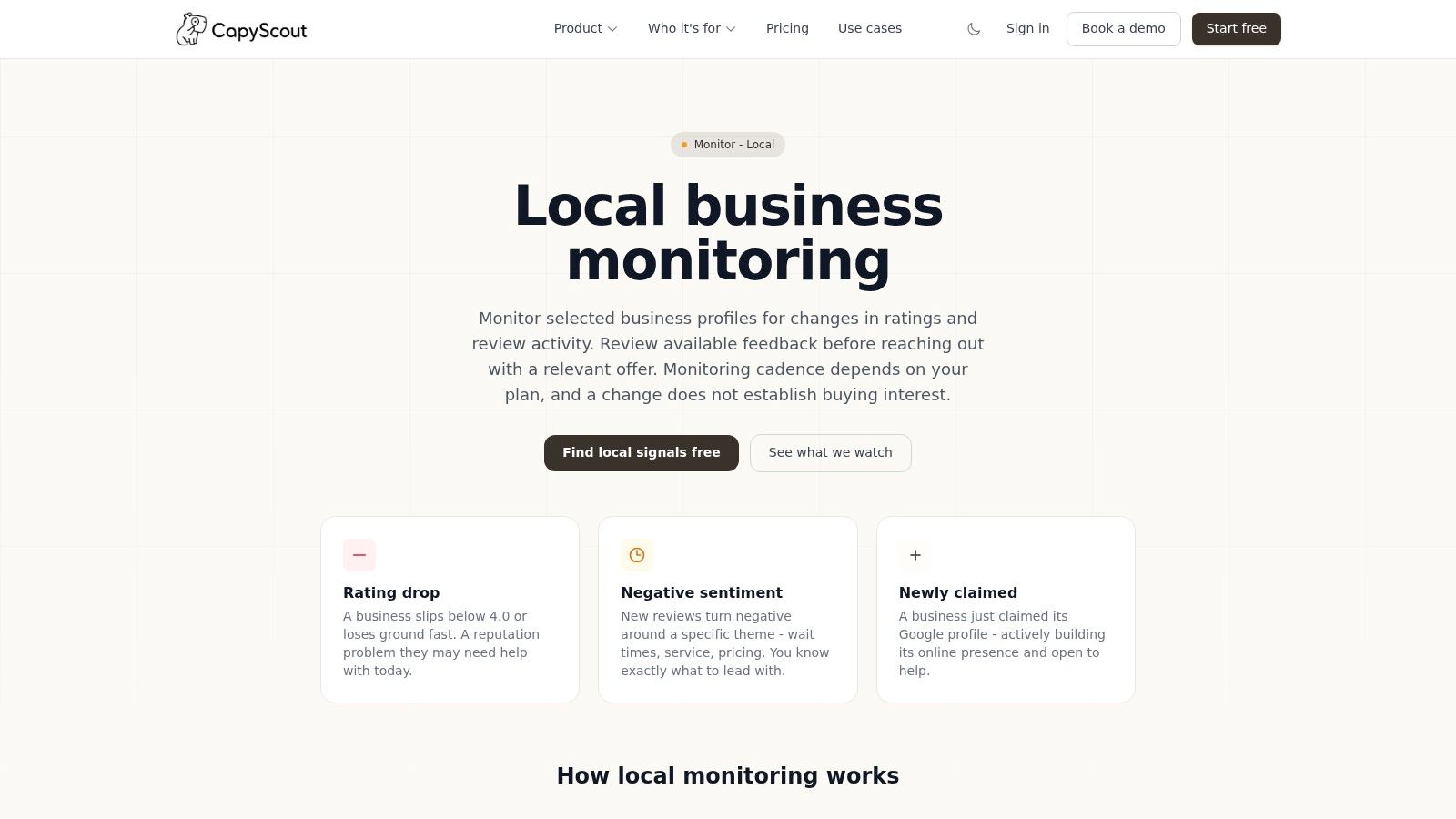
Review platforms assume you already manage the business. Local Reputation on CapyScout assumes you sell to the owner. It watches Google Business Profiles for rating drops, sentiment shifts, and stalls in new reviews, then turns each change into a reason to call. That is a different product from an inbox full of star ratings.
Take an agency carrying 80 home-service prospects. Generic cold email about "reputation" gets ignored. A note that a plumber's rating slipped and recent reviews keep mentioning missed arrival windows starts a conversation. Those signals sit alongside the other account triggers a rep already works from, so nobody is opening profile after profile between dials. Each hit carries the review that triggered it, so the change can be checked before anyone writes.
Google's numbers explain why timing matters. The 2026 Google Business Profile playbook reports that 91% of consumers use reviews to evaluate local businesses and that 65% are more likely to choose a business that responds. An agency that catches the drop can offer response help while the owner still cares, and Transactional's guide to managing online reviews is a useful companion when the next step is an operating routine rather than another dashboard.
What it is good at, and where it stops
- Actionable changes: flags rating drops, sentiment shifts, and stalls in new reviews, not a static average that hides them.
- A specific opener: gives the rep a recent, concrete reason instead of a generic pitch about reputation.
- Less tab-hopping: cuts the manual loop of opening profile after profile to find something worth mentioning.
- Narrow on purpose: weak if your prospecting has nothing to do with reviews, because the signal is the whole product.
Practical rule: Treat a stall in new reviews as seriously as a one-star drop. A stable four-star average can hide a business that stopped earning fresh feedback.
Ask the vendor for check frequency, profile coverage and scenario pricing before you model cost per rep. Those three answers decide whether the math works across 80 accounts or only looks fine on a demo call. A starting workflow lives in the local reputation template. I would skip this if you need review requests, widgets or white-label client reports. Those are review-generation and agency-reporting jobs, and a monitoring tool billed for them just adds a line item nobody opens.
2. Birdeye
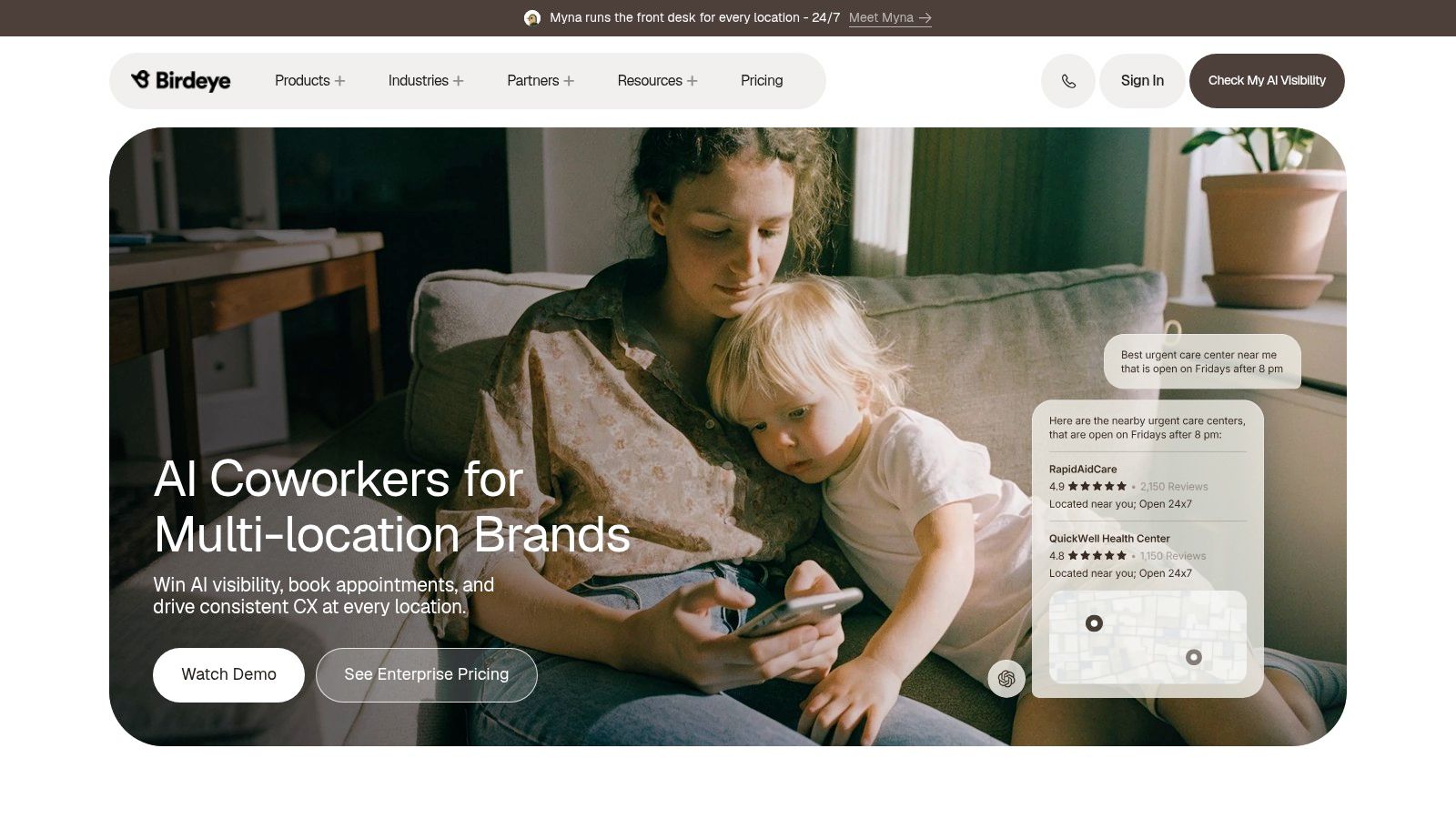
Birdeye is the wide local-marketing platform, not a monitor you bolt onto an existing stack. Birdeye pulls review monitoring, requests, responses, sentiment, listings, messaging, surveys, and reporting into one place. Multi-location brands use it when every branch should follow the same request and reply routine.
AI-assisted replies and automated requests cut the busywork of thanking a five-star and chasing the silent customer. Location workflows help a regional manager see which sites are slipping without exporting five spreadsheets. That breadth is the trade-off. If all you wanted was "ping me when a new Google review lands," you are paying for a marketing suite.
Pricing is quote-based and moves with location count. Integrations and contract length are not something you can price from the homepage, so put both on the evaluation checklist before a demo turns into a proposal. I would shortlist Birdeye for a multi-branch operator that already plans to run listings and messaging in the same system. I would skip it for a single-location shop that only needs alerts.
3. Podium
Text is the whole point of Podium. Local service businesses already talk to customers by SMS. Podium puts review invitations, reminders, incoming reviews, and other messages in one inbox, with AI help on invitations and replies, plus reporting and a mobile app.
A plumber who just closed a job can ask for the review in the same thread as the appointment reminder. Staff stop hopping between Google, Facebook, and a separate texting app. That is the fit for review-generation-first buyers. It is a poor fit if you wanted a lightweight monitor and nothing else, because you are buying a messaging platform.
Current pricing is not clearly published on the product page, so the demo has to answer whether the inbox justifies the contract. Teams comparing this path with a lighter local workflow can look at options for local businesses before they commit to a full communications suite. I like Podium when the front desk already lives in text. I don't like it as a pure listening tool.
4. GatherUp
GatherUp belongs in the agency white-label bracket: monitoring, review requests, feedback, replies, and reporting, with white-label plans for firms that manage other businesses' locations. GatherUp covers review monitoring across 100+ sites, AI-assisted replies, and a 14-day trial. Core plan prices are published, which is rarer than it should be.
Listings management and Review Defense are add-ons. Multi-location pricing depends on location count and billing period. Review Defense disputes do not guarantee a platform will take a review down. That is easy to oversell to a client who expects a one-star review to vanish.
The FTC's 2025 final order against Sitejabber alleged that ratings were collected at purchase, before customers had the product, then shown as genuine reviews. Shoppers often say they run into reviews that look fake or AI-generated. Use GatherUp to collect evidence and respond rather than assuming the platform will filter out fraud. A single-location owner should skip the white-label layer. For an agency, the reporting and client-facing workflow are the reason to pay.
Treat a removal request as a case file: keep the wording, the timing, and the platform. Challenge only when those pieces disagree with a real visit.
5. ReviewTrackers
ReviewTrackers is for teams that want feedback intelligence across locations, not a texting product with reviews attached. ReviewTrackers centralizes monitoring, reporting, and customer-feedback analysis, with agency and reseller options. Mid-sized and multi-site operators use it to compare what customers say, site by site.
A stable star average is a weak scorecard. BrightLocal's 2025 survey, as covered by SMK, found that the share of consumers who trust online reviews as much as a personal recommendation fell from 79% in 2020 to 42% in 2025, and 46% said a lack of detail would make them suspect a fake review. ReviewTrackers earns its place when you read themes, photos, and recency, not just the mean.
Buying friction
- Custom quotes: Standard self-service pricing is not published, so a fast spreadsheet comparison is hard.
- Source list: Confirm which review sites and integrations are in the tier you are quoted.
- Sales cycle: Fine for a planned rollout. Annoying if you needed alerts this week.
For the Google-only setup that should exist before any vendor call, use this practical Google review monitoring setup. I would pick ReviewTrackers over a messaging suite when the buyer is an insights lead, not the front desk.
6. Reputation
Reputation is an enterprise customer-experience platform. Reputation covers reviews, surveys, messaging, and listings, and its Reputation Score rolls performance across those touchpoints into one benchmark. That is useful when a formal CX program already exists and leaders want one number they can defend in a quarterly review.
It is the wrong first buy for a five-person team that needs "email me when we get a one-star." You will spend the trial learning the navigation. Pricing is sales-led. Ask for a sandbox with your real locations, then time how long a store manager takes to answer one review and how long an analyst takes to pull a recurring-complaint view.
Review reading is not only a U.S. habit. Customer Alliance's 2024 online review survey found that 91% of 750 respondents across Germany, Austria, Switzerland, France, and Italy read online reviews at least once a month. A global brand on Reputation should confirm those markets' review sources are in the feed, not assumed.
If the score cannot be tied to calls, complaints, or churn, it is a vanity tile. Make the vendor show that link with your data before you sign.
7. NiceJob
NiceJob is the straightforward review-generation tool for a small business. NiceJob sends requests by SMS and email, then shows the results in widgets and a customer-facing microsite. Automated social sharing pushes strong reviews outward. AI replies and competitor intelligence sit on the Pro plan, not on Starter.
Public pricing and advertised no-contract terms make a trial decision cheap. You can see the monthly number before a sales call. That clarity is the reason I put it on the shortlist for a single-location clinic or trades business whose real problem is "we don't have enough recent reviews," not "we can't benchmark 40 sites."
Starter will disappoint if you assumed AI replies were included. Large, messy location portfolios outgrow the product. Confirm the review sites and integrations for your niche before you migrate widgets off the current site. I would start here, not on an enterprise suite, when the owner is also the person who will log in.
8. Grade.us
Grade.us is built for the agency that wants to resell reputation management under its own name. Grade.us combines monitoring, scheduled reports, and review-request campaigns with white-label email alerts, reports, and custom URLs. A premium white-label dashboard is available. There is a 14-day trial, and published pricing makes a first-pass cost model possible.
The bill still moves. Price depends on locations and seats. API access and SMS may need a higher tier or a conversation with sales. Premium dashboard branding costs extra on some plans. Quote the client-facing package with those extras in it, or your margin disappears after the third location.
Agency packaging check
- White-label depth: Alerts and URLs can carry your brand. The premium dashboard is a separate decision.
- Per-location math: Model seats plus locations before you promise a flat retainer.
- Trial use: Put two real client profiles in the 14 days, not a demo listing.
I would compare Grade.us with GatherUp when the agency's product is "we run reviews for you." I would not pick it as the company-wide CX system for a 200-location brand.
9. BrightLocal
BrightLocal is a local SEO platform that happens to manage reviews well, on the right plan. BrightLocal puts review monitoring and responses on the Grow tier, next to rank tracking, listings, and Google Business Profile tools. Requests can go out by email, SMS, and in-store campaigns. Reporting compares locations. A free 14-day trial lets a local SEO team see whether the rest of the toolkit is worth keeping.
That bundling is the reason to buy it, and the reason to walk away. If your agency already lives in rank reports and citation work, adding reviews in the same login saves a vendor. If reviews are the only service you sell, you are paying for SEO features you will not open. Review tools are not on every plan, and price shifts with plan, location count, and billing period.
Listings still decide whether the monitored profile is the one customers see. Teams fixing that layer can use this guide to help customers find your Brisbane business as a reminder that a clean listing and a watched review feed are one job. I shortlist BrightLocal for local SEO agencies. I don't shortlist it for a CX team that never opens a rank tracker.
10. Reviewflowz
Reviewflowz is the alert router. Reviewflowz watches reviews and pushes them into Slack, Microsoft Teams, Zendesk, and reporting tools, with AI replies and collection workflows. Higher tiers add API access and deeper reporting. Public, location-based pricing and a 14-day self-service trial mean an ops lead can test routing without a procurement cycle.
That is the scenario I mean by alert-first. A support queue already exists. Reviews should land in it, tagged, not in another login. Pro limits the user count. Unlimited seats need Premium. SMS and email invitations carry usage charges on some plans. It is not an all-in-one local-marketing platform the way Birdeye is, and it should not be sold as one.
Route the one-star to a named channel with a response owner. A notification nobody owns is just a louder version of the review you already missed.
I start ops-minded teams here when the question is latency and routing, not white-label client reports or enterprise benchmarking.
Review Monitoring Software Compared
The table scores each tool against the scenario it fits, so the pricing column carries as much weight as the capability column. Four vendors let you start without a sales call: GatherUp, Grade.us, BrightLocal and Reviewflowz all run 14-day trials. Every quote-based row is a sales conversation first.
| Tool | Best fit | Pricing you can confirm | Standout capability |
|---|---|---|---|
| Birdeye | Local businesses and multi-location brands wanting broad customer-experience tools | Quote-based, scales with location count | Reviews plus messaging, listings and surveys |
| Podium | Local service businesses tying review requests to customer texting | Quote-based | Text-based invitations and one shared customer inbox |
| GatherUp | Agencies and businesses managing reviews across locations | Public pricing on core plans; add-ons extra | Monitors reviews on 100+ sites |
| ReviewTrackers | Mid-sized and multi-location teams mining review insights | Quote-based | Centralized feedback analysis across locations |
| Reputation | Large organizations running a formal CX program | Sales-led quote | Reputation Score benchmarks customer touchpoints |
| NiceJob | Small businesses whose main goal is more reviews | Public pricing; no contract advertised | Automated SMS and email requests, review widgets |
| Grade.us | Agencies and resellers selling reputation management | Published pricing; varies by locations and seats | White-label alerts, reports and custom URLs |
| BrightLocal | Local SEO agencies mixing reviews with search work | Varies by plan, location count and billing period | Reviews inside a local SEO toolkit |
| Reviewflowz | Teams routing review alerts into existing tools | Public, location-based pricing | Slack, Teams and Zendesk routing |
Agency support separates the portfolio tools from the single-brand ones. GatherUp sells agency plans with white-label options, Grade.us centers white-label alerts, reports and custom URLs, ReviewTrackers lists agency and reseller paths, and BrightLocal folds agency reporting into its SEO tools. Price those four by true per-location cost: Grade.us moves on locations and seats, BrightLocal on plan and billing period, so the sticker is rarely the invoice. For Birdeye, Podium, Reputation, NiceJob and Reviewflowz, agency fit is an open question, so get branding and per-client reporting confirmed in writing before putting a client book on one.
Match the buyer to the job. Review-generation-first buyers pay for request volume and response rate, and should measure those instead of seat counts. Enterprise CX buyers pay for analytics that connect to calls, complaints or churn. Alert-routing buyers pay for latency into Slack or Zendesk. Monitoring-plus-outreach is its own scenario: CapyScout watches a list of companies or your CRM on a schedule and tells you who to contact and why now, with the evidence attached. Agencies using reputation changes as an outreach trigger have a fifth scenario, and it is scoped by alert coverage across a client list rather than by report templates.
How to Choose: Match the Tool to Your Scenario, Not the Feature List
Shortlist by the job, then throw out anything that only wins on a feature grid.
Local businesses that need more reviews should start with NiceJob or Podium. NiceJob is easier to price and understand. Podium wins when texting is already how you talk to customers. Agencies with client portfolios should put GatherUp and Grade.us side by side and compare white-label depth against true per-location cost, including seats and add-ons. Local SEO teams should weigh BrightLocal only if rank tracking and listings will get used. Enterprises with a formal CX program fit Reputation or Birdeye, and should demand that analytics connect to calls, complaints, or churn. Ops teams that want reviews in Slack or Zendesk should start with Reviewflowz. Agencies using reputation moves as outreach triggers should look at the Local Reputation scenario instead of buying a client-reporting suite they will not white-label.
Before you sign, run this check on the finalist:
- Confirm sources: List every site you must watch, and get that list in writing for the tier you will buy.
- Test latency: Post or stage a review on a real location and time how long the alert takes.
- Price the extras: Add listings, dispute tools, SMS, extra seats, and branding. That is the cost, not the sticker.
- Use a live location: Run the trial on a real profile with real volume, not a demo business.
A higher average is not proof the tool works. A missed one-star, a stall nobody noticed, or a quote that doubled after add-ons is the failure mode. Pick the category that matches the work this quarter. You can add a suite later. You cannot get the three quiet weeks back.
CapyScout watches the accounts you care about and flags reputation changes, with the evidence attached, so your team knows who to contact and why now. If review monitoring software should feed outreach instead of another dashboard login, start with Local Reputation and route the alert to Slack, Teams, email, or your CRM. See how that workflow runs at CapyScout.
Not ready to start? Get a free target list: 10 companies to sell to, picked from your website.