

Account Based Prospecting: The 2026 B2B Playbook
Learn what account based prospecting is, how it works in 2026, the signals that matter, and the playbooks top B2B teams use to book more meetings.
A Tuesday morning can expose everything wrong with an outbound program. Priya, an SDR at a mid-market SaaS company, opens her CRM to find hundreds of new contacts from a webinar and several cold-list imports. Some addresses bounce, some contacts have moved jobs, and the surviving records tell her almost nothing about which companies are evaluating a solution now.
Her AE counterpart has one useful clue: two people from the same company opened the same email. That account might be active, or the opens might be noise. Nobody knows because the team has been tracking contact activity instead of account movement.
Account based prospecting solves this by changing the unit of attention. Priya doesn't chase every responder in a contact database. She selects a defined group of companies, maps the people involved in a purchase, watches for fresh evidence, and routes a specific next action to the right person. The advantage isn't more personalization for its own sake. It's better judgment about which account deserves attention, why now, and who should receive it.
Table of Contents
- A Tuesday Morning That Shows Why This Matters
- What Account Based Prospecting Actually Means
- The Shift From Contact Lists to Live Account Signals
- A Practical Framework for Running Account Based Prospecting
- How B2B and Local Teams Apply the Same Model
- The Failure Modes Nobody Talks About
- Your 30 60 90 Rollout and the Metrics That Prove It Works
A Tuesday Morning That Shows Why This Matters
By mid-morning, Priya has three competing tasks. She needs to follow up with webinar attendees, work through a list purchased by marketing, and respond to an inbound signup that may or may not fit the company's ideal customer profile. Every contact appears equally urgent because the CRM offers no account-level explanation.
She starts researching manually. One company has hired a new finance leader. Another is advertising for a systems administrator. A third has returned to the pricing page, but the visit is anonymous and could have come from a student, a vendor, or an existing customer. The useful clues are scattered across job pages, company news, the website, and outdated CRM fields.
The result is familiar. Priya spends time proving that a contact exists instead of deciding whether the account has a live problem. Meanwhile, an account that has just changed leadership receives no outreach because it wasn't part of the latest list export.
The unit of work changes
A contact-first process asks, “Who can I email?” An account-based process asks, “Which company shows enough evidence to justify coordinated attention, and which roles matter there?”
That distinction changes the daily queue. A strong account record contains:
- Stakeholder coverage: Which economic buyer, technical evaluator, champion, and potential blocker have been identified?
- Role relevance: Does each contact still hold a role connected to the problem?
- Evidence history: What happened, when did it happen, and where did the signal come from?
- Buying-stage confidence: Is the account actively evaluating, showing early change, or a good fit?
The account score shouldn't be a black box. If the only reason an account is ranked highly is one pricing-page visit, the rep needs to see that limitation. If several contacts engage with relevant content while the company hires for a related function, the system can show a more credible “why now” explanation.
Practical rule: Never let one noisy interaction determine the next sales action. Require corroboration or label the account as uncertain.
Priya's improved queue is smaller, but each account has a reason, a role hypothesis, and a next step. That is the practical promise of account based prospecting. It turns a messy contact backlog into a set of decisions that sales and marketing can inspect together.
What Account Based Prospecting Actually Means
Account based prospecting is a disciplined way to identify named companies, understand their buying group, monitor observable changes, and coordinate outreach when evidence supports action. It isn't a more polished cold email. It's an operating model for deciding where prospecting effort should go.
The account is the primary record. Contacts provide the routes into that account, but no single contact should stand in for the whole purchasing process. The 2024 Account-Based Marketing Benchmark associates stronger financial outcomes with organizations that align sales and marketing around selected account cohorts, engage multiple stakeholders, and monitor those groups throughout the buying journey. That finding is directional rather than causal, so teams should validate it with controlled cohorts and outcome measures such as qualified-account conversion, opportunity creation, win rate, cycle length, and revenue per target account.
Three approaches that teams often confuse
Lead-based outbound begins with individual records. A rep receives a list, filters by title, and sequences contacts who appear to match. Account context may be added later, usually after someone replies. This approach is efficient for list loading, but it treats a company as an afterthought and can mistake one person's activity for organizational demand.
Traditional account-based marketing usually starts with a named-account list and coordinated campaigns. It can improve relevance, but it sometimes stops at advertising, content, and one-to-one personalization. Without a prospecting motion, marketing may create account engagement that sales doesn't act on, or sales may contact one executive while the rest of the buying group remains invisible.
Account based prospecting connects the two. It asks sales development to:
- Select accounts that fit the commercial model and current territory.
- Map roles across the people who influence, approve, evaluate, or obstruct a purchase.
- Collect evidence from company changes, first-party interactions, and relevant external activity.
- Sequence actions across the buying group instead of repeating the same message to one person.
- Record outcomes at the account level so the next decision improves.
For teams refining their outbound motion, these strategies for high-value buyer outreach are useful as a complement to account-level planning. The principle is simple: personalization should express a verified business context, not merely decorate a template with a name and company.
A useful internal explanation of the wider account-based discipline is available in this guide to what account-based marketing really means. Prospecting is the pipeline-facing layer. It keeps the account model alive after the campaign brief is approved.
The Shift From Contact Lists to Live Account Signals
A rep opens a contact list on Tuesday morning and finds three people who no longer hold the roles beside their names. One account paused the project months ago. Another has just changed leadership and entered a new buying cycle. The list is accurate only as a historical record.
Live account monitoring keeps the record tied to observable movement. It captures the event, timestamp, source, affected account, and confidence level. That context helps sales decide whether to act now, keep watching, or remove an account from the active sequence.
The useful question is what a signal can reasonably predict. Hiring may reveal an operational priority, yet it does not confirm a vendor evaluation. A funding event can create capacity for change without identifying the budget owner. A return to the pricing page is closer to first-party interest, though one visit can still be noise.
Signal types and what they actually predict
| Signal Type | Predictive Strength | Freshness Window | Example Source |
|---|---|---|---|
| Relevant hiring | Strong when the role matches the problem | Recent activity should receive priority | Careers page or company announcement |
| Funding or leadership change | Strong when the event is current and connected to a strategic shift | Review quickly, then downgrade as context ages | Company news or public announcement |
| Pricing or demo interaction | Medium, because intent can be ambiguous | Preserve event time and review repeated activity | First-party website analytics |
| Review and community activity | Medium and qualitative | Reassess when the conversation changes | Review platforms and public communities |
| Technology change | Moderate when the new technology is relevant | Validate that the change is active, not historical | Public technology signals |
| Product or webhook event | Strongest when owned and consented | Process close to the event | Product, CRM, or integration data |
A fuller list of buying signals and how to find them can help teams define the evidence they will monitor. The operating rule is simple: connect each signal to a business hypothesis and a next action. A hiring event might justify researching the new function. Repeated first-party activity might justify coordinated outreach. A single anonymous visit may justify observation only.
Signal quality depends on timing and context. Recent, repeated events deserve more attention than isolated old activity. Contradictory evidence should reduce an account's priority rather than vanish inside a combined score. A signal record should include the event, source, timestamp, account, related role, confidence, and a rule for when the evidence expires.
The invisible account problem
Account based prospecting still misses buying activity that happens outside owned channels. Current buyer research reports that 90% of surveyed buyers research before first contact, with roughly one-third identifying web search, peer recommendations, or generative-AI chatbots as primary discovery channels. These findings describe research behavior before a seller can reliably attach activity to a person.
Private research creates uncertainty, not a clean negative signal. A missing form fill or known website visit does not prove that an account lacks interest. Teams should combine visible company changes with a restrained hypothesis, then choose whether to contact, monitor, or hold the account.
That distinction changes how buying groups are handled. One visible contact may represent only the person willing to engage publicly. Other stakeholders can be researching privately, comparing options, or waiting for an internal trigger. Account evidence therefore needs to guide coverage across relevant roles, while fresh signals determine when and how the team acts.
A Practical Framework for Running Account Based Prospecting
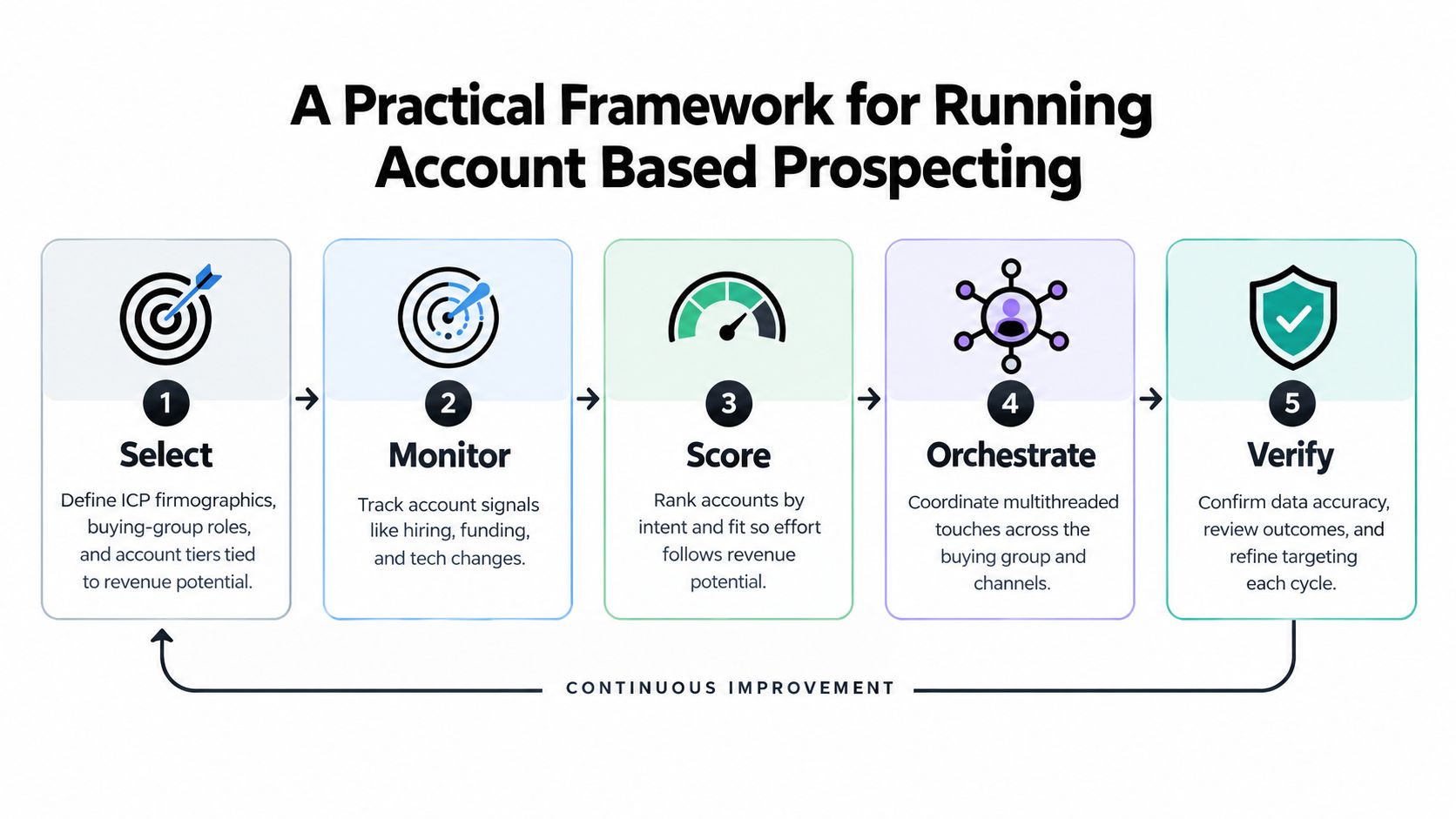
A workable program needs five connected stages. Tools should support each stage, not replace the judgment inside it. A CRM remains the system of record, enrichment keeps account facts current, signal feeds provide new evidence, routing assigns ownership, and drafting tools help reps turn verified context into a message.
Select
Start with the commercial boundary. Define the industries, operating conditions, geography, technology environment, and business problem that make an account worth pursuing. Then document the buying-group roles required for a credible opportunity.
Account tiers should reflect revenue potential and the effort available to serve them. A top tier may justify research-led, multithreaded outreach. A lower tier may receive lighter monitoring and programmatic education. Don't create tiers that sales can't explain or that marketing can't activate.
Monitor
Choose signals that can change a sales decision. Relevant hiring, funding, leadership changes, technology shifts, review movement, and first-party interactions are useful when they connect to a known problem.
For every signal, write down what it predicts and what it doesn't. A new security hire may support a hypothesis about compliance work. It doesn't prove that the company wants your product. A new location may create a reason for a local agency to contact the owner. It doesn't justify claiming that the owner has a marketing problem.
Inbound signup screening belongs here too. Enrichment can check fit, risk, and confidence before routing a signup, while near-real-time handling protects the value of a high-intent event.
Score
Use an explainable score rather than an opaque total. A simple architecture can be expressed as:
Account priority = fit × signal confidence × freshness × stakeholder coverage
The formula isn't valuable because of its arithmetic. It's valuable because it forces the team to separate four questions. Does the account fit? Is the evidence credible? Is the evidence current? Do we know enough of the buying group to act responsibly?
Store the underlying components and source links. When a rep asks why an account moved up, the answer should be visible without opening five research tabs.
Orchestrate
Assign channels according to account tier, role, and evidence. An executive may need a concise business message, while a technical evaluator may respond to implementation detail. Marketing can support the account with ads or relevant content, sales can coordinate email, LinkedIn, and phone, and partners can provide credibility where direct access is limited.
One account should have one coordinated next action. Without ownership, multiple reps may contact the same company with conflicting claims. The step-by-step guide to target account management provides useful context for keeping account ownership and execution connected.
For teams experimenting with AI-assisted messaging, this resource on revolutionizing sales prospecting can help with drafting workflows. Keep the source evidence outside the generated prose, and make the rep approve every assertion about a company.
Verify
Verification is the quality gate before outreach. Check that the contact still holds the role, the account isn't duplicated, the signal date is recorded, and the “why now” claim is supported by a source. If a fact can't be verified, mark it as unknown instead of converting it into confident copy.
This stage also feeds the next cycle. Record whether the account replied, whether the role hypothesis was correct, and whether the signal led to a meaningful conversation. The system improves when sales outcomes correct the scoring model.
How B2B and Local Teams Apply the Same Model
The same operating model works across very different markets because the core problem is identical. A team needs to recognize a commercially relevant account change, connect that change to the right roles, and act without overstating what the evidence proves.
Consider a mid-market B2B SaaS team selling into finance and healthcare organizations. Its account model might watch for a new finance leader, a security initiative, a relevant hiring pattern, or a public sign that the company is replacing a competitor. The buying group could include finance, revenue operations, information security, and an executive sponsor. Email and phone may support direct conversations, while LinkedIn advertising and partner co-selling create broader account coverage.
A local digital marketing agency can use the same logic with regional home-services chains. New locations, ownership changes, review stagnation, or a shift in customer sentiment can justify research. The relevant contacts may be an owner-operator, a franchise development director, or a regional marketing manager. Direct mail and phone may work better than a highly automated digital sequence because the account structure and local context demand a more tangible approach.
One framework, different evidence
| Dimension | B2B SaaS Team | Local Marketing Agency |
|---|---|---|
| Account definition | Company with a relevant operational or technology problem | Chain, franchise group, or service business in a target region |
| Useful signals | Hiring, leadership changes, technology movement, competitor displacement | New locations, ownership changes, review shifts, reputation movement |
| Buying group | Finance, operations, security, executive sponsor | Owner, franchise development, regional marketing |
| Core message | Connect the business change to a measurable operational concern | Connect the local change to customer acquisition or reputation risk |
| Channels | Email, phone, LinkedIn, partner co-sell, account ads | Phone, direct mail, local networking, targeted email |
| Verification | Validate roles, systems, project timing, and source dates | Validate ownership, location status, review context, and service area |
The trade-off is precision versus coverage. A SaaS team may need deeper role mapping before contacting an account. A local agency may need stronger geographic and reputation verification. Neither should treat a signal as a conclusion.
A shared checklist keeps execution practical:
- Tier accounts: Decide which companies receive research-led attention.
- Choose three useful signals: Pick evidence that can change the next action.
- Assign an owner: Name the person responsible for monitoring and follow-up.
- Set a response rule: Define what happens when evidence appears.
- Review outcomes: Feed replies, disqualifications, and stale signals back into the account record.
The Failure Modes Nobody Talks About
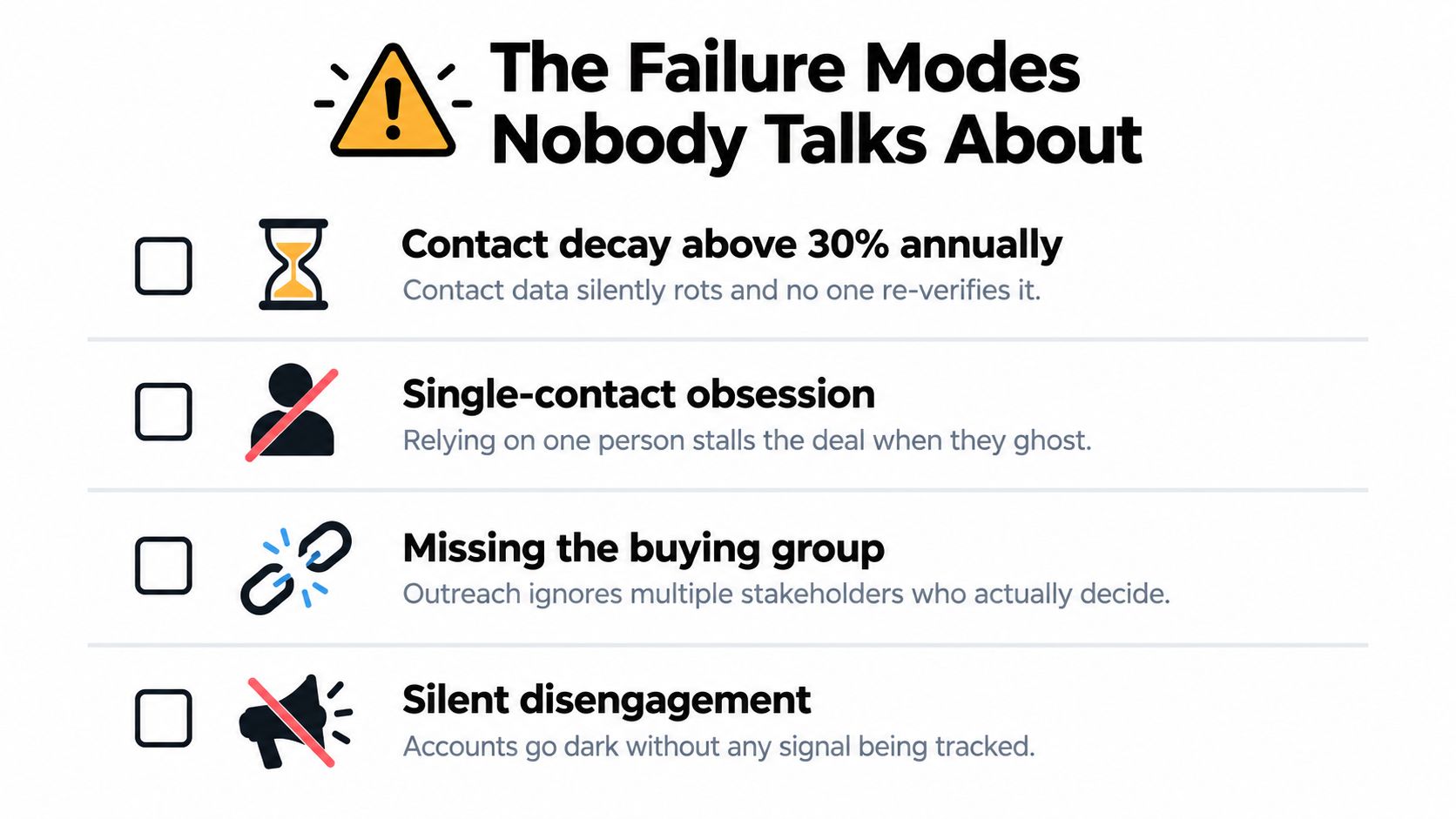
Most ABP programs don't fail because the team lacks personalization. They fail because the underlying evidence is stale, incomplete, or routed badly.
Four diagnostic tests
Contact decay hides behind a clean-looking database. If the CRM doesn't show when a role, email, or firmographic fact was last verified, the score is built on assumption. Require freshness dates before a record can influence routing, and send uncertain contacts back to enrichment.
Single-contact obsession creates false progress. One enthusiastic champion can be useful, but one silent contact can also make a real opportunity look dead. Set a minimum role-coverage rule before an account receives a high-effort sequence, then identify the missing economic, technical, and operational perspectives.
Over-personalized spam damages trust when the message contains irrelevant details or sounds machine-generated. Review AI-assisted openings against the source record, limit automation where the evidence is weak, and measure negative replies and unsubscribes alongside positive engagement.
Privacy-bait signals inflate scores with generic visits that don't reveal buying intent. Treat anonymous activity as a weak clue unless the watched account shows relevant page behavior, repetition, or corroborating company change. Don't pretend that website activity identifies a person.
Routing creates another silent failure. A high-priority account sent to an unprepared rep can receive a fast but shallow response, wasting the timing advantage. Make ownership depend on account tier, complexity, and rep readiness rather than whoever has an open task slot.
Your 30 60 90 Rollout and the Metrics That Prove It Works
A small team doesn't need a large implementation project. It needs a clean account universe, a shared record, a few defensible signals, and a review rhythm that exposes bad assumptions quickly.
| Phase | Focus | Metrics |
|---|---|---|
| First 30 days | Clean the account universe, define tiers, repair CRM fields, and publish the first monitored list | Data freshness, duplicate rate, role coverage, source completeness |
| First 60 days | Run coordinated prospecting against signal-qualified accounts and document ownership | Signal-to-alert time, alert-to-first-touch time, account response, false-positive rate |
| First 90 days | Add integrations, refine scoring, and compare signal-led work with a control group | Qualified-account conversion, opportunity creation, cycle length, win rate, revenue per target account |
What to do first
During the first phase, remove duplicate accounts and define what “fit” means in the CRM. During the second, make reps work from a shared account queue rather than personal contact lists. During the third, connect the signal sources that can be acted on and review the model with sales, marketing, and operations.
The McKinsey research on B2B growth economics reports that buyers use an average of ten touchpoints across in-person, remote, and digital channels and expect consistent information across them. The same source reports AI use among surveyed U.S. B2B professionals during early research, shortlist formation, and vendor comparison, with 72%, 48%, and 62% respectively. Those figures reinforce the operating requirement: synchronize the account record before adding more automated touches.
Track leading indicators first. Can the team see a new signal quickly? Are alerts reaching an owner? Does each account have the required role coverage? Are stale facts being downgraded? Lagging indicators then show whether those improvements create qualified conversations and pipeline.
Don't optimize for emails sent. Compare outcomes by signal type and response window, and use a control group where possible. If a signal produces activity but not qualified opportunities, change the signal rule or the message. If good signals sit untouched, fix routing and capacity.
CapyScout helps teams discover fitting companies, enrich and score signups, monitor account-level signals, and deliver source-backed briefs for the next sales action. Visit CapyScout to see how live account monitoring can replace stale prospect lists with evidence your team can verify and act on.