

Target Account Management: A Step-by-Step Execution Guide
Master target account management with this practical guide. Learn to select accounts, monitor signals, sequence outreach, and coordinate cross-functional teams
A rep starts Monday with three competing lists: inbound signups from unknown companies, a purchased contact file, and a CRM full of accounts that haven't been checked in months. During the week, someone mentions a new executive hire in Slack, a prospect returns to the pricing page, and a customer's review rating slips. None of those events reliably reaches the person who should act on it. By Friday, the team has logged plenty of activity but still can't explain why one account deserved attention over another.
Target account management fixes the unit of work. Instead of treating every contact as an independent opportunity, the revenue team chooses named companies, studies their context, monitors meaningful changes, and coordinates action around the buying group. The result isn't a bigger prospecting list. It's a living operating system for deciding which account matters, why now matters, who owns the next move, and what happens after the handoff.
Table of Contents
- Why Target Account Management Exists
- Building a Target Account List That Actually Drives Pipeline
- Monitoring Buying Signals Across Accounts
- Sequencing Outreach Around Account-Level Moments
- Coordinating Cross-Functional Handoffs
- When Target Account Management Fails and How to Fix It
- Running Target Account Management as a Weekly Operating Rhythm
Why Target Account Management Exists
Lead-based prospecting encourages reps to optimize for visible activity. A new form fill becomes a task, an old contact becomes a sequence, and a vague industry match becomes a call. The rep may work hard while the account receives disconnected messages from several people, each unaware of the company's priorities or the others' activity.

Target account management exists because complex purchases rarely move through one isolated contact. A finance leader may approve the commercial case, an operations leader may own the problem, IT may assess the integration, and an executive sponsor may decide whether the initiative deserves priority. Chasing one responsive contact can create the illusion of progress while leaving the actual buying group untouched.
The operating shift is simple but consequential:
- The account becomes the record of intent. Contacts, technology, hiring, news, website behavior, and opportunity history sit under one company context.
- Prioritization becomes explicit. A named account earns attention because it fits the ICP and shows a relevant business change, not because a rep happened to find its email address.
- Research becomes reusable. A source-backed account brief can inform sales, marketing, customer success, and leadership instead of disappearing in one rep's notes.
- The handoff gains a reason. Sales receives a specific trigger and recommended action, rather than a generic “please follow up” task.
The model became mainstream alongside account-based marketing. In a HubSpot benchmark, 70% of marketers reported using ABM by 2021, up 15 percentage points from 2020, while 57% of professionals said their companies targeted 1,000 accounts or fewer. The same benchmark found that organizations intentionally pursued only 38% of their target accounts at one time, a useful reminder that focus matters more than list size. See the HubSpot account-based marketing statistics for the benchmark context.
Practical rule: If a rep can't explain why this account belongs in today's queue, the account isn't prioritized yet.
Building a Target Account List That Actually Drives Pipeline
A target account list should answer a commercial question, not showcase how much data your team can collect. Start with the accounts most likely to have the problem you solve, the ability to act on it, and a business context that makes the problem urgent.
Start with fit, then add timing
Build the list in layers. First define firmographic boundaries such as industry, location, company size, operating model, and sales motion. Then add technographic clues, including the tools an account already uses, the systems it may be replacing, and integrations your product can support. Finally, add observable business signals, such as relevant hiring, expansion, leadership changes, funding announcements, or a public initiative connected to your offer.
A useful scoring rubric can stay deliberately simple:
- ICP fit: Does the company resemble customers who can succeed with the product?
- Problem fit: Is there evidence that the account faces the problem you address?
- Buying capacity: Can the likely buying group sponsor or influence a purchase?
- Timing: Has something changed that creates a credible reason to engage now?
- Coverage: Can your team identify more than one relevant stakeholder?
Give each account a clear tier based on those answers. Tier 1 accounts deserve research depth and coordinated outreach. Tier 2 accounts may fit strongly but lack a current trigger. Tier 3 accounts can remain monitored without consuming the same human effort. Don't force equal coverage across unequal opportunities.

Keep discovery dynamic
Static databases are useful for initial coverage, but they rarely tell you whether an account still fits or what changed this week. Natural-language discovery tools such as CapyScout can help teams search the live web using combinations of competitors, technology, hiring, location, and niche, then save suitable companies for monitoring. The important design choice is to make the search criteria reflect your ICP, not a vague phrase such as “fast-growing B2B companies.”
Use the ideal customer profile guide to document the characteristics that matter before you build the list. Then test the rubric against accounts your team knows well. If strong accounts score poorly, the rubric is wrong. If almost every company qualifies, it isn't selective enough.
Breadth creates coverage. Depth creates conversion. Choose the balance your team can execute, not the list size that looks impressive in a spreadsheet.
Monitoring Buying Signals Across Accounts
Signals don't create pipeline by themselves. They become useful only when a system classifies them, validates them, assigns an owner, and converts them into a next action. Many teams fail here because they collect alerts without deciding what a rep should do after reading one.
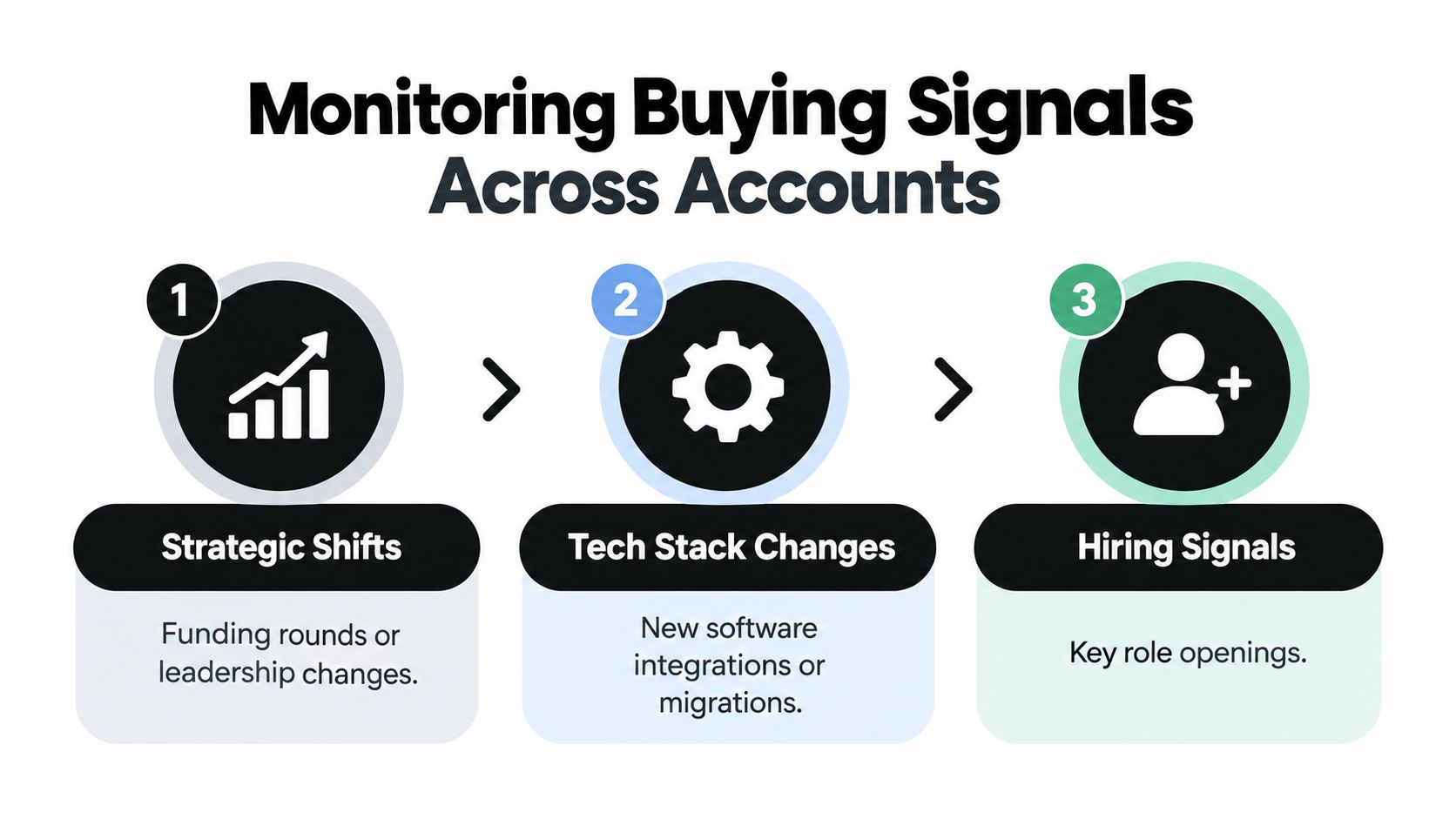
Use three operational tiers
Strategic shifts sit at the highest level. Funding announcements, acquisitions, market expansion, leadership changes, and public strategic priorities can alter budget, ownership, or urgency. These signals deserve human review because the same event can mean growth for one account and cost control for another.
Technology changes reveal implementation context. A new integration, migration, product launch, or change in the visible stack may indicate a project, a replacement decision, or a new dependency. Treat the event as a prompt for investigation, not proof of intent.
Hiring signals often expose planned work before the company announces it. A key role opening can show that an account is building capability around sales operations, security, analytics, marketing, or another function connected to your product. Match the role to the problem you solve and identify the likely manager or executive sponsor.
A fourth layer can sit across all three: website intent and reputation. Repeated visits to pricing, demo, or integration pages can support an account-level timing decision when paired with fit and stakeholder coverage. For local businesses, rating movement, sentiment changes, and review patterns may create a practical reason for an agency to contact the owner.
Route evidence, not noise
Live web monitoring beats a precompiled record when the job is to detect change. But freshness alone doesn't make an alert valuable. Every notification should include the event, the source, the date, the account's fit, the likely implication, and a recommended action. Unverifiable items should be marked as such rather than presented as fact.
A daily queue might contain only a small set of reviewed accounts:
- Act now: a verified signal aligns with the ICP and has an identified owner.
- Investigate: the event looks relevant, but the buying group or business implication is unclear.
- Watch: the account fits, but no current trigger justifies outreach.
- Suppress: the signal is weak, duplicated, outdated, or unrelated to the offer.
This approach keeps sales from treating every alert as urgent. The guide to buying signals provides a useful reference for designing the categories and search logic behind that queue.
The workflow should be visible in the tools your team already uses. CRM records hold account ownership and history. Slack, Teams, email, or webhooks distribute reviewed alerts. A signal platform or custom workflow checks sources, writes the “why now” note, and creates a task only when the evidence clears your threshold.
A short demonstration can help teams align on what a usable alert looks like:
Sequencing Outreach Around Account-Level Moments
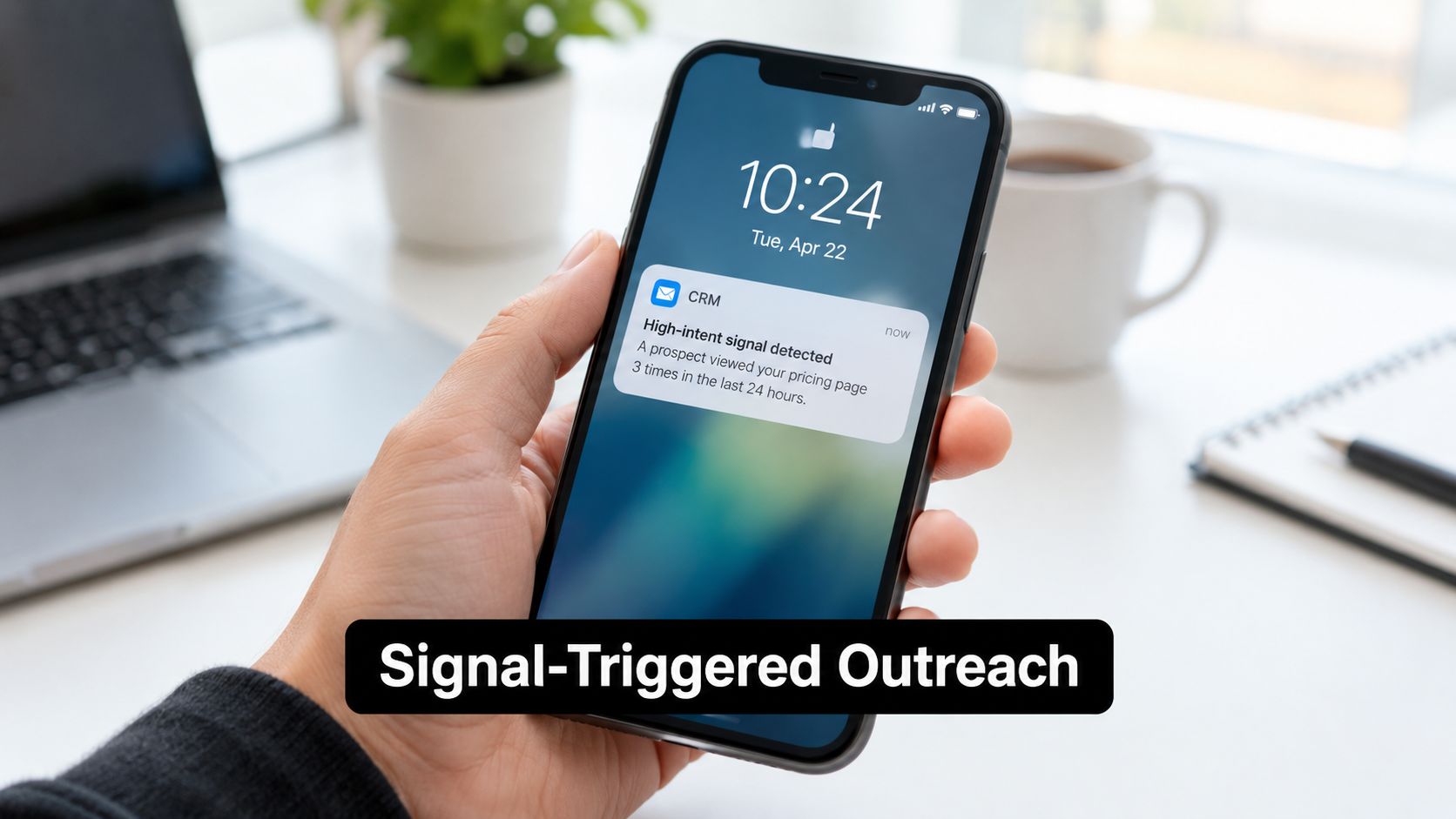
A fixed cadence treats every prospect as if timing were identical. Signal-triggered sequencing starts with the account event, then chooses the audience, message, channel, and follow-up based on what the event means.
Turn a signal into a point of view
Begin with a source-backed observation. Don't write “I saw your company is growing” when the evidence only shows one job opening. State what happened, connect it to a plausible operational consequence, and offer a useful next step without pretending to know the account's internal plans.
Examples of sound first-line logic:
- Hiring event: “Your team is hiring for a revenue operations role. That often creates pressure to standardize the systems that connect pipeline, routing, and reporting. We help teams assess where account signals should enter that workflow.”
- Funding or expansion news: “Your recent expansion announcement suggests the team is preparing for a broader operating footprint. We work with revenue teams that need account research and signal monitoring to keep coverage consistent as the market widens.”
- Website intent: “Several visits to your integration pages suggest the topic may be under review. If the team is comparing workflows, I can share how similar operators structure account-level research before involving sales engineering.”
These lines are starting points, not templates to send blindly. Verify the event, remove assumptions, and write for the role receiving the message. A new technical leader may care about data quality and integration. A commercial leader may care about coverage, prioritization, and pipeline visibility.
Build a short, conditional sequence
A good sequence has an exit condition. If the contact replies, the account moves to a human conversation. If the signal is corrected or the account becomes unsuitable, the sequence stops. If the first stakeholder doesn't respond, the next move may be a different member of the buying group rather than another identical reminder.
Use your CRM as the system of record and keep outreach drafts connected to the account, contact, signal, and source. Tools that open a prefilled draft in Gmail or Outlook can preserve normal sending, threading, and review without requiring inbox access. That matters because automation should reduce research and preparation, not remove judgment from the sender.
The sequence can include:
- A personalized email grounded in the verified event.
- A relevant asset or observation that helps the recipient evaluate the problem.
- A call or social touch directed at a different stakeholder when the purchase is multi-threaded.
- A final note that closes the loop and states when you'll stop contacting the account.
Don't over-personalize irrelevant details. A message that mentions a company's headquarters, recent award, and generic growth language still fails if it doesn't address the operational reason for contact.
Coordinating Cross-Functional Handoffs
Target account management breaks when each function owns a different version of the account. Marketing maintains a campaign list, sales keeps private notes, revenue operations manages CRM fields, and customer success discovers expansion opportunities after the fact. The company may have plenty of information, but no shared decision about who acts next.
Define ownership at each transition
Write the handoff rules before launching the program. A practical model looks like this:
| Workflow moment | Primary owner | Required handoff |
|---|---|---|
| Account selection | Marketing and sales leadership | ICP rationale, tier, territory, and owner recorded in the CRM |
| Signal review | Revenue operations or assigned account owner | Source, event date, confidence, and suggested action attached to the account |
| Outreach approval | Account executive or SDR | Message adapted to persona and buying-group coverage |
| Opportunity creation | Sales | Contacts, use case, stage, and next meeting captured against the account |
| Post-sale adoption | Customer success | Success plan, stakeholders, risks, and expansion context updated |
| Expansion or renewal | Account management or sales | Commercial event tied to health, usage, and account history |
The goal isn't to make every team attend every meeting. It's to make ownership unambiguous. Marketing can create account-specific content, sales can coordinate the conversation, and customer success can protect context after conversion. Each function should know what it receives and what complete information it must pass forward.
Make the CRM the shared memory
Bi-directional synchronization with systems such as HubSpot, Pipedrive, or Attio helps prevent the account record from becoming stale. At minimum, backfill the ICP grade, account tier, current owner, active signals, source links, stakeholder map, open opportunity, and last reviewed date. If an alert doesn't update the record, the next team member will repeat the research.
Customer success should also feed signals back into the account motion. Usage changes, new departments, leadership turnover, and customer concerns can create expansion or retention actions. Those signals need a shared escalation path, not a private note visible only to one CSM.
The sales and marketing alignment playbook is useful for clarifying service levels and shared definitions. Keep the process lightweight. A handoff that requires a long form or several approvals will be bypassed when the signal is time-sensitive.
When Target Account Management Fails and How to Fix It
The static-list myth is the most common failure. A team selects accounts at the start of a quarter, assigns contacts, and calls the work account-based even though no one checks whether the accounts still fit or whether anything has changed. That is list management, not target account management.
Diagnose the operating failure
Too many accounts create shallow coverage. Reps revert to generic messaging because they can't research every company or map every buying group. Reduce the active set, separate monitored accounts from actively pursued accounts, and make tier changes visible.
Weak signal triage creates alert fatigue. If every funding mention, job opening, or website visit becomes a task, reps learn to ignore the system. Require a source, a clear account implication, and an owner before an alert enters the Today queue.
Single-contact dependence hides account risk. One enthusiastic contact may not control the budget, and a deal can stall when the contact changes roles or stops responding. Track stakeholder coverage and ask each opportunity which functions still need confidence.
Old intent assumptions produce bad timing. A page visit or content interaction may indicate research, but it doesn't establish a project, authority, or urgency. Treat intent as supporting evidence, then combine it with fit, a business event, and buying-group coverage.
Research supports that shift from static targeting to coordinated account execution. A Salesforce benchmark found that 28% of organizations running ABM programs saw higher overall account engagement, 17% saw better SAL-to-opportunity conversion, 13% saw higher average deal size, and 12% saw improved win rate. The same source reported that only 2% saw no additional lift. These figures don't excuse weak execution. They reinforce the need to measure the operating chain, not just the existence of a target list. See the Salesforce account-based selling benchmark for the source context.
A more useful health measure is buying confidence. Ask whether the account fits, whether a relevant change is verified, whether the right stakeholders are engaged, and whether the next action has a credible business purpose. Account count is a capacity constraint. Buying confidence is a decision signal.
Running Target Account Management as a Weekly Operating Rhythm
A sustainable program runs on repetition. The team doesn't need a complicated command center, but it does need a dependable cycle that turns new evidence into reviewed work and reviewed work into clean CRM records.
Set the cadence
| Day | Core activity | Owner |
|---|---|---|
| Monday | Review active tiers, ownership, and open account actions | Sales leader and revenue operations |
| Tuesday | Validate new strategic, technology, and hiring signals | Revenue operations and account owners |
| Wednesday | Map buying-group gaps and prepare signal-based outreach | SDRs, BDRs, and account executives |
| Thursday | Review replies, meetings, opportunity movement, and stalled handoffs | Sales and marketing |
| Friday | Reconcile CRM fields, suppress weak alerts, and capture lessons | Revenue operations and functional owners |
Nightly monitoring can check watched accounts and refresh the queue. Each morning, the owner should see only the accounts that meet the team's action threshold. Weekly reviews should focus on decisions, not status theater. Remove accounts, change tiers, reassign ownership, or approve a new play when the evidence changes.
Use a small operating checklist
- Fit: Is the account still aligned with the ICP?
- Signal: What changed, when did it change, and can the team verify it?
- Stakeholders: Which buying-group roles are covered, and which are missing?
- Action: Who contacts whom, through which channel, and with what point of view?
- Record: Has the source, next step, and outcome been written back to the CRM?
- Learning: Did the signal produce a useful conversation, no response, disqualification, or a better rule?
ABM programs have demonstrated business impact when teams connect engagement to pipeline and revenue. In a BCG benchmark, 92% of respondents using account-based programs reported a positive impact on account engagement, 83% reported a positive impact on pipeline growth, and 72% reported revenue growth uplift. The BCG account-based engagement research also shows why teams should track finite account populations and outcomes rather than celebrate unconnected activity.
Start Monday with a manageable watchlist, clear owners, and three signal rules. Review the results after one week, remove noisy triggers, and keep the workflow only where it helps a human make a better account decision.
CapyScout helps teams discover fitting companies from the live web, enrich CRM records, monitor account signals, and build a scored Today queue with source-backed outreach drafts. Visit CapyScout to see how its account intelligence workflow can support target account management from discovery through handoff.