

Account Based Selling: A Practical Guide for B2B Teams
Account Based Selling explained step by step: map buying groups, detect buying signals, and measure results with benchmarks B2B teams can use.
Your reps have a territory list, a sequence tool, and a dashboard full of activity. What they don't have is a shared answer to a simpler question. Which accounts matter this quarter, who inside each account has to agree, and what would make you act today instead of next month? Account based selling is built to answer those questions before outreach starts. It's not more personalization on top of a lead list. It's a different unit of work, with the account and its buying group at the center.
Table of Contents
- What Account-Based Selling Is and Where It Came From
- How the Account-Based Selling Process Runs, Step by Step
- Mapping the Buying Group Beyond One Champion
- Buying Signals Worth Acting On
- Metrics That Show Whether Account Selling Works
- Testing Whether Signals Actually Pay Off
- Launch a Small Account Pilot This Quarter
What Account-Based Selling Is and Where It Came From
Lead-based selling casts a wide net and sorts the catch later. You collect contacts, score form fills, and hope the person who responded can approve a purchase. Account based selling reverses that order. You choose a short list of named companies first, study each one, and then engage the people inside it.
That choice changes what you count. A lead model counts contacts and form fills. An account model counts accounts engaged, pipeline created, and win rate. Sales and marketing work from the same named list, so marketing can't celebrate volume from companies sales never wanted.

Where the Idea Came From
The roots go back further than most software categories. The G2 guide to account-based marketing notes that Don Peppers and Martha Rogers published The One-to-One Future in 1993, arguing that companies should identify the relatively small share of customers generating the greatest financial value. ITSMA coined and promoted the phrase “account-based marketing” in 2003, then worked with companies including Accenture, HP, IBM, and Xerox to codify it.
Account based selling is the sales-side execution of that idea. If you want the marketing view of the shared model, it's worth learning how to align sales and marketing through ABM before you split tasks between teams.
Self-check: Can your team name its top target accounts and one person in each who could approve a purchase? If not, you don't have an account model yet. You have a list.
How the Account-Based Selling Process Runs, Step by Step
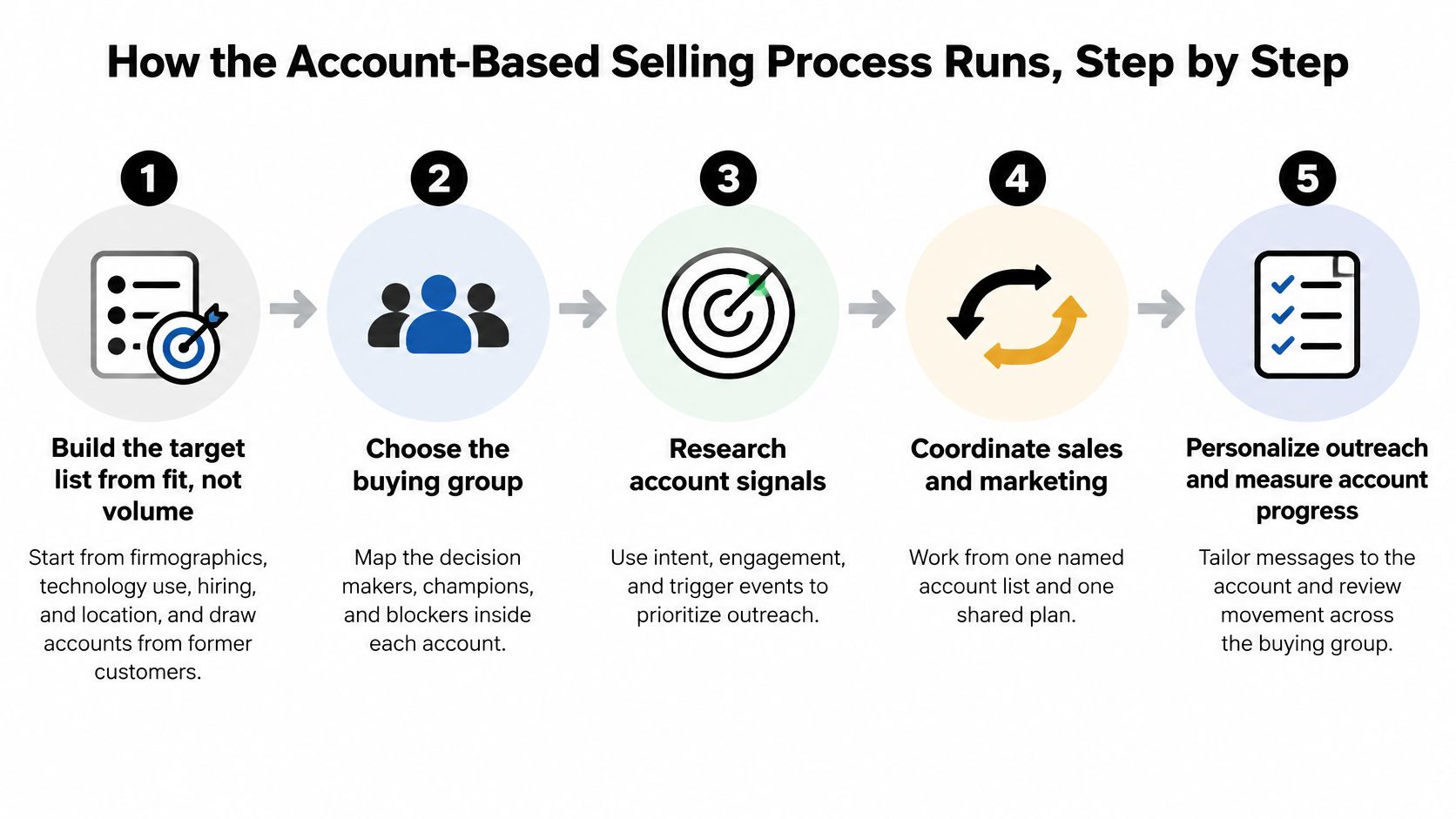
Think of account based selling as a loop you run for every named account, not a campaign you launch once. The five steps below give you a written plan, a shared trigger list, and a review date for each account. That discipline is what stops accounts sitting in “active” status by default.
The flow is easier to see before you read the detail.
The Five Steps
Build the target list from fit, not volume. Start from firmographics, technology use, hiring, and location. Draw accounts from former customers, lost deals, website visitors, and watched companies, because a fit-based list keeps every later step focused. A practical way to rank that list is with an account prioritization matrix that scores fit and timing separately, so a large company with no trigger doesn't outrank a smaller one that's changing now.
Map the buying group. Identify the roles that will shape the decision, not just one friendly contact. Your map decides who you engage next and what evidence each person needs. Without it, reps default to whoever replied first.
Define the triggers. Agree in writing which signals move an account from watch to active, such as a pricing page visit or a leadership change. Reps should act on a rule rather than instinct, and they should know when to ignore an alert. This is the moment in our outbound process where you find accounts, catch the right moment, and then send outreach, in that order.
Engage in a coordinated sequence. Write one account plan, then give each role a message whose first line refers to a recent change. Generic outreach is the usual reason cold sequences fail, even to well-chosen accounts. Say a 900-person logistics software firm hires a new VP of operations and visits your integration page. The rep sends the VP a short note tied to the hire and sends the technical evaluator integration notes in the same week, not the same generic email to both.
Review, then expand or release. Widen effort when a second stakeholder engages. Return the account to nurture after a set period of silence, so effort follows evidence. An Agent's new people can come from daily searches and feeds, LinkedIn connections, website visitors and signups, your customers, a list, or companies on a watched list when a signal fires, but each source still needs that review rule.
A short walkthrough helps if you're aligning a team on the sequence for the first time.
What You Should Have on Paper
- One account plan per target: Fit notes, likely use case, named roles, and the next action for each role.
- One shared trigger list: The signals that activate outreach, with a response window for each.
- One review date per account: The day you expand, change approach, or release it back to nurture.
If any of those three items lives only in a rep's head, the process isn't repeatable. Write it down where marketing can see it too.
Mapping the Buying Group Beyond One Champion
Most advice tells you to find one engaged champion and help that person sell internally. That's necessary, but it's not enough. Buying groups are rarely one person, and a champion who can't get finance, security, or the business owner aligned will stall no matter how enthusiastic they sound.
The G2 2025 Buyer Behavior Report reports that the traditional five-to-eight-person buying committee remains common, while smaller groups of three or four are becoming more prominent in software decisions. Size matters because it changes your job. A small, aligned committee may need a concise proof of fit. A larger group needs role-specific business, technical, financial, and risk evidence.
Why Multi-Threading Changes the Odds
Multi-threading means engaging several relevant stakeholders instead of depending on one contact. It exposes separate decision criteria early and creates internal advocates. It also protects the deal when a champion changes roles or stops responding.
A Storylane account-based selling benchmark reports a 130% win-rate improvement for deals above $50,000 when multiple stakeholders are engaged. Treat that vendor-published figure as directional, not as a controlled experiment, and check it against your own CRM cohorts. The mechanism still makes sense. More engaged functions means fewer surprises late in the cycle.
Consensus is the other half of the equation. In a Gartner survey of 632 B2B buyers, buying groups reaching consensus were 2.5 times more likely to report that their deal was high-quality. Your goal isn't just more contacts. It's agreement among the contacts you have.
Buying-group roles, the evidence each needs and the next action
| Role | Core question | Evidence to send | Next action |
|---|---|---|---|
| Champion | Will they sell this internally? | Account summary and internal business case | Offer a short review call on the internal case |
| Business owner | What outcome does it deliver? | Before-and-after example from a similar company | Share a scenario tied to their metric |
| Technical evaluator | Does it fit our stack? | Integration notes and security overview | Offer a technical walkthrough |
| Finance | What does it cost against the value? | ROI model with stated assumptions | Send a payback estimate |
| Procurement and security | What paperwork and risk checks apply? | Security questionnaire and contract terms | Confirm the review timeline and steps |
Consensus Risks to Log
Some risks matter more than a high-intent page visit. A stalled internal evaluation, visible disagreement between roles, or no clear economic owner should lower your readiness score even if engagement looks strong. Score stakeholder coverage and consensus risk, not just activity volume.
Say your champion is enthusiastic, but finance hasn't seen a payback estimate. The deal stalls until the rep sends an ROI model with stated assumptions that finance can challenge and adjust. That single document does more than three extra check-in emails to the champion.
Map roles, not names, and assign an owner to each role on every target account. A name with no role tells you nothing about what that person needs to say yes.
Buying Signals Worth Acting On
Not every change inside an account deserves outreach. The signal families that usually matter for B2B timing are hiring, funding, leadership changes, technology shifts, and first-party website intent. Your job is to rank them, verify them, and know which ones your team will deliberately ignore.
First-party intent outranks weaker external indicators. A return visit to your pricing or integration page from a watched account is evidence from your own pages. A news mention is context that might explain timing, but it doesn't show the account is evaluating you. If you want a practical starting set, this guide to buying signals and free sources you can check yourself is a useful companion before you buy any data.
Buying signals, what they suggest and how to respond
| Signal | What it may indicate | Suggested response window | How to verify |
|---|---|---|---|
| Visit to pricing or integration page from a watched account | Active evaluation | Same week | First-party visit record with date |
| New hire in the buyer's function | New budget or priorities | Two to four weeks | Dated job posting or announcement |
| Funding round | Spending capacity | Within a month | Press release or filing |
| Leadership change | Vendor review likely | Within a month | Announcement and updated org chart |
| Technology added or replaced | Gap in the current tool | Within a week | Stack data or job posting naming the tool |
The response windows above are working guidance for your team to refine, not industry benchmarks. Record every signal with its source, date, and confidence level before anyone acts on it. That record lets you check later which signals were right and which wasted rep time.
Negative Signals Most Guides Skip
- A champion stops replying: Pause the sequence and ask a direct question about internal timing.
- Two roles disagree in a meeting: Book time with the dissenting role before sending more material to the champion.
- No budget owner is named: Treat the evaluation as early, however warm the conversations feel.
Say a watched account visits your integration page on Tuesday, but its last two meetings ended with the technical evaluator objecting. A good rep verifies the visit, logs medium confidence, and books a call with the evaluator before sending anything else. A signal is a reason to start a conversation. It isn't proof of a deal.
Metrics That Show Whether Account Selling Works
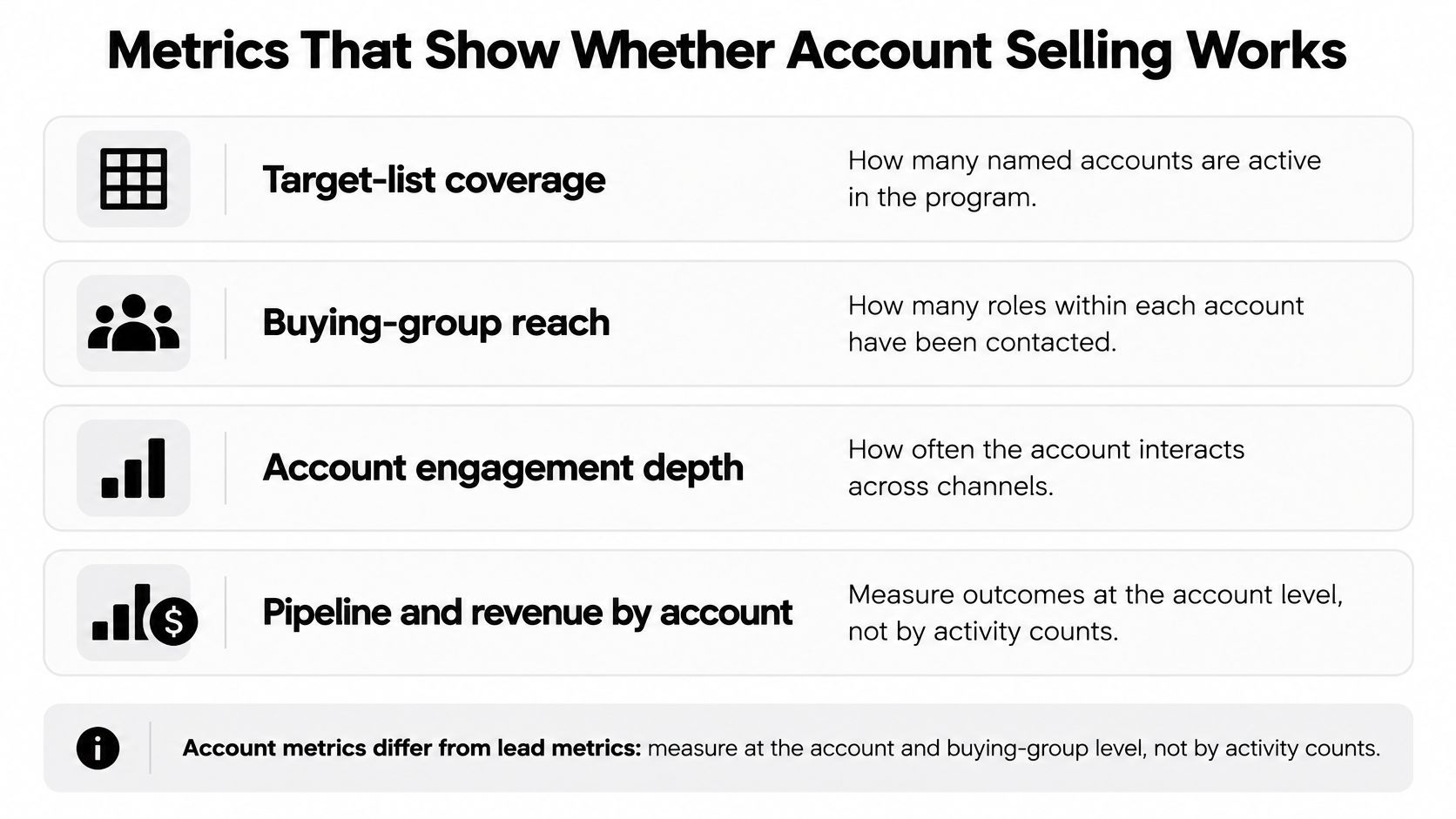
Lead metrics reward activity. Account metrics reward movement inside named companies. If you measure account based selling by emails sent or contacts touched, reps will optimize for touches and you'll learn nothing about whether the right accounts are progressing.
The diagram below sums up the shift in what to watch.
Benchmark Bands to Start From
The KPI Tree account-based sales analysis framework classifies target-list coverage below 30% as weak, 30–60% as healthy, and above 60% as strong. It treats engaged-account-to-pipeline conversion below 10% as weak, 10–25% as healthy, and above 25% as strong, with account win rates above 30% considered strong.
Account selling benchmark bands
| Metric | Weak | Healthy | Strong |
|---|---|---|---|
| Target-list coverage | Below 30% | 30-60% | Above 60% |
| Engaged-account-to-pipeline conversion | Below 10% | 10-25% | Above 25% |
| Account win rate | Below your past-deal baseline | At your past-deal baseline | Above 30% |
| Sales-cycle duration | Longer than your historical median | At your historical median | Shorter than your historical median |
Track average contract value and sales-cycle duration alongside those bands. Where there's no published band, set your own baseline from past deals and hold it steady for at least one cycle. Changing the baseline mid-quarter makes every result look acceptable.
A Monthly Diagnosis You Can Run
Segment results by account tier, market, use case, channel, and signal type before you draw conclusions. Then apply a simple rule. If coverage is strong but conversion is weak, your list is likely too broad or your messages aren't reaching the buying group. If conversion is strong but coverage is weak, your list is probably too narrow to produce volume.
Scoring rule: Optimize for fit-qualified accounts with real engagement. The largest number of contacts or touches is not the goal, and high activity from poorly matched accounts is not progress.
Testing Whether Signals Actually Pay Off
A signal-rich workflow can create an illusion of precision. Your team contacts accounts that were already likely to buy, a deal opens, and the alert gets the credit. You feel data-driven while learning nothing about whether the signal changed the outcome.
The measurement gap is documented. A 2025 survey of more than 600 B2B marketers published by 6sense found that 92% of ABM teams use an attribution model, yet 63% measure ROI through overall contribution rather than isolating the effect of a specific program or tactic. Influenced pipeline can show an account was touched. It can't show the signal helped.

A Holdout Test You Can Copy
Split comparable watched accounts into an alerted group and a holdout group, or route alerts at random across reps. Act on the signal in one group and follow your normal process in the other. Then compare time to each stage, opportunity quality, and win rate, using the holdout's conversion with no action as your baseline.
That design is how you track signal performance and win lift against a real comparison group instead of against activity counts. Keep the groups similar in fit and size, or the comparison won't mean anything.
Four Questions the Test Should Answer
- Which signals predict in each segment: A hiring signal may work in one segment and fail in another.
- What conversion looks like with no action: That's your baseline, and it often goes unmeasured.
- How quickly a signal loses value: Compare outcomes by days between signal and first touch.
- When a rep should ignore an alert: Log a reason for every accepted or rejected alert, then review the rejects.
Track false positives and rep follow-through as carefully as wins. An alert nobody acts on tells you about workflow, not signal quality. Separate first-party website behavior from weaker external indicators in your analysis, because mixing them hides which one is doing the work.
Start with a minimum experiment. One signal, one segment, one quarter, judged against the holdout. If a signal can't beat doing nothing, drop it, however intuitive it feels.
Launch a Small Account Pilot This Quarter
Don't rebuild your whole motion at once. Run a one-quarter pilot that's small enough to evaluate accurately.
- Choose two comparable segments. Select about fifty target accounts across them, matched on size and fit, so results can be compared.
- Map the ten highest-fit accounts. Use the role table to name each buying role, so the pilot tests engagement rather than list building.
- Pick three signals. Write the response window for each, so no alert is judged without a rule.
- Set a holdout for one signal. Agree success metrics with sales and marketing before the first message goes out, so the result can't be redefined later.
- Review after one full sales cycle. Keep, change, or drop each signal based on the holdout comparison.
Don't expand the list before that review, and don't count activity as success. If watching accounts by hand becomes the bottleneck, choose an alert tool that shows the source, timestamp, and confidence for every alert, and run it through the same holdout design. We score signups, trials, partner requests, and sales asks for fit, risk, and confidence, and give the next step, a reply to send, and the evidence behind it, which is the same evidence habit your pilot needs.
Your first Monday action is simple. Name the ten accounts and the person in each buying role.
If manual account watching is already eating your reps' mornings, CapyScout finds fitting companies on the live web, monitors watched accounts for hiring, funding, leadership, and website intent signals, and delivers source-backed briefs that show who to contact and why. Bring your ten pilot accounts, put them on a watched list, and judge the alerts against your holdout before you scale anything.
Not ready to start? Get a free target list: 10 companies to sell to, picked from your website.