

B2B Intent Data Explained: Types, Uses and Limits
Learn what B2B intent data is, its main types and sources, how teams apply it, and where it misleads, with practical examples.
Your sales team has a full prospect list, but nobody agrees on whom to contact first. Marketing points to content downloads. Sales wants companies with an actual reason to change. Meanwhile, a promising account may be comparing vendors without ever submitting a form.
B2B intent data can help you make that prioritization decision. The useful question isn't whether a company will buy. It's whether the evidence gives your team a better reason to spend time on that account, and whether acting on it produces better results.
Table of Contents
- What B2B Intent Data Is
- Types of Intent Data and Where They Come From
- How Intent Signals Become an Account Score
- Where Sales and Marketing Teams Use Intent Data
- Where Intent Data Misleads and How to Avoid It
- How to Test Whether Intent Data Pays Off
- What to Ask Any Intent Data Provider
- Decide Whether Intent Data Fits Your Pipeline
What B2B Intent Data Is
B2B intent data is the observable trail of research activity that suggests a company is investigating a problem, product category, or vendor, gathered about accounts rather than necessarily identified individuals.
Think about a household shopping for a car. They compare models, investigate financing, and arrange test drives before approaching the dealer they eventually choose. At company level, intent data captures parts of a similar evaluation trail, not the final decision.
That trail can include website visits, content consumption across publisher networks, and reviews. Job postings, funding announcements, leadership changes, and public business events add context about why a company might need something different.

Why direct inquiries miss part of the journey
In their 2012 study of approximately 1,500 business leaders across 22 large B2B organizations, Google and the Corporate Executive Board's Marketing Leadership Council found that business buyers typically waited until 57% of the purchasing process was complete before contacting a supplier.
That historical finding explains the visibility problem, not a universal timetable for today's buyers. A form fill can arrive after a team has learned the category, established technical requirements, and narrowed its shortlist.
Intent data gives you a reason to investigate an account. It doesn't give you a list of guaranteed buyers.
Here's the explanation to give a colleague: intent data shows observable activity that may indicate relevant business interest. We use it to decide where to investigate next, not to claim we know someone's purchasing plans.
Types of Intent Data and Where They Come From
A 2019 Gartner survey of 750 B2B buyers, summarized by Floe's B2B buying statistics guide, found that respondents spent 27% of their purchasing time researching independently online and 18% offline, compared with 17% meeting potential suppliers.
Your CRM can document supplier conversations well while missing much of the work buyers do independently. Different intent sources help fill different parts of that gap. They aren't interchangeable, though, and some are better described as business context than direct evidence of research.
Intent data types, sources and strengths
| Type | Source | Typical example | Strength and limit |
|---|---|---|---|
| First-party intent | Your website, product trials, signups | Repeat visits to pricing, demo, or integration pages | High relevance, limited to accounts that already know you |
| Third-party topic surges | Publisher and content networks | An account repeatedly consumes articles about a particular topic | Broad reach, but activity can be attributed to the wrong account |
| Account signals | Job boards, funding news, leadership announcements, reviews | A hypothetical company advertises a cluster of engineering roles | Strong business context, not proof of an active project |
| Engagement signals | Social and professional networks | A prospect engages with a competitor's content | Useful outreach context, noisy when engagement is casual |
First-party intent is activity you observe on properties you control. Say a company returns to your integration documentation after exploring your pricing page. You know what content attracted attention, although you may not know who visited or whether the account has an approved project.
Third-party intent extends visibility beyond your website. A topic surge means a provider has detected increased consumption around a category relative to its baseline. Ask what the topic includes: reading about information security broadly is different from investigating a specific security integration.
Business changes need interpretation
An account signal describes something happening at the company. A hiring push could make onboarding software relevant, but it might also reflect replacement hiring or an unrelated department's expansion. Inspect the roles and responsibilities before attaching a sales narrative.
Social engagement needs similar care. Someone commenting on a competitor's announcement might be evaluating alternatives, congratulating a former colleague, or discussing their own industry. The action is observable; the motivation isn't.
For practical places to gather that context, use our guide to buying signals and free sources.
Practical rule: Start with the source closest to the behavior you care about, then use other sources to verify your interpretation.
First-party signals generally offer stronger relevance but narrower coverage. Third-party sources expand coverage, but require more verification before you commit a rep's time.
How Intent Signals Become an Account Score
An account score works like a simplified credit assessment: you examine a pattern rather than treating an isolated event as the whole story. The analogy is about combining evidence, not borrowing a credit bureau's formula.
A buyer-journey benchmark cited by Omnibound's buyer intent statistics guide describes an approximately 60/40 split between independent research and seller interaction. That supports combining off-site research with direct engagement rather than depending entirely on either.
The scoring process should remain understandable to the person using it.
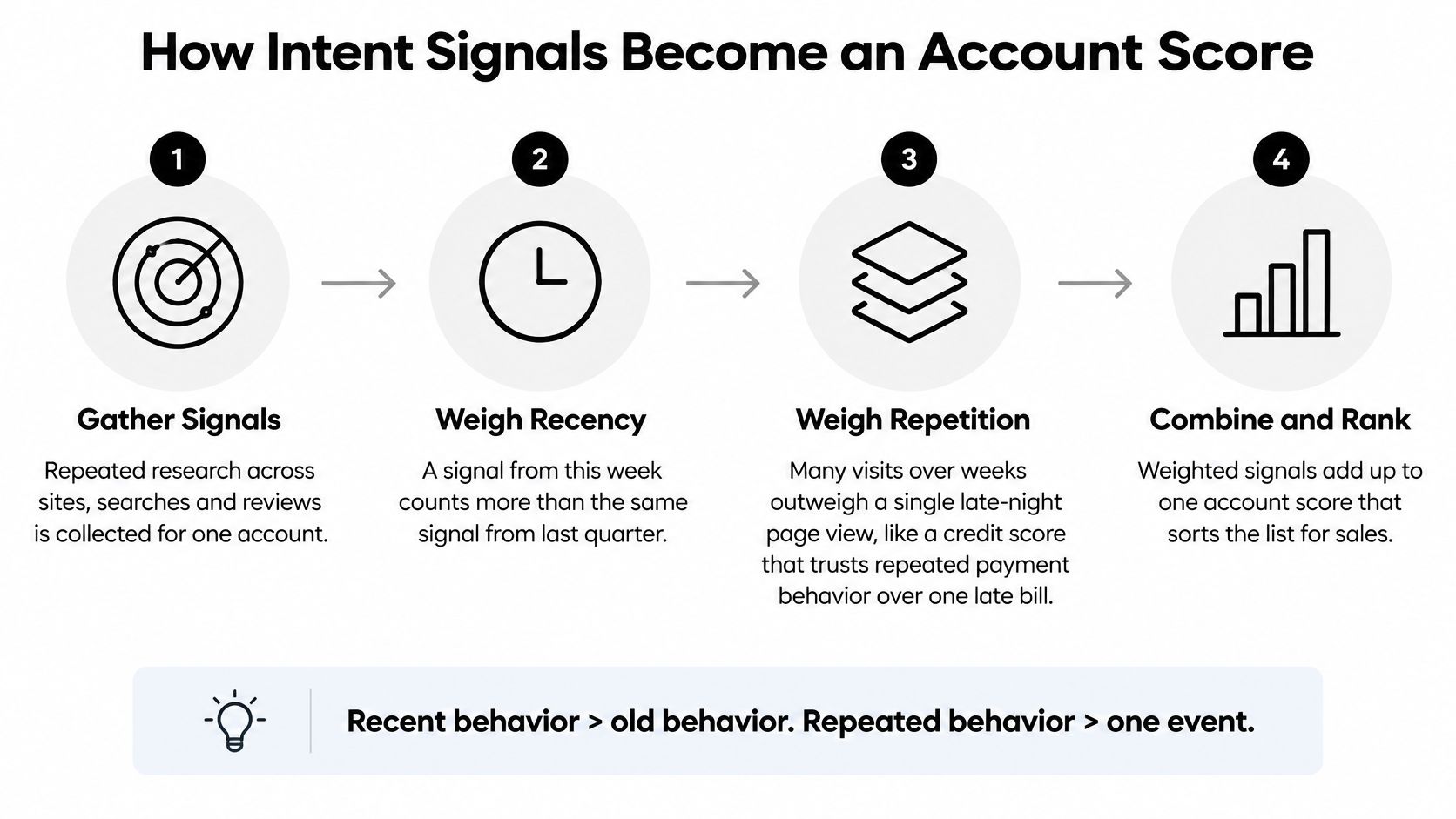
Build a weighted, time-decayed model
- Weight commercial actions more heavily. Repeat visits to pricing, demo, or integration pages deserve more attention than a general educational article. Keep explicit requests separate so they don't get buried beneath anonymous activity.
- Give broad consumption less influence. Category reading can justify monitoring an account without justifying immediate sales contact.
- Reduce weight as evidence ages. Apply recency decay by event type. A stale research spike shouldn't outrank a fresh commercial interaction indefinitely.
- Increase confidence through corroboration. Relevant activity from identifiable stakeholders or a verified business change can strengthen the case. Don't assume separate anonymous sessions represent separate people.
For the underlying distinction between qualification and scoring, EmailScout's lead scoring explainer provides useful context. Our practical B2B lead scoring framework can help translate those decisions into routing rules.
Make the score explainable
Keep fit, activity, and confidence visible rather than hiding everything inside a total. A high activity score at a poorly matched company should lead to a different decision from moderate activity at an excellent-fit account.
Before routing, document:
- Eligible events: What counts, and which behaviors you exclude.
- Decay rules: How quickly each event loses influence.
- Corroboration requirements: What supporting evidence sales needs.
- Next action: Research, nurture, review, or a conversation.
The output should be a work queue, not an automatic aggressive sequence. A person still needs to confirm budget, authority, and the actual project.
Where Sales and Marketing Teams Use Intent Data
A useful alert changes someone's next action. If the team receives another dashboard but continues working the same accounts in the same order, you haven't changed the workflow.
For an outbound rep, the practical output is a short account brief and a defensible reason to act.
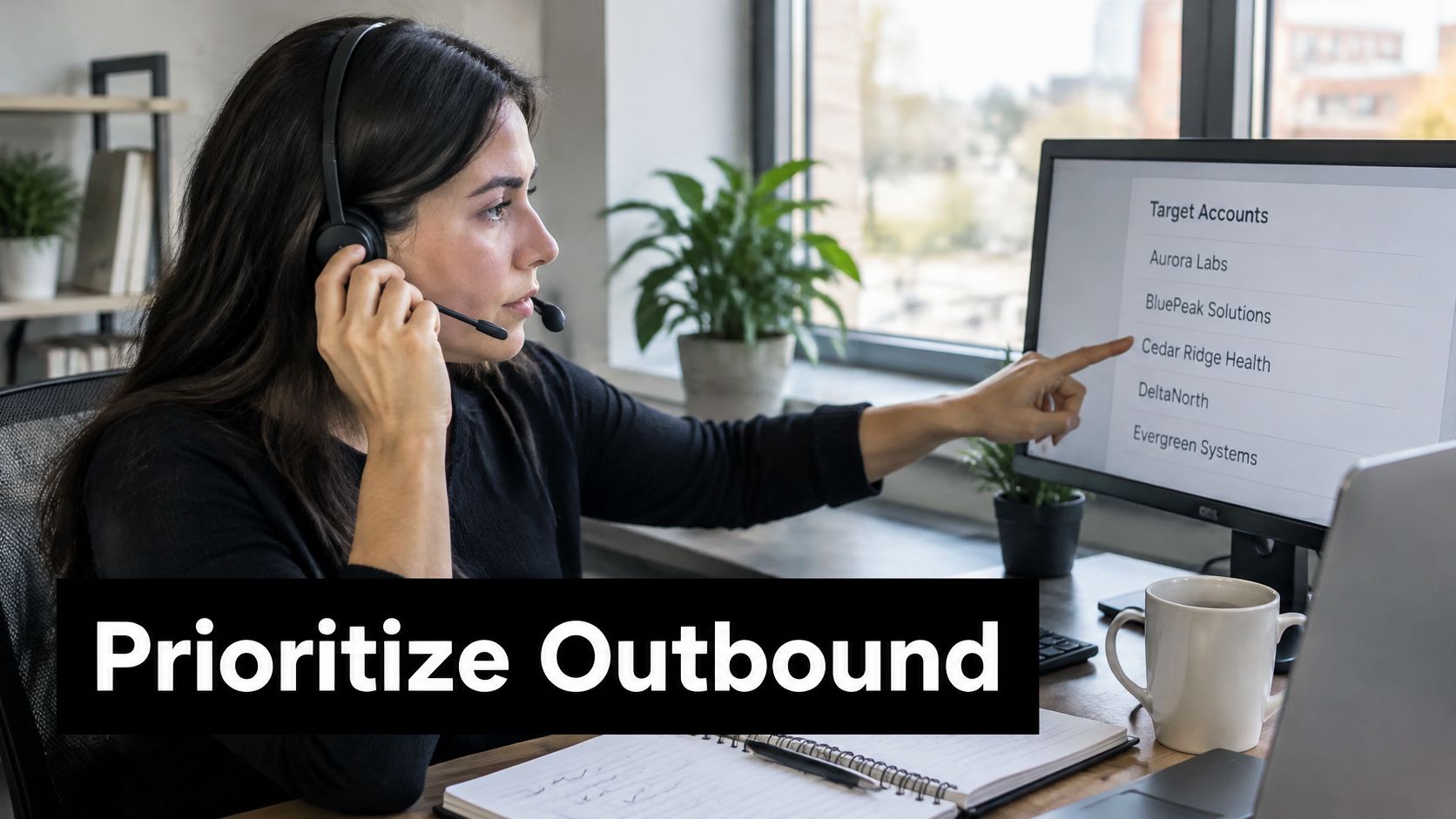
Outbound prioritization and timing
An SDR choosing accounts starts with companies that match the ideal customer profile, or ICP. Among those companies, a relevant technology change can justify moving an account ahead of an otherwise similar company with no current context.
A rep writing the opening line can reference a public operational change without pretending to know private buying plans. Say a company is hiring implementation specialists. The rep might ask how the team plans to maintain onboarding consistency as it grows, rather than declaring that it needs new software.
Our guide to buying signals, timing, and outreach develops that distinction between a relevant observation and an unsupported assumption.
The accompanying video offers another way to explore the workflow.
Customer monitoring and marketing follow-up
A customer success manager can investigate a customer's technology change before recommending an expansion conversation. A negative review might instead justify a service check-in. The appropriate action depends on the account's history, not just the latest event.
A marketer adjusting campaigns can distinguish accounts exploring integrations from accounts reading introductory material. The former may benefit from implementation content; the latter may need category education rather than a demo invitation.
In our website workflow, install the snippet under Integrations, then press Add high-intent companies to start a campaign with companies that viewed pricing, demo, or contact pages. Visitors arrive as companies; contact finding must be enabled in campaign Settings to identify a person to write to.
Outreach check: Reference a business change the recipient can recognize, not a browsing behavior that makes your message feel intrusive.
Every application still needs a fit filter. Interest in your subject doesn't mean your product suits the company, and a company-level visit doesn't identify the visitor.
Where Intent Data Misleads and How to Avoid It
Intent data is a prioritization signal, not a purchase prediction. An independent analysis published by The Growth Syndicate reports that third-party topic surges match the correct account only about 30–65% of the time.
That reported range concerns account matching, not purchase likelihood, and shouldn't be treated as a universal vendor benchmark. Account identification, topic relevance, and actual buying activity are separate inference problems. Employees may consume content for consulting, hiring, education, or competitor analysis without an approved purchase.
Common intent data misreads and fixes
| Misreading | Why it happens | Fix |
|---|---|---|
| A research spike means the account is buying now | Research can come from consulting, hiring, or competitor analysis | Require ICP fit and multiple corroborating signals |
| A topic surge identifies the right account | Account attribution can be wrong | Verify with first-party activity or timestamped evidence supporting the identity |
| A high conversion rate proves the signal works | Flagged accounts already look more likely to buy | Use a randomized holdout comparison |
| A score is a purchase prediction | Teams confuse prioritization with qualification | Queue the account, then confirm budget and project |
Apply checks before routing
Use a layered gate rather than letting an attractive score bypass verification:
- Fit first: Confirm industry, operating model, relevant technology, and serviceable needs.
- Evidence next: Preserve the source, observation timestamp, and what it establishes.
- Corroboration last: Look for supporting activity such as repeated commercial-page visits, relevant hiring, or a verified technology change.
Under this policy, an inferred signal alone doesn't route an account to sales. An explicit request for contact belongs in a separate inbound workflow, not an anonymous-intent queue.
Keep the underlying evidence available when a rep challenges an alert. Distinguish observed facts from interpretations, and label unresolved identity questions rather than filling gaps.
Data handling requires its own scrutiny. Our contact results go only into the customer's lists and campaigns, and we don't warehouse or resell contact data. That policy addresses handling, not whether an account is ready to buy.
How to Test Whether Intent Data Pays Off
A plausible signal isn't proof of commercial value. Zan Digital's intent data vendor disclosure review found no published independent accuracy study across four major providers and recommends comparing qualified opportunities or revenue over 60–90 days using a holdout experiment.
The problem is selection bias: your flagged accounts may already be more attractive prospects. Comparing them with your entire database won't isolate the benefit of acting on intent.
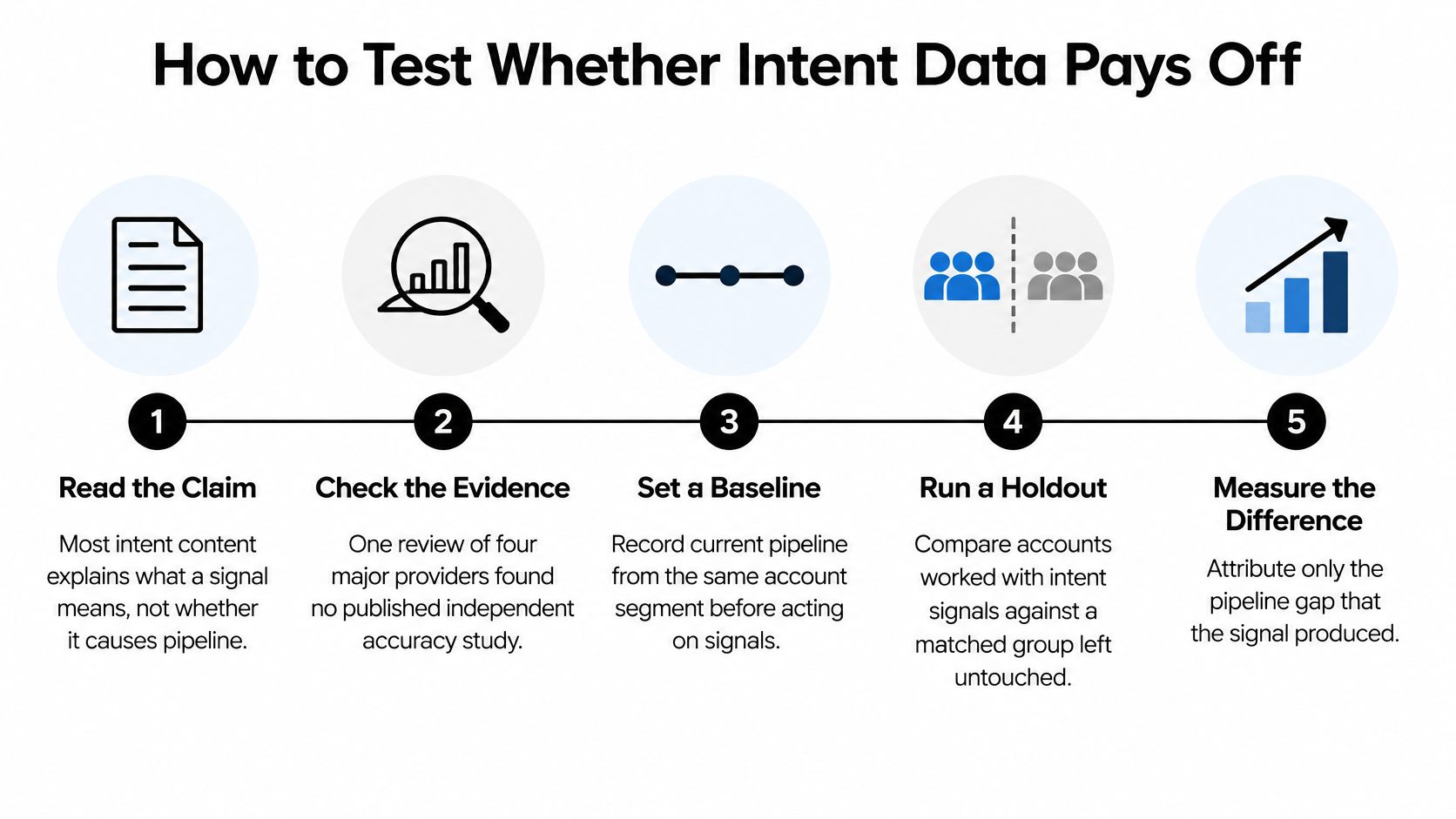
Run a controlled pilot
- Define eligibility before assignment. Write down the ICP criteria and qualifying signals so reps can't selectively add promising accounts after the test begins.
- Randomize comparable flagged accounts. Assign accounts, not individual contacts, to intent-triggered outreach or a holdout. Otherwise, colleagues at the same company could receive different treatments.
- Standardize everything except the intervention. Use the same eligible rep pool, offer, qualification standard, and measurement rules. The holdout receives no intent-triggered outreach; ordinary inbound handling remains consistent.
- Track commercial outcomes through the test window. Record qualified opportunities and revenue, including accounts that never respond. Define what qualifies before reviewing results.
- Preserve an audit trail. Log source, timestamp, confidence, recommended action, and actual action. Record overrides and reasons.
- Compare outcomes and effort. Assess incremental opportunities alongside rep time and data costs. Keep response speed separate so execution problems aren't mistaken for bad signals.
Separate the measurements
Signal accuracy asks whether the observed activity and account attribution were correct. Sales-response speed measures how promptly the team acted. Incremental lift asks whether the intervention improved outcomes relative to the holdout.
An accurate signal can fail commercially if the team responds too late. A positive result from a small pilot also deserves caution when outcomes are sparse.
Treat the score as a testable prioritization hypothesis, not proof of ROI. That discipline matters especially when a small team can't absorb an expensive, inconclusive program.
What to Ask Any Intent Data Provider
Bring a sample alert to the evaluation meeting and ask the provider to explain it from collection to recommended action. A polished dashboard tells you less than a traceable example.
Record answers side by side, including what the provider cannot verify. Separate contractual commitments from capabilities shown only in a demonstration.
Inspect the evidence and the terms
| Evaluation area | What to request |
|---|---|
| Sourcing | Named source categories, collection methods, account identification logic, and boundaries of coverage |
| Accuracy evidence | Precision and recall definitions, validation methods, and purchase-outcome evidence where available |
| Explainability | A sample alert with source, observation time, confidence, and a reason for the recommendation |
| Data handling | Contract terms covering storage, permitted use, resale, retention, and deletion |
| Testability | Exportable assignments and outcomes so you can maintain a holdout and audit results |
| Exit terms | Written cancellation conditions and access to historical signal logs after a pilot |
Ask questions that expose ambiguity
For sourcing, distinguish when an event happened from when the provider discovered it. A newly collected announcement may describe an old business change. Ask how duplicate articles and syndicated announcements are prevented from appearing as independent evidence.
For accuracy, request the denominator. A percentage calculated only from successfully identified accounts doesn't describe coverage across your target market. Likewise, engagement reporting isn't a substitute for qualified opportunity outcomes.
For explainability, ask the provider to show an uncertain alert, not just its strongest example. You need to know whether the system exposes ambiguity or disguises it with a precise-looking score.
A provider that clearly explains what it cannot observe is easier to evaluate than one that promises complete visibility.
Finally, retain the written answers with the pilot agreement. Your team should be able to judge the delivered service against a defined commitment, not its memory of a sales conversation.
Decide Whether Intent Data Fits Your Pipeline
B2B intent data is most useful when you already know what a suitable customer looks like and have a reliable way to act. It won't repair an undefined market, neglected CRM records, or an overloaded sales queue.
Use these yes-or-no questions before committing:
- Defined fit: Can you name your best customers and explain the characteristics that make them suitable?
- Operational capacity: Can someone review and act on relevant alerts while the context is still useful?
- Measurement readiness: Can you preserve a holdout through a complete evaluation period?
- Realistic expectations: Will your team accept prioritization evidence without treating it as a purchasing commitment?
Choose the smallest useful pilot
If most answers are no, start with fit data and CRM hygiene. Resolve duplicate accounts, establish ownership, and agree on qualification criteria before adding another stream of alerts. Otherwise, you'll generate faster noise rather than clearer decisions.
If you're ready, select a narrow segment with a recognizable business need. Write down the eligible signals, their relative weights, the routing policy, and a fixed review date. Assign an owner who can resolve disputed alerts and keep the treatment and holdout groups intact.
Judge every provider against the same operational requirements. Inspect the evidence attached to alerts, whether reps can use it, and whether commercial outcomes justify the effort. A large volume of detected activity is not, by itself, a reason to expand.
Your next action is simple: write down the signals your team would trust most and the holdout size you can afford. Choose that holdout with your expected account volume and opportunity frequency in mind, not a desire to produce a quick success story.
CapyScout scores signups, trials, partner requests, and sales asks for fit, risk, and confidence, with a recommended next step, a reply, and the evidence behind it. Visit CapyScout to explore an evidence-backed workflow, then evaluate it with a focused pilot and a holdout rather than assuming an intent score proves buying readiness.
Not ready to start? Get a free target list: 10 companies to sell to, picked from your website.