

Account Prioritization Matrix: How to Build and Score One

Build an account prioritization matrix step by step: score fit, intent, buying signals and risk, then turn tiers into daily CRM actions backed by live signals.
The usual advice is to plot accounts on a fit-versus-intent grid and work the top-right corner. That's a useful sketch, but it isn't an operating system. Without signal expiration, confidence checks, and suppression rules, reps can keep chasing accounts whose strongest buying moment has already passed.
A useful account prioritization matrix tells a rep what to do today, which evidence supports that action, and when to leave the account alone. Build the scoring model around those decisions, not around making the spreadsheet look precise.
Table of Contents
- Account Prioritization Matrix Template and Scoring Dimensions
- What an Account Prioritization Matrix Does and Why Teams Use It
- How to Build Your Matrix in Six Steps
- Turning Tiers Into Daily Actions and Suppression Rules
- Wiring Live Signals Into Your CRM Workflow
- Handling Missing Data and Proving the Tiers in a Pilot
Account Prioritization Matrix Template and Scoring Dimensions
Starting scoring dimensions for an account prioritization matrix
| Dimension | Question it answers | Example inputs | Points and decay |
|---|---|---|---|
| Fit | Would this account buy and succeed with us? | Verified industry, headcount band, technology stack, region, operating model | Largest positive weight. Recheck when account attributes change |
| Intent | Is the account researching us now? | Pricing, demo and integration page return visits | Short-lived positive weight. Reduce as activity ages |
| Buying signals | Has something changed that creates a need? | New hires in the target function, funding, leadership change, technology switch | Positive weight based on relevance. Expire each event independently |
| Engagement breadth | How many people in the account are involved? | Distinct contacts engaged across roles | Reward additional relevant stakeholders, not repeated activity from one person |
| Risk | Should we slow down or hold? | Hiring freeze, rating drop, disposable email domain, no buying authority | Negative adjustment or an explicit hold. Release only after verification |
Treat these weights as pilot settings, not established benchmarks. Fit should carry more weight when reliable signals are sparse, while recent evidence should distinguish accounts that otherwise look equally suitable.
Start with fit because timing can't rescue an account your product can't serve. Define the attributes that matter commercially, rather than awarding points for whatever your enrichment provider happens to return. Pipecorn's resource on using ICP scoring to prioritize prospects is a useful companion when translating an ideal customer profile into scoring criteria.
Keep the dimensions separate
Intent and buying signals answer different questions. A return visit to an integration page concerns observed research; a leadership appointment concerns organizational change. Don't award the same event full credit across both dimensions.
Engagement breadth should measure relevant participation. Repeated visits from one contact shouldn't outweigh activity across the roles needed to evaluate and approve a purchase.
Risk needs more care than a blanket deduction. A disposable email address may undermine confidence in a signup, while a rating drop could create a relevant opportunity for a reputation agency. Interpret the flag in the context of what you sell.
Practical rule: A hard restriction should override the score, not compete with positive points.
Build the spreadsheet with one row per account and separate columns for every dimension. Add the source, event timestamp, verification date, confidence, owner, and next action. Set queue and review thresholds during the pilot, then keep the original settings recorded so changes remain auditable.
What an Account Prioritization Matrix Does and Why Teams Use It
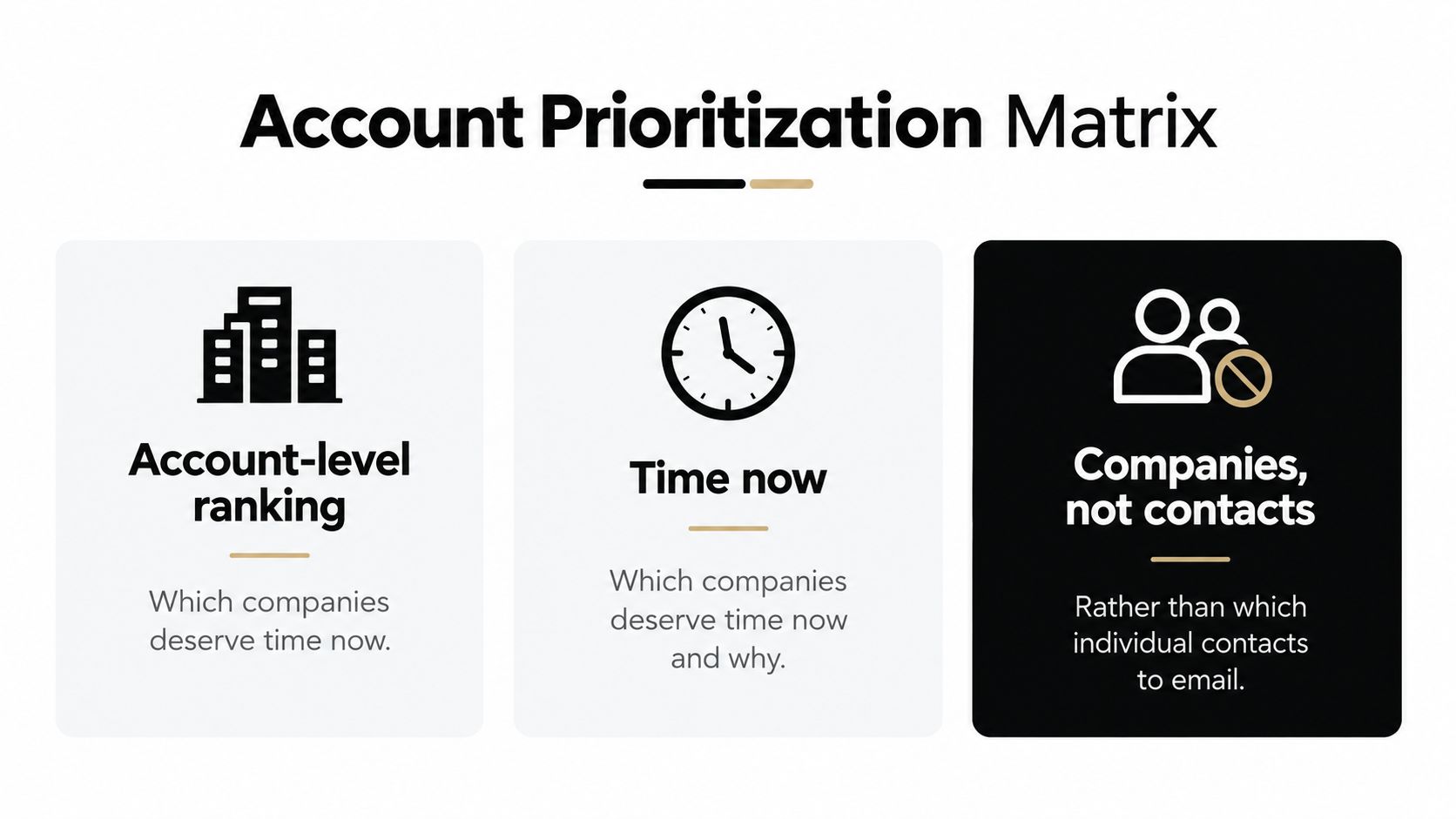
An account prioritization matrix is useful only when it changes what a team does today. It ranks companies by their fit and current signals, then gives account owners a reason to act, wait, or suppress outreach.
The matrix separates three decisions:
- Eligibility: Can the organization plausibly buy, implement, and benefit from the product?
- Urgency: Is there recent, credible evidence of a relevant need?
- Execution: What action fits the evidence, and what conditions should block it?
A fit score answers whether an account is worth pursuing. It cannot show whether a signal is still fresh. A return visit to a relevant product page may warrant follow-up while the activity is recent, then lose weight as time passes. Set decay rules and confidence thresholds so an old or weak signal does not keep an account at the top of the queue.
Several relevant people researching from one company can indicate wider buying-group participation, even if no individual contact would rise to the top of a lead-scoring queue. Treat that as a reason to investigate, not proof that a purchase is imminent. The matrix should also suppress action when a hard restriction applies or the evidence lacks enough confidence.
A static account list cannot reflect those changes. Keep the recommendation tied to dated evidence, and make the owner's next action clear. The matrix sets priority; the account owner checks the context and decides whether outreach is appropriate, without claiming more than the evidence supports.
How to Build Your Matrix in Six Steps
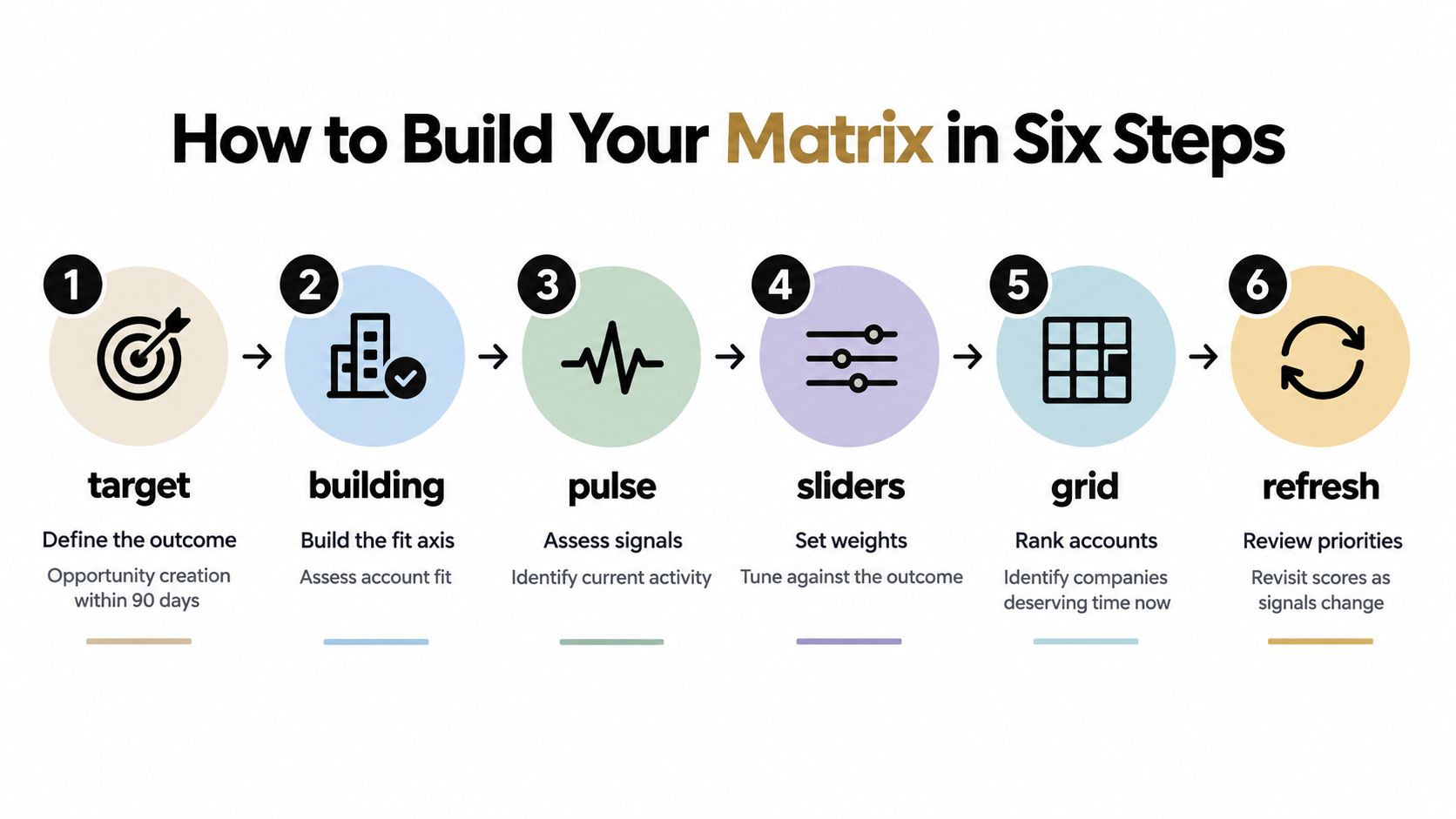
Choose the commercial decision first. A scoring model is only useful if it leads to a clear recommendation that teams can compare with actual outcomes.
Define the outcome. Decide what the matrix should help your team achieve, such as identifying accounts worth sales attention. Set a clear outcome your CRM can record consistently, then define what qualifies before scoring begins. The two-stage account-prioritization framework can inform how you separate account selection from prioritization.
Build fit from verified attributes. Use industry, headcount band, region, technology environment, and operating model. Start with a documented ideal customer profile, rather than shaping criteria around familiar accounts. Keep these attributes separate from buying signals. For example, record an active hiring event as a dated signal, not as both a fit attribute and a signal score.
Accept only dated, observable signals. Store what happened, when it happened, and where the evidence came from. A general claim that a company is expanding carries less weight than an identifiable opening in a function your product serves. Apply a decay window so older events lose priority instead of keeping an account at high priority indefinitely.
Compare accounts with their peers. Segment by meaningful differences, such as company size, industry, or operating model, then rank within each group. A small agency and an enterprise bank shouldn't need identical levels of digital activity to demonstrate interest. Keep each segment large enough to support useful comparisons, and check that its criteria reflect how your team sells to that type of account.
Define tier entry and precedence. Use Strategic, Active, Review, Watch, and Hold consistently. Set the evidence and confidence required for each tier, then specify which conditions override the score. Missing evidence, an active conversation, or an unresolved risk may change the recommended action even when the total score is high.
Recalibrate against outcomes. Review thresholds on a regular schedule, keep a change log, and test whether the model distinguishes commercially useful accounts from merely active ones. Change a weight only when outcome patterns support the adjustment, not because a signal is popular with reps. A lead scoring for franchise development example can serve as a comparison when deciding whether your own criteria fit a distinct sales context.
Check the decision with a hypothetical account
Consider a fleet-software company in Ohio that matches your industry, region, and technology requirements. It has recent pricing-page activity, limited engagement breadth, and a newly appointed operations leader whose remit connects directly to your product.
If the evidence is verified and no restriction applies, the account could qualify for Active. Remove the leadership event, and the remaining evidence may support Review instead. That change reflects urgency, not a change in the company's fit.
If removing a meaningful event never changes the recommendation, its weight may be too low. If any leadership change triggers outreach, the rule is too broad. Check both the score and the evidence confidence before assigning the tier.
Turning Tiers Into Daily Actions and Suppression Rules
Tier entry rules, rep motions and suppression rules
| Tier | Entry rule | Rep motion | Suppression rule |
|---|---|---|---|
| Strategic | Strong fit and strategic value, confirmed through account planning | Assign an owner, build an account plan, engage relevant buying roles | Skip generic sequences and coordinate all outreach |
| Active | Verified fit, fresh relevant evidence, sufficient confidence | Send personal outreach grounded in the trigger before it loses relevance | Pause automation after a reply; respect the owner's conversation |
| Review | Potentially actionable, but evidence or relevance needs judgment | Read the brief and decide during the current queue review | Don't launch outreach while the decision is unresolved |
| Watch | Suitable account without a current reason to engage | Monitor for changes and use appropriate nurture | No prospecting task until qualifying evidence appears |
| Hold | Low confidence, unresolved restriction, or active risk | Verify the record and document the release condition | No outreach until the restriction clears |
The difficult trade-off is freshness versus fit. A recent pricing-page visit can justify attention ahead of an older, better-fitting account, provided the newer account still meets your eligibility requirements. Intent works better as a prioritization layer than as a rigid database filter, a distinction discussed in Martal's predictable-pipeline guidance.
That doesn't mean every new event deserves immediate outreach. Require a credible connection between the event and the problem you solve. Funding may be relevant to an expansion product but weak evidence for a replacement purchase.
Make suppression part of routing
Suppression should run before task creation, not after a rep has drafted an email. Check account ownership, existing opportunities, recent replies, opt-outs, and any unresolved Hold condition.
A reply should move the account into a conversation workflow. It shouldn't merely subtract points while another sequence continues running.
Use your target-account management process to assign responsibility for these exceptions. Sales operations can maintain the rules, but the account owner needs a clear way to record why an otherwise eligible account should remain untouched.
The daily queue must make the action inspectable: what should the rep do, why now, and what evidence would change the decision?
Wiring Live Signals Into Your CRM Workflow

Treat CRM signals as perishable evidence, not permanent account attributes. A daily workflow should record where an event came from, when it was verified, and when it stops qualifying. The windows below are starting rules. Set explicit expiration dates, then adjust them to the event: an open hiring need may remain relevant while the role is active, while a completed technology migration should lose weight sooner.
| Signal | Source | Freshness rule | CRM field |
|---|---|---|---|
| Hiring | Job boards, careers pages | Keep eligible while the relevant opening is current and verified | Hiring signal and role type |
| Funding | Funding news | Retain while the stated initiative remains actionable | Funding round and date |
| Leadership change | News, professional profiles | Retain during the verified transition | Role and start date |
| Technology shift | Job posts, site technology | Keep eligible while the change remains current | Tool added and date |
| Review movement | Google Business Profile | Retain recent, verified movement; expire stale snapshots | Rating and sentiment change |
| Website intent | Pricing, demo and integration page returns, watched accounts only | Use a short window; refresh only after new qualifying activity | Intent flag and page count |
A job opening is useful evidence only when the role points to a plausible need your product addresses. A professional woman reviewing a job listing at her desk while analyzing an account management dashboard.
Write evidence before writing alerts
Build the workflow in this order: ingest the event, match it to the correct company, check the source, apply freshness and suppression rules, then update the company record. In HubSpot, Pipedrive, or Attio, store the ICP grade, current tier, confidence, and a concise Why now note. Keep the original source link on the record so reps can check the evidence. Guidance on finding and acting on sales trigger events can help teams decide which events merit a CRM update.
For website intent, monitor watched accounts only, and avoid cookies or person graphs. Account-level activity does not prove that a named individual viewed a page.
Alert reps through Slack, Teams, email, or a webhook when an account meaningfully moves into Strategic or Active. Don't generate a notification for every field update. Include the event, its source, and its age so the rep can validate the recommendation without repeating the full research process. The video below provides additional workflow context.
Handling Missing Data and Proving the Tiers in a Pilot
A low score can mean poor fit, no observed activity, or insufficient evidence. Keep fit, signal strength, and confidence in separate fields so reps can distinguish those situations.
A suitable company without visible hiring shouldn't be rejected just because its careers page is absent. Label unverifiable claims, record source reliability, and route uncertainty to review rather than treating missing information as negative intent without acknowledging the uncertainty.
Audit visibility before changing weights
In LeanData's GTM research, 43% of respondents rated data hygiene as a high priority, reinforcing the importance of checking the underlying records before refining the formula (State of GTM Efficiency).
Compare tier distribution across company sizes and regions. Public signals are unevenly available, so review whether digitally visible companies receive preferential treatment even when less visible peers have comparable fit.
Confidence check: Missing evidence is a research condition, not a customer characteristic.
Cap repeated events, preserve timestamps, and check calibration, false positives, segment bias, and data leakage before reweighting. Commercial claims of 72–85% predictive-model accuracy versus 48–54% for threshold scoring are directional, not independently audited universal benchmarks, as acknowledged in the commercial scoring-statistics overview.
Run a controlled pilot
Choose comparable accounts. Include distinct peer segments and freeze the initial scoring rules. Record exclusions so the test doesn't remove difficult accounts without notice.
Create a credible comparison. Randomize prioritization where feasible, or use historically matched accounts based on size, industry, and prior activity. Document whether you're testing ranking, outreach allocation, or both. A contacted group versus an untouched group measures more than scoring alone.
Measure decisions and outcomes. Track precision at the top of the queue, conversion by tier, lift against the comparison group, time-to-first-touch, revenue per rep-hour, and accounts held for missing data. Don't substitute email opens for commercial evidence.
Make a bounded change. Keep the weights, adjust a dimension, or retire a signal that fires frequently without predicting useful outcomes. Preserve the previous version so you can evaluate the change.
A short pilot can expose routing failures and weak evidence, but revenue outcomes may need a longer observation period. The pilot, not the template, decides whether the matrix works.
CapyScout is one option for monitoring watched accounts for buying signals and writing source-backed Why now notes and ICP grades into HubSpot, Pipedrive, or Attio. Visit the platform to assess how its daily monitoring and account queue could support your prioritization pilot without building the signal collection and CRM write-back yourself.