

CRM Sales Pipeline Stages: Definitions and Exit Criteria
Learn CRM sales pipeline stages, exit criteria, KPIs and how automation and enrichment lift conversion.
The most common advice about a CRM sales pipeline is to define stages, assign probabilities, and keep adding deals. That's not enough. If sellers move opportunities forward without buyer evidence, the CRM becomes an organized collection of assumptions.
Treat your pipeline as a lagging record of evidence, not a live picture of everything buyers are doing. A stage should describe what's been verified, while freshness checks and confidence labels determine whether that evidence is strong enough to support a forecast.
Table of Contents
- CRM Sales Pipeline Stages and Exit Criteria
- What a CRM Sales Pipeline Tracks and Why It Matters
- Pipeline Design Rules That Keep Forecasts Honest
- Pipeline KPIs That Show Whether Revenue Is Coming
- How Buying Signals and Enrichment Lift Conversion
- How One Team Turned a Stale Pipeline Around
- Confirm Your Stage Rules Before Your Next Forecast
CRM Sales Pipeline Stages and Exit Criteria
A deal can sit in Proposal and still be useless for a forecast. The stage name only says what someone already verified. If that proof is stale, or the confidence label is too weak, the amount does not count toward coverage.
Pipeline stages with exit evidence
| Stage | What the deal has proven | Exit evidence required |
|---|---|---|
| Prospect | Account fits the ideal customer profile | Company, role and fit verified |
| Contacted | Someone has engaged or replied | Reply or accepted meeting logged |
| Qualified | A business problem exists | Problem, budget owner and timing confirmed |
| Discovery | The decision process is mapped | Decision makers and steps named, next meeting booked |
| Proposal | Buyer has a priced solution | Proposal sent with a dated follow-up |
| Negotiation | Only terms remain open | Procurement or legal path agreed |
| Closed Won | Contract signed | Signed order and handover booked |
| Closed Lost | Deal ended with a reason | Loss reason and date logged |
Treat the ladder as a working model. You do not need a new field for every row. Entry evidence is why the deal may sit in the current stage. Exit evidence is the only thing that lets it move. A finished internal checklist does not replace a buyer milestone.
What earns each stage
Walk one opportunity down the ladder before you configure the CRM. The same proof question applies at every step: what did the buyer do, and is that record still fresh enough to trust?
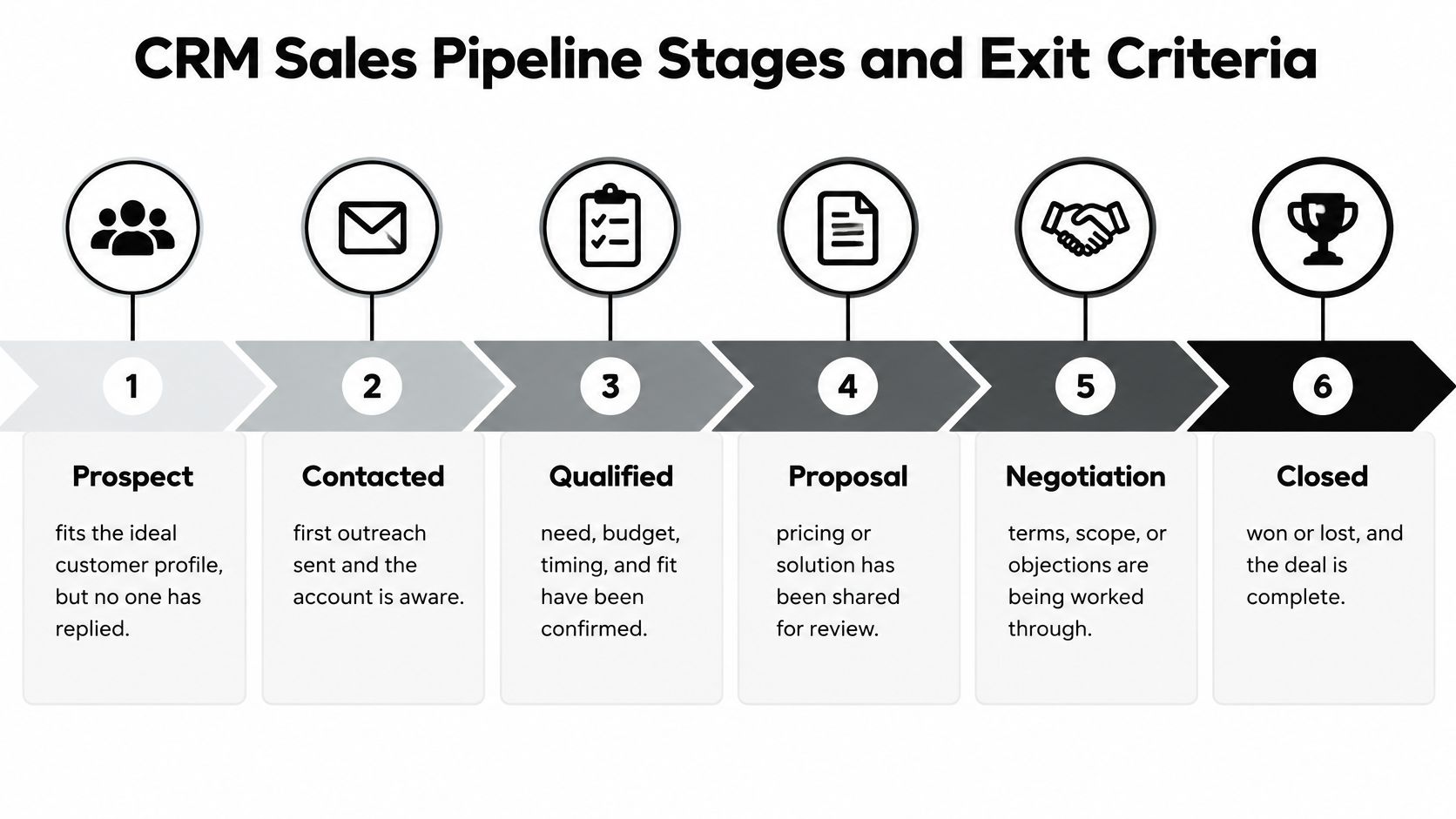
At Prospect, the company matches your ideal customer profile and nobody has replied. Confirm the company, the relevant role, and the fit before more outreach. A strong match is still a stored account, not an active opportunity.
At Contacted, a person replied or accepted a meeting. An email sent, or a LinkedIn connection requested, is activity. It is not engagement.
At Qualified, the buyer has named a business problem and a real reason to act now. Write down who owns the budget and what sets the timing. A rep's guess that the company can pay is not that record.
At Discovery, you have mapped who decides and how. Exit requires named people, known approval steps, and a next meeting on the calendar. A finished demo is not enough.
At Proposal, the buyer has a priced solution and a dated follow-up. A draft in the seller's folder has not left the building.
At Negotiation, the buyer has accepted the solution. Only commercial or contract terms are still open. If they are still unsure the product solves the problem, move the deal back.
The diagram is a short map. Use the table's evidence rules when you set stage requirements in the CRM.
Close the record properly
Closed Won needs a signed order and a booked handover. A verbal yes stays in the open pipeline until that commitment exists.
Closed Lost needs a loss reason and a date. Separate no decision, missing capability, budget withdrawal, and competitor selection. Each one points to a different fix in qualification or selling.
Nurture stays off this ladder. An account that is not ready for a sales conversation can receive email outside the opportunity, and that activity does not advance a stage or enter the forecast. Lead Printer's email marketing services are one place to review email nurture for those accounts, without counting campaign participation as deal progress.
Have each seller write the exit rule for every stage in their own words. Then open five live deals together. If two people read the same note and pick different stages, fix the rule before you touch the forecast view. A stage only earns its place in coverage when the exit evidence is present, recent, and marked with a confidence level the team accepts.
What a CRM Sales Pipeline Tracks and Why It Matters
Think of a conveyor belt in a warehouse. Each deal is a parcel, and each stage is a checkpoint where someone inspects it before allowing it forward. Contacts sit in the warehouse; the opportunity pipeline tracks what's on the belt.
That distinction matters when your CRM includes a prospecting board. You can organize unengaged accounts there without counting them as qualified revenue opportunities.
The warehouse analogy makes the difference between stored records and active movement concrete.

Visibility, movement, and expected revenue
A well-run pipeline performs distinct jobs:
- Show the workload. Managers can see which opportunities are live, who owns them, and how much revenue they represent.
- Expose friction. Stage histories reveal where buyers stop advancing, so managers can investigate the relevant conversation or approval step.
- Support a forecast. Eligible deal values, expected timing, and calibrated probabilities become an estimate of future bookings.
The commercial purpose isn't new. In Salesforce's 2016 State of Sales study, which surveyed more than 3,100 sales leaders, 40% of high-performing teams using intelligent selling capabilities reported increased pipeline generation, and 43% reported higher deal-close rates.
Those findings connect pipeline work with both opportunity creation and conversion. They don't mean that storing more records produces revenue.
Management test: A larger pipeline is useful only if it contains more opportunities with a credible path to a buying decision.
Say a team's Discovery column looks crowded, but only a small subset of deals has a named decision maker. The manager shouldn't celebrate the column's size or demand more demos. They should inspect whether sellers are reaching the people who can approve a purchase.
This also changes coaching. Instead of asking whether a deal feels promising, ask which buyer action would demonstrate progress and who will secure it.
Write a sentence describing what your pipeline must answer every Monday morning. A useful version is: Which buyers can realistically decide this period, what evidence supports that assessment, and what must we do next?
Pipeline Design Rules That Keep Forecasts Honest
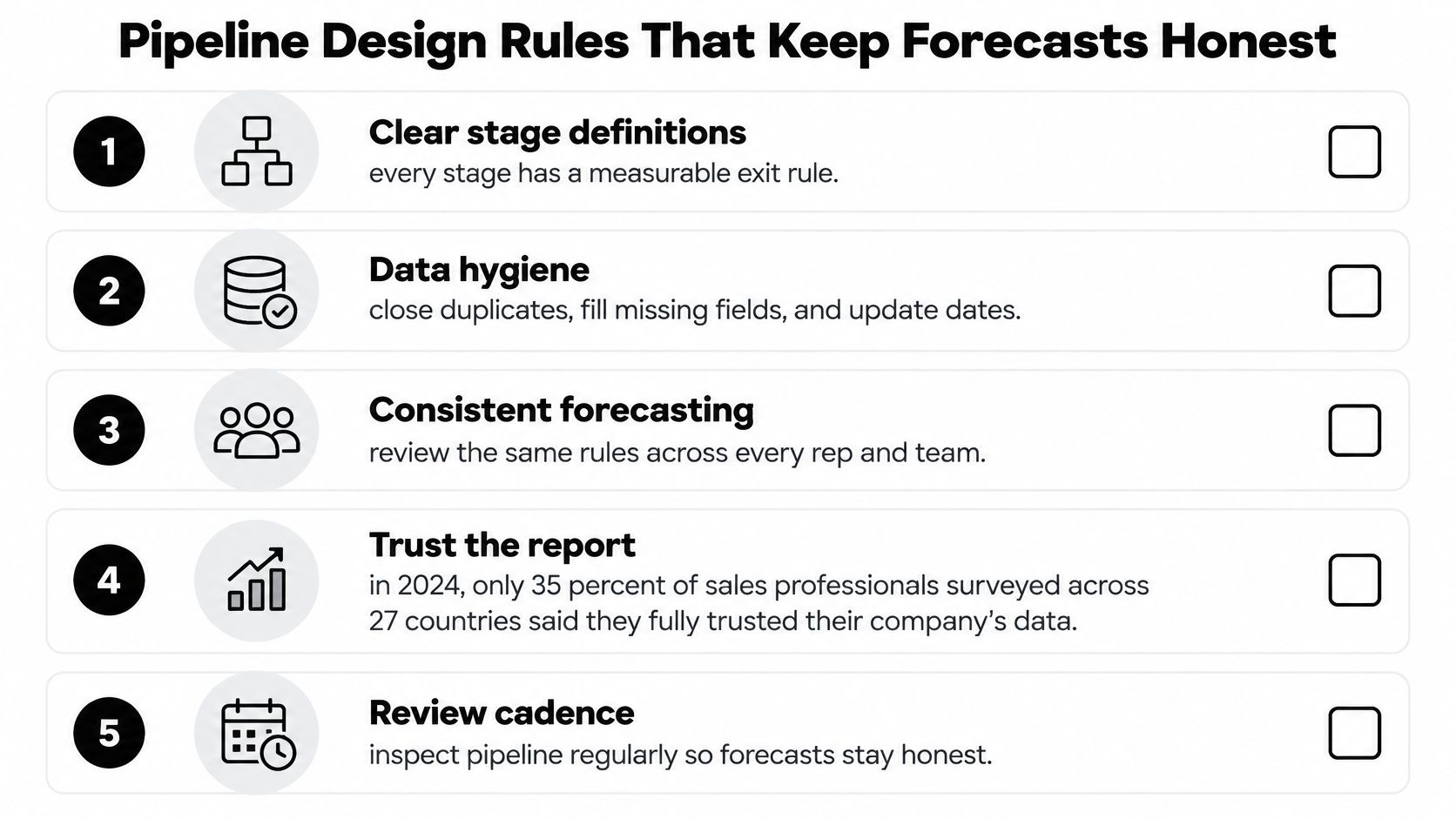
In 2024, 35% of sales professionals surveyed across 27 countries fully trusted the accuracy of their company's data, according to Salesforce's State of Sales report as reported by CRM.eu. A forecast built from disputed inputs won't become dependable merely because the CRM calculates it automatically.
Outdated contacts, duplicate accounts, and unsupported close dates create different problems. They can misroute follow-up, count the same buying process twice, or place revenue in a period the buyer hasn't committed to.
Build controls into the workflow
- Attach freshness metadata. Store when contact roles, company status, qualification evidence, activity, and next actions were checked, so reviewers can distinguish current facts from inherited assumptions.
- Require observable milestones. Make stage changes conditional on evidence rather than allowing a dropdown selection to stand alone.
- Assign a field owner. Name the person accountable for resolving an incorrect value, even when automation populates it.
- Quarantine stale opportunities. Keep the history accessible, but remove forecast eligibility until the relevant evidence is revalidated.
- Prioritize daily backfill. Review high-value and high-risk records first rather than refreshing every account with equal urgency.
Record freshness rules by field
These are proposed operating thresholds, not universal benchmarks. Adjust them for your sales cycle and segment.
| Record field | Freshness check | Action when stale |
|---|---|---|
| Contact role | Re-confirmed within 90 days | Mark unverified and queue for enrichment |
| Company status | Checked every 6 months | Flag as possibly acquired or closed |
| Qualification evidence | Dated and linked to a source | Remove from forecast until revalidated |
| Last meaningful activity | Logged within 14 days | Downgrade stage probability |
| Next action | Dated and in the future | Require a date before the deal stays open |
An automated email shouldn't reset meaningful-activity freshness. Use buyer replies, substantive meetings, agreed document reviews, or another interaction that changes your understanding of the deal.
Keep the checklist visible where managers review opportunities.
Separate evidence from interpretation
Create distinct labels for verified account facts, observed behavior, inferred intent, and seller judgment. A published leadership appointment is a fact; the belief that the new leader will replace the current software is an inference.
Assign confidence to the claim, not to the account as a whole. When sources contradict each other, preserve both and route the record for review rather than overwriting the older value.
Use data integrity checking for CRMs and customer databases to structure the validation work. Track the share of forecastable deals with current contact, account, activity, and next-step fields, split by seller and stage, so you can identify where the process breaks down.
Pipeline KPIs That Show Whether Revenue Is Coming
Eligible pipeline coverage is eligible open pipeline value divided by quota. The important word is eligible: opportunity value belongs in the calculation only when the deal meets your evidence and timing requirements.
A common planning range is 3x to 4x coverage, implying aggregate conversion requirements of approximately 33.3% and 25%, respectively, before slippage and timing variance, as explained in Avoma's sales pipeline metrics guide. That's planning arithmetic, not a guarantee that either multiple suits your business.
Calculate coverage by segment, source, and opportunity age. Exclude deals without a recent verified buying signal, a dated next step, or confirmed decision-maker information; otherwise, stale value inflates the coverage numerator and creates false confidence.
Core pipeline KPIs and how to calculate them
| Metric | How to calculate | What to watch |
|---|---|---|
| Eligible pipeline coverage | Eligible open pipeline value divided by quota | 3x to 4x as a planning reference, after excluding stale deals |
| Stage-to-stage conversion | Deals advancing divided by deals entering the stage | Compare by segment and source |
| Aging and slippage | Days in stage and count of pushed close dates | Rising age in the same stage |
| Forecast error | Forecast minus actual, by period | Tracked separately from quota attainment |
| Record freshness | Forecastable deals with current fields divided by all forecastable deals | Split by rep and stage |
Read the measures together
Coverage describes available value; conversion describes how effectively a defined group progresses. Don't calculate conversion by dividing this week's exits by unrelated new entries. Follow the same cohort, and allow enough time for its outcomes to become meaningful.
Aging needs similar care. A long procurement stage may be normal for enterprise buyers but abnormal for a self-serve upgrade, so compare like-for-like deals rather than imposing a single deadline.
Forecast error isn't quota attainment. A team can correctly predict that it will miss quota. Keep signed forecast error to distinguish overforecasting from underforecasting, and define the denominator explicitly if you also report percentage error.
An honest forecast can contain bad news. Its job is to describe the likely outcome, not make the target look achievable.
Calibrate before adding sophistication
Before producing a weighted forecast, set starting stage probabilities from historical win rates within relevant segments. Then compare those predictions with actual cohort outcomes by market, deal size, and acquisition channel.
If a persistent gap appears, investigate both the weight and the stage definition. Changing a probability won't fix sellers placing very different opportunities in the same stage.
Keep account prioritization separate from closing probability. A strong fit score can justify outreach without making an account forecastable; a practical B2B lead-scoring framework helps maintain that distinction.
Build the weekly dashboard with these lines:
- Coverage: Eligible value against the relevant target.
- Conversion: Cohort progression by segment and source.
- Timing: Stage age and close-date movements.
- Forecast error: Predicted bookings against actual bookings.
- Freshness: Current required fields across forecastable deals.
Assign an owner to investigate each exception, not just display it.
How Buying Signals and Enrichment Lift Conversion
In a study of more than 4,000 B2B buyers across North America, EMEA, and APAC, 94% ranked preferred vendors before first contact, according to 6sense's 2025 Buyer Experience Report announcement. Your CRM can therefore show Prospect while the buyer has already developed a preference.
Account research should inform the conversation before the seller asks the buyer to repeat everything.

Interpret signals without overstating them
Enrichment should connect an account change to a plausible business problem. Attach the source, grade ICP fit, and write a Why-now note that separates the observation from your hypothesis.
Buying signals and what they prove
| Signal | What it suggests | What it does not prove |
|---|---|---|
| Hiring in sales or RevOps | Budget and a new process to fix may exist | Active buying intent |
| Funding round | Budget may be available | A decision is already in progress |
| Leadership change | Priorities may reset | The new leader wants this category |
| Technology adoption | Current stack may have gaps or integration needs | Purchase timing |
| Visits to pricing or integration pages | Vendor research may be underway | Which vendor will win |
| Changes in review activity | A shortlist may be forming | Your product is on it |
For example, a RevOps job posting mentioning CRM migration supports a more specific question than a generic hiring announcement. It still doesn't establish that the company wants your product or that the person you've found owns the project.
Require corroboration or a meaningful pattern before acting on inferred intent. Even corroborated signals should trigger investigation, not automatic stage advancement; the buyer must still supply the required milestone evidence.
Use the CRM data enrichment practical guide to organize source attribution and record updates. Keep the resulting note short enough for a seller to use before a call.
For a complementary video resource:
Measure relevant changes among ICP accounts, time from change to detection, and whether evidence and a next action reached the CRM. Those operational measures suit small teams because they focus attention on actionable account changes without requiring broad SDR coverage.
How One Team Turned a Stale Pipeline Around
Consider a hypothetical team of six account executives with a quarterly quota of $1.2 million. Their CRM displays $3.6 million in open opportunities, apparently providing 3x coverage. These figures are illustrative, not a customer result.
The first audit removes $900,000 from eligible coverage because the opportunities lack dated next steps and confirmed decision makers. The remaining $2.7 million provides 2.25x coverage. The team hasn't suddenly lost those buyers; managers have stopped treating unsupported value as dependable.
Correct the record before coaching the seller
In the scenario's second week, managers inspect Proposal records against actual sent documents. A third have no delivered proposal, so the sellers move them back to the appropriate stage and schedule the missing work.
That correction changes the coaching conversation. Instead of asking why buyers haven't signed, managers ask whether discovery is complete, whether scope is agreed, and who is preparing the commercial offer.
Removing a deal from the forecast isn't the same as declaring the account lost.
By the fourth week, the hypothetical team adds source-backed Why-now notes and signal checks to active accounts. That exercise returns 40 accounts to targeted outreach with specific reasons to reconnect, while keeping them separate from forecastable opportunities.
Define improvement honestly
Suppose the team's percentage forecast error later narrows from roughly 30% to under 10%, using the same calculation throughout. That would be a worked-example outcome, not evidence that an audit guarantees a particular improvement. Managers would still need to examine bookings, quota attainment, and whether the change persists.
Forecast misses are a broader management concern: in Xactly's 2024 survey of 400 sales and finance professionals, 4 in 5 sales and finance leaders reported missing a quarterly forecast during the previous year, and more than half missed it at least twice.
Copy the operational changes, not the hypothetical results:
- Audit eligibility. Reconcile the headline pipeline with the evidence that supports counting it.
- Inspect stage claims. Compare CRM labels with actual buyer interactions and documents.
- Preserve future opportunities. Keep nurture and reactivation accounts available without misrepresenting them as near-term revenue.
The useful outcome is a clearer distinction between work worth doing and revenue worth forecasting.
Confirm Your Stage Rules Before Your Next Forecast
Make the first implementation pass small enough to finish this working week. Assign an owner and completion date to each action before the next pipeline review.
- Publish the stage contract. The sales manager writes an exit criterion for each stage, tests the wording with sellers, and stores it beside the CRM workflow.
- Configure freshness checks. Revenue operations adds verification dates for contact role, company status, qualification evidence, last meaningful activity, and next action. Use the proposed thresholds as starting settings, then document segment-specific exceptions.
- Label Why-now confidence. The account owner distinguishes facts from interpretations and sends low-confidence or contradictory claims to a named reviewer.
- Schedule the dashboard review. The operations lead creates the coverage, conversion, timing, forecast-error, and freshness views. The sales manager owns decisions arising from exceptions.
- Set and revisit stage weights. The analyst or operations owner calculates starting probabilities from historical outcomes and schedules a quarterly calibration review. Where history is limited, label the assumptions explicitly.
Test the rules on actual records
Keep a completion log so the team can distinguish a configured control from an unfinished task. At the next forecast cycle, check whether sellers used the rules during normal work, not just during the cleanup.
CapyScout's Signals watch a list or your CRM for the right moment to reach out. HubSpot, Pipedrive, or Attio can be connected in one click, and CRM changes land on the record and in Slack with a drafted first line.
Finish with the ten-deal test: select ten open deals, apply your stage criteria and freshness checks, and resolve any unsupported claims before those records count toward the next forecast. Let the results determine what you fix first.
CapyScout monitors account changes and enriches CRM records with source-backed context, helping sellers identify who to contact and why now. Visit CapyScout to bring that evidence into your pipeline workflow while keeping stage advancement and forecast eligibility tied to your team's rules.
Not ready to start? Get a free target list: 10 companies to sell to, picked from your website.