
Outbound Sales Prospecting: How It Works in 2026

Outbound sales prospecting explained: workflow, targeting, timing, outreach and metrics, with 2026 benchmarks for replies and meetings.
In 2024, Cognism recorded 55,701 cold-call dials, of which 9,247 connected with a prospect and 5,265 became conversations, according to Cognism's State of Cold Calling. Three numbers, three different events, and most dashboards only count the first one.
That gap is where outbound arguments go wrong. A team concludes its emails aren't working when the problem is that nobody on the list had a reason to reply. Another team rewrites subject lines for a month while a third of every send bounces. Both are staring at one blended number, blaming one stage for a failure that started two stages earlier.
Outbound sales prospecting works when you treat it as a chain of five decisions, each with its own count, its own failure mode and its own fix. The stages below are the ones every outbound motion runs, whether it's a founder sending twenty emails a week or a floor of SDRs working a dialer.
Table of Contents
- How Outbound Sales Prospecting Works, Stage by Stage
- Picking Accounts and Buying Signals Worth Acting On
- Building a Multi-Touch Sequence That Earns Replies
- Writing Outreach That Cites a Real Reason
- Measuring Each Stage Without Blending the Numbers
- Common Failure Points and How to Fix Them
- Run a Five-Account Test Before Scaling Outbound
How Outbound Sales Prospecting Works, Stage by Stage
Dropping a net into open water and hoping isn't fishing. You pick the water, the depth and the bait, then you watch the line. Outbound sales prospecting is that discipline applied to revenue: proactive contact with accounts that have not asked to hear from you, built as a chain where each stage sets up the next.
It runs beside inbound rather than replacing it. In 2025, 43% of surveyed sales teams used a hybrid model combining inbound and outbound sales within the same function, according to Outreach's 2025 prospecting report. The useful question isn't outbound or inbound. It's which link in the outbound chain is leaking.
The diagram below shows the same process as a single flow, from defining the motion through measuring it.
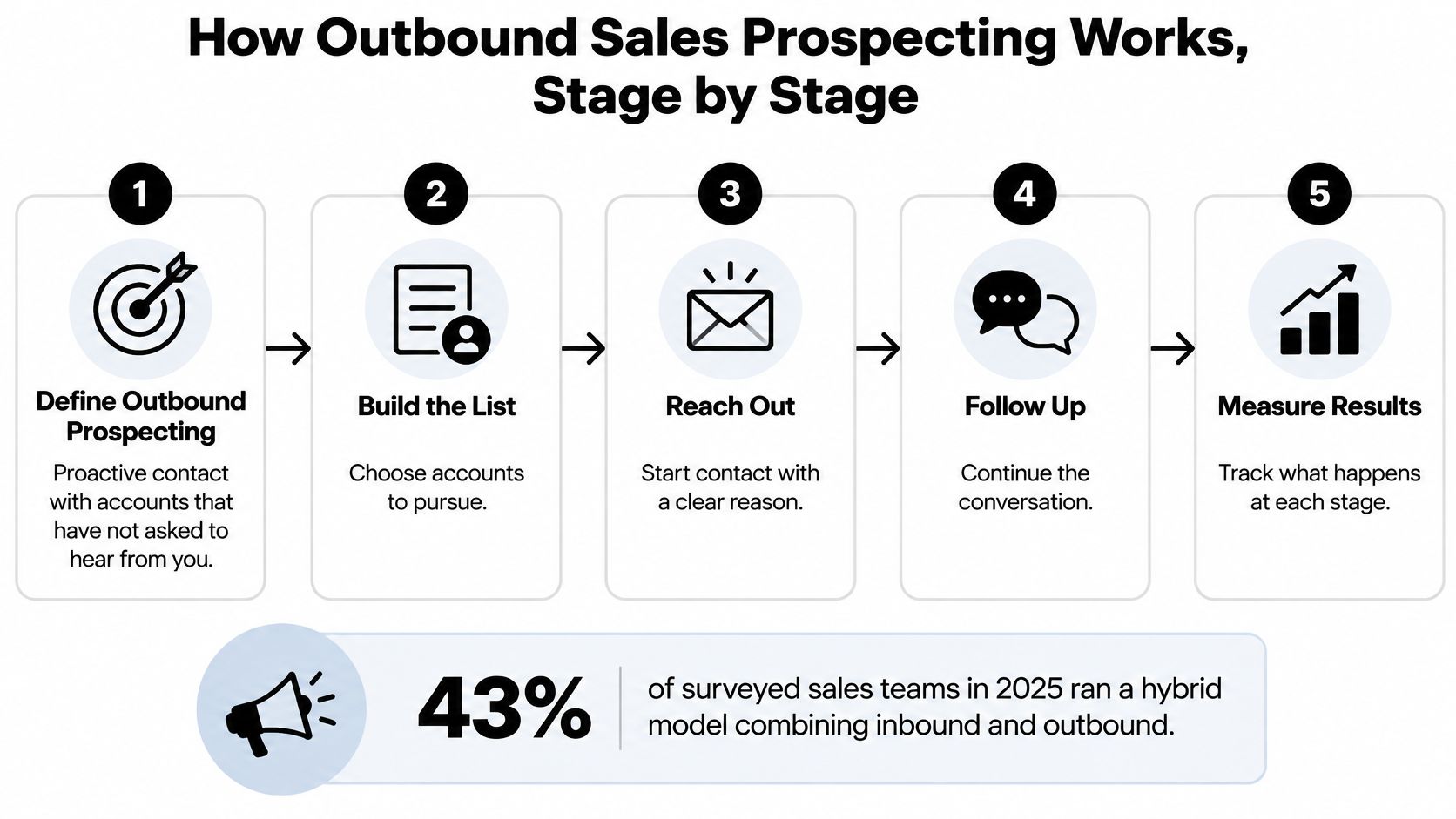
Five stages, five counts, five different ways to fail.
| Stage | Question it answers | Output | Metric to track |
|---|---|---|---|
| Target accounts | Which companies fit our buyer profile? | Scored account list | Fit score per account |
| Find the buyer | Who decides or influences this purchase? | Named contact with verified email or phone | Contact found rate |
| Catch the trigger | Why contact this account now? | Dated buying signal with source | Share of accounts with a live signal |
| Run outreach | What do we say, and in which channel? | Multi-touch sequence with a reason to reply | Connect rate and reply rate |
| Hand off meetings | Did the prospect engage enough to talk? | Booked meeting or disqualified account | Meetings per 100 accounts contacted |
A dial is not a conversation, and a conversation is not a qualified opportunity. Each stage needs its own denominator, because a blended rate lets a stage failure hide. If your list has no fit score, no amount of rewriting will lift a connect rate that was never going to be high. If you skip the trigger, a well-written sequence still reads as cold, because the prospect can't see why you picked this week.
Each stage leans on the one before it. A weak fit score produces a contact list nobody answers. A missing trigger makes even a strong message arrive at the wrong moment. And a meeting handed off without the signal that prompted it leaves the account executive starting from zero.
Our own process follows that dependency on purpose: find accounts, catch the right moment, then send outreach. The order matters more than the tooling.
If you're shopping for software before you've fixed your stages, a side-by-side of AI cold call software makes the limits obvious. Nearly every tool automates two of those five rows. None of them repair a bad fit score.
Map your current process against the five rows and circle the stage where the most accounts drop out. That circle is where next quarter's improvement lives.
Picking Accounts and Buying Signals Worth Acting On
Your target list is a hypothesis, not a purchase. You're betting that a group of companies shares the conditions that make your offer useful, and the fit criteria are how you write that bet down. Many teams rely on five criteria: industry, company size, technology stack, geography and hiring activity.
The checklist below is the one to run before a single message gets written.
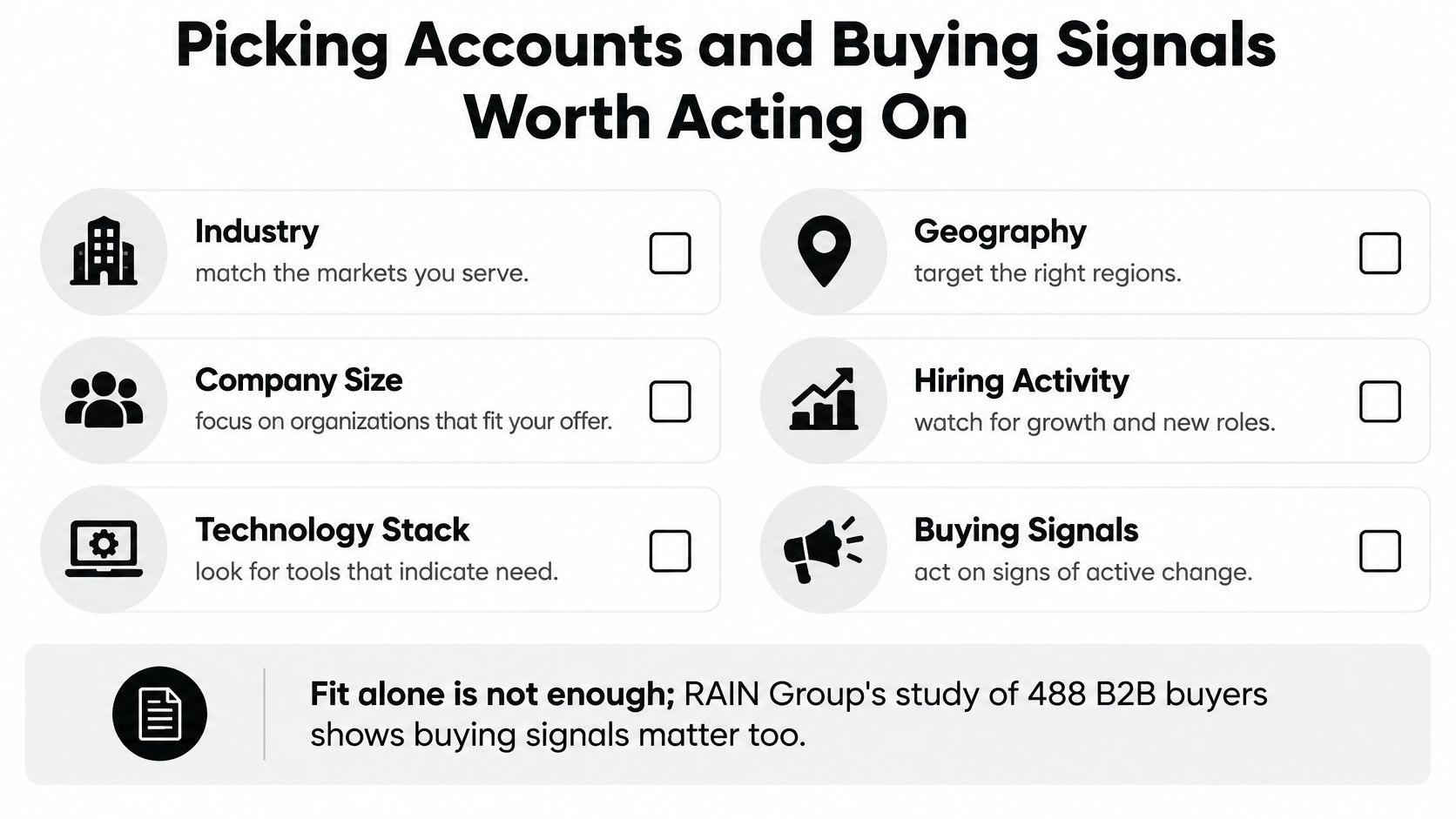
Fit criteria that earn their keep
Industry narrows the vocabulary of your first sentence, because a company already buying category software recognizes the problem faster. Company size decides whether your offer is a rounding error or a budget line. Technology stack tells you what breaks next, and geography sets which regulations, time zones and buying norms apply. Hiring activity is the quiet one. A role posted three times in a month is a public statement about where a team feels pressure.
Why fit alone stalls
A company can match every criterion and still have no reason to talk this quarter. Top-performing prospectors generated an average of 52 conversions (meetings, conversations or demos) for every 100 buyers targeted, in the RAIN Group Center for Sales Research study of 488 B2B buyers representing $4.2 billion in purchases across 25 industries. Those same sellers advanced more opportunities to proposal, at 56% versus 46%, and won more proposals, at 48% versus 37%. The mechanism wasn't volume. They reached buyers at the right organizational level and customized the first interaction around the buyer's situation.
Signals that justify contact now
A signal is a dated, sourced event that changes what a company needs or how urgently it needs it. Six deserve a workflow.
- A hiring push tied to your problem. Three account executive postings suggest pipeline is outrunning capacity. A first RevOps hire suggests process debt.
- A funding round. New budget and new targets usually land in the same quarter.
- A leadership change. A new VP of Sales typically audits the stack within 90 days.
- A technology adoption or switch. A migration is work, and work needs tools.
- A drop in local reviews or reputation. Rating drops and sentiment shifts are visible, dated and urgent for service businesses.
- Repeat visits to pricing, demo or integration pages from accounts already on your watch list.
Every one of those needs a date and a source. A signal you can't cite is a hunch wearing a badge, and it collapses the first time a prospect asks how you knew. This guide to buying signals and their free sources maps where each event can be monitored without paid data.
On our side, new people arrive from whatever sources a campaign points at: daily searches and feeds, LinkedIn connections, website visitors and signups, your existing customers, an imported list, or a watched list that fires when a signal lands. A saved search re-runs your ideal customer description and adds only companies you don't already have.
For a walkthrough of how those signals get captured and turned into a shortlist, watch below.
The one-sentence test: write the reason you're contacting this account today as a single sentence with a date in it. If you can't, drop the account.
That sentence becomes the first line of the first touch, the note on the CRM record and the field you later measure by trigger type. An account that can't produce one belongs in nurture, not in a sequence.
Building a Multi-Touch Sequence That Earns Replies
Ask ten sales leaders why they follow up five times and nine will cite the claim that 80% of sales require five follow-ups. That number traces to a 1942 poll of members of a local sales club on Long Island, not to any modern representative study, as this review of sales statistics myths documents. Repeating folklore makes an otherwise careful sequence look built on guesswork.
The instinct behind it survives, for a better-documented reason. Research summarized from Cognism's 2025 dataset, covering more than 204,000 cold calls, found that 93% of conversations occurred by the third call, with more than 98% occurring by the fifth. A separate benchmark drawn from nearly 3.5 million leads found that 93% of converted leads were reached by the sixth call.
Read those carefully. They don't justify nine touches that repeat the same paragraph. They say that stopping after one attempt deletes most of the buyers you could have reached.
What a later touch owes the reader
A second email that restates the first isn't persistence, it's noise. Every later touch has to carry something the earlier one didn't have: a new event, a changed circumstance, a specific example, or a smaller ask. That's the whole difference between a cadence and a nag.
A four-touch sequence that carries new information
Here's the structure we run, and it fits in under two weeks.
| Touch | Channel | Typical day | Purpose |
|---|---|---|---|
| 1 | Email about a new office or hire | Day 1 | Open with a specific, recent trigger |
| 2 | LinkedIn connection request with no note | Day 3 | Get recognized without a pitch |
| 3 | Email with one example from a similar firm | Day 7 | Show proof that the problem has been solved before |
| 4 | Short easy-question email | Day 10 | Give the prospect an easy way to reply or decline |
Touch one exists to be specific, not clever. Touch two works better with no note attached, because a blank connection request asks for a small yes while a note asks for a small decision. Touch three answers the question every buyer asks, which is whether someone like them has done this before. Touch four lowers the cost of saying no, and a clean no is worth more than a month of silence.
We run those same four steps in our own campaigns, and we find the person at each company and check the email first. Where a business buys through a shared inbox or by phone, that's the channel we use instead.
If you're wiring the sequence into a CRM or marketing automation platform, these GoHighLevel workflow templates show how to automate the timing without automating the thinking.
Stop rule: the sequence ends the moment someone replies, forwards or declines. Every touch after a reply spends credibility you already earned.
Writing Outreach That Cites a Real Reason
Buyers aren't allergic to cold email. They're allergic to email that could have been sent to anyone. In RAIN Group's research on what makes buyers respond, 69% of buyers said primary research relevant to their business influences them to accept a meeting or otherwise connect, while 67% said content fully customized to their specific situation does the same. And 82% of buyers accept meetings from sellers who reach out proactively, which means the channel itself isn't the problem.
The implication is narrow and practical. Personalization has to be evidence-based, not a company name dropped into a template.
The formula that does the work
Map one verified signal to one plausible operational consequence, state it as a short hypothesis, and invite the buyer to correct you. Three examples of the mapping:
A recent hiring pattern supports a hypothesis about capacity or process pressure. A technology change supports a hypothesis about integration or migration work. A funding event supports a hypothesis about a pipeline push landing on a team that hasn't hired for it yet.
Generic versus cited
Compare the opener most sequences produce with one that has a source behind it.
"You posted three account executive roles in March, which usually means pipeline is outrunning capacity. Is that on your radar, or am I off base?"
The generic version of that message is "Congrats on the growth." One earns a reply because it contains a claim the buyer can verify in five seconds and a question with an easy exit.
The strongest openers often don't come from cold research at all. They come from warm sources: former customers, your LinkedIn network, people who react to posts on your topic, and accounts that just came back to your pricing page. Those people already know what you do, so the opener can skip the explanation.
For signal-triggered campaigns, the user picks the moment, we add the company, find the person and draft an opener that starts with the signal, and nothing sends until the user approves it. That approval step is what keeps a sourced claim from becoming an invented one.
A seller who can't produce the source of a claim is one probing question away from losing the meeting.

Store the source, the event date and a confidence level next to the CRM record, so the claim survives the handoff to whoever runs the next call. If you want more openers built this way, these outreach email examples for B2B SaaS and local services show the same structure across different triggers.
Before you scale any of it, read up on outbound sending guardrails. A precise opener sent from a burned domain still lands in spam.
Measuring Each Stage Without Blending the Numbers
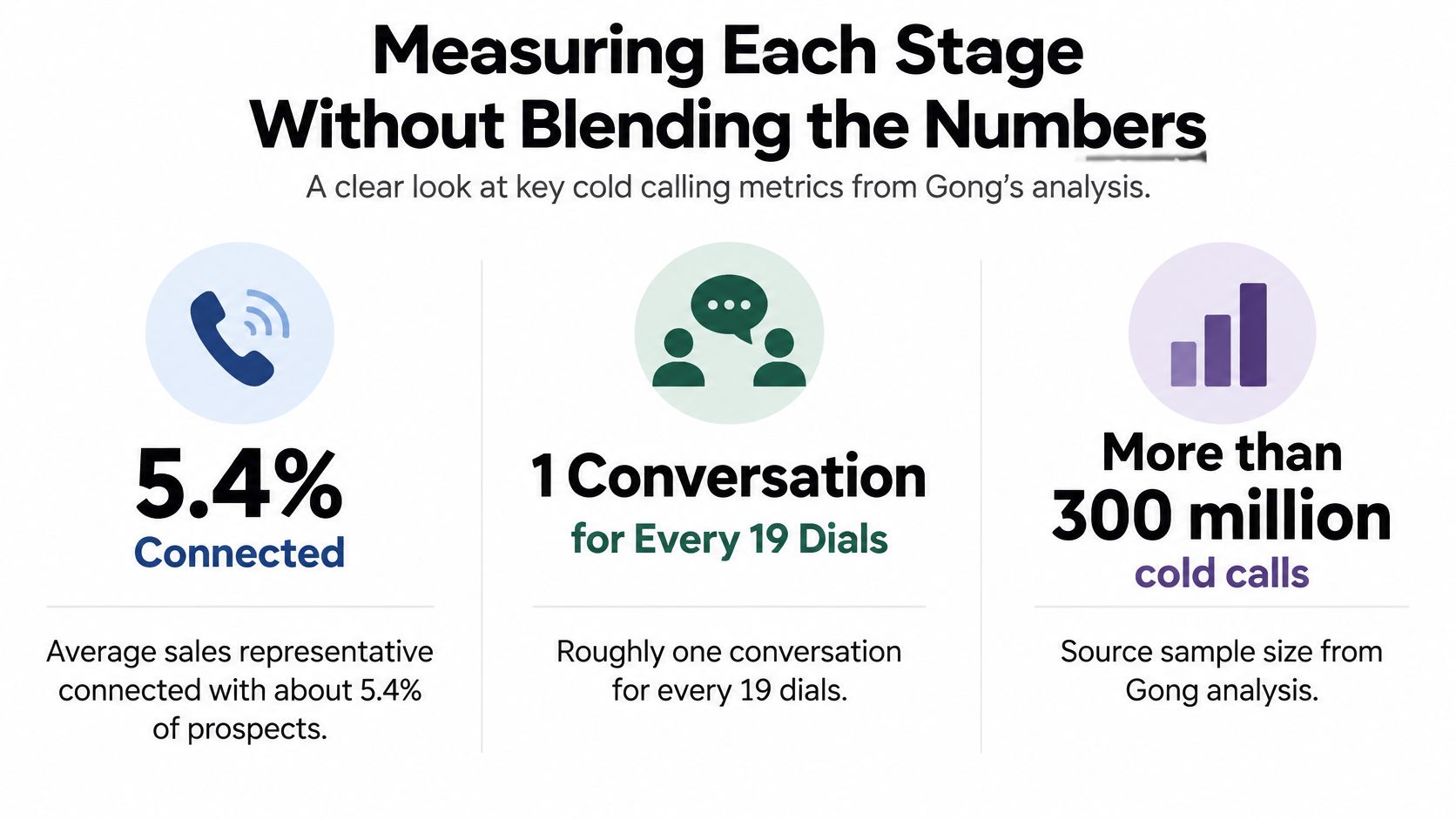
Now the numbers that make people wince. Gong's analysis of more than 300 million cold calls found that the average sales representative connected with about 5.4% of prospects, roughly one conversation for every 19 dials, while top performers connected with 13.3%, according to sales.co's compilation of B2B sales statistics. Among connected calls, 4.6% produced a meeting for the average rep, against 16.7% for top performers. The same benchmark found the average rep needed about 402 cold calls to book one meeting.
Two things follow. Execution quality creates a wide spread inside the same channel. And a single "cold-call conversion rate" hides which stage is broken.
| Metric | Definition | Average rep | Top performers |
|---|---|---|---|
| Connect rate | Share of dials that reach a live prospect | 5.4% | 13.3% |
| Meeting rate from connected calls | Share of connected calls that book a meeting | 4.6% | 16.7% |
| Dials per booked meeting | Cold calls needed to book one meeting | About 402 | About 45 |
That last cell is arithmetic, not a published figure. Multiply a 13.3% connect rate by a 16.7% meeting rate and you get roughly one meeting per 45 dials, which is the gap the average rep is living inside.
Why blending hides the failing stage
Two teams can post identical blended conversion and have opposite problems. One connects with everyone and books almost nobody, because the message gives no reason to meet. The other books a third of the conversations it gets but reaches almost no one, because the list is full of accounts that were never going to pick up. The first team should rewrite. The second should rebuild the list.
Diagnose in order: contact found rate, then trigger coverage, then reply rate by message type, then meeting rate by trigger category. Fixing stage four while stage one is broken is how a team spends a quarter on subject lines.
Work down that order every month. When you reach a stage that sits at or above your own baseline, stop touching it and move down. When you map these metrics into your CRM, track them per pipeline stage rather than as one field, because a clean set of pipeline stage definitions and exit criteria is what makes stage-by-stage reporting possible in the first place.
Compare your numbers to these benchmarks only after you've confirmed the list and the timing are sound. Otherwise you're benchmarking your copy against a problem it never caused.
Common Failure Points and How to Fix Them
Most outbound problems get misdiagnosed in the same direction. Copy is the visible thing, so copy gets the blame, while the invisible stages upstream keep failing. Five failures account for most weak results, and only one of them lives inside the message.
List-first prospecting. The symptom is a connect rate that stays flat no matter which subject line you test. The cause is a large contact list with no fit score, exported from a database instead of built from a description of who you serve. Fix it by scoring accounts against your criteria before any sequence starts, and cutting anything below the threshold rather than hoping the copy carries it.
Quitting after one touch. Most contacts never reply to the first email, and most sellers stop there. That's a design problem, not a copy problem. Build the planned four touches and let them run until someone replies, forwards or declines.
Repeating the message in a new wrapper. Replies fall away sharply after the second touch when later messages add a fresh subject line but no fresh information. Give every later touch a reason the earlier one didn't have.
Fake personalization. Prospects ignore the opener, or ask how you knew something you only half knew. That happens when a scraped detail arrives without a verified source. Require a link and a date behind every claim, and delete any sentence you can't stand behind.
Website visitors treated as ready buyers. A visit is a trigger, not a contact, and outreach to an anonymous visit goes unanswered. Website visitors arrive as companies, and contact finding has to be turned on in the campaign settings so a real person is chosen before anything is sent.
The habit worth breaking is rewriting copy first. A weak list makes every later fix look like it failed, because the message is being judged on accounts that were never going to answer. Change one thing, let it run two weeks at enough volume for the numbers to mean something, then judge it.
Run a Five-Account Test Before Scaling Outbound
Nobody should approve a budget or a headcount plan on the strength of a demo. Prove the workflow on five accounts first, where a wrong answer costs an afternoon instead of a quarter.
Pick five accounts from your ideal customer profile, each with one dated buying signal and a written why-now sentence. If you can't fill five, the profile is too vague to test.
Find a named contact at each one and verify the email, or confirm the business inbox or phone number when that's how the company buys. A shared info@ address is a disqualifier, not a contact.
Write the four touches with new information in each, and send from your own inbox and LinkedIn so deliverability and threading stay intact.
Record the four counts separately for two to three weeks: contact found rate, connect rate, reply rate and meetings booked.
Fix the first stage that falls short, and only that stage, before running the test again.
Then compare those counts to the benchmarks in the table above. Only connect rate and meeting rate from connected calls have benchmarks in this guide, so judge contact found rate and reply rate against your own baseline from the first test.
The workflow is what our own agents run: sources bring in new companies, agents keep proven campaigns moving overnight, and the morning starts with a short list of drafts, replies and calls. Once you've found the right brands, the pattern is to watch them for buying signals, find the founder or operations lead, and start a campaign from your own inbox and LinkedIn.
Scale only when the weakest stage reaches the benchmark for your segment. If it doesn't after a second test, the problem is still upstream of the copy.
CapyScout finds companies that match the profile you describe, watches them for dated buying signals, finds the person to contact and drafts an opener that starts with the signal, ready for you to approve or edit. Every brief carries its source, so the why-now sentence is already written before you sit down. Start with five accounts at CapyScout and find out which stage your current process is losing.
Not ready to start? Get a free target list: 10 companies to sell to, picked from your website.