

Target Account Selling Definition: A Practical Guide
Target account selling definition explained: how it differs from lead-based selling, its core principles, and how to measure results.
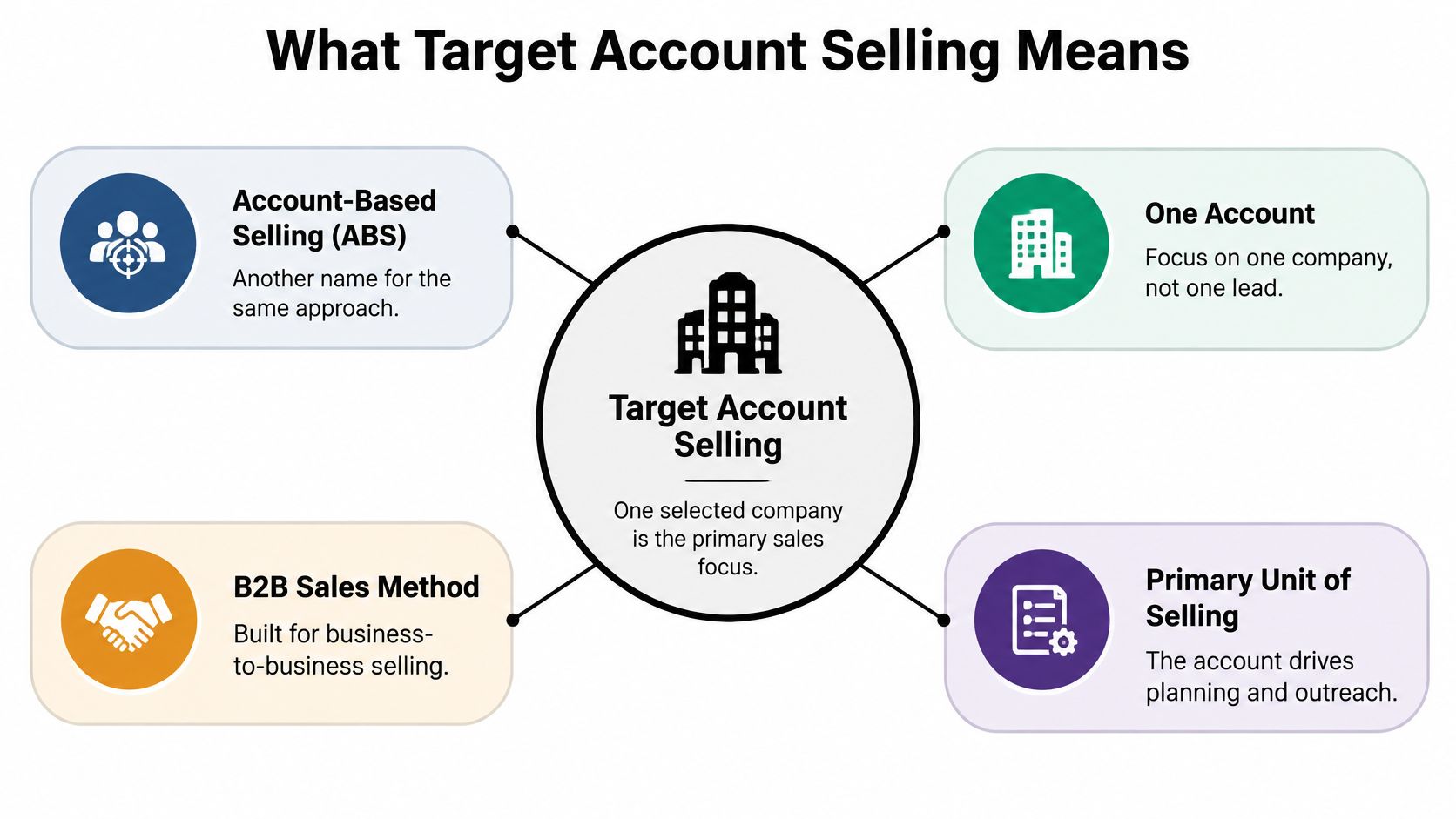
Target account selling, often called account-based selling, is a B2B sales method that treats a selected company, not an individual lead, as the primary unit of pursuit. You might have a crowded CRM, a handful of promising names, and no clear answer to a simple question. Which companies deserve your best research this quarter, and why now?
That's the confusion this approach clears up. Instead of chasing whoever fills in a form, you choose a short list of companies, learn how each one buys, and move accounts up or down as evidence changes. Think of it less as a label and more as a way to allocate scarce selling time.
Table of Contents
- What Target Account Selling Means
- How It Differs From Lead-Based Selling
- How to Choose and Tier Target Accounts
- Mapping the Buying Group Inside Each Account
- Buying Signals That Change Account Priority
- Measuring Whether Account Focus Pays Off
- Decide Whether Target Account Selling Fits Your Team
What Target Account Selling Means
Here's the practical target account selling definition to keep in mind. Lead-based selling casts a wide net over a whole market. Target account selling picks a few specific fish, studies where they swim, and learns what they need before casting at all.
Enterprise purchases rarely rest on one contact, which is why the account, and the buying group inside it, becomes the working unit. One account-based selling source reports that an average B2B purchasing decision involves 6.8 people, according to the Rox guide to account-based selling.
The Five Core Principles
- Finite list: Work from strategically valuable accounts that match your ideal customer profile.
- Coordinated effort: Align research, messaging, and outreach around each organization's business priorities.
- Account ranking: Rank companies by expected value, strategic fit, buying potential, and access to the buying group.
- Buying-group mapping: Identify champions, economic buyers, users, procurement, and blockers.
- Evidence-based timing: Let a source-backed signal change priority only when it fits the profile and points to a plausible problem.
Self-test: You're doing target account selling when you can name every account you're working this quarter and explain why each one was chosen.
How It Differs From Lead-Based Selling
Say two people from the same company download your guide. As leads, each scores well on title and activity. As one account, they tell a richer story. Does the company have a real problem, a budget, and a reachable path to a decision?
That's the technical difference described in the Bebop explanation of target account selling. A lead model ranks people by attributes such as title or form activity. Target account selling ranks companies by expected account value, strategic fit, buying potential, and access to the buying group.
Side by Side
| Dimension | Lead-based selling | Target account selling |
|---|---|---|
| Unit of pursuit | Individual lead | Named company and its buying group |
| Selection basis | Title, form fill or activity score | Ideal customer profile fit and expected account value |
| List size | Broad and constantly refilled | Finite, named and reviewed regularly |
| Outreach trigger | Lead action or inbound form | Account signal such as hiring, funding or leadership change |
| Stakeholders engaged | One contact per lead | Several roles across the buying committee |
| Success measure | Lead volume and meeting conversion | Account progression, win rate, deal size and cycle length |
Because the list stays finite and reviewed, you spend effort on fewer companies in greater depth. You research priorities, tailor messages by role, and follow several threads inside one account instead of restarting with every new name.
Lead-based selling still has a place. If you're selling a high-volume, lower-value product that one person can buy alone, a broad funnel often works fine. Teams handling that volume will find practical ideas in this guide on how to automate lead management, which covers the routing work that mode creates.
For larger, multi-person deals, though, the distinction matters. Target account selling isn't a better contact list. It's a different allocation of effort, where the company, not the click, decides where your week goes.
How to Choose and Tier Target Accounts
Selection is often where progress stalls. They build a prestigious dream list once, then never revisit it. A better method treats tiering as a repeated decision.
A Five-Step Procedure
- Score strategic fit: Rate each candidate against your ideal customer profile, using firmographics, technology, and problem fit.
- Check current opportunity: Look for evidence of a business problem or a recent change, not just a good profile match.
- Confirm execution feasibility: Ask whether you can reach two or more relevant stakeholders.
- Assign a tier: Place the account in Target, Active pursuit, Nurture, or Out of scope.
- Set a review date: Write the rule that would move it between tiers, then revisit on schedule.
A scoring grid helps you apply those three lenses consistently, and this walkthrough on building an account prioritization matrix shows how to structure one.
Say a 300-person logistics software company fits your profile well. It even has a named sponsor. But there's no current change underway and no reachable contact beyond that sponsor. Good fit alone doesn't earn active pursuit. This account belongs in nurture until a trigger appears or coverage improves.
| Tier | Typical condition | Action |
|---|---|---|
| Target | Strong fit, no current trigger yet | Research the account and map stakeholders; no sequence yet |
| Active pursuit | Strong fit, a live signal and reachable buyers | Run coordinated multi-role outreach this week |
| Nurture | Good fit but no trigger or thin stakeholder coverage | Light, relevant touches; re-check on the review date |
| Out of scope | Weak fit or no feasible access | Remove from the list and record the reason |
A static dream-account list keeps reps focused on prestigious but inactive companies.
Tiers aren't permanent labels. An account moves when its fit, opportunity, or feasibility changes, and your review date forces that call instead of letting it drift.
Mapping the Buying Group Inside Each Account
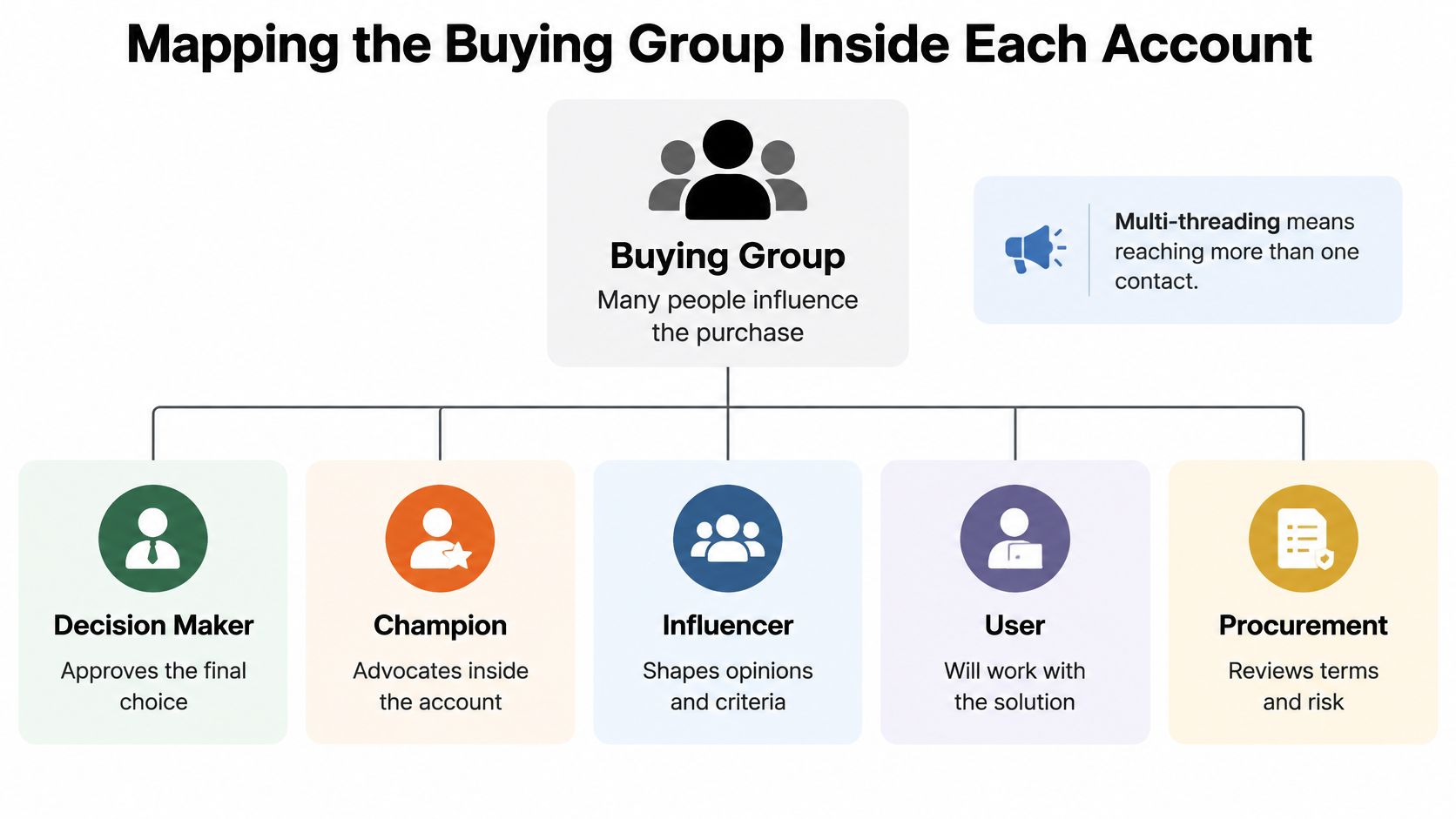
Complex B2B purchases are rarely decided by one contact, so coverage of the buying group, often called multi-threading, becomes the central challenge. The Demand Gen Report ABM benchmark identifies building the account list and augmenting it with relevant contacts from each buying committee as a major operational challenge.
Don't model an account as one CRM contact. Model it as a small network of roles.
Roles to Map
- Business sponsor: Owns the problem and champions change internally.
- Economic approver: Signs off on budget and final value.
- Technical evaluator: Checks fit, integration, and implementation risk.
- Operational user: Lives with the tool daily and feels workflow pain first.
- Procurement and security: Review terms, risk, and compliance requirements.
- Potential blocker: Prefers the status quo or a competing priority.
Say you're selling to a fintech firm. Your champion, a head of operations, loves the tool and pushes hard. Then a security review led by someone you never mapped stalls everything for weeks. The deal didn't fail on product fit. It failed on coverage.
That's why the useful metric isn't how many contacts you've added. It's the share of priority accounts with verified coverage across the roles that can advance or stop a deal. A simple minimum rule helps, such as requiring two or more independent stakeholders before you qualify an opportunity.
For each contact, record source, role confidence, recency, and last observed activity. Those fields keep your map honest when you review it. This playbook on account-based prospecting shows how that mapping feeds day-to-day outreach.
Treat the map as a working hypothesis, not a permanent org chart. People change roles, leave, or gain budget authority, so refresh it whenever the account changes.
Buying Signals That Change Account Priority
A signal is like a dated photograph. It shows something true at one moment, not a permanent label, so each one needs a date and an expiry window.

Teams typically monitor hiring, funding, leadership changes, technology adoption, reviews and reputation, news, and visits to pricing or integration pages. For a fuller taxonomy, this overview of identifying B2B buyer signals is a useful companion, and our own guide to using buying signals for timing and outreach covers response workflow.
| Signal | Likely meaning (hypothesis) | Limit |
|---|---|---|
| Cluster of hiring | Capacity expansion | Changes priority only with ICP fit |
| Customer-success roles posted | Possible retention problem | Test in conversation, not a purchase signal |
| Technology shift | Integration demand | Needs a plausible stakeholder-level problem |
| Reputation decline | Urgent service need | Expires; re-check on the review date |
| Visits to pricing or integration pages | Active evaluation of cost and fit | Needs a named role and recent, repeated visits |
The short video below walks through how timing changes the first conversation.
Say a company posts three customer-success roles in one month. That suggests a possible retention problem to test in conversation. It doesn't guarantee a purchase, and your message shouldn't pretend it does.
Decision rule: A signal changes priority only when it aligns with ICP fit and points to a plausible problem for a specific stakeholder. Otherwise it stays a research note.
When a signal passes that test, respond within one working day. Use the change itself as the reason for your first message to a named role, while the evidence is still fresh.
Measuring Whether Account Focus Pays Off
Many teams declare victory when meetings or pipeline appear. That doesn't prove account focus created incremental revenue. It might only mean ordinary lead generation got relabeled.
The measurement gap is documented in the 6sense guide to ABM metrics, which reports that nearly 80% of organizations in a 2025 ABM study reported having an ABM program, yet only 29% measured it solely with ABM-aligned metrics. Nearly half still measured success using MQLs, including MQLs from non-target accounts.
If you count leads from companies you never targeted, you can't isolate what targeting did. You need a comparison design instead.
What to Compare
- Target-account conversion: How many named accounts become opportunities.
- Sales-cycle duration: Whether focused accounts move faster or slower.
- Win rate: Target accounts versus comparable non-target accounts, or a pre-program baseline.
- Deal size: Whether multi-role engagement expands scope and value.
- Expansion and retention: Whether won target accounts grow and stay.
- Buying-group coverage: Whether several roles engaged, so one contact isn't counted as whole-account engagement.
Keeping those cohorts clean in your CRM is the unglamorous part. Guidance on CRM automation for sales teams can help you tag target status consistently so the comparison stays trustworthy.
Keep one caveat beside the metrics. Personalization can improve relevance without improving economics if it adds labor faster than it lifts win rates or deal value. A beautifully researched account that takes three times the effort for the same revenue is not a win.
Review cohorts each quarter. Compare target accounts against your baseline, then drop accounts whose coverage and progression don't improve. That's how you prove focus paid, rather than assume it.
Decide Whether Target Account Selling Fits Your Team
This motion suits deals where several people decide and account value justifies researching each company. Check three conditions first. You need a defined ideal customer profile, a team able to research a short list by hand each week, and enough deal value to justify multi-role outreach.
If all three hold, start in order. Write the ideal customer profile, build the list, assign tiers with a review date, and map at least two buying roles per priority account. Record a baseline for win rate and sales-cycle length before your first campaign, then compare the target cohort against it after one quarter.
Our process follows that same order. We find accounts, catch the right moment, and then send outreach. To start, you choose who you sell to and where leads should come from, and CapyScout finds the companies and the right person, drafts each message, and sends from your own inbox or LinkedIn once you approve.
Before you begin, answer one question. Which five accounts would you act on this week, and why?
If your team is ready to work a named list with evidence behind every move, CapyScout can help you find fitting companies, monitor them for buying signals, and draft source-backed outreach to the right person at the right moment. Visit us to build your first target list and see which accounts deserve action this week.
Not ready to start? Get a free target list: 10 companies to sell to, picked from your website.