

Sales Data Mining: Methods, Use Cases and First Steps
Sales data mining explained: the core methods, real use cases and a 30-day plan to turn CRM and market signals into decisions your team can act on.
In 2024, 83% of sales teams using AI reported revenue growth, compared with 66% of teams not using AI, according to Salesforce's survey of 5,500 sales professionals across 27 countries. That association doesn't prove AI caused the growth. It does raise a practical question: how can a sales team turn the information it already collects into better decisions about whom to contact, when, and why?
Table of Contents
- What Sales Data Mining Really Means
- The Six Methods That Mine Sales Data
- Use Cases Across the Sales Funnel
- Mining New Signals Without Crossing Ethical Lines
- Misconceptions That Stall Sales Data Mining
- Turn Raw Sales Data into Insight in 30 Days
What Sales Data Mining Really Means
Sales data mining is the systematic search through deals, accounts, activities, and outcomes for patterns that explain or predict buying behavior.
Say your team receives inbound demo requests. Reps work through them in arrival order, while a manager reviews a dashboard showing signups and booked meetings. Everyone can see activity, but nobody has established which signups deserve attention first.
Mining starts with a different question: what did successful customers have in common before they bought? You might examine company characteristics, campaign responses, and early product activity, then test whether those characteristics help identify promising new accounts.
Sales data mining turns historical records into testable patterns that guide the next commercial decision.
From totals to decisions
Reporting is the ledger; mining is the detective work. The ledger says what happened. The detective work investigates possible explanations and what to do next, without treating every correlation as a cause.
- Revenue reporting totals sales by month. Mining examines which customer segments contributed to repeatable wins.
- Activity reporting counts calls and meetings. Mining tests which behaviors precede progress rather than merely accompany it.
- Pipeline reporting lists deals by stage. Mining identifies combinations of account characteristics and stage history associated with closing.
The distinction isn't that dashboards are basic and models are advanced. A spreadsheet comparison can uncover a useful pattern, while an elaborate dashboard can remain purely descriptive.
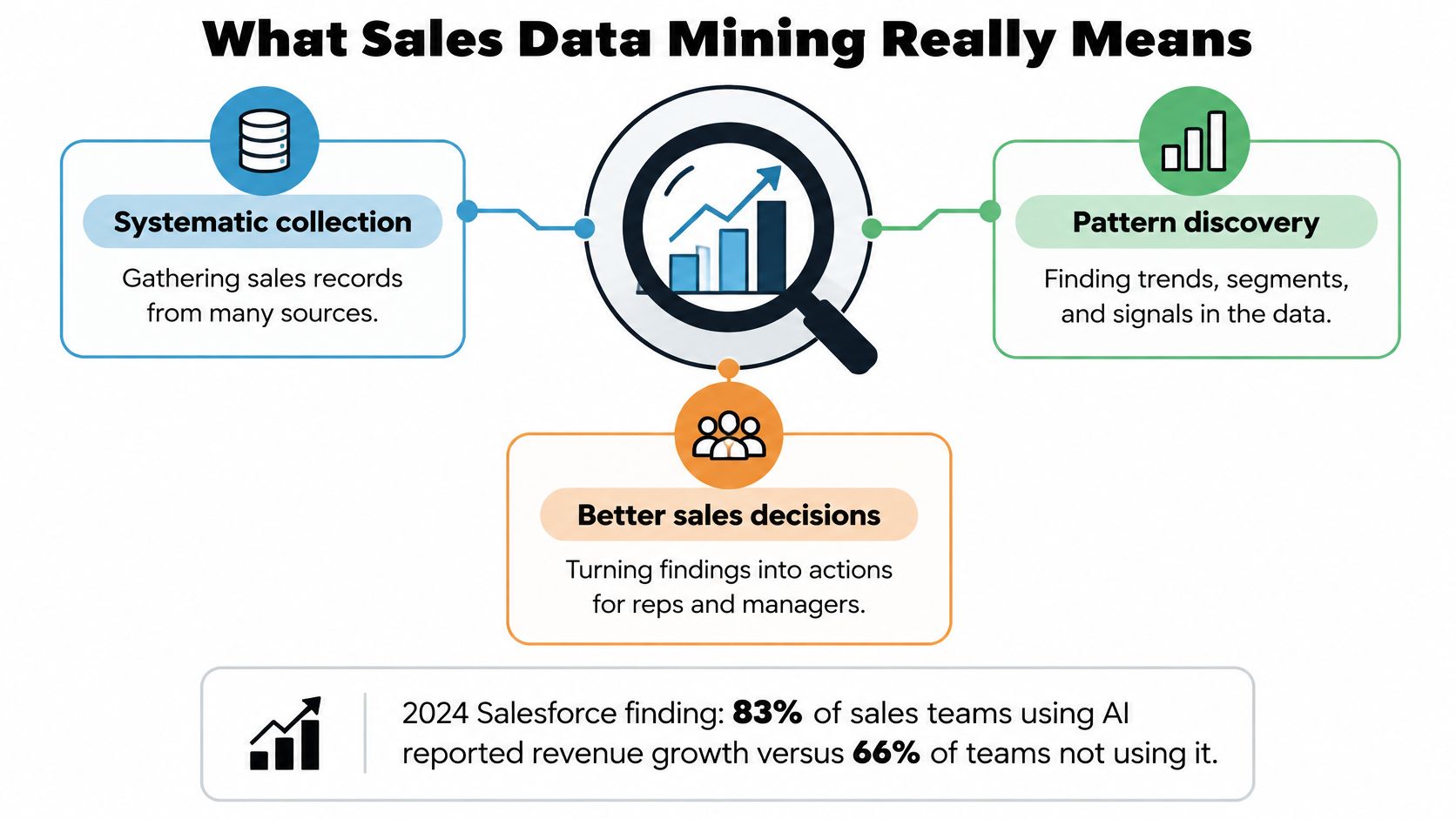
This concept map shows the path from collecting records to making a decision.
Why governance belongs at the beginning
AI-assisted workflows can surface candidate patterns during daily work instead of waiting for a quarterly review. But faster analysis also means a mistaken account match or misleading signal can reach a rep sooner.
Before connecting another platform, establish who owns each field, where it came from, and which uses are acceptable. Stimulead's discussion of data governance before revenue platforms is a useful starting point for organizing that conversation.
Keep the process grounded in records, patterns, prediction, and action. Records supply the evidence. Patterns describe relationships, predictions estimate likely outcomes, and actions translate those estimates into a decision someone can review.
The Six Methods That Mine Sales Data
Start with the sales question, not an algorithm. Classification, clustering, forecasting, regression, association analysis, and sequence discovery belong to the established data-mining toolkit; Purdue's introduction to data mining describes the field's foundations and commercial applications.
Six sales data mining methods mapped to sales questions
| Method | What it does | Sales question it answers | Example output |
|---|---|---|---|
| Classification | Sorts records into known groups using labeled history | Which leads look like our best customers? | Lead scored high, medium, or low fit with reasons |
| Clustering | Groups similar records without predefined labels | What natural segments exist in our pipeline? | Segments such as fast-moving small businesses versus slow enterprise accounts |
| Forecasting | Projects future values from time-based patterns | What will we realistically close next quarter? | Quarterly revenue forecast with a confidence range |
| Regression | Estimates how one variable moves with others | Which factors are associated with deal size or cycle length? | Deal-size estimate weighted by segment, source, and region |
| Association analysis | Finds items or behaviors that occur together | What do buyers of this product also buy? | Cross-sell pairs and next-best-offer rules |
| Sequence discovery | Finds ordered patterns of events over time | What path do winning deals actually take? | Common stage sequences and points where deals stall |
Choose by the answer you need
Use classification when you have reliable outcome labels, such as won and lost. The model learns distinctions between those groups and applies them to new records. A fit grade isn't automatically a purchase probability, so label the output accurately.
Choose clustering when you suspect meaningful segments exist but can't name them yet. After grouping accounts, inspect what distinguishes each group. A cluster becomes commercially useful only when a rep can change messaging, qualification, or service around it.
Use forecasting for time-based planning and regression for estimating a numeric outcome. Regression can reveal an association between account characteristics and contract value, but it doesn't prove that changing a characteristic would change the deal.
For product combinations, use association analysis. For the order of events, use sequence discovery. Buying an add-on alongside a core product is a different finding from buying it after a particular onboarding milestone.
Combine methods only when needed
A hypothetical team might cluster accounts by purchasing behavior, then classify new leads within each segment. That approach is worth testing only if it outperforms a simpler model and each segment has enough representative outcomes.
Missing firmographics can prevent either method from being useful. A practical CRM data enrichment guide can help define which attributes to complete before analysis, without collecting fields merely because they're available.
Pick the method that matches both your question and the records you have. Don't choose sequence discovery when your CRM stores only the latest stage and no event history.
Use Cases Across the Sales Funnel
Sales data mining use cases from first touch to renewal
| Use case | Data inputs | Typical insight | Action it triggers |
|---|---|---|---|
| Lead scoring | Firmographics, signup details, campaign responses | Which inbound signups match won-deal profiles | Route high-fit leads to sales, send the rest to nurture |
| Customer segmentation | Purchase history, industry, company size, usage | Behavioral segments with distinct needs | Tailor messaging, offers, and cadence per segment |
| Churn prediction | Usage trends, support tickets, payment history | Behavior patterns that precede cancellations | Trigger a save play before renewal |
| Cross-sell and upsell | Purchase sequences, product pairings | Products bought together and likely upgrade timing | Time offers to the account's upgrade window |
| Pipeline forecasting | Stage history, deal sizes, win-loss records | Expected close rates and quarter-end revenue | Adjust coverage targets and rep focus |
| Win-back | Closed-lost records, churned accounts | Why deals were lost and which can return | Re-engage with a specific fix or offer |
Inbound screening changes the work queue
Say a B2B SaaS company treats every trial signup equally. A classification workflow compares each new account with historical customer profiles, then assigns a suggested route.
Before mining, a rep opens every signup and researches it manually. Afterward, the rep begins with accounts that meet explicit fit criteria, while uncertain records enter review rather than being rejected.
Keep fit, readiness, and risk separate. A company can match your ideal customer profile without being ready to buy. A suspicious email address also shouldn't become a permanent judgment about the company behind it.
Churn prediction creates a reason to investigate
Suppose an existing customer's usage declines while support requests and payment friction increase. If comparable patterns preceded past cancellations, customer success can investigate before renewal.
The right action isn't an automated discount. The account manager should check whether the customer has an unresolved problem, a seasonal usage change, or an internal ownership transition.
For local-market agencies, a service business's changing review sentiment can similarly justify closer inspection. A guide to finding and acting on sales trigger events helps connect an observed change with an appropriate next step, rather than treating any change as permission to pitch.
Win-back requires a specific change
Closed-lost records become useful when the loss reason is concrete. A missing integration, unsuitable contract structure, and poor product fit call for different decisions.
If an integration is now available, re-engagement can explain that specific change. If the account was never a fit, another generic check-in won't fix the underlying mismatch.
A useful insight changes the next action. If every account still receives the same message, the analysis hasn't reached the workflow.
When comparing implementation options, TopToolAdvisor's best sales intelligence software shortlist can support an initial review. Evaluate tools against the inputs and actions your chosen use case requires, not the length of their feature lists.
Start with the use case whose evidence already exists in your CRM. Expanding later is easier than untangling several untested workflows launched together.
Mining New Signals Without Crossing Ethical Lines
Surveys of data and analytics leaders repeatedly find that valuable insight stays trapped in unstructured sources while ethical-AI guidelines lag behind adoption. A review of AI-driven sales-force optimization identifies data quality, bias, explainability, governance, and human oversight as continuing concerns when models move from research into daily sales work.
Email threads, call transcripts, reviews, hiring news, and website activity can supply context that structured CRM fields miss. More signals aren't automatically better, though. A timely signal can still be wrong, privacy-sensitive, geographically uneven, or an indirect proxy for a protected characteristic. Governance is therefore part of the mining work itself: each new source gets checked for reliability, privacy exposure, and bias before it feeds outreach.
Approve sources before using their scores
Signal governance checks before a new source feeds your models
| Signal source | What it can support | Main risk | Check before use |
|---|---|---|---|
| CRM fields such as stage, size, and source | Scoring, forecasting, segmentation | Stale or mistyped records | Reconcile against closed deals on a scheduled review cycle |
| Email and call transcripts | Objection themes, intent phrases | Privacy, consent, and sensitive content | Confirm lawful purpose, set retention limits, and add human review |
| Website behavior | Account-level interest in pricing or integrations | Over-reading individual identity from visits | Keep inferences at account level and document the method |
| Hiring and funding news | Timing outreach to growth moments | Stale, noisy, or uneven coverage | Verify source, timestamp, and confidence before acting |
| Reviews and reputation | Local-business pain points and sentiment shifts | Sentiment bias and unverified claims | Cite the source and separate facts from interpretation |
Assign a named owner to each approved source. Record its provenance, permitted purpose, access restrictions, retention rule, and conditions for removal. RichAPI's enrichment guide for GTM engineering teams offers implementation context when adding external attributes to account records.
Test coverage as well as accuracy. A source that provides richer information about certain regions or business types will leave gaps elsewhere, and missing information must not read automatically as poor fit. Compare routing decisions across relevant groups, examine potential proxies for protected characteristics, and give reviewers a way to override the result.
Keep account inference separate from individual intent
A pricing-page visit associated with a watched company can support the inference that the account is showing interest. It doesn't establish which person visited, what that person wanted, or whether a purchase decision exists. Reps who write as if it does put a guess in front of the prospect and call it evidence.
Describe the observation as possible account interest, supported by the event and its timestamp. Avoid outreach claiming that a named person viewed a page when the evidence doesn't establish that. A privacy-smart approach to tracking website visitors helps maintain that boundary, and the same restraint applies to reviews: an unhappy reviewer's allegation isn't a verified account fact.
Keep an audit trail behind every consequential score. Preserve the observation, source, collection time, interpretation, confidence, model or rule version, and reviewer decision so a rep can explain why outreach happened.
Misconceptions That Stall Sales Data Mining
Myth one is that this is a new AI fad
Reality: Retailers were analyzing buying behavior long before modern software.
A historical account of consumer research identifies 1920–1940 as a formative period for systematic purchasing analysis in U.S. retailing and describes a 1931 New York Times report treating knowledge of buying habits as essential to profitable retailing. Modern tools extend that practice; they didn't invent the commercial question.
Myth two is that better charts are enough
Reality: A clearer visualization doesn't establish whether a proposed decision rule works.
A chart showing high revenue from enterprise customers may reflect larger contracts, heavier sales investment, or both. Before prioritizing every enterprise lead, examine the effort required, the available sample, and whether the relationship holds for new accounts.
Myth three is that infrastructure must come first
Reality: A clean CRM export and a narrow question can support an initial analysis.
You can use Excel or Google Sheets to compare outcomes by source, segment, or qualification attribute. A dedicated data science team becomes more valuable as the problem grows in complexity, not as a prerequisite for asking a useful question.
Keep the initial scope manageable:
- Define the decision before purchasing another tool.
- Inspect the records before choosing a model.
- Test a simple baseline before adding complexity.
Myth four is that the model replaces rep judgment
Reality: A model can prioritize investigation without deciding the account's future.
A rep may know that an apparently stalled opportunity is waiting on a documented procurement process. That context should support an override with a reason, not disappear because it contradicts a score.
Don't wait for perfect data, perfect tools, or perfect certainty. Start with a bounded decision, acknowledge what remains unknown, and make it possible to reverse a mistaken recommendation.
Turn Raw Sales Data into Insight in 30 Days
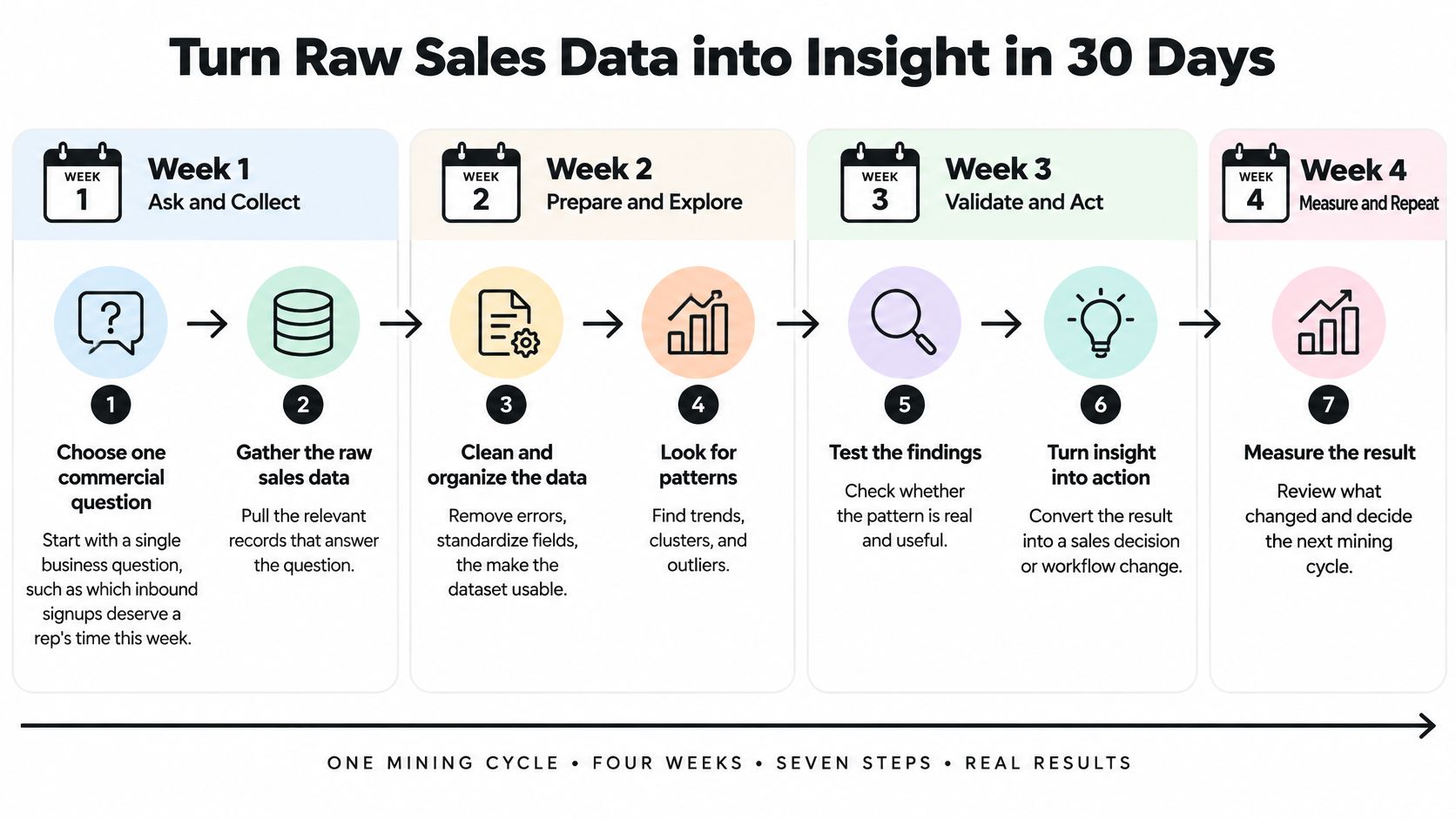
Treat the first month as a controlled mining cycle, not a promise of a production-ready predictive system. Your deliverable is a tested decision rule, an operational workflow, and a clear account of its limitations.
The roadmap below provides a visual overview of the work.
Build and test the decision
Week one, choose one commercial question.
Write a question that names a decision and an owner. For inbound screening, use: which signups should the sales team review first?
Define success before looking for patterns. If rep capacity is the constraint, evaluate the quality of the prioritized queue, not merely how many records receive scores. The common slip is starting with mine everything, which produces findings without a clear user.
Inventory the records that can answer it.
Pull account identifiers, signup details, source, industry, stage history, and outcomes. Add purchase history, campaign responses, or support records only when they serve the question.
Check whether records can be joined reliably by company or account ID. Record when each field became available. The common slip is including information created after the sale, which makes historical prediction look better than it could have been in practice.
Week two, clean and define the dataset.
In 2025, 45% of CRM users said their organization's CRM data wasn't ready for AI, according to Validity's State of CRM Data Management research. Deduplicate companies, standardize field values, reconcile currencies where relevant, and define won, lost, open, and disqualified consistently.
Don't invent a universal minimum number of closed deals for trusting a model. Readiness requires representative wins and losses, enough examples for the segments being evaluated, and a separate validation set. If the available history can't support that test, use transparent rules and manual review rather than presenting a score as statistically reliable.
Week three, match the method to the question.
For labeled inbound outcomes, test classification against a simple rule-based baseline. Use only attributes available when the signup would have been routed.
Begin with interpretable inputs and inspect why records receive their scores. The common slip is adding complexity before establishing whether basic qualification rules already solve the operational problem.
Validate against outcomes the model hasn't seen.
Train on older records and test on later closed deals, keeping repeated records from the same account from leaking across the split. Review incorrectly prioritized accounts and promising accounts the model missed.
Check whether performance holds across sources and segments. A model that looks strong overall may still fail on the accounts your team most wants to reach.
Release gate: If you can't explain the inputs, reproduce the result, and describe its known failure cases, keep the workflow under human review.
Put the result into daily work
Week four, write the result into the CRM.
Store the classification, reasons, confidence, evidence timestamp, recommended action, and review status. Assign an owner, define the refresh cadence, and establish what happens when evidence expires or a rep disagrees.
At CapyScout, we watch a company list or your CRM and check the live web on a schedule, then identify who to contact and why now, with evidence attached. Our scoring result includes classification, fit, risk, confidence, recommended action, suggested reply, company details, signals, evidence, and uncertainty. The operational mistake to avoid is leaving the insight in a slide deck rather than the rep's working queue.
Measure the workflow and retire weak patterns.
Compare reply and win rates with the prior month, keeping audience, channel, and sales-cycle differences visible. Where feasible, retain a comparable group under the existing process so you can better distinguish workflow effects from changes in demand.
Track overrides and review outcomes as well as commercial results. Don't claim a win-rate improvement before the relevant deals have had time to close, and retire patterns that no longer help.
For an additional walkthrough alongside your implementation work, use the video below.
Finish the cycle with a decision: expand, revise, or stop. A documented finding that a signal isn't useful is better than an automated workflow nobody can justify.
CapyScout connects account monitoring with source-backed evidence, helping your team identify whom to contact and why now. Visit CapyScout to start with a company list or your CRM and build a focused sales data mining workflow around a decision your team needs to make.
Not ready to start? Get a free target list: 10 companies to sell to, picked from your website.