

8 Bases for Segmentation: Which Ones Actually Matter
Compare 8 bases for segmentation, from firmographic and behavioral to intent signals and geography, with examples for B2B and local-market prospecting.
Your sales team has a list of companies that look like good customers. They're in the right industries, their teams seem large enough, and their websites look credible. You send the same sequence to everyone, then spend the next week wondering whether the subject line needs work.
The message might need work. But first, inspect the list. You've probably grouped together companies that resemble one another without checking whether they share a problem, can use your product, or have a reason to act now.
Bases for segmentation are the criteria you use to divide a market into groups that deserve different treatment. In prospecting, that treatment might mean a different offer, sales owner, outreach message, or decision to hold off entirely.
The practical question isn't which basis is universally best. It's which combination changes what your team does next. For smaller teams, segmentation guidance for growth-focused SMBs provides useful context, but your operating test should stay simple: can a rep explain why an account belongs in a group and what to do about it?
Start with eligibility, sharpen the problem fit, and then decide who deserves attention now.
Table of Contents
- 1. Firmographic Segmentation
- 2. Behavioral Segmentation
- 3. Needs-Based Segmentation
- 4. Psychographic Segmentation
- 5. Value and Revenue Segmentation
- 6. Technographic Segmentation
- 7. Intent and Real-Time Signal Segmentation
- 8. Geographic and Local-Market Segmentation
- How the 8 bases for segmentation compare in practice
- Layering Bases Into One Targeting Workflow
1. Firmographic Segmentation
Firmographic segmentation groups companies by organizational attributes, including industry, company size, revenue, business model, funding stage, and ownership structure. Use it to define a workable prospecting universe before spending time on deeper account research.
Say you sell scheduling software to multi-location dental practices. Practice category and operating structure matter because they affect scheduling complexity. A large manufacturer might have more employees and purchasing power, but neither makes it a better prospect.

Separate Eligibility From Priority
Build your initial filter around attributes that change delivery or buying economics, not every field available in your CRM.
- Required fit: Industry, business model, and operating scale must support the problem you solve.
- Hard exclusions: Remove unsupported territories, incompatible business types, and accounts you can't serve.
- Useful context: Keep funding stage or ownership structure when they affect the buying process.
The trade-off is straightforward: firmographics make accounts findable, but they don't establish urgency. Companies with similar headcounts can have different budgets, workflows, and priorities. A good-looking account isn't automatically an active opportunity.
For regional expansion, The Social Search's APAC segmentation guide is a relevant companion to this work. Keep territory assumptions explicit rather than treating a broad region as a uniform market.
This week, inspect recent won and lost deals. Retain the company attributes that would have changed qualification, then combine that baseline with a current need or observable change.
2. Behavioral Segmentation
A prospect requests a demo and reads implementation documentation. Another downloads a broad industry report. Treating those actions as equivalent creates a queue that reps can't trust.
Behavioral segmentation groups accounts by what they do, including product usage, purchase history, content engagement, event attendance, and first-party website interactions. It's especially useful for onboarding, expansion, retention, and inbound routing. For a complementary definition, see customer targeting insights from Rebus.
Practical rule: Record the action you observed separately from the buying intention you inferred.
A pricing-page visit is an observed event. A purchase decision is not. Repeated feature adoption may justify an expansion conversation, but you still need to establish whether the account has an unmet requirement.
Make Events Decision-Ready
Define meaningful events before assigning scores. A demo request should trigger a different workflow from passive browsing, while declining usage should trigger investigation rather than an automatic discount.
- Capture context: Store the event, timestamp, account match, and source.
- Apply recency: Let old activity lose influence unless the account shows renewed engagement.
- Respect uncertainty: Hold weak account matches instead of presenting them as verified buyers.
Privacy belongs inside this workflow. Infomineo's market segmentation guide provides context for segmentation methods and responsible data use. Prefer necessary first-party and company-level evidence, document retention and deletion rules, and give reviewers a way to suppress sensitive or unreliable signals.
Behavior is most useful after fit checks. An active account that you can't serve still shouldn't enter the sales queue.
3. Needs-Based Segmentation
Needs-based segmentation groups accounts by the problem they're trying to solve or the outcome they want. It helps you avoid sending the same pitch to buyers who might purchase the same product for different reasons.
Consider a prospecting platform. A founder may need to establish a repeatable outbound motion, while a revenue-operations leader needs cleaner CRM records and consistent qualification. Both could buy, but their evaluation criteria and internal business cases will differ.

Turn Problems Into Testable Hypotheses
Write each segment as a concrete operational problem. Replace growth-focused companies with sales teams struggling to research accounts before outreach. Then identify evidence that could support or disprove that hypothesis.
Useful inputs include discovery notes, support requests, job descriptions, product usage, and statements on company websites. Keep stated needs separate from inferred needs in your CRM so reps know what still requires validation.
- Evidence: A job description assigns account research and data cleanup to a new operations hire.
- Hypothesis: The team may be trying to improve its prospecting workflow.
- Qualification question: Which parts of account preparation still require manual work?
The weakness is discoverability. You can search for an industry directly, but a problem may remain invisible until someone explains it.
Use firmographics to find plausible accounts, then use evidence and conversation to validate the need. For a local reputation agency, a pattern of unresolved reviews can justify a question about response management, not a declaration that the owner is losing customers.
4. Psychographic Segmentation
Psychographics help you choose how to explain value after you've established account fit. They describe attitudes, motivations, values, and decision preferences rather than company structure or observed activity.
The distinction matters because demographic and geographic descriptions don't explain every buying preference. Wikipedia's overview of market segmentation traces the development of psychographic approaches alongside demographic, geographic, and behavioral bases.
A revenue-operations buyer might prioritize auditability and workflow control. A founder evaluating the same product might care most about reducing personal involvement in routine prospecting. Don't assume either preference from the job title alone.
Use professional motivations to choose relevant proof, not to invent a personality profile.
Change the Proof, Not the Facts
Say discovery reveals that an operations leader worries about automation writing incorrect information into the CRM. Lead with evidence provenance, review controls, and exception handling. If another buyer explicitly prioritizes speed, demonstrate the shortest usable workflow without hiding the same limitations.
Customer interviews, win-loss notes, and recorded objections are better inputs than speculative labels such as visionary buyer or risk-averse founder. Keep the buyer's actual words attached to the segment wherever possible.
The trade-off is message relevance versus inference risk. Psychographics can make a conversation more useful, but they're difficult to verify across a cold list.
This week, review sales notes for recurring professional priorities. Tag those priorities only where there's supporting evidence, and compare which proof points help buyers progress. Don't infer sensitive beliefs, personal circumstances, or private characteristics from public browsing or social activity.
5. Value and Revenue Segmentation
Your largest potential contract may also require extensive implementation work, legal review, and ongoing support. Value segmentation should allocate effort according to expected economics, not the most impressive company logo.
Group customers and prospects by current revenue, expansion potential, likely profitability, acquisition effort, and service requirements. Keep current customer value separate from future opportunity value. A small existing account with a clear expansion path deserves a different plan from an unqualified enterprise prospect.
Build Service Tiers You Can Defend
For an agency, a nearby service business with a clear need and a repeatable delivery model might justify immediate outreach. A larger business requiring unfamiliar services could belong in a research track instead.
- High-touch accounts: Strong fit, credible opportunity value, and enough evidence to justify focused research.
- Standard accounts: Clear fit with a repeatable offer and manageable sales effort.
- Nurture accounts: Plausible future value, but unresolved timing, fit, or delivery questions.
Don't let an estimated deal size override a hard disqualifier. If an account requires functionality you don't offer, a large theoretical budget doesn't make it sales-ready.
The main trade-off is precision. Revenue estimates, expansion assumptions, and service costs can all be uncertain, especially before discovery. Record the confidence behind the estimate rather than disguising a guess as a calculated forecast.
Start with your own closed-deal economics. Compare acquisition effort, delivery burden, retention, and realized account value, then use those patterns to set research depth and response expectations. Keep the tiers simple enough that reps can explain why an account receives more attention.
6. Technographic Segmentation
A company uses HubSpot, Pipedrive, or Attio. That's useful if your product depends on its CRM environment. It's much less useful if you sell something unrelated to that workflow.
Technographic segmentation groups accounts by their technology environment, including platforms, integrations, infrastructure, and evidence of migrations. Use it to establish implementation fit, identify replacement opportunities, or understand technical constraints.

Verify Usage Before Writing the Pitch
Technology detection isn't the same as confirmed production usage. A website tag might remain after a migration, and a job advertisement might describe a planned platform rather than the current stack.
Store the supporting page, observation date, and confidence level. When evaluating collection options, use this guide to technographic data providers to frame questions about coverage, freshness, and evidence.
- Compatibility filter: Can the account use your product without unsupported integration work?
- Workflow context: Which existing tools affect adoption or purchasing ownership?
- Change trigger: Has the company announced or demonstrated a relevant migration?
Say you offer a CRM implementation service. A confirmed platform migration gives you a reason to discuss data mapping, workflow rebuilding, and user adoption. A generic claim that you noticed their technology stack gives the buyer little reason to respond.
The trade-off is technical relevance versus freshness. Stable stack information helps qualify accounts, while recent changes can support timing. Neither proves dissatisfaction with the current vendor, so ask about the transition instead of assuming the buyer wants a replacement.
7. Intent and Real-Time Signal Segmentation
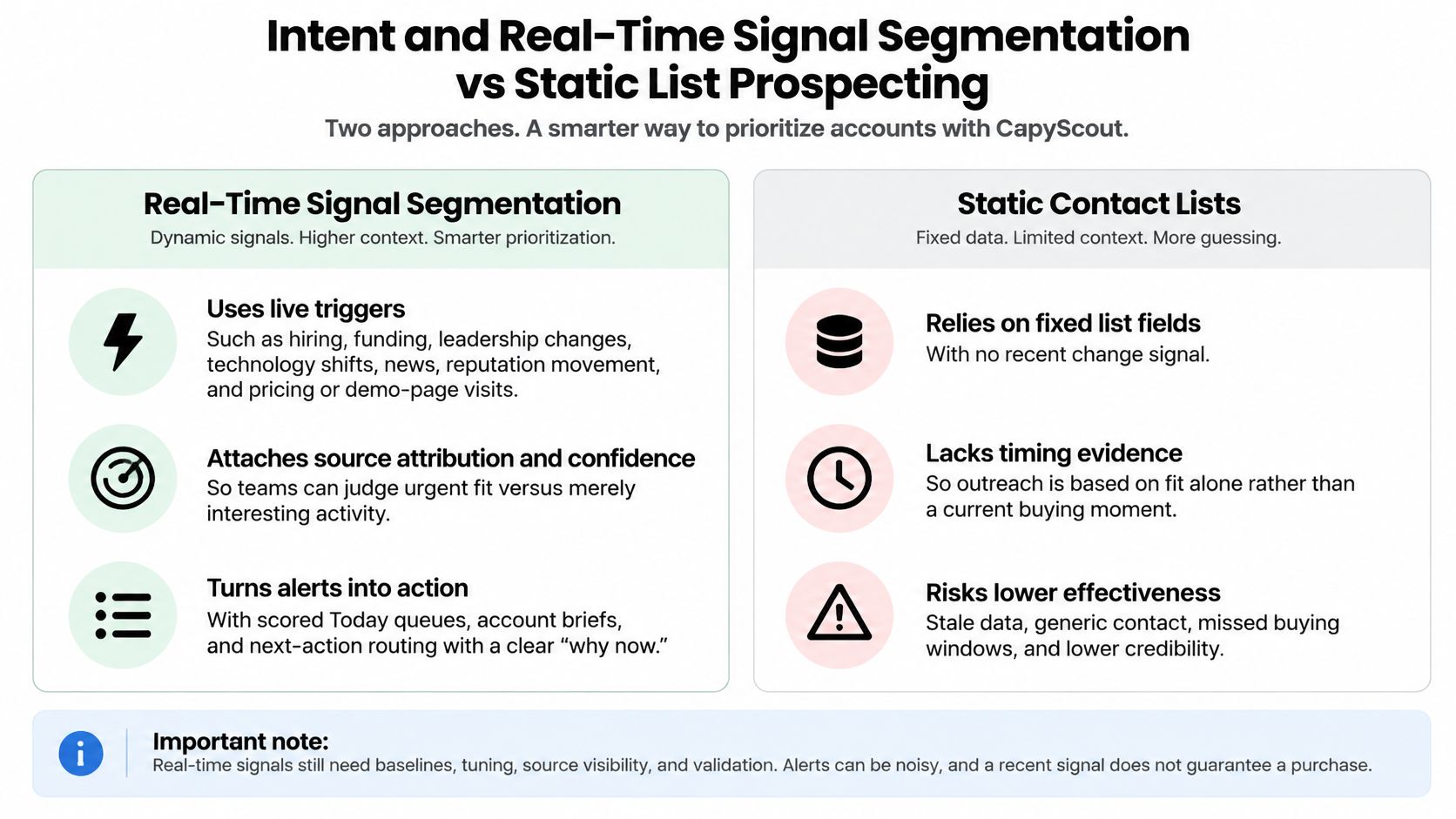
Intent and real-time signals help answer who to contact now and why. Relevant events include hiring, funding, leadership changes, technology migrations, review deterioration, and meaningful first-party engagement.
The distinction between fit and timing is central to HG Insights' guide to B2B market segmentation. Static company attributes describe an account, while recent business changes can help you investigate whether a relevant buying situation exists.
Use this comparison to separate ongoing prioritization from a static list.
Require a Business Interpretation
Say a company advertises a sales-operations role. That supports a hypothesis about investment in sales operations, not proof that it needs your product. Qualify the account's fit, verify the posting, and explain which responsibility makes your offer relevant.
A signal should earn a closer look before it earns an outreach sequence.
Rank signals by problem relevance, recency, source confidence, and likely urgency. Reduce their weight as they age, suppress repeated alerts, and require human review when sources conflict. Anonymous activity shouldn't become a claim about a named buyer's intentions.
This explainer adds context for evaluating intent signals.
For implementation boundaries, consult B2B intent data types, uses, and limits. Start with a watched-account list and a small set of meaningful events. Track qualified opportunities by signal type so activity volume doesn't become your definition of success.
8. Geographic and Local-Market Segmentation
For a local agency, location can be a delivery constraint. For a SaaS team, it may determine territory ownership, language support, or purchasing requirements. Geographic segmentation groups accounts by where they operate, sell, or receive service.
Be explicit about which location matters. Headquarters, branch locations, service areas, and customer markets aren't interchangeable. A business registered in your target city might deliver its services elsewhere.
Define the Operating Footprint
Say your agency serves home-service companies in a metropolitan area. Start with service coverage and business category, then look for an addressable need such as unresolved reviews or inconsistent location information. Don't treat proximity alone as qualification.
Use the local-business lead generation signal playbook to connect location discovery with account-level reasons to reach out.
- Coverage: Can your team deliver the service in the account's actual operating area?
- Routing: Which owner handles the territory and relevant language?
- Local context: Do branch-level reviews or service differences change the offer?
The trade-off is operational simplicity versus missed context. Broad territories are easy to assign but can hide differences between locations. Extremely granular filters create maintenance work when they don't change delivery or messaging.
For multi-location businesses, keep parent and branch records connected. A reputation issue at a particular location may warrant local outreach, while the buying decision sits with a central operations team.
This week, inspect your geographic fields and routing rules. Replace ambiguous location labels with headquarters, operating footprint, or service area, and collect only the detail you'll use.
How the 8 bases for segmentation compare in practice
| Item | Best for | Typical data sources | Data freshness risk | Primary use |
|---|---|---|---|---|
| Firmographic Segmentation | Defining and grading ideal customer profiles | Company size, revenue, industry, funding, location, technology, ownership | Public or estimated attributes may be incomplete or stale | Filter and prioritize accounts by company fit |
| Behavioral Segmentation | Identifying engagement, intent, and lifecycle stage | Product and website activity, event attendance, content use, CRM engagement, reviews | Requires consistent tracking; activity may be incomplete or ambiguous | Score and route accounts based on observed actions |
| Needs-Based Segmentation | Matching prospects to specific problems and outcomes | Sales research, discovery, customer feedback, business signals, firmographics | Needs may be inferred, change over time, or require research | Tailor qualification and messaging to buyer needs |
| Psychographic Segmentation | Shaping positioning and messaging around motivations | Interviews, surveys, sales calls, win/loss analysis, behavior | Difficult to verify consistently; assumptions can become outdated | Adapt messaging to professional priorities and preferences |
| Value and Revenue Segmentation | Allocating resources by customer or opportunity economics | Revenue, contract value, margin, lifetime value, opportunity data | Estimates may be uncertain; historical value may not predict future potential | Prioritize accounts by current and expected economic value |
| Technographic Segmentation | Finding accounts by technology fit or change | CRM and marketing platforms, integrations, technology adoption or migration data | Technology data may be inferred, incomplete, or outdated | Target compatible accounts and surface integration opportunities |
| Intent and Real-Time Signal Segmentation | Finding timely buying moments and reasons to reach out | Hiring, funding, leadership, technology, news, website activity, reputation, CRM engagement | Signals can be noisy, incomplete, or misinterpreted | Trigger timely, source-backed outreach and account actions |
| Geographic and Local-Market Segmentation | Targeting territories, regions, and service areas | Country, region, city, postal code, territory, service radius, local reviews | Location data may be approximate or outdated | Focus discovery, routing, and campaigns by location |
Layering Bases Into One Targeting Workflow
No single basis is enough because each answers a different question. Firmographics and geography establish eligibility. Needs and technology sharpen fit, behavior and intent guide timing, psychographics shape the message, and value tiers determine how much effort to invest.
Don't compress those judgments into an unexplained lead score. Keep fit, timing, risk, confidence, and expected value visible so a rep can understand why an account reached the queue. Strong engagement shouldn't cancel an unsupported integration requirement, and a prestigious company name shouldn't override weak evidence.
Give Every Segment an Action
Build a workflow your team can operate:
- Define the universe: Set firmographic and geographic requirements, including hard exclusions.
- Validate the problem: Add a needs hypothesis and any technical conditions that affect delivery.
- Prioritize current opportunities: Assess meaningful behavior and recent changes using dated, source-backed evidence.
- Allocate and route: Assign an owner, effort tier, message angle, and next action.
- Maintain the record: Give each segment an entry rule, exit rule, refresh cadence, and accountable owner.
For example, a local reputation agency could start with service businesses in its delivery area, retain accounts with an addressable review-management problem, and prioritize verified recent deterioration. The agency would still distinguish a branch-level issue from a company-wide need before approaching the buyer.
Treat segmentation as a system to evaluate, not a taxonomy to complete. Simon-Kucher's segmentation strategy guide identifies purchasing behavior, digital interactions, and surveys as inputs, with profitability, satisfaction, market penetration, and customer lifetime value among the measures for ongoing evaluation.
Retire Filters That Don't Change Outcomes
Review conversion by segment quarterly, and refresh time-sensitive signals as accounts change. Compare replies, qualified opportunities, retention, and the effort required to serve each group. Investigate differences before adding more categories.
If a field changes neither qualification nor execution, remove it from the active workflow. If accounts grouped together consistently need different offers or buying conversations, split them. The best bases for segmentation help your team make a clearer decision, not maintain a more elaborate spreadsheet.
CapyScout finds fitting B2B and local companies, enriches account records, and monitors buying signals with source-backed briefs. Visit CapyScout to start with your website or best customers and build a prospecting workflow around account fit and a concrete reason to reach out.
Not ready to start? Get a free target list: 10 companies to sell to, picked from your website.