

ABM Intent Data Explained: Signals, Scoring and Use
Learn what abm intent data is, which buying signals matter, how to score accounts with them, and how to act on scores without overreaching.
Your CRM flags fourteen accounts as high intent this morning. A rep works the list, sends twelve emails, and gets one reply: "We're not evaluating anything right now." The signals were real. The interpretation wasn't.
That gap is where most intent programs stall. ABM intent data tells you where to look first, not who's ready to sign. Treat it as a ranking layer over your account list, and it earns its place in the workflow. Treat every spike as a buying project, and your team spends its best hours chasing readers who'll never buy.
Table of Contents
- Intent Signal Types and What Each One Reveals
- How Signals Become an Account Score
- Why Intent Signals Mislead and How to Check Them
- Privacy Limits and What Intent Data Cannot Tell You
- Turning Intent Scores into Account-Based Actions
- Build Your First Intent-Based Account List
Intent Signal Types and What Each One Reveals
ABM intent data is account-level evidence that a target company is researching a topic or changing its situation, gathered from first-party and third-party sources and used to rank accounts rather than to prove that a named person is ready to buy.
Say a rep opens the account feed and sees that a target company hit your integration page three times in one week. That's a real observation. What it doesn't say is whether a project has started, who's driving it, or whether anyone holds budget. The visit could be an engineer scoping a migration, a support analyst checking a compatibility list, or a competitor's product manager.
Seven signal families worth watching
| Signal type | What it indicates | Example | Typical strength |
|---|---|---|---|
| Third-party topic surge | Account is researching a topic across publisher and review networks | Six articles on data warehouse migration read in 30 days | Medium, needs a fit check |
| First-party website visit | Known visitor from a watched account returns to pricing, demo or integration pages | Three pricing-page visits in one week | High when the account matches the ICP |
| Hiring activity | Company adds roles that relate to the problem your product solves | Five open data engineering roles | Medium, slow to develop |
| Funding event | New budget may open evaluation of new tools | Series B announced last month | Medium, time-limited |
| Leadership change | A new executive may review existing vendors | New CIO in post for under 90 days | Medium |
| Technology change | The stack shifts and creates a gap or a new requirement | Legacy CRM removed from the stack | High when it matches your integrations |
| Review or reputation shift | Public rating or sentiment moves, signalling a service problem | A clinic's Google rating slips and new reviews stall for a month | Low for B2B accounts, check audience fit |
Why no single row proves a purchase
Every row describes research or change. None describes a decision. A funding round opens budget across twenty priorities, and yours may rank nineteenth. A new CIO reviews vendors, but usually after a quarter of listening. Only fit plus timing turns a row into a reason to act, which is why the same signal deserves outreach at one account and silence at another.
This isn't a new idea dressed up in new tooling. ITSMA coined the term account-based marketing in 2003 and built it as a distinct discipline, as documented in the Momentum ITSMA and ABM Leadership Alliance ABM survey, so signals belong inside an account-centered motion with named owners and coordinated sales actions, not bolted on as a lead score. If you want the wider inventory of triggers beyond these seven, our guide to buying signals and free sources for finding them covers where each one lives on the open web.
Practical rule: a signal earns outreach only when you can name the account, the change, and the reason the change matters to your product.
Before you buy anything, audit what you already have. Which of these seven does your CRM record today, with a date attached? You may find first-party visits and nothing else, then discover hiring and technology changes were sitting in public view the whole time.
How Signals Become an Account Score
A single thermometer reading on your porch tells you almost nothing about tomorrow. A forecast built from many instruments, each weighted for how reliable it is and how fresh its data is, becomes something you can plan around. Account scoring works the same way, and the stages below are what separate a forecast from a guess.
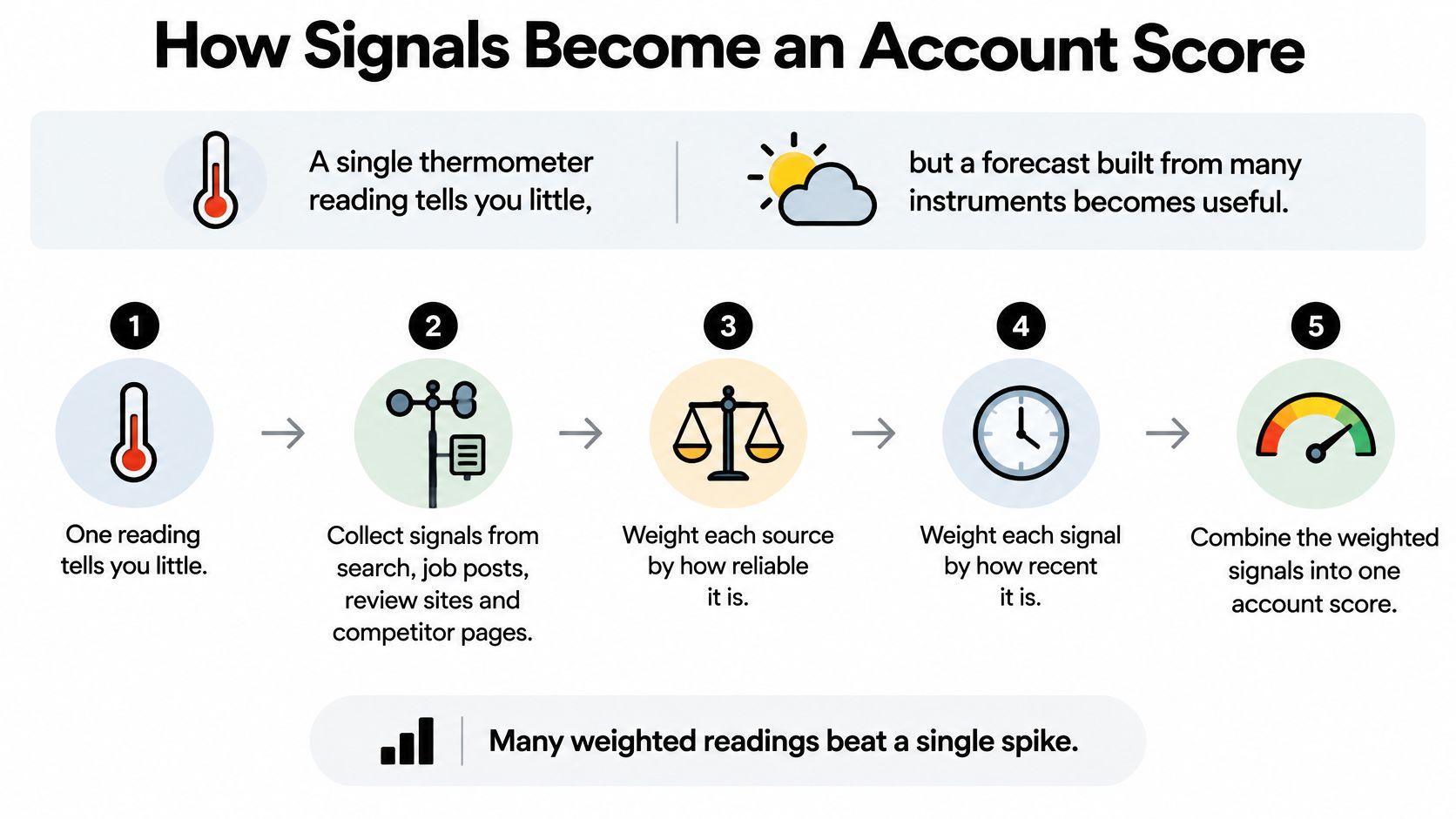
The six stages, in order
- Collect at the account level. Pull every signal into one record per company, not per contact and not per event. Skip this and you'll score the same account three times because three people visited.
- Classify by topic and stage. Tag each signal with what it's about (integrations, security, pricing) and how far along it looks. Without classification you can't map the signal to a message later.
- Decay by recency. Give a signal from the last 14 days full weight and one from 60 days ago a fraction of it. Interest goes stale, and a score that never decays keeps last quarter's curiosity at the top of the queue.
- Weight by source reliability. A confirmed return visit to your pricing page and a verified job posting outrank one anonymous topic spike from a publisher network. Not all evidence deserves equal trust.
- Adjust for account fit. Multiply the result by how closely the company matches your ideal customer profile. This is the stage that stops students, competitors and out-of-segment firms from crowding your list.
- Publish the score with its evidence. Output the number, a confidence level, the signals behind it, and what's still unknown. A score nobody can explain won't survive contact with a skeptical rep.
Foundry's 2023 ABM benchmark of B2B technology marketers.pdf) makes the same structural point: scoring should rank accounts against an ICP and a defined time window rather than fire outreach from one isolated event.
A worked comparison
Take two accounts. The first matches your ICP and returned to your pricing page twice this week. The second is a poor-fit company whose only signal is an anonymous article read two months ago. Counting events equally puts them side by side. Applying decay, reliability and fit puts the first at the top and the second in monitoring, which is the correct answer.
Teams that skip weighting usually notice the symptom before the cause: reps complain the list is full of universities, agencies and competitors. If you want the fit axis built out properly, our account prioritization matrix guide walks through the scoring grid.
Run this check on any score your tooling produces: can you name the three signals behind it, their dates, and the specific event that would lower it? If not, you're looking at a black box, and black boxes get ignored.
Why Intent Signals Mislead and How to Check Them
The most common failure isn't missing data. It's a topic spike from a student, an industry analyst or a competitor's researcher getting labeled a buying project, after which the team books meetings nobody needed and burns a quarter of credibility with sales.
More volume makes this worse, not better. Every additional feed adds false positives unless someone measures which signal types produce qualified meetings, broken out by account segment.
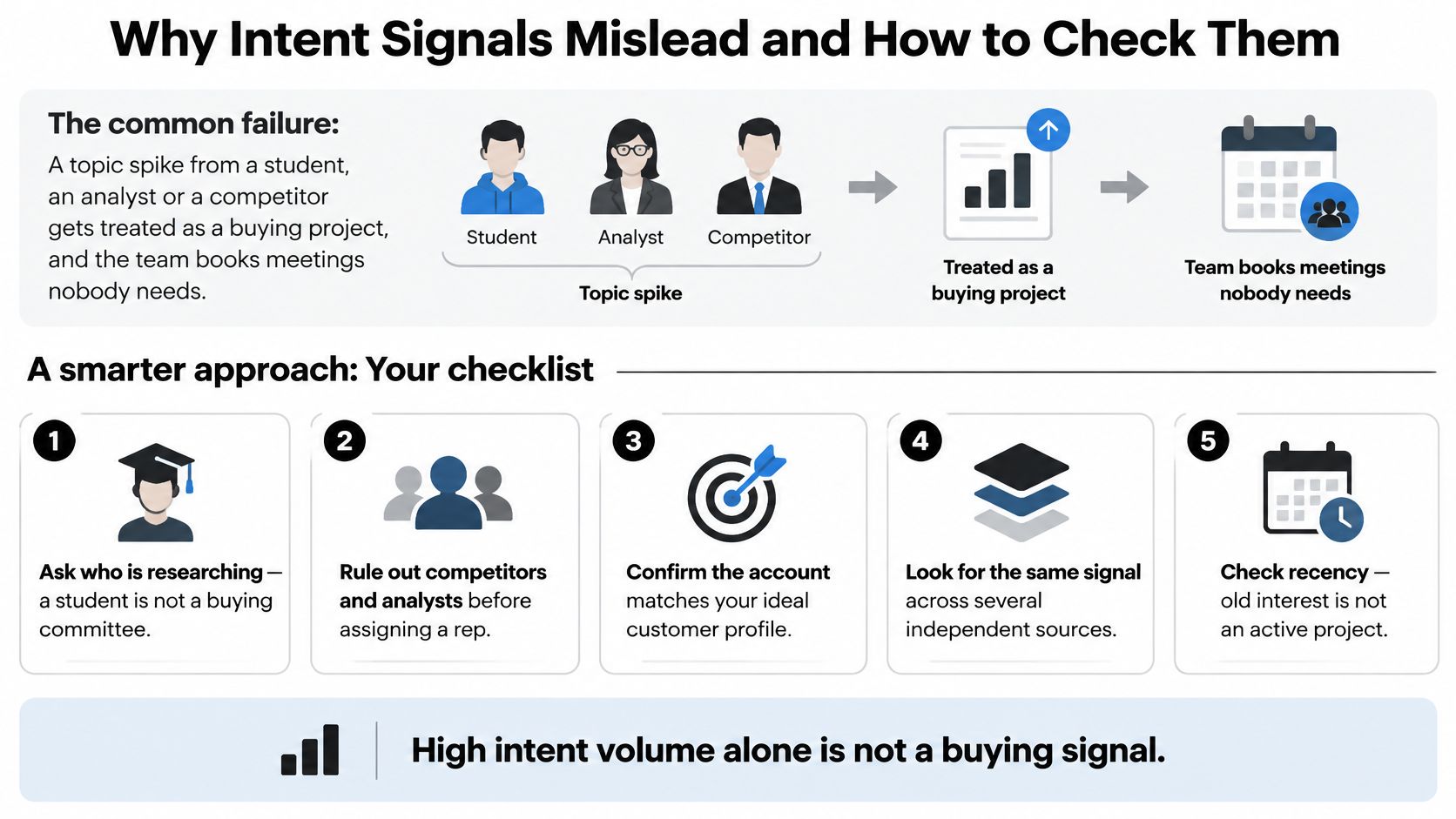
The validation checklist
- Confirm timestamp and source first. Open the underlying page or posting. If the alert can't show you where it came from and when, it isn't evidence yet.
- Look for a corroborating event. A topic surge plus a relevant job posting, a leadership change or a first-party visit is a pattern. A surge alone is weather.
- Re-check ICP fit. Company size, industry, stack and region, verified today rather than trusted from an old enrichment pass.
- Hunt for negative signals. A hiring freeze, a recent vendor cancellation, churn in your own base, or no plausible stakeholder in the account should push the score down, not sit ignored in a separate tab.
- Test the signal type over a full quarter. Track qualified meetings, opportunity creation and revenue by signal family. Some families will earn outreach rights and others won't.
Vendor benchmarks aren't your pipeline
In 2024, 90% of CMOs surveyed said intent data delivered good or excellent return on investment, according to the Intentsify and Ascend2 survey cited in this roundup of account-based marketing statistics. That tells you the category is valued by its buyers. It doesn't tell you your conversion will move.
The counterweight is sharper: a 2024 benchmark discussed in Forrester's writing on preference versus in-market intent found 62% of B2B marketing teams used intent data while 58% said it hadn't meaningfully improved pipeline conversion. Collecting signals and validating them are different jobs, and only the second one shows up in revenue.
If a signal can't be checked against at least one independent source, it's a reason to monitor, not to contact.
Privacy Limits and What Intent Data Cannot Tell You
Intent data almost always describes an organization's research, not the identity, role or authority of the person doing it. Anonymous, cross-device and aggregated behavior can show that a company is looking at a topic without confirming who inside it is looking.
The market definition for Forrester's Wave evaluation of B2B intent data providers describes persona-level insight and buying-group prediction as emerging capabilities built on anonymized identifiers and device graphs, and notes these methods don't necessarily include personally identifiable information. Read that as a boundary, not a promise: a predicted persona is a hypothesis about a role, not a verified participant in a decision.
Separate what you observed from what you inferred
Keep two columns in every account brief:
| Observed fact | Inference you're allowed to draw |
|---|---|
| The account visited your pricing page three times this week | Someone at the account may be comparing costs |
| Five data engineering roles are posted on the company's careers page | The team is scaling, so data tooling may be under review |
| A new CIO started last month | Vendor review is plausible, not confirmed |
Write outreach from the left column. "I noticed your team is hiring data engineers" is defensible. "I saw you were researching data warehouse migration" claims knowledge you don't have and reads as surveillance. Recommend role-specific outreach only when independent evidence supports the role, such as a relevant job posting or a leadership announcement.
Governance belongs in the setup, not the retrofit
Before enabling any contact-finding feature, get the storage and retention answers in writing. Our website-intent events never store a raw IP address and are pruned after 30 days. Contact finding is off by default, and an admin turns it on in Settings and attests to a lawful basis for processing. Name an owner for data access and deletion requests on day one, because global privacy rules make consent and governance part of the program rather than a later cleanup.
Then apply a proportionality test: take the smallest step the evidence supports. An account-level nurture touch fits an ambiguous signal. A personal email to a named executive needs a verified reason.
Turning Intent Scores into Account-Based Actions
A score without a mapped action is a dashboard ornament. The bands below give each pattern a meaning, a next step and a review window, so nobody has to improvise at 9am.

| Score pattern | What it means | Recommended action | Review window |
|---|---|---|---|
| High fit with one recent signal | Possible change in timing, not yet confirmed | Targeted education or light outreach | 30 days |
| Low fit with many signals | Interest without a match to your ICP | Nurture or hold, do not route to sales | Monthly |
| Strong signals but no relevant contact found | Account is active, buying group unknown | Research stakeholders before any outreach, do not guess roles | Weekly until a verified contact is found |
These bands are a starting point, not a rulebook. Set your real thresholds from your own conversion history, then revisit them each quarter.
Map topic to content, then route
- Match the message to the signal. An account researching integrations gets technical documentation or a migration comparison. An account showing hiring plus a leadership change gets an operational business case with staffing math in it. An account with a slipping public rating gets a reputation-focused message about the specific decline.
- Route by fit and corroboration. High-fit accounts with multiple recent signals go to sales with the cited evidence attached, so the rep opens with a fact rather than a guess. Emerging interest goes into education or nurture until a second signal arrives.
- Log the action per account. Record which play each account received and when. Without that record you can't compare outcomes later, and every argument about intent ROI stays anecdotal.
Content mapping is now standard practice rather than an experiment. In 2024, 91% of B2B technology marketers used intent data to prioritize accounts, select content, and build target-account lists, according to the study cited in G2's account-based marketing statistics collection. For play design that goes past a single email, see our breakdown of account-based marketing campaigns that convert.
The walkthrough below shows how teams operationalize this routing day to day.
Clicks and content views won't tell you whether any of this works. They measure attention, and attention is what you already had. Judge the program on qualified meetings, opportunities created and revenue, compared against matched accounts you left alone.
Build Your First Intent-Based Account List
Start smaller than your ambition suggests. A tight list with two well-chosen signals will teach you more in a month than a sprawling feed you can't interpret.
Write the ICP in one paragraph. Industry, company size, tech stack, and the problem you solve, in plain sentences. If two people on your team would score the same account differently after reading it, tighten the wording until they wouldn't.
Pick a list you can work. Choose a manageable set of accounts that fit the paragraph and add them to a watched list or connect your CRM. Depth beats breadth here: you want to notice changes, not accumulate logos.
Choose two or three signal types. Go back to the seven families and pick the ones that move first in your segment. A developer-tools company might watch technology changes and integration-page returns. An agency serving clinics might watch reputation shifts and new location openings. Set your thresholds from the score bands, then leave them alone long enough to produce data.
Review at 30 days with a control group. Compare accounts you acted on against a matched group you deliberately left untouched, and track qualified meetings, opportunities and revenue for both. That comparison is the only honest answer to "is intent working for us."
For the watch step, we run this at CapyScout: we watch a list of companies or your CRM and check the live web on a schedule, then tell you who to contact and why now, with the evidence attached. The Agent sends one short summary a day so the team sees what changed without opening five dashboards. Use whatever tooling fits your stack, as long as every alert carries a source and a date.
Write the review meeting into the calendar before you switch anything on. Programs without a scheduled reckoning drift into noise.
Create the list this week, set two signals, and book the 30-day review now. That single hour of setup gives you something most intent programs never get: a defensible answer about what the data did for pipeline.
CapyScout watches your account list or your CRM for hiring, funding, leadership, technology, reputation and website-intent signals, then hands you a source-backed brief that separates what happened from what it might mean. Every alert cites its evidence and flags what's unverifiable, so your reps open with a fact instead of a guess about who's in-market. Visit CapyScout to set up your first watched list and see which of your accounts changed this week.
Not ready to start? Get a free target list: 10 companies to sell to, picked from your website.