

How to Target Your Ideal Customers with AI Using CapyScout
Learn how to target your ideal customers with AI using CapyScout, from target account selling principles to how it differs from account-based sales.
Your SDRs have a full prospecting queue, but they still spend the morning asking who's worth contacting. The CRM says a company fits. A job posting suggests something is changing. Neither tells the rep whether an email would be useful today.
AI can collect those clues, but it shouldn't turn every clue into a message. A useful targeting process produces both a contact decision and a documented reason to hold an account.
Table of Contents
- What Target Account Selling Means in Practice
- Core Principles Behind Target Account Selling
- How AI Narrows a Market to a Short List
- Turning One Buying Signal Into an Outreach Reason
- Target Account Selling Compared With Account-Based Sales
- Guardrails for Contacting Accounts Responsibly
- Run a Two-Week Target Account Pilot
What Target Account Selling Means in Practice
Target account selling means choosing a small, named set of companies that match a written ideal customer profile, then contacting them when a verifiable change suggests they might need your product.
Think of the difference between a fisherman casting a wide net and a harpoonist studying a whale before choosing the moment to act. The analogy is about selectivity: the account, not the contact row, becomes the unit of work. You investigate a business situation before looking for someone to email.
Say a small SDR team replaces a scraped contact list with a manageable set of logistics software companies. Instead of enrolling everyone in a fixed sequence, the reps investigate each company's operating environment, current projects, and likely buying roles.
From names to business situations
One company appears to be expanding its integration team. Another matches the industry perfectly but shows no relevant change. The first deserves investigation; the second stays out of the outreach queue.
The team's hypothesis is that better selection will produce more useful conversations from fewer emails. That's something to test, not a result to assume.
A target account isn't merely a company you could sell to. It's a company whose situation you can explain.
This approach suits founders running outbound, SDR leads protecting limited research time, and RevOps teams maintaining shortlists in HubSpot, Pipedrive, or Attio. It also makes coaching easier: managers can review the account choice before critiquing the email.
Write your team's definition in a sentence. Then name the required account fields, such as service category, operating region, and technology environment, that distinguish a qualified company from a plausible-looking name.
Core Principles Behind Target Account Selling
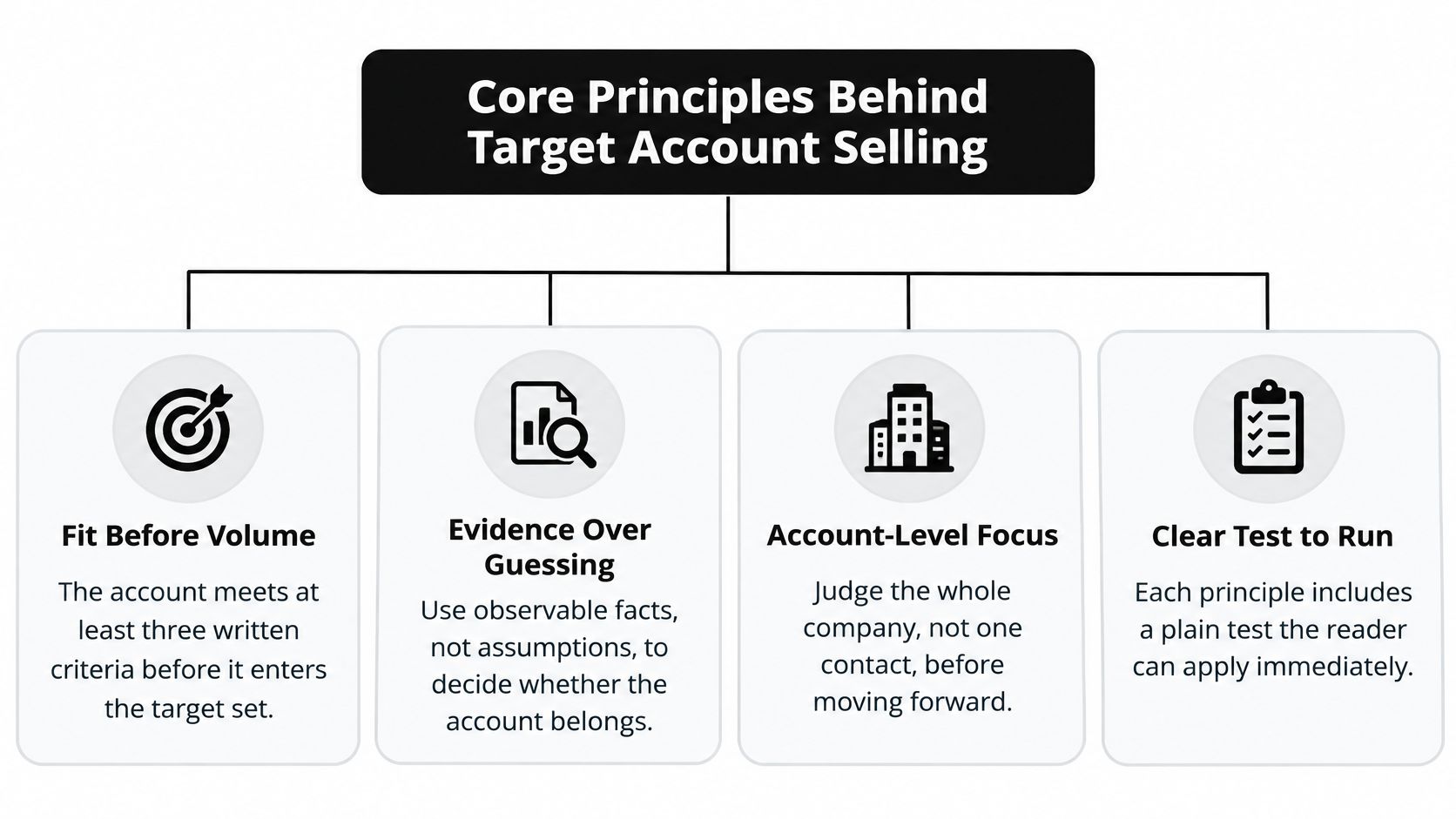
Two reps given the same market will build two different shortlists unless the team writes down its admission rules. Without them, reps substitute familiar logos, enthusiastic guesses, or whichever information is easiest to find.
Write the criteria before anyone searches. If yours still describe almost any business, MakeAutomation's guide can help you refine your ICP for better leads, and the guide to building and using an ideal customer profile gives you a practical structure for the fields.
Six principles of target account selling and how to test them
Treat the criteria below as operating rules your team chooses, not universal numerical thresholds.
| Principle | What It Requires | Practical Test |
|---|---|---|
| Fit before volume | Multiple written ICP criteria, covering the business, its environment, and your ability to serve it | Can you name the criteria it meets? |
| Timing from change | A recent, verifiable event relevant to your offer | Did something observable change this quarter? |
| Relevance over personalization | First line references the change, not just the company name | Would the line fit a competitor? If yes, rewrite it. |
| Evidence you can cite | Every factual claim has a source link and date | Can you show where each fact came from? |
| Multi-threaded view | Relevant approval, user, and budget roles mapped | Do you know who approves, uses, and pays? |
| Speed once the signal fires | A prompt first touch after qualification | What is your median signal-to-first-touch time? |
These principles start with fit and end with a decision someone can defend. That decision includes abstaining. An account that passes every fit check but shows no observable change earns a written reason to wait, not a generic email. "Do not contact yet" is a valid output of the same discipline, and recording the reason makes the account easy to revisit when its situation shifts.
Speed matters most when someone has already expressed interest. A 2011 Harvard Business Review study of 2,241 U.S. companies, summarized by Vida's analysis of speed-to-lead research, found that companies contacting inbound leads within an hour were nearly seven times more likely to qualify them than companies waiting an additional hour.
That finding concerns inbound leads, not a promise about cold outreach. Apply it by assigning qualified signups promptly and giving the owner enough context to respond intelligently.
Audit your pipeline against the table once a month. Record which principle fails most often, then fix that bottleneck before increasing prospecting volume. If timing is what fails the audit, the honest result is a longer watch list with documented reasons, not a bigger send.
How AI Narrows a Market to a Short List
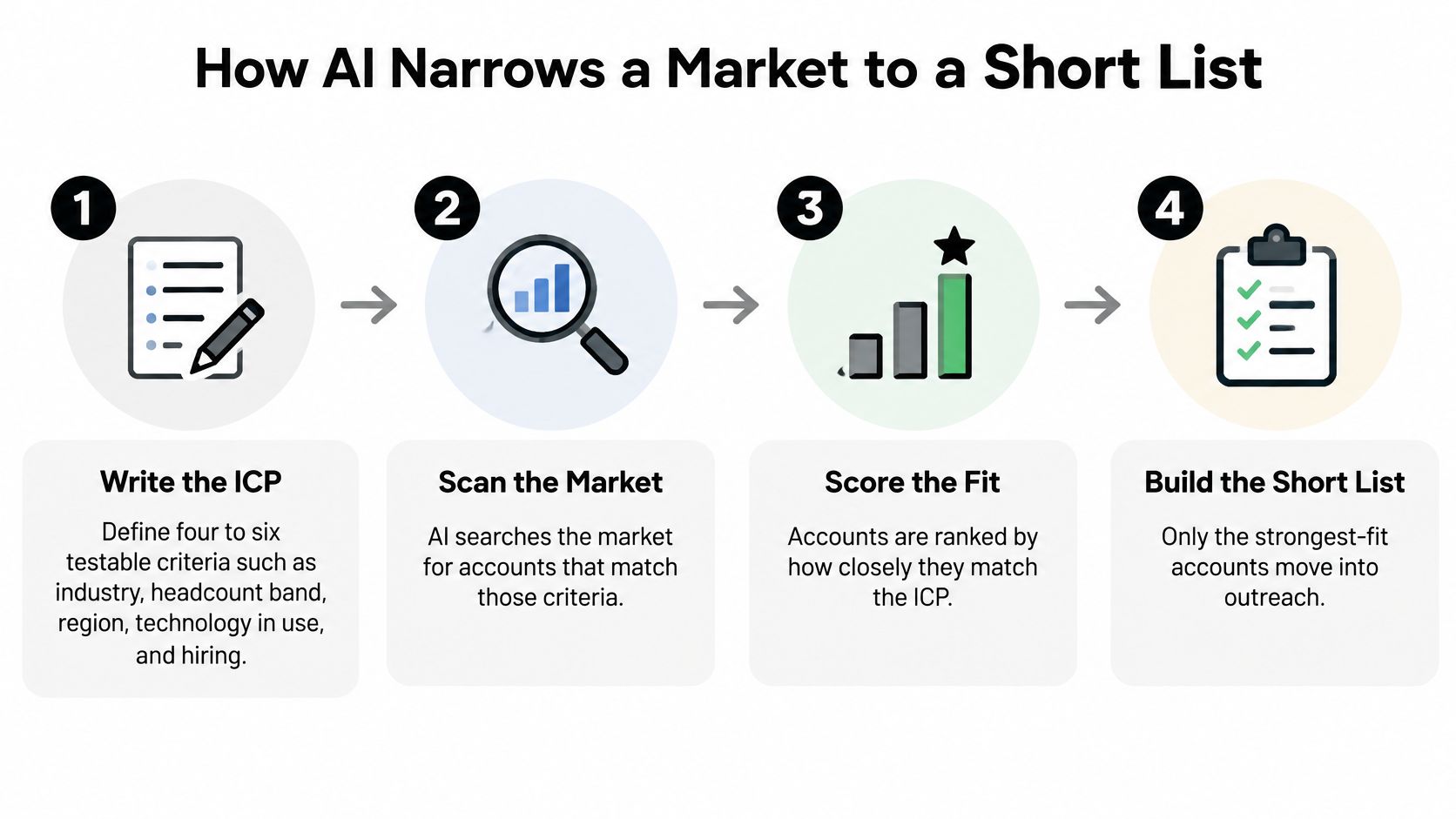
The purpose of AI discovery is to reduce the number of companies a rep must investigate manually. Keep discovery, qualification, and permission to contact separate.
Write a testable ICP. Describe industry, employee band, region, technology environment, and relevant operating needs. For a hypothetical logistics campaign, specify software vendors serving warehouse operators rather than all technology companies.
Search the live web. Use natural-language discovery by competitor, technology, hiring, location, or niche, then save the search. Reusable searches make it easier to inspect why a company appeared.
Review fit separately from timing. Check firmographics and the evidence behind the fit score. A strong-fit company without an active need belongs in nurture, not automatically at the top of the calling queue.
Attach relevant monitoring. Choose signals that support a specific buying hypothesis, using the table below. Keep website intent at watched-account level, without cookies or person graphs; don't infer which employee visited.
Review the nightly queue. Let Autopilot assemble candidates, then have reps accept, reject, or hold them. Keep the active shortlist small enough that each account receives genuine investigation.
The visual summarizes discovery; outreach still requires a separate timing decision.
Buying signals and what each one suggests
| Signal | Example | What It Suggests |
|---|---|---|
| Hiring | Data engineering vacancies mention a relevant technology | The team may be building capacity for a problem |
| Funding | A funding announcement | Budget may be available for new tools |
| Leadership change | A new operations or sales leader | Priorities and vendors may be reviewed |
| Technology adoption | A new platform appears in the stack | Integration or replacement needs may follow |
| Pricing or integration page revisits | Repeat visits attributed to a watched account | Active evaluation may be underway |
| Rating drop or stalled reviews | Ratings decline or new reviews stop | Reputation work may warrant investigation |
| Negative sentiment shift | Review language becomes more critical | A service gap may be emerging |
These are hypotheses, not proof of purchasing intent. In Gartner's survey of 632 B2B buyers conducted in August and September 2024, 73% said they actively avoided suppliers that sent irrelevant outreach.
Use an account prioritization matrix to keep fit and urgency distinct. If you're evaluating supporting software, Bazzly's tool comparisons for small teams offer a starting point for comparing options.
This week, build a saved search and attach only the signals you can explain.
Turning One Buying Signal Into an Outreach Reason
Say a logistics software company publishes data engineering vacancies and a warehouse migration plan. Your watched-account monitoring also records return visits to an integration page. The public project announcement supplies the strongest reason to investigate.
The conversation should start with the operational change, not the tracking.

Build the signal card before the draft
- Evidence: Save the actual vacancy and migration-plan links, publication dates, and monitoring timestamp. Don't invent a publication date when none appears.
- Observed change: The company is recruiting data engineering capacity while preparing a warehouse migration.
- Likely implication: Its technical team may need to validate connectors, reconcile records, or reduce migration risk.
- Uncertainty: You don't yet know whether the project is active, funded, or already covered by another vendor.
A draft could say that the published migration plan and engineering vacancies suggest integration testing may be on the team's agenda. It could then ask whether the migration timetable is already set or still being scoped.
Compare that with a generic opening about noticing the company's growth. Growth alone doesn't explain what you can help with, and the same sentence could go to almost any expanding business.
Drafting rule: State the observation confidently, describe the implication cautiously, and let the buyer verify the problem.
For additional timing guidance, use the buying signals and outreach guide.
The following video offers a supplementary resource.
McKinsey reports that personalization most often produces a 10–15% revenue lift. That broad finding doesn't establish an expected return for this email; the practical lesson is to make the message useful through context, not decorative name insertion.
Hold the draft if the underlying evidence is weak or the implication becomes an unsupported claim.
Target Account Selling Compared With Account-Based Sales
Target account selling is a sales-led method for deciding which account merits a conversation now. A broader account-based program coordinates marketing and sales around named accounts over a longer buying journey.
There's a terminology trap here: ABM means account-based marketing, not account-based sales. Teams often use it informally for the wider coordinated program, which is the meaning used in the comparison below.
Target account selling versus account-based sales
| Dimension | Target Account Selling | Broader Account-Based Sales (ABM) |
|---|---|---|
| Owner | Sales reps or SDRs with RevOps support | Marketing and sales jointly |
| List size | Small enough for a rep to research each account | Tiered account groups with different coverage levels |
| Trigger for action | Verified buying signal or observed change | Campaign calendar, account tier, and engagement |
| Channels | Direct, tailored outreach and short sequences | Ads, content, events, email, and sales outreach |
| Core question | Why this account, why now, and who should we contact? | Which accounts should we engage across the journey? |
| Success measure | Replies, meetings, and opportunity conversion by signal type | Pipeline influenced, account engagement, and expansion |
| Suppression rule | Pause outreach when the trigger becomes stale or unverifiable | Retain strategic membership unless eligibility changes, while honoring contact restrictions |
Choose according to the work involved
A founder without a marketing budget can run target account selling alone. The work is concentrated: inspect the company, understand the change, choose the relevant role, and decide whether a conversation would help. There's no need to build an advertising program just to test whether a narrowly defined market responds.
A team with dedicated marketing spend, differentiated account tiers, and a long buying process needs broader coordination. Marketing may educate operations leaders through content while sales investigates a technical initiative and an executive sponsor develops the commercial case. Shared account ownership prevents those efforts from becoming disconnected messages.
The approaches aren't rivals. A verified operational change can inform both a rep's outreach and the subject of a marketing campaign, but those actions don't need to happen simultaneously.
For example, a company may fit your strategic account program while lacking a current reason for direct outreach. Marketing can continue offering useful educational material without asking an SDR to manufacture urgency.
Keep strategic account membership separate from permission to send a particular message.
This distinction also improves reporting. Evaluate the rep's timing decision separately from the broader program's ability to build awareness and engagement. Otherwise, teams may mistake campaign activity for evidence that an account is ready to buy.
Guardrails for Contacting Accounts Responsibly
Better AI targeting doesn't mean maximum personalization. It means more relevance per verified signal, including a defensible do not contact yet decision.
The IAPP discussion of ethical AI in advertising highlights why privacy, transparency, and human oversight matter in AI-driven personalization. For a sales team, those principles need to become reviewable decisions, not a policy document nobody opens.
Set an explicit abstention policy
Require independent corroboration before unsolicited, signal-led outreach. A job posting repeated by an aggregator isn't independent evidence; a public project announcement supporting the same operating need is more useful.
Preserve the source and date for each claim. Downgrade stale evidence according to how quickly the situation could change, and mark missing dates or unverifiable details rather than letting the model fill them in.
Keep sensitive personal traits and inferred individual browsing behavior out of targeting. Require human approval before consequential routing decisions or outreach, and let reviewers override scores with a documented reason.
- Ready for review: Relevant evidence supports the proposed message, and a person checks the draft.
- Nurture: The company fits, but there's no persuasive reason to start a sales conversation.
- Hold: Evidence is missing, contradictory, risky, or too old to support the claim.
For example, an account with a relevant hiring announcement but no corroborating business context stays on hold. Record what's missing and assign a re-check date instead of repeatedly returning it to the outreach queue.
Don't confuse this outbound policy with handling an explicit inbound request. Someone asking for help should receive an appropriate response, not silence while the team hunts for unrelated signals.
Before sending, ask: Can I show the evidence? Would this account reasonably expect this kind of message? Can a person explain the selection without relying on an opaque score?
Run a Two-Week Target Account Pilot
Use the pilot as a bounded test of selection quality, not a sprint to send as many emails as possible.
Opening week: Write a concise ICP, build a saved search, and choose relevant signals to watch. Manually inspect a manageable sample so you can catch broad criteria and unreliable sources before automating them.
Following week: Contact only accounts that pass human review. Build each message around the observed change, its possible operational implication, and a verification question; assign the remaining accounts a nurture or hold status.
Pilot close: Measure the share of reviewed accounts with corroborated signals, reply rate, positive-reply rate, meetings booked, and false-positive rate. Define a false positive as an account the system marked as fitting but the rep rejected after investigation.
Decide what earns expansion
Keep signals that produce relevant conversations. Remove or revise signals that repeatedly generate false positives, and widen discovery only when response quality remains stable.
When deciding how to target your ideal customers with AI using CapyScout, treat it as an account-intelligence option alongside your CRM: it runs saved searches, monitors changes, prepares source-backed briefs, and syncs context to HubSpot, Pipedrive, or Attio. Reps retain responsibility for interpreting that evidence and approving contact.
Your first action is smaller than a software rollout: open the ICP document and write the first criterion.
CapyScout offers live-web account discovery, buying-signal monitoring, and source-backed briefs to support a more selective prospecting workflow. Visit CapyScout to explore how those capabilities can support your pilot while your team keeps control of who gets contacted and why.