

Gojiberry.ai Versus GetWhitewhale.com: A Buyer’s Guide

Compare gojiberry.ai versus getwhitewhale.com for B2B prospecting. Detailed analysis of features, pricing, and workflows to help you choose the right tool.
Gojiberry.ai suits founder-led automated outreach, while Get White Whale is better for research-heavy account monitoring. Neither replaces CapyScout's source-backed CRM enrichment and unified B2B-plus-local workflows.
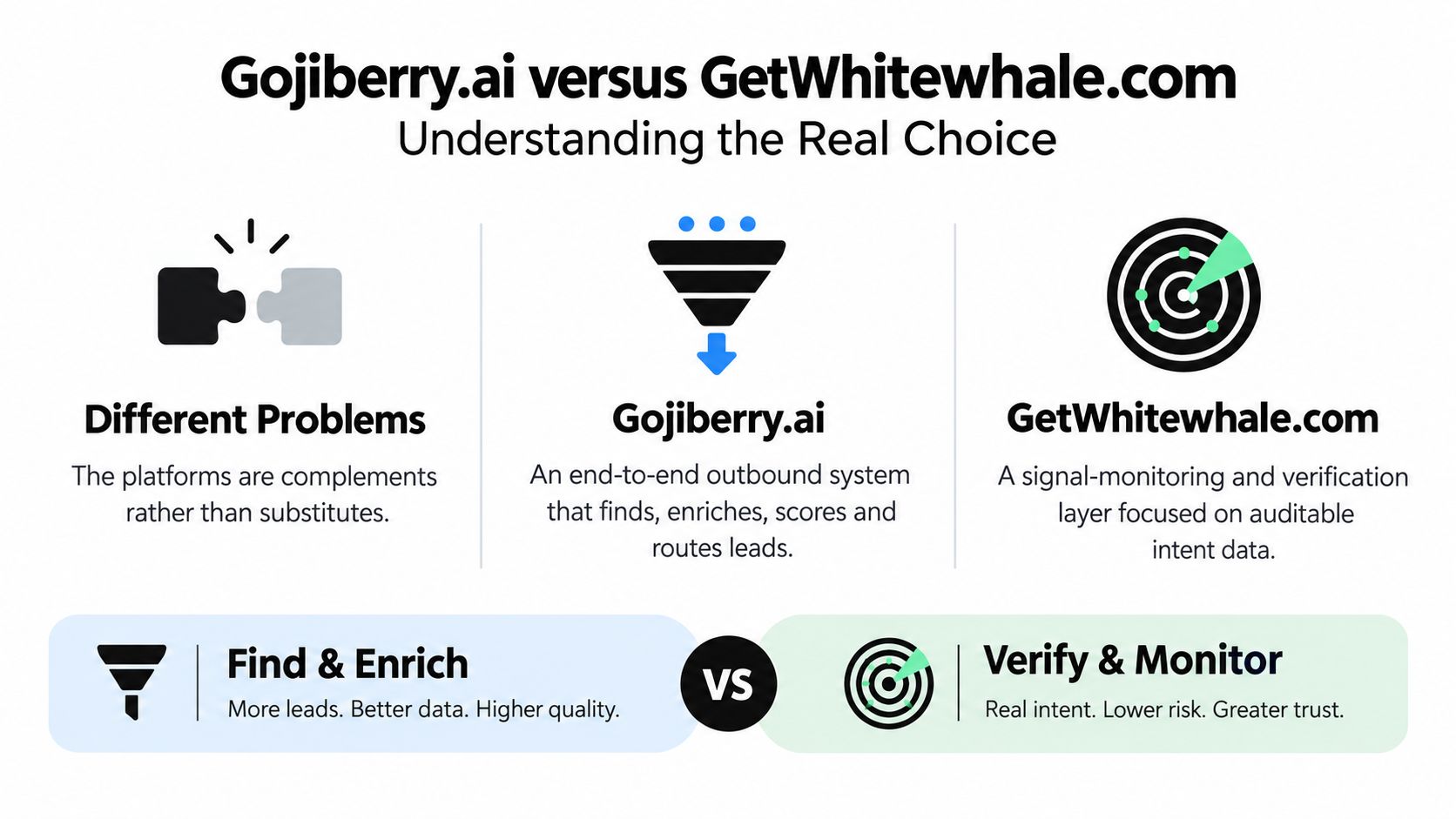
The popular advice is to compare these products feature by feature and pick the one with more signals, integrations, or automation. That approach misses the commercial decision. Gojiberry.ai and Get White Whale represent different operating models: one moves from prospect discovery toward an automated conversation, while the other helps teams define, monitor, and verify account-level buying events.
That distinction changes how you should evaluate cost, staffing, compliance, and pipeline impact. A founder trying to create outbound conversations may value autonomous execution. A revenue-operations team covering named accounts may care more about source provenance, alert review, and whether a sales manager can explain why an account entered the queue.
Table of Contents
- Understanding the Choice Between Gojiberry.ai and GetWhitewhale.com
- Company Profiles and Scale Evidence
- Feature Comparison and Workflow Differences
- Pricing Models and Hidden Operating Costs
- Signal Reliability and Verification Gaps
- Recommendations for B2B Sales Teams and Smaller Sellers
Understanding the Choice Between Gojiberry.ai and GetWhitewhale.com
Feature grids can blur the decision here. What matters first is the operating model your team can run, day after day, without creating extra work in sales ops, compliance review, or rep coaching.
Gojiberry.ai is built as an end-to-end AI outbound system. Its public positioning spans signal detection, ideal-customer-profile filtering, enrichment, lead scoring, and personalized outreach across LinkedIn and email. In practice, that means the product is trying to compress several steps into one motion, from spotting a possible buying moment to sending the first message. For founder-led outbound or lean teams, that can be attractive because speed and execution matter more than a long review loop.
Get White Whale takes a narrower path. It focuses on custom buying-signal monitoring, lets users define plain-English questions, and presents evidence from public sources for review. That design points to a different discipline. Instead of pushing directly toward outreach, it helps teams monitor accounts, inspect what triggered attention, and decide whether the signal belongs in pipeline coverage.
Practical rule: Choose the workflow you need to operate every day, not the feature list that looks most impressive in a product tour.
The central question is which model your team can sustain: automated outreach execution or configurable account intelligence with inspectable evidence. That difference affects more than workflow design. It shapes who owns the process, how much seller judgment stays in the loop, and whether your team is working at the prospect level or the account level.
| Buying question | Gojiberry.ai | Get White Whale |
|---|---|---|
| Primary workflow | Find, enrich, score, and contact prospects | Define, monitor, and verify buying signals |
| Best fit | Founder-led or small-team outbound | Research-heavy account-based sales |
| Signal orientation | Behavioral and company activity | Source-backed public events |
| Main unit of work | Prospect and sender activity | Monitored account and signal question |
| Human involvement | Review and refine automated outreach | Validate and route detected evidence |
A broader market view appears in this Gojiberry comparison. The useful takeaway is operational. Teams are rarely choosing between two feature sets. They are choosing between prospect-driven execution and account-driven verification, and that choice carries downstream consequences for pricing logic, infrastructure needs, and evidence standards.
Company Profiles and Scale Evidence
Company maturity matters because public scale evidence can indicate how much operating history a buyer can inspect. It doesn't prove product quality, retention, or suitability, but it helps separate reported momentum from positioning language.
Gojiberry AI appears to have been founded in 2025. Its Y Combinator company profile reports growth from $0 to $2.5 million in annual recurring revenue within 10 months, approximately 30% month-over-month growth, profitability, and more than 2,000 customers. The same profile describes earlier traction of $112,000 in monthly recurring revenue after nine months, 44% month-over-month growth, and more than 1,000 paying customers.
Those figures are notable, but they need careful handling. The profile contains company-profile and self-reported traction data, so they should be treated as reported milestones rather than independently audited financial statements. A separate revenue snapshot recorded $424,368 in monthly recurring revenue, $1,801,629 in cumulative revenue, and 3,944 active subscriptions in August 2026, but that snapshot is historical and shouldn't be mistaken for current performance.
White Whale has a different evidence profile
WhiteWhale was founded in mid-2024, making it historically older than Gojiberry AI by approximately one year based on the available company histories. Its company story positions it as go-to-market software for custom buying signals and outbound sales teams.
The public evidence is less quantitative. WhiteWhale emphasizes outcomes such as return on investment within the first 90 days, faster deal cycles, and improved close rates, but accessible material doesn't disclose audited revenue, customer totals, growth percentages, or employee counts beyond a LinkedIn classification of 1–10 employees.
That asymmetry matters for competitive analysis. Gojiberry has a public record containing specific reported ARR, MRR, customer, subscription, and growth milestones. WhiteWhale has stronger public positioning around custom signals and account monitoring, but fewer independently verifiable indicators of operating scale.
Scale evidence can help you understand a vendor's trajectory. It can't substitute for a workflow pilot, especially when one company publishes more self-reported metrics than the other.
The fairest conclusion is limited. Gojiberry appears to be the younger company with unusually rapid reported early growth. WhiteWhale appears historically older, but its accessible commercial record supports conclusions about positioning more confidently than conclusions about revenue or customer scale.
Feature Comparison and Workflow Differences
A useful comparison starts with the work a seller must complete after a signal appears. Detection alone doesn't create pipeline. The system must help someone decide whether the account fits, identify the right contact, understand the evidence, and choose an appropriate next action.
Gojiberry's public materials describe more than 30 behavioral and company signals, 15+ enrichment providers, multichannel follow-up, and campaign benchmarking against industry top performers. Those capabilities point toward a system optimized for autonomous execution. It isn't merely surfacing an account. It's attempting to move the prospect through filtering, enrichment, scoring, and outreach.
WhiteWhale's published description says users can define up to 35 plain-English signal questions. Its monitoring coverage includes SEC filings, earnings-call transcripts, ATS job postings from Greenhouse, Lever, and Workday, 8,000+ news feeds, press releases, company websites, and company LinkedIn posts. This breadth supports research workflows where the sales team wants to inspect the event before acting.
| Capability | Gojiberry.ai | Get White Whale | CapyScout |
|---|---|---|---|
| Prospect discovery | Signals and ICP-based prospect filtering | Account monitoring based on custom questions | Natural-language discovery across the live web |
| Enrichment | 15+ enrichment providers | Signal context and source evidence | CRM enrichment, firmographics, ICP grading, and “Why now” notes |
| Signal design | Behavioral and company signals | Up to 35 plain-English signal questions | Rules-based monitoring across hiring, funding, leadership, technology, reviews, news, and website intent |
| Outreach | Automated LinkedIn and email follow-up | Primarily monitoring and routing | Source-cited drafts opened in Gmail or Outlook |
| CRM workflow | Public material emphasizes outbound execution | Integrations available on displayed plans | Native HubSpot, Pipedrive, and Attio integrations |
| Verification emphasis | Recommendations and campaign execution | Sources, quotes, and configurable monitoring | Source-backed alerts with unverifiable items called out |
For a team evaluating AI automation beyond sales intelligence, the Agentable AI workflow guide is useful context because it frames tools by workflow rather than by isolated features. That lens is important here. Gojiberry's broader scope may reduce manual movement from signal to message, while WhiteWhale's configurable source coverage may better support account research and internal review.
The two products shouldn't be judged by the same success metric. Gojiberry should be tested on signal-to-qualified-meeting rate, enrichment match rate, positive-reply rate, unsubscribe rate, and the percentage of AI-generated messages requiring human edits. WhiteWhale should be tested on source coverage, false-positive rate, signal freshness, analyst verification time, and qualified-opportunity creation per monitored account.
A third option matters when teams need discovery and operational follow-through in the same system. CapyScout's WhiteWhale comparison describes a workflow that joins live-web discovery, signup scoring, account monitoring, CRM backfill, and alert routing. That combination is especially relevant for teams serving both B2B accounts and local businesses, where a single outbound sequence doesn't cover the full operating model.
Pricing Models and Hidden Operating Costs
Sticker price hides the main difference. These tools charge for different units of work, so the monthly fee alone does not explain which one will cost less in practice.
Gojiberry is commonly described as offering a $99 per month Pro plan with two LinkedIn senders and roughly 1,800 contacted prospects, based on independent Gojiberry review coverage. Publicly available material does not show broader team pricing. WhiteWhale presents a different model: $200 per month for 300 monitored accounts and $500 per month for 750 monitored accounts, with unlimited seats and integrations on the listed plans. Those numbers reflect account monitoring capacity, not an equivalent outreach allowance.
That distinction matters because pricing changes behavior. A per-prospect model pushes teams toward sender throughput, sequence volume, and inbox capacity. A per-account model pushes teams toward coverage decisions, account selection, alert review, and territory ownership. Both can be rational. They just support different operating models.
The denominator should match the job your team is trying to complete:
- Outbound volume: founder-led or SDR-led teams may care most about contacted prospects and available senders.
- Account coverage: account-based teams may care more about monitored companies, segments, and territory breadth.
- Team access: revenue operations may value unlimited seats more than sender count if multiple functions need visibility.
- Operational workload: managers should include the time needed to review alerts, route them, and convert them into follow-up.
A five-person team covering 500 accounts is solving a different problem from a solo founder running automated outreach. The first group needs monitoring coverage, evidence review, routing logic, and ownership rules. The second may care more about sender capacity, message generation, and prospect throughput.
The costs outside the subscription
Gojiberry can look efficient for a small outbound motion, but the visible subscription does not include everything required to run that motion. Review coverage indicates that warmed domains and inbox infrastructure are not part of the package. Buyers therefore need to budget for sender setup, domain management, deliverability oversight, and human review before automated outreach is allowed to run at scale.
WhiteWhale shifts cost into a different layer. Teams need to decide which accounts deserve monitoring, which sources matter, how ambiguous events should be handled, and what sales should do with each alert. Unlimited seats make access easier across sales and operations, but they do not remove the labor involved in deciding whether a signal is useful enough to act on.
Cost insight: The subscription is only one line in the operating model. A complete comparison includes sender infrastructure, verification labor, CRM administration, and the time required to turn an alert into a qualified opportunity.
A sensible pilot models at least two cases: founder-led outbound and account-based monitoring. If your team does both, compare cost per territory and cost per verified opportunity before comparing monthly fees. Confirm that the plan's unit of value matches the way your team allocates work.
Signal Reliability and Verification Gaps
Signal volume doesn't solve the reliability problem. A sales manager needs to know why an account was prioritized, whether the event is recent, and whether the evidence can be reviewed after an opportunity enters the forecast.
Gojiberry emphasizes intent signals from LinkedIn and social activity, including likes, comments, job changes, and fundraises. Review coverage reports advertised reply rates of 18–31%, but the available G2 coverage doesn't disclose the sample size or methodology behind those figures. They should therefore be treated as advertised claims, not general performance benchmarks.
WhiteWhale's pricing material describes monitored accounts with “signals, sources, and quotes.” That supports an evidence-oriented workflow, but available comparison material doesn't explain signal freshness, source hierarchy, false-positive handling, geographic coverage, or how the platform distinguishes a meaningful buying event from ordinary social activity.

What regulated and multinational teams should test
LinkedIn activity may be incomplete. Public announcements can be ambiguous. A job posting may indicate expansion, replacement hiring, or a role unrelated to the buying problem. Those limitations matter more when a team needs auditability, privacy safeguards, or consistent decision-making across regions.
Run each vendor through the same verification questions:
- Evidence: Can a seller open the original source and understand the context?
- Freshness: Can the team identify when the event was detected and when it occurred?
- Confidence: Does the platform distinguish confirmed information from inference?
- Reproduction: Can a manager later reconstruct why the account was prioritized?
- Actionability: Does the signal identify a relevant account-level next step?
Source-backed workflows become strategically valuable here. CapyScout's public platform description says its alerts and briefs cite their sources, call out unverifiable items, and use website intent detection without cookies or person graphs. Its guidance on signals and tuning is relevant for teams that need to adjust monitoring rules rather than accept an opaque recommendation.
Gojiberry may be the better choice when the organization accepts automated recommendations and wants to move quickly into multichannel outreach. WhiteWhale may fit teams that need custom event logic and broader public-source monitoring. Neither public record establishes a neutral accuracy advantage.
The contrarian conclusion is straightforward: more signals may produce worse pipeline if the team can't verify, prioritize, and govern them. Reliability should be measured through false positives, analyst review time, freshness, and qualified-opportunity creation, not signal count alone.
Recommendations for B2B Sales Teams and Smaller Sellers
Start with the team's daily motion, not the product demo. If one person owns prospect research, campaign setup, message review, and follow-up, an autonomous workflow may create more value than a research layer that produces another queue to manage.
Choose Gojiberry for execution-led outbound
Gojiberry is the stronger fit for founder-led outbound and small teams that want to move from prospect identification toward conversation without manually assembling every step. Its positioning around enrichment, scoring, LinkedIn, email, and multichannel follow-up supports that use case.
The condition is operational readiness. Buyers still need to manage sender infrastructure, domain warming, message quality, and compliance. A low subscription price doesn't remove those responsibilities.
Choose White Whale for account research
WhiteWhale is better suited to research-heavy account-based workflows. Teams monitoring named accounts, custom business events, and public-source changes may prefer a system that lets them define questions and inspect supporting evidence before routing an alert.
That model works particularly well when multiple stakeholders need to trust the rationale behind prioritization. It can be less suitable when the main objective is to generate and execute a high volume of automated outreach.
Validate either choice with a controlled pilot
Don't begin with reply rates or a vendor's broadest feature list. Build a pilot around the work your team performs:
- Define the account set. Use a consistent group of target companies and document the ICP criteria.
- Record the evidence. For each alert, capture the source, event date, detection date, confidence, and reviewer decision.
- Measure workflow friction. Track analyst verification time, enrichment match rate, and the number of alerts that require manual correction.
- Measure commercial movement. Record qualified opportunities created per 100 monitored accounts and the signal-to-qualified-meeting rate where outreach is used.
- Audit the messages. Count how often AI-generated outreach needs human edits, and monitor unsubscribe behavior rather than treating positive replies as the only outcome.
- Model the full cost. Include sender infrastructure, CRM work, alert handling, and the time required to turn evidence into a sales action.
Teams comparing broader AI lead-generation options may also find the OGTool AI lead generation guide useful for separating discovery, enrichment, automation, and outreach categories. The same discipline applies here: don't compare products as if they share one unit of value.
CapyScout is the more relevant option when the team needs live-web prospect discovery, real-time signup screening, daily CRM enrichment, ongoing account monitoring, and source-backed routing in one workflow. Its support for B2B and local-market use cases also matters for agencies and smaller sellers whose pipeline doesn't fit a single outbound pattern.
The final decision should follow the evidence. Choose Gojiberry when automated prospect-to-conversation execution is the bottleneck. Choose WhiteWhale when configurable, inspectable account signals are the bottleneck. Choose a source-backed account intelligence workflow when your team needs both discovery and verification before action.
If your team needs live-web prospect discovery, source-cited account signals, CRM enrichment, and practical routing for B2B or local workflows, explore CapyScout. Use the pilot criteria above to test signal quality, verification effort, and qualified-opportunity creation before you commit to a larger operating model.